I've written about "spoke volume" before and there's some overlap, but
I'll write a bit about the relationship between left-right different diameter lacing and left-right different spoke count lacing.

First, "spoke volume" refers to
the total volume of steel in the steel spokes between the hub and rim.
You calculate it by multiplying the spoke cross-sectional percentage by the number of spokes,
and when thinking simply, you usually ignore the length factor.
By the way, if you further multiply that by 0.0257,
you get an approximate estimate of spoke weight (in grams).
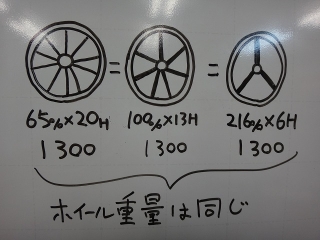
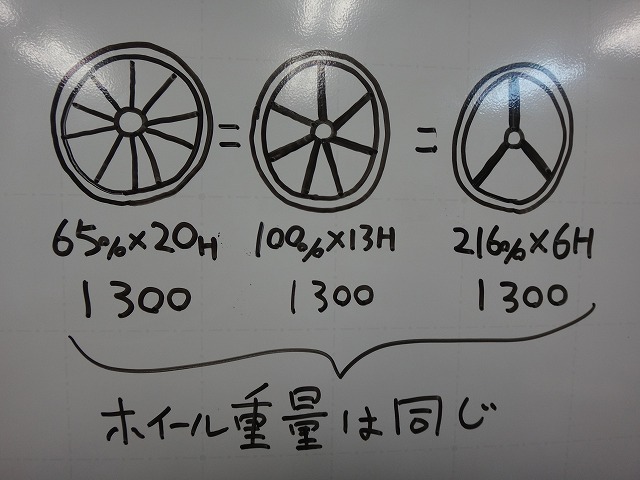
Here, I've lined up three front wheels.
20H with 65% spoke cross-section, 13H with 100%,
and hypothetically 6H with 216% (which doesn't exist in reality).
These have the same total volume of steel spokes used in the wheel, so
(setting aside the minor point that the number of nipples differs)
if the hub and rim are the same, the wheel weight will also be the same.
Of course, for example, 130H with 10% would also be the same weight, but
when comparing high cross-section/few spokes versus low cross-section/many spokes,
my conclusion is that as long as
・the spokes don't go "floppy" while building the wheel
・the rider doesn't feel the wheel as "sloppy"
the more spokes the better.
Also, the aerodynamic disadvantage of more spokes is a minor factor
compared to the optimization of spoke volume.
The condition of "not going floppy" is
extremely strict with 65% cross-section round butted spokes,
but totally fine with 65% cross-section flat spokes.
From experience, the practical minimum spoke cross-section is
65% with the condition that they're flat spokes.
Regarding the condition "the rider doesn't feel the wheel as sloppy,"
I always say that
"Shimano's C24 front wheel with 16H is too few spokes;
there are more rigidity drawbacks than aerodynamic and spoke weight reduction benefits,
and considering major and minor factors, it's clearly not good."
As an example, the C24's spoke volume is 65(%) × 16(H) = 1040.
I've sold hundreds of front wheels built with Kinlin XR200 rims
(nearly the same weight as C24's WO rim)
with CX-RAY spokes (65% cross-section), and whenever I ask someone
who's compared them side-by-side with a C24, they always say
"it's stiffer than the C24."
That wheel's spoke volume is 65(%) × 20(H) = 1300.
So if you insist on the C24 being "16H,"
then 81.25(%) × 16(H) = exactly 1300,
which would be better.
But since it's better to increase spoke count within the range of not going floppy,
ultimately with the same spoke volume, 65 × 20 is even better than 81.25 × 16.
Racing 3 is a practical example of 81.25% × 16.
Also, Mavic's steel spoke front wheels
use extremely high cross-section spokes with few spokes,
and the fact that they don't casually make spokes thinner shows they think things through well.
Some models use spokes based on #13, and if you're going to build a "proper" 16H steel spoke front wheel,
that specification makes sense.
These manufacturers probably don't think in terms of "spoke volume," "spoke cross-section," or
"floppy" — our workshop terminology — but
they clearly grasp the same concepts at a higher level,
and when I see their finished products, I often think "hmm, nice."
Also, if you reduce spoke count too much, depending on rim height and rim rigidity,
spoke tension can cause the rim to wave side-to-side,
forcing you to compromise on lateral truing tolerance.
Looking at the diagram above, a 216% × 6H front wheel
would have the rim getting all wibbly side-to-side
and wouldn't be buildable to be usable.
The C24's 16H front wheel shows the same tendency,
and if you tighten the truing stand gauge, you'll notice lateral runout
that doesn't appear or can't be removed on wheels with 20H or more.
To avoid that by going to fewer spokes, you'd have to use
paired spoke phasing.
That's exactly what Rolf Prima wheels do.
If those had evenly spaced rim holes, they wouldn't be proper wheels.
At the beginning, I wrote about "ignoring length" in calculating spoke weight, but
if you don't ignore length, there exists a rim height (rim rigidity)
where spoke volume of 65(%) × 16(H) makes a proper wheel.
With a C50 front wheel, 16H might work.
It's not that 16H is wrong,
it's that using 16H with a lightweight, low-profile rim and low cross-section spokes is wrong.
The original carbon hood rim, Cosmic Carbone, has an inner diameter
almost the same as Open Pro.
So structurally it's equivalent to an Open Pro 16H front wheel,
but by using high cross-section #13 aero spokes,
they avoid spoke volume becoming too low,
and the Cosmic Carbone front wheel actually meets the condition that
"most riders don't feel it as sloppy."
Compared to the C24 rim, the Racing 3 and Cosmic Carbone rims are
definitely much heavier.
But even if the C24 rim were heavier,
it might solve the rim lateral runout compromise issue, but
the rigidity deficiency stemming from low spoke volume
wouldn't change much (if rim height is the same).
A "Racing 3 rim built with CX-RAY straight spokes" front wheel
feels sloppy whether the rim is stiff or heavy.
The WH-7800 front wheel I rebuilt at the end of last year is also 16H,
the original spokes were flat spokes with higher cross-section than CX-RAY, and
after switching I was afraid to use CX-RAY-equivalent spokes, so
I used modified Sapim Aero SB3.
Now for the main topic.
About replacing "spoke volume" between left-right different diameter lacing and left-right different spoke count lacing.
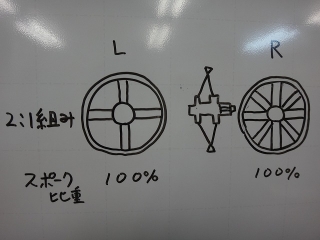
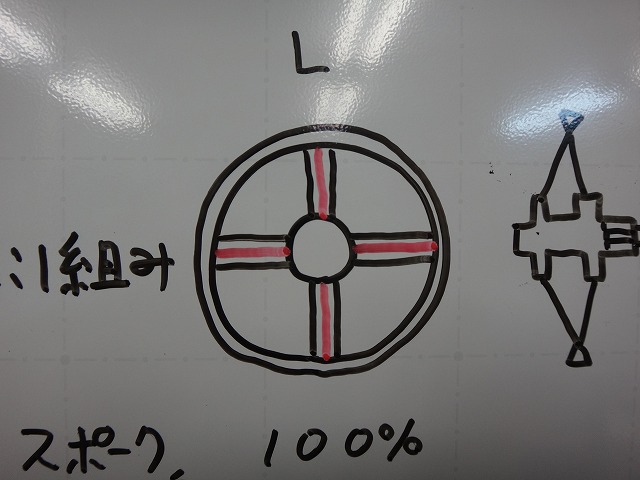
Since drawing is tedious, I drew an 8+4 = 12H rear wheel.
Left-right radial lacing. Even with left-right radial lacing,
you should factor the difference in spoke length by the amount of offset,
but I'll ignore length.
With 100% cross-section spokes at 12 spokes,
spoke volume is 1200.
Right is 100 × 8, left is 100 × 4.
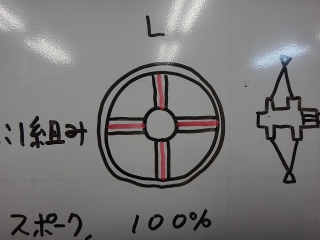
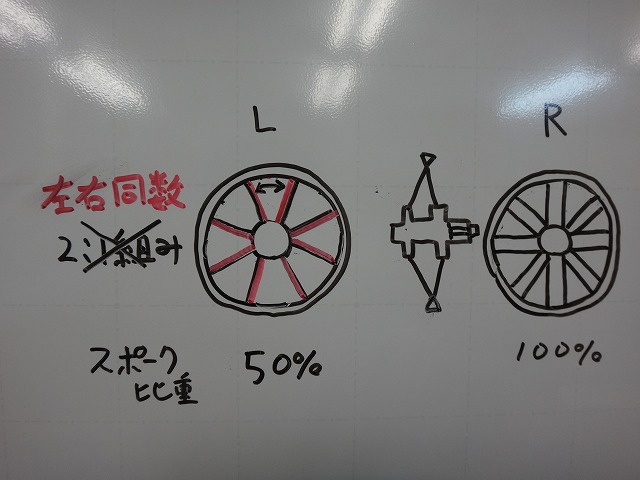
When you split the non-drive side spokes like chopsticks,
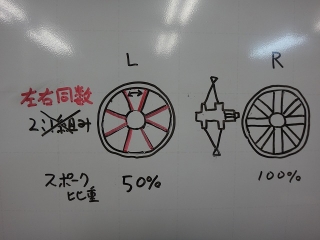
a 2:1 lacing of left-right same diameter and same spoke count
gets converted to left-right same diameter and different spoke count with different diameter lacing.
The spoke volume hasn't changed.
The non-drive side spokes have 50% cross-section, but
in reality spokes with 50% cross-section don't exist.
Based on Sapim's CX-Super (an ultra-light #15-based aero spoke) manufacturer specs,
it calculates to about 54%, but
since it's not definitely certain from experience that it won't go floppy,
the practical limit is still flat 65%.
From here, keeping spoke volume the same while using same-diameter spokes on both sides
means both sides 75% cross-section with spoke volume of 1200.
From there, since it's same spoke count on both sides, incorporating left-right different diameter lacing,
and considering spokes that are actually in stable supply, factoring in their cross-sections,
what I always do with semi-comp lacing is right 85% / left 65%,
and in terms of "just" the correction of left-right spoke tension difference,
the 2:1 lacing is overwhelmingly superior.
From experience with 2:1 lacing:
・when using butted spokes, the risk of non-drive side spoke neck breakage is very high
・when using tangential lacing on the non-drive side, the non-drive side spoke tension becomes higher
・regardless of round or flat, you shouldn't do it with 65% cross-section spokes
The butted spoke issue is probably solved in complete wheels by using straight spokes.
For example, Zonda and Bora don't show prominent non-drive side butting issues.
The fact that 2:1 lacing essentially forces radial lacing on the non-drive side
seems like a disadvantageous condition for drivetrain torque.
For example, with a 24H rear wheel, a 12+12H tangential laced
(I also wire-tie in my case) non-drive side structure with 12H,
compared to a 16+8H with 8H radial laced non-drive side,
I really don't think the latter is stronger against torque.
However, there's a possibility that it's offset by the drive side becoming 16H from a major/minor factors perspective.
So if it's straight spokes,
I don't think 2:1 laced wheels are bad.
Though I wouldn't say it's a definitive conclusion even for rear wheels with free body offset.
For 2:1 laced rear wheels, don't use
65% cross-section Revolution or CX-RAY,
that's empirical knowledge.
It's the same in actual hand building,
and while I hear quite a few spoke pop cases with Roval's CLX40 (24H),
I almost never hear them with Bora 35 (21H),
and I think that's why.
Roval's previous generation used 65% cross-section round spokes,
recently the same cross-section as aero spokes, but
this spoke volume, not for all riders but for a portion of them,
falls below the threshold of whether or not spoke pop occurs.
Roval's rear hub dimensions being inferior to Bora is
a minor factor compared to spoke volume, so
if you get spoke pop with a Roval rear wheel,
rebuilding with higher cross-section spokes (flat would probably be square aero)
should significantly improve it (reducing the rate of spoke pop),
but unfortunately I don't know of spokes matching that spec
being in stable supply.
I've gotten quite off track, but what I wanted to write this time
is that the concept of spoke volume can unify left-right different diameter lacing and left-right different spoke count lacing.
And the reason Colima's 12+8H rear wheel and Zonda DB's rear wheel
use reverse different diameter lacing (non-drive side spokes have higher cross-section)
is probably that these manufacturers have specific coefficients
and formulas unifying the correction degree between left-right different diameter lacing,
but I don't have that, so
thinking it wouldn't be as extreme as Zonda DB's front wheel,
I tried left-right different diameter lacing with a front hub that has offset,
and it happened to settle into just the right left-right difference, and
to be honest with self-praise, I thought "hmm, nice" about the front wheel
from the previous article — that's what this was about.
By the way, spoke volume is also related to the "beaker theory."
I'll write a bit about the relationship between left-right different diameter lacing and left-right different spoke count lacing.

First, "spoke volume" refers to
the total volume of steel in the steel spokes between the hub and rim.
You calculate it by multiplying the spoke cross-sectional percentage by the number of spokes,
and when thinking simply, you usually ignore the length factor.
By the way, if you further multiply that by 0.0257,
you get an approximate estimate of spoke weight (in grams).
Here, I've lined up three front wheels.
20H with 65% spoke cross-section, 13H with 100%,
and hypothetically 6H with 216% (which doesn't exist in reality).
These have the same total volume of steel spokes used in the wheel, so
(setting aside the minor point that the number of nipples differs)
if the hub and rim are the same, the wheel weight will also be the same.
Of course, for example, 130H with 10% would also be the same weight, but
when comparing high cross-section/few spokes versus low cross-section/many spokes,
my conclusion is that as long as
・the spokes don't go "floppy" while building the wheel
・the rider doesn't feel the wheel as "sloppy"
the more spokes the better.
Also, the aerodynamic disadvantage of more spokes is a minor factor
compared to the optimization of spoke volume.
The condition of "not going floppy" is
extremely strict with 65% cross-section round butted spokes,
but totally fine with 65% cross-section flat spokes.
From experience, the practical minimum spoke cross-section is
65% with the condition that they're flat spokes.
Regarding the condition "the rider doesn't feel the wheel as sloppy,"
I always say that
"Shimano's C24 front wheel with 16H is too few spokes;
there are more rigidity drawbacks than aerodynamic and spoke weight reduction benefits,
and considering major and minor factors, it's clearly not good."
As an example, the C24's spoke volume is 65(%) × 16(H) = 1040.
I've sold hundreds of front wheels built with Kinlin XR200 rims
(nearly the same weight as C24's WO rim)
with CX-RAY spokes (65% cross-section), and whenever I ask someone
who's compared them side-by-side with a C24, they always say
"it's stiffer than the C24."
That wheel's spoke volume is 65(%) × 20(H) = 1300.
So if you insist on the C24 being "16H,"
then 81.25(%) × 16(H) = exactly 1300,
which would be better.
But since it's better to increase spoke count within the range of not going floppy,
ultimately with the same spoke volume, 65 × 20 is even better than 81.25 × 16.
Racing 3 is a practical example of 81.25% × 16.
Also, Mavic's steel spoke front wheels
use extremely high cross-section spokes with few spokes,
and the fact that they don't casually make spokes thinner shows they think things through well.
Some models use spokes based on #13, and if you're going to build a "proper" 16H steel spoke front wheel,
that specification makes sense.
These manufacturers probably don't think in terms of "spoke volume," "spoke cross-section," or
"floppy" — our workshop terminology — but
they clearly grasp the same concepts at a higher level,
and when I see their finished products, I often think "hmm, nice."
Also, if you reduce spoke count too much, depending on rim height and rim rigidity,
spoke tension can cause the rim to wave side-to-side,
forcing you to compromise on lateral truing tolerance.
Looking at the diagram above, a 216% × 6H front wheel
would have the rim getting all wibbly side-to-side
and wouldn't be buildable to be usable.
The C24's 16H front wheel shows the same tendency,
and if you tighten the truing stand gauge, you'll notice lateral runout
that doesn't appear or can't be removed on wheels with 20H or more.
To avoid that by going to fewer spokes, you'd have to use
paired spoke phasing.
That's exactly what Rolf Prima wheels do.
If those had evenly spaced rim holes, they wouldn't be proper wheels.
At the beginning, I wrote about "ignoring length" in calculating spoke weight, but
if you don't ignore length, there exists a rim height (rim rigidity)
where spoke volume of 65(%) × 16(H) makes a proper wheel.
With a C50 front wheel, 16H might work.
It's not that 16H is wrong,
it's that using 16H with a lightweight, low-profile rim and low cross-section spokes is wrong.
The original carbon hood rim, Cosmic Carbone, has an inner diameter
almost the same as Open Pro.
So structurally it's equivalent to an Open Pro 16H front wheel,
but by using high cross-section #13 aero spokes,
they avoid spoke volume becoming too low,
and the Cosmic Carbone front wheel actually meets the condition that
"most riders don't feel it as sloppy."
Compared to the C24 rim, the Racing 3 and Cosmic Carbone rims are
definitely much heavier.
But even if the C24 rim were heavier,
it might solve the rim lateral runout compromise issue, but
the rigidity deficiency stemming from low spoke volume
wouldn't change much (if rim height is the same).
A "Racing 3 rim built with CX-RAY straight spokes" front wheel
feels sloppy whether the rim is stiff or heavy.
The WH-7800 front wheel I rebuilt at the end of last year is also 16H,
the original spokes were flat spokes with higher cross-section than CX-RAY, and
after switching I was afraid to use CX-RAY-equivalent spokes, so
I used modified Sapim Aero SB3.

Now for the main topic.
About replacing "spoke volume" between left-right different diameter lacing and left-right different spoke count lacing.
Since drawing is tedious, I drew an 8+4 = 12H rear wheel.
Left-right radial lacing. Even with left-right radial lacing,
you should factor the difference in spoke length by the amount of offset,
but I'll ignore length.
With 100% cross-section spokes at 12 spokes,
spoke volume is 1200.
Right is 100 × 8, left is 100 × 4.
When you split the non-drive side spokes like chopsticks,
a 2:1 lacing of left-right same diameter and same spoke count
gets converted to left-right same diameter and different spoke count with different diameter lacing.
The spoke volume hasn't changed.
The non-drive side spokes have 50% cross-section, but
in reality spokes with 50% cross-section don't exist.
Based on Sapim's CX-Super (an ultra-light #15-based aero spoke) manufacturer specs,
it calculates to about 54%, but
since it's not definitely certain from experience that it won't go floppy,
the practical limit is still flat 65%.
From here, keeping spoke volume the same while using same-diameter spokes on both sides
means both sides 75% cross-section with spoke volume of 1200.
From there, since it's same spoke count on both sides, incorporating left-right different diameter lacing,
and considering spokes that are actually in stable supply, factoring in their cross-sections,
what I always do with semi-comp lacing is right 85% / left 65%,
and in terms of "just" the correction of left-right spoke tension difference,
the 2:1 lacing is overwhelmingly superior.
From experience with 2:1 lacing:
・when using butted spokes, the risk of non-drive side spoke neck breakage is very high
・when using tangential lacing on the non-drive side, the non-drive side spoke tension becomes higher
・regardless of round or flat, you shouldn't do it with 65% cross-section spokes
The butted spoke issue is probably solved in complete wheels by using straight spokes.
For example, Zonda and Bora don't show prominent non-drive side butting issues.
The fact that 2:1 lacing essentially forces radial lacing on the non-drive side
seems like a disadvantageous condition for drivetrain torque.
For example, with a 24H rear wheel, a 12+12H tangential laced
(I also wire-tie in my case) non-drive side structure with 12H,
compared to a 16+8H with 8H radial laced non-drive side,
I really don't think the latter is stronger against torque.
However, there's a possibility that it's offset by the drive side becoming 16H from a major/minor factors perspective.
So if it's straight spokes,
I don't think 2:1 laced wheels are bad.
Though I wouldn't say it's a definitive conclusion even for rear wheels with free body offset.
For 2:1 laced rear wheels, don't use
65% cross-section Revolution or CX-RAY,
that's empirical knowledge.
It's the same in actual hand building,
and while I hear quite a few spoke pop cases with Roval's CLX40 (24H),
I almost never hear them with Bora 35 (21H),
and I think that's why.
Roval's previous generation used 65% cross-section round spokes,
recently the same cross-section as aero spokes, but
this spoke volume, not for all riders but for a portion of them,
falls below the threshold of whether or not spoke pop occurs.
Roval's rear hub dimensions being inferior to Bora is
a minor factor compared to spoke volume, so
if you get spoke pop with a Roval rear wheel,
rebuilding with higher cross-section spokes (flat would probably be square aero)
should significantly improve it (reducing the rate of spoke pop),
but unfortunately I don't know of spokes matching that spec
being in stable supply.
I've gotten quite off track, but what I wanted to write this time
is that the concept of spoke volume can unify left-right different diameter lacing and left-right different spoke count lacing.
And the reason Colima's 12+8H rear wheel and Zonda DB's rear wheel
use reverse different diameter lacing (non-drive side spokes have higher cross-section)
is probably that these manufacturers have specific coefficients
and formulas unifying the correction degree between left-right different diameter lacing,
but I don't have that, so
thinking it wouldn't be as extreme as Zonda DB's front wheel,
I tried left-right different diameter lacing with a front hub that has offset,
and it happened to settle into just the right left-right difference, and
to be honest with self-praise, I thought "hmm, nice" about the front wheel
from the previous article — that's what this was about.
By the way, spoke volume is also related to the "beaker theory."