Another day, another wheel (and so on).

A customer left me with a rim from HUNT Bike Wheels,
a British brand.
When you search the katakana name, the brand's homepage comes up first.
At least, for now.
When I'm trying to look something up, that crappy Nomu Lab Diary blog
ends up at the top or near the top and gets in the way of searching,
so HUNT Bike Wheels (in katakana) might end up the same way someday.

The model name is 30 Carbon Aero Disc—
it's a tubeless-ready carbon rim, but it's not compatible with rim brakes.

That's probably why it's a pretty lightweight rim.
The rim depth is 30mm as the name suggests,
and the rim width is a wide 27mm, so weight-wise it's excellent.

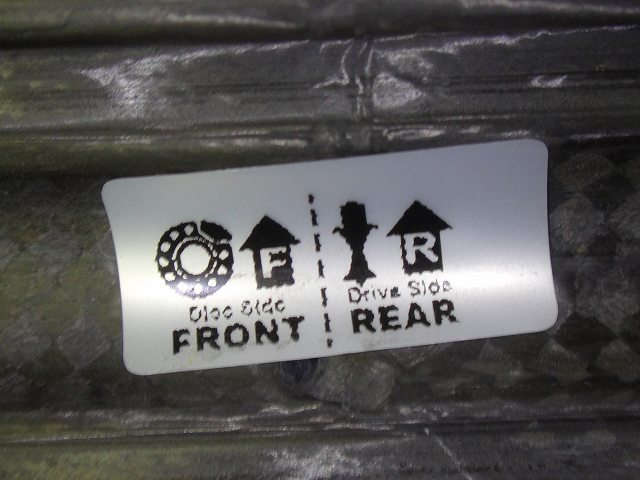
The rim holes have directionality with left and right orientation markings,
but what's unusual is that they don't just mention the freewheel side like with rear hubs—
they also mention the rotor mounting side on disc front hubs.
In other words, you're supposed to orient the arrows toward
the side where the spokes have a steeper angle.

The hub is a Schmidt SON delux12 model,
where the "12" in the model name means it's a 12mm through-axle.

The hub body is wrapped in tape as protection
to prevent scratches when threading the spokes through.

It's a disc front hub, but there's a dish of about 4.5mm.
If the outside of the flange were at the outer edge of the calipers in the image above,
it would be a hub with no dish.
Even if no dish isn't possible,
I get the feeling it could be a bit tighter.
Since there's no interference between the centerlock rotor and spokes,
they might have added a little dish to rule out any possibility of interference
between the brake body and spokes.
I was told to lace it however I saw fit,
but at first I didn't realize it was a disc hub and thought it was
just a regular dynamo hub, so I asked the customer some silly questions like
"shall we do radial lacing or tangent lacing?"
Tangent lacing is the only option anyway, dummy.

It's built.

24H, black CX-RAY, 3-cross reverse Italian lacing, purple aluminum nipples.
The calculated spoke length differs by only about 0.4mm between left and right,
and when rounded to the nearest millimeter they come out the same length,
so I used the same length spokes for both sides.
Even with a small dish, I didn't need to work in
asymmetrical different-diameter lacing.
Or couldn't, rather.
If there were aero spokes with about 70% specific gravity,
using them on the rotor mounting side might have been just right.


↑The orientation is correct, yep.


The Shimano 12mm through-axle wheel building adapter,
TL-FH12, feels almost like a press-fit when used on Shimano hubs
due to thick plating on the shaft or dimensional tolerances,
and it's so tight to remove that it's very inconvenient—
I think I wrote before that it was a waste of money.


But on the Schmidt 12mm through-axle it fit with slightly looser tolerances,
so it turned out to be very useful.


The final centering is checked without the adapter, just to be safe.

A customer left me with a rim from HUNT Bike Wheels,
a British brand.
When you search the katakana name, the brand's homepage comes up first.
At least, for now.
When I'm trying to look something up, that crappy Nomu Lab Diary blog
ends up at the top or near the top and gets in the way of searching,
so HUNT Bike Wheels (in katakana) might end up the same way someday.

The model name is 30 Carbon Aero Disc—
it's a tubeless-ready carbon rim, but it's not compatible with rim brakes.

That's probably why it's a pretty lightweight rim.
The rim depth is 30mm as the name suggests,
and the rim width is a wide 27mm, so weight-wise it's excellent.
The rim holes have directionality with left and right orientation markings,
but what's unusual is that they don't just mention the freewheel side like with rear hubs—
they also mention the rotor mounting side on disc front hubs.
In other words, you're supposed to orient the arrows toward
the side where the spokes have a steeper angle.

The hub is a Schmidt SON delux12 model,
where the "12" in the model name means it's a 12mm through-axle.

The hub body is wrapped in tape as protection
to prevent scratches when threading the spokes through.

It's a disc front hub, but there's a dish of about 4.5mm.
If the outside of the flange were at the outer edge of the calipers in the image above,
it would be a hub with no dish.
Even if no dish isn't possible,
I get the feeling it could be a bit tighter.
Since there's no interference between the centerlock rotor and spokes,
they might have added a little dish to rule out any possibility of interference
between the brake body and spokes.
I was told to lace it however I saw fit,
but at first I didn't realize it was a disc hub and thought it was
just a regular dynamo hub, so I asked the customer some silly questions like
"shall we do radial lacing or tangent lacing?"
Tangent lacing is the only option anyway, dummy.

It's built.

24H, black CX-RAY, 3-cross reverse Italian lacing, purple aluminum nipples.
The calculated spoke length differs by only about 0.4mm between left and right,
and when rounded to the nearest millimeter they come out the same length,
so I used the same length spokes for both sides.
Even with a small dish, I didn't need to work in
asymmetrical different-diameter lacing.
Or couldn't, rather.
If there were aero spokes with about 70% specific gravity,
using them on the rotor mounting side might have been just right.


↑The orientation is correct, yep.


The Shimano 12mm through-axle wheel building adapter,
TL-FH12, feels almost like a press-fit when used on Shimano hubs
due to thick plating on the shaft or dimensional tolerances,
and it's so tight to remove that it's very inconvenient—
I think I wrote before that it was a waste of money.


But on the Schmidt 12mm through-axle it fit with slightly looser tolerances,
so it turned out to be very useful.


The final centering is checked without the adapter, just to be safe.