Another wheel build today (and so on).

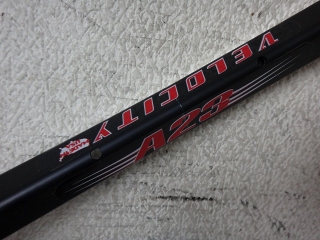
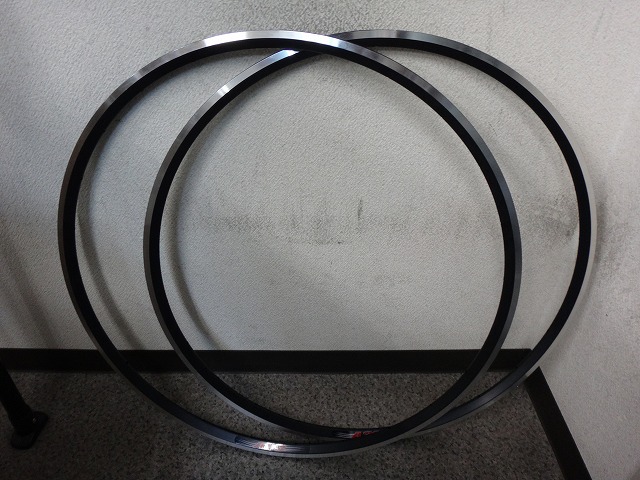
A customer brought me a Velocity A23 rim.
It's a tubeless-ready rim without a hump.
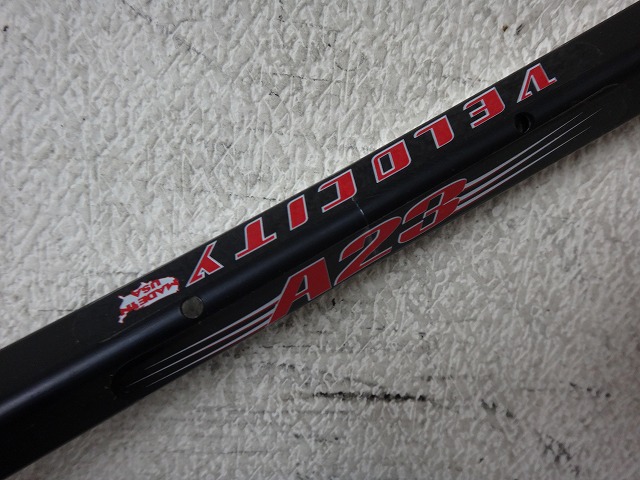
The A23 designation means "aero rim with 23mm outer width,"
but the rim's internal width is 18mm.
For comparison, the current Shamal Ultra C17 (17mm internal rim width) has an outer width of 22mm,
so this rim, being 1mm wider, falls into the wide-rim category.
According to the manufacturer, when a 23C tire is mounted,
the aerodynamic performance anticipated for the rim and tire together
will be maximized.
However, pairing this rim width with a 23C tire is
somewhat inappropriate when you consider other manufacturers' standards.
In fact, the usable tire width range is 23–35C, and
they're marketing this as a road or cyclocross rim,
so it doesn't seem to carry the nuance that anything other than 23C is forbidden.
The labeling is simple—one side shows only the manufacturer name, the other only the model name—but
I think it's better to build it so that when viewed from the right, you can clearly see "A23!"
So I'll position the A23 side as the de facto right side when building.
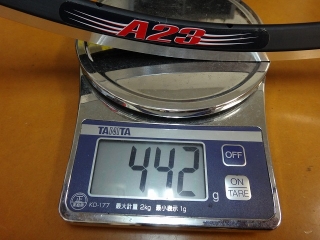
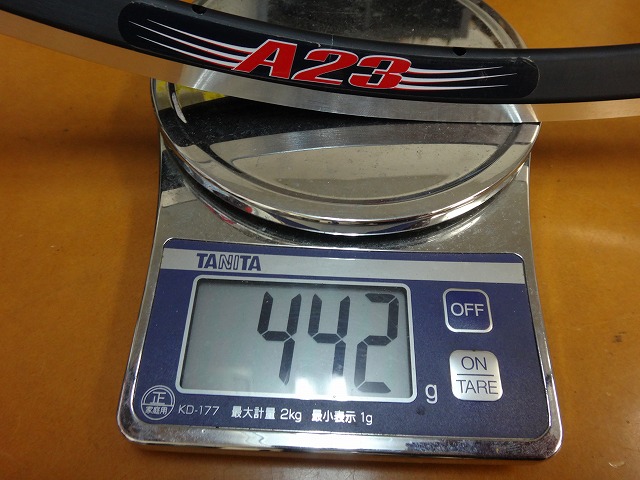
The manufacturer's stated weight is 450g. I have two 24-hole rims on hand,
and both weighed the same.
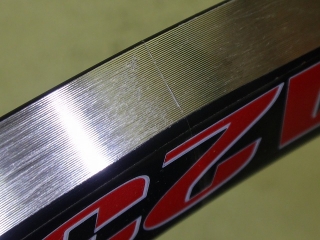
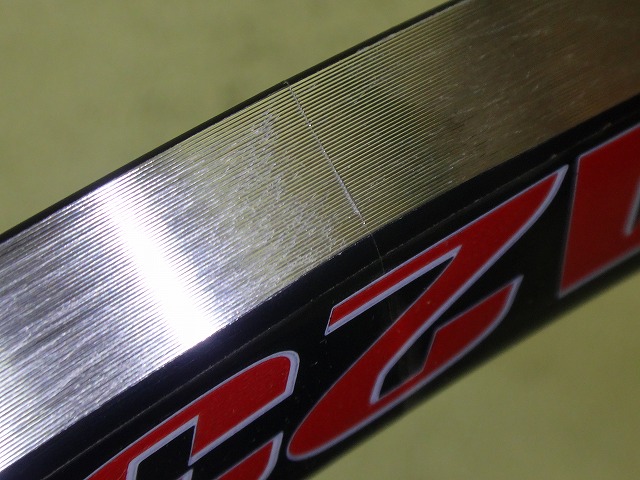
Velocity rims often have loose tolerances at the joint seam,
with the rim offset enough that your fingernail catches,
but it seems they've improved lately.
Both of these rims showed no seam misalignment.
This particular rim comes in two variants—one with the sidewall machined and finished,
and one without—and this one is the machined version,
which may be why there's no misalignment.
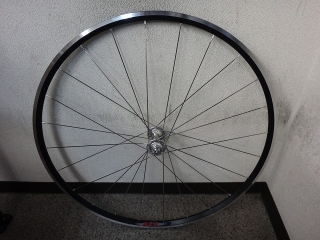
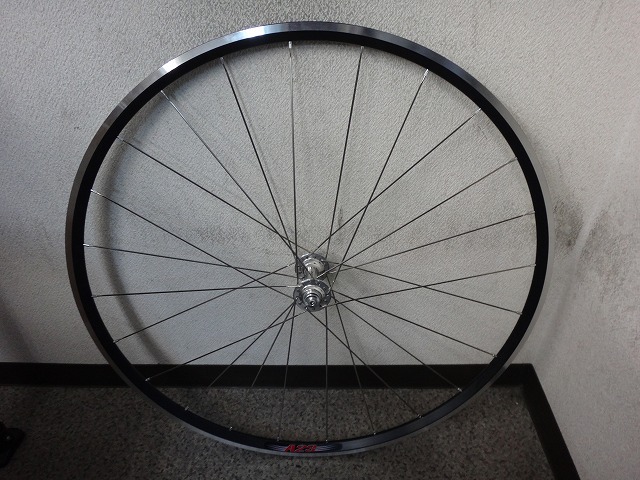
Built.
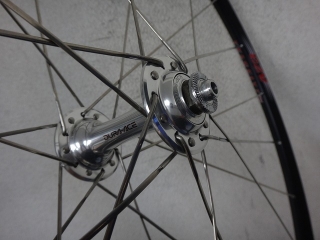
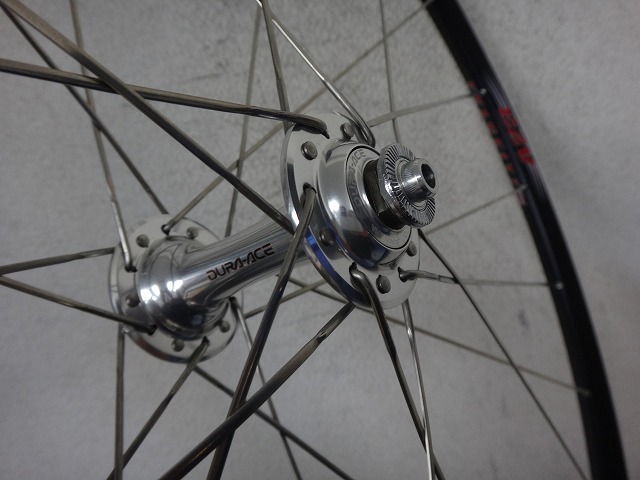
HB-7700, 24-hole, CX-RAY, 4/4 Italian lacing.
The customer wanted silver spokes and silver nipples in tangential lacing,
and it's true that this hub does have radial lacing forbidden.
Though I should mention, I regularly use a front wheel built radial on this same hub with the same number of holes.
Shimano road hubs were first able to be laced radially with
the HB-5500 front hub of the 5500-series 105, which was the same generation as the 7700-series Dura-Ace—
actually, not the HB-5500, and not its minor update, the HB-5501,
but the variant version of that, the HB-5501-A.
The RH-5501 rear hub has no A variant,
so technically rear hub radial lacing on the non-freewheel side is also forbidden.
However, even on complete bikes from that era,
radial lacing on Shimano hubs—front or rear left—was fairly common,
and I've never seen a case of a flange actually tearing off
(though it has happened with non-Shimano hubs),
so I don't think there's a problem with radial lacing.
Besides, the 7700 and 7400-series Dura-Ace
and 6400-series 600 Ultegra came with 18-hole front hubs,
so telling people not to use radial lacing on 18-hole builds is unreasonable.
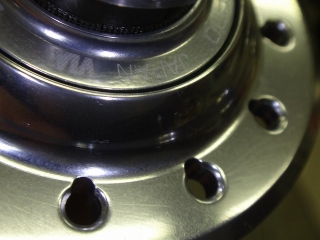
The flange holes were drilled for aero spokes,
but there's no reason to use spokes that require this specific pattern,
so I went with CX-RAY spokes instead.
A customer brought me a Velocity A23 rim.
It's a tubeless-ready rim without a hump.
The A23 designation means "aero rim with 23mm outer width,"
but the rim's internal width is 18mm.
For comparison, the current Shamal Ultra C17 (17mm internal rim width) has an outer width of 22mm,
so this rim, being 1mm wider, falls into the wide-rim category.
According to the manufacturer, when a 23C tire is mounted,
the aerodynamic performance anticipated for the rim and tire together
will be maximized.
However, pairing this rim width with a 23C tire is
somewhat inappropriate when you consider other manufacturers' standards.
In fact, the usable tire width range is 23–35C, and
they're marketing this as a road or cyclocross rim,
so it doesn't seem to carry the nuance that anything other than 23C is forbidden.
The labeling is simple—one side shows only the manufacturer name, the other only the model name—but
I think it's better to build it so that when viewed from the right, you can clearly see "A23!"
So I'll position the A23 side as the de facto right side when building.
The manufacturer's stated weight is 450g. I have two 24-hole rims on hand,
and both weighed the same.
Velocity rims often have loose tolerances at the joint seam,
with the rim offset enough that your fingernail catches,
but it seems they've improved lately.
Both of these rims showed no seam misalignment.
This particular rim comes in two variants—one with the sidewall machined and finished,
and one without—and this one is the machined version,
which may be why there's no misalignment.
Built.
HB-7700, 24-hole, CX-RAY, 4/4 Italian lacing.
The customer wanted silver spokes and silver nipples in tangential lacing,
and it's true that this hub does have radial lacing forbidden.
Though I should mention, I regularly use a front wheel built radial on this same hub with the same number of holes.
Shimano road hubs were first able to be laced radially with
the HB-5500 front hub of the 5500-series 105, which was the same generation as the 7700-series Dura-Ace—
actually, not the HB-5500, and not its minor update, the HB-5501,
but the variant version of that, the HB-5501-A.
The RH-5501 rear hub has no A variant,
so technically rear hub radial lacing on the non-freewheel side is also forbidden.
However, even on complete bikes from that era,
radial lacing on Shimano hubs—front or rear left—was fairly common,
and I've never seen a case of a flange actually tearing off
(though it has happened with non-Shimano hubs),
so I don't think there's a problem with radial lacing.
Besides, the 7700 and 7400-series Dura-Ace
and 6400-series 600 Ultegra came with 18-hole front hubs,
so telling people not to use radial lacing on 18-hole builds is unreasonable.
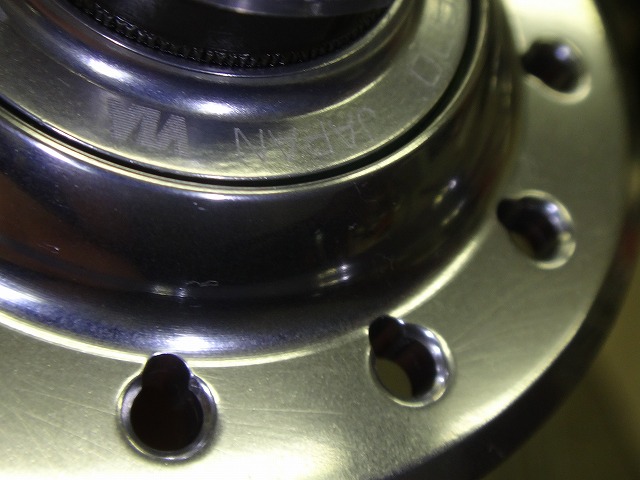
The flange holes were drilled for aero spokes,
but there's no reason to use spokes that require this specific pattern,
so I went with CX-RAY spokes instead.