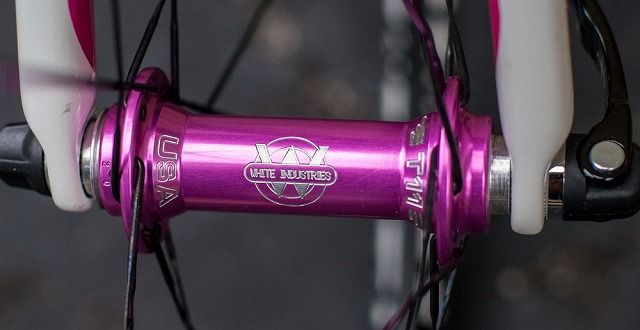
The other day, on the White Industries homepage I mentioned that
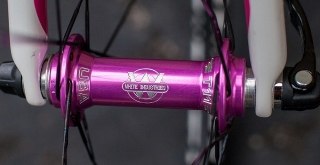
↑this was a reversed logo, but
I've received multiple comments from the same person saying
"this orientation looks more natural."
I don't see it that way.


For example, the markings on handlebars or stem front caps,
or logos on cycle computers
are oriented so they read correctly when viewed from the front.
Following this logic, about the only thing you might do
is orient bar tape end tape so it reads correctly from the front.
For the front hub, following the same principle, the logo would be reversed when viewed from above,
which seems to be the basis for the "reversed logo looks natural" argument.
However, when a logo or text is oriented left-right on a hub,
it's standard for the rear hub to have the logo oriented correctly.
There are counterexamples, but they're very rare.
So I think it's more natural to orient the front hub the same way (correct orientation)
as the rear hub...
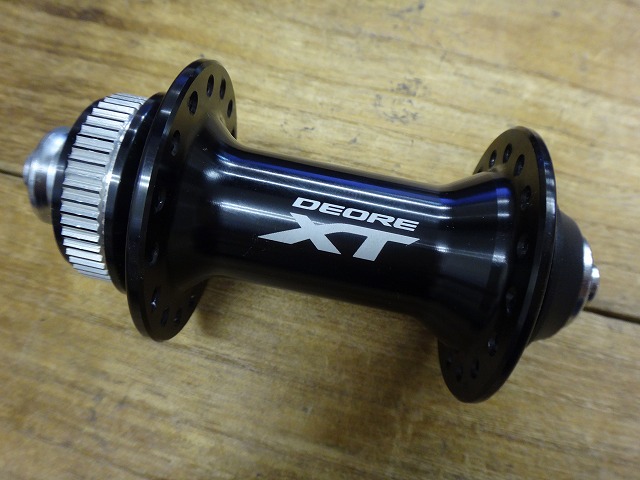
If you disagree, then with a correctly-oriented disc front hub,
you could just assemble it with the rotor mounting on the right side.
At least for White Industries specifically,
disc front hubs are 100% without exception oriented correctly,
so White Industries' premise is "front hubs are correctly oriented,"
which means the image at the beginning is indeed just "assembled haphazardly by an American."
When I assembled my H2 hub in reversed orientation,
it wasn't for the reason of "so the logo reads correctly from the front"—
it was the result of following the premise that
"the bearing adjustment mechanism is on the left side,"
and with the current T11 hub, the logo is simply oriented correctly
when the bearing adjustment mechanism is on the left side.
Also, as a convention in hand-built wheels,
from the era when 32-spoke and 36-spoke wheels were standard,
front hub logos have been correctly oriented,
so unless there's a strong reason to go against that,
I see no need to assemble with a reversed logo.
Let me provide the counterarguments I can think of.
Until recently, Chris King's R45 disc front hubs
had the logo reversed for 6-bolt rotor mounts,
but correct for centerlock.
This wasn't random—it was always that way.
Looking at the current manufacturer website, even the 6-bolt version is now correctly oriented.
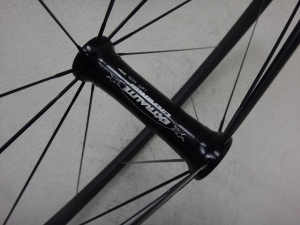
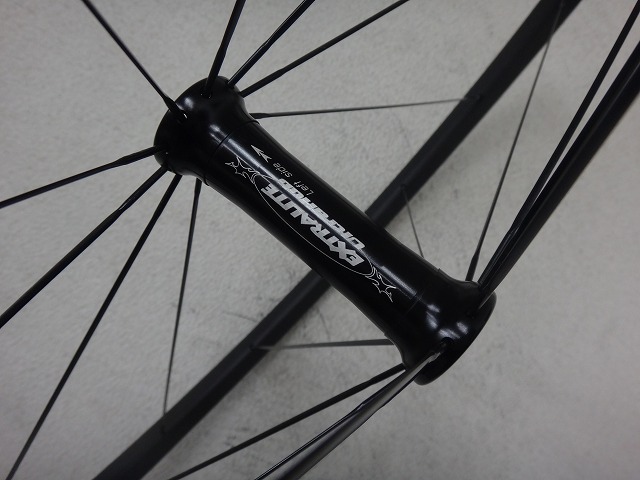
On the Extra Light front hub shell
there's a "this side is left" designation, and following it results in reversed orientation,

yet the rear hub is correctly oriented.
But please don't say things like
"See! This is the right way!\" based on this.
This is simply because I'm presenting
an exception from a tiny minority.
Also, stickers on Campagnolo and Fulcrum hub shells
are sometimes correctly oriented and sometimes reversed,
but that's completely random with no rhyme or reason,
so they're not deliberately reversed for any logical basis.
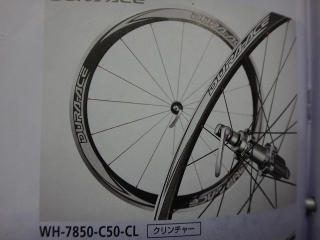
A story I remembered about wheel installation direction.
With the 7850 C50,
on the rear wheel, both left and right
have the arrows pointing in the direction of forward rotation
on the stickers. So it seems natural to install the front wheel to match that, but
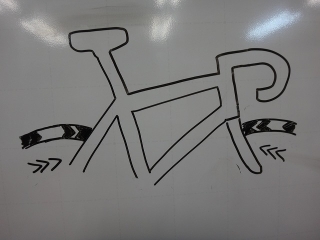
at a workshop, I was told this orientation is the correct way to install it.
This information isn't in any manuals.
And regarding the reason, I was only told "it's just the way it is,"
without any clear explanation.
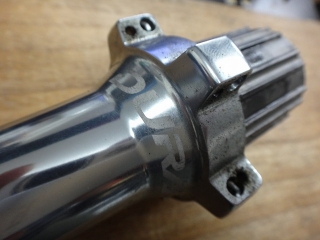
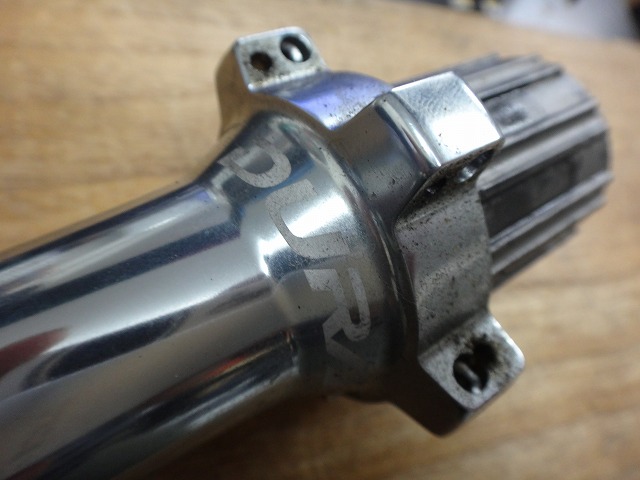
As a rough basis,
on the tapered section of the hub shell, the Dura-Ace marking is on the right on the rear hub,
and if the front hub follows that,
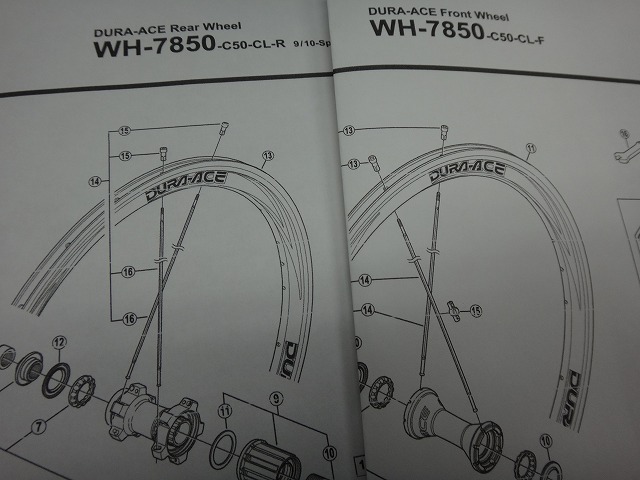
then "the sticker orientation differs front to rear,"
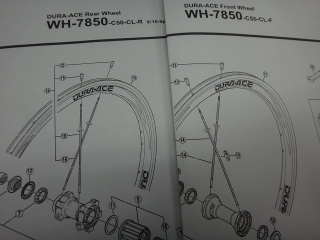
but in the parts diagram the sticker orientation is consistent.
With the hub axle insertion side on the right,
the bearing adjustment mechanism side or the W-nut side on the left,
you get "sticker orientation consistent front to rear," which
does seem more natural...
Searching "WH-7850 C50" shows examples where the front wheel sticker
is installed opposite to the rear, but
whether this is done consciously or not is unclear.
Postscript:
I received an applause comment from the person who originally commented,
so let me respond while presenting some materials.
"People making things obviously want to align front and rear—even an amateur like me would assemble it that way,
but for the people making catalogs, they prefer the logo oriented correctly when taking photos,
so I bet they just say 'assemble with the logo pointing up' without thinking."
But this statement about "catalog makers prefer the logo oriented correctly when taking photos" makes no sense.
↑Why not shoot from the back like this?
White Industries hubs, except for the H2 front hub,
have the bearing adjustment mechanism on the left, so they "suggest" correct-orientation assembly.
Since there's no strong reason to go against that, I assemble in correct orientation—that's the story.
Suppose "the bearing adjustment mechanism should be on the left side when assembled" is
some strange personal rule unique to me.
But, to reiterate, White Industries
has 100% of their disc front hubs in correct orientation,
so if you assemble a front wheel with a disc front hub,
you literally cannot assemble the logo in the orientation of the opening image.
So even without considering which side the bearing adjustment mechanism is on,
it's reasonable to judge that the manufacturer specifies correct orientation.

Next, I'll address the case where the logo runs left-right when viewed from the side.
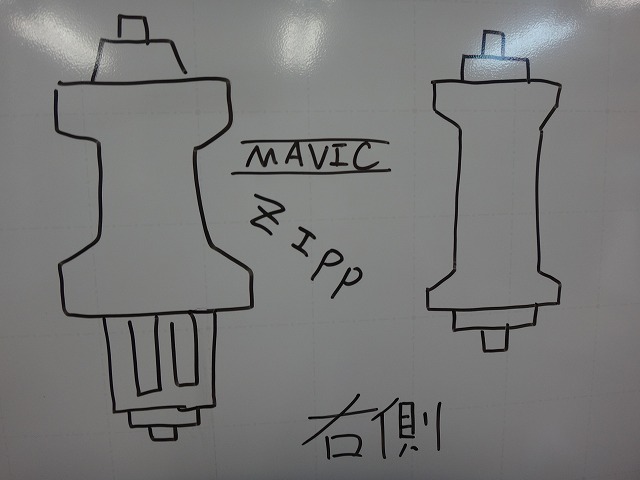
Mavic and ZIPP have hubs where
"the rear hub marking reads correctly from the right side."
For hubs with characters or logos oriented left-right,
the original comment was that having the rear hub correctly oriented and front hub reversed is natural,
but would this mean installing the front hub logo
in the opposite direction from the rear?
Because you can't read it from the front, does it not matter either way?
I still think having the logo orientation differ front to rear is unnatural.
The reason I brought up Mavic and ZIPP specifically is deliberate.
Each manufacturer has file marks on the brake zone,
and the front wheel installation has direction specifications—Exalith and NSW—
but following these direction specifications in both cases results in correct orientation when viewed from the right,
meaning front and rear hub orientations don't reverse during installation.
Would you deliberately install the front wheel in reverse orientation
because of some vague preference?
You might say "brake orientation specification is a stronger reason than hub logo orientation,
so of course you wouldn't install it reversed!"
But my point is that Exalith and NSW being oriented this way is
"a clue that the manufacturer thinks this orientation is correct."
So for other Mavic wheels that aren't Exalith
or other ZIPP wheels that aren't NSW, I'll also install them in this orientation.
Installing a Ksyrium Pro Exalith following brake zone orientation in the same direction as the rear,
while installing an Axiom (non-Exalith) reversed because "there's a preference,"
would be unnatural.
By the way, when an Exalith front wheel is installed in its specified direction,
the bearing adjustment mechanism will (at least at the time of shipment) always be on the left side.
The H2 front hub is currently discontinued,
and White Industries' front disc hubs
are all correctly oriented, so if I treat this like an Exalith
"as a clue that the manufacturer thinks this orientation is correct,"
then even non-disc hubs can only be correctly oriented—that's my thinking.

On the White Industries manufacturer website, in images showing
front and rear hubs side by side,
the front hub is never shown upside-down,
so assembling both front and rear hubs in the same orientation seems natural.
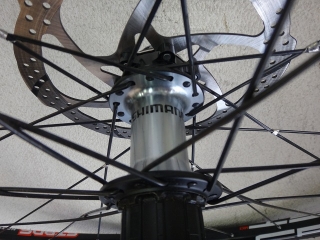
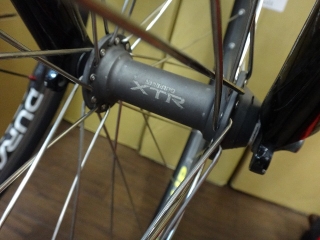
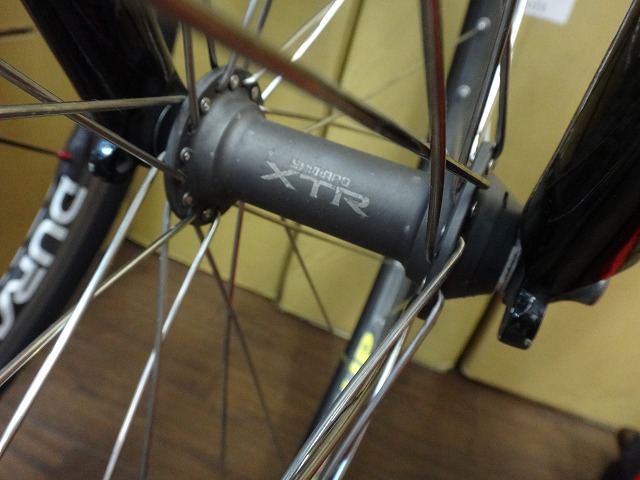
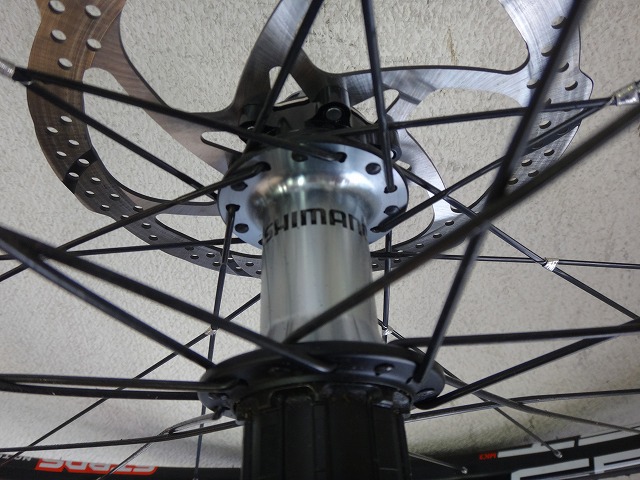
On Shimano hubs with logos running front-to-back on the hub shell,
they're often "correctly oriented when viewed from the right side,"

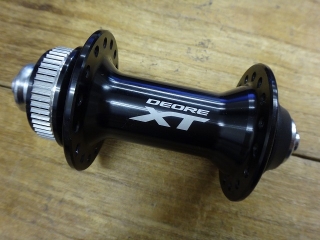
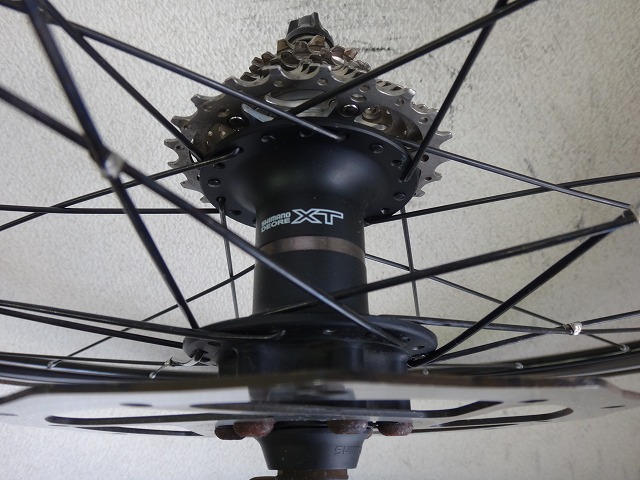
but the first-generation disc brake hub XT (in the image above)
and MC18-series Alivio hubs have "reversed when viewed from the right side" examples.
However, even with these hubs, "the logo and markings orientation is the same front to rear"
doesn't change.
What I'm getting at is
that having the logo or markings orientation reversed front to rear is unnatural.
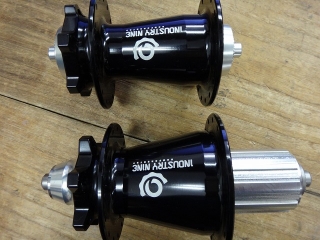
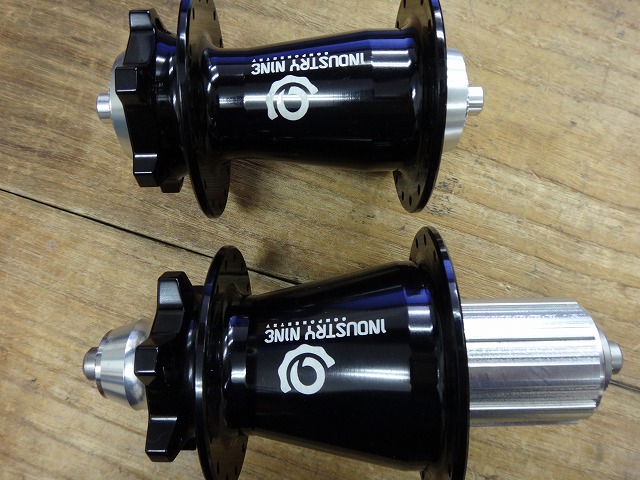
This is a hub from the brand Industry Nine,
with both front and rear hubs in reversed orientation.
And since they're disc hubs, both wheels must be assembled reversed.
Now about my own guidelines—
if this weren't a disc hub, what would I do?
I'd respect "the same orientation as the rear hub" and assemble the front hub reversed too.
This is definitely not for the reason "to make the logo read correctly from the front."
If hypothetically a disc hub had the rear correctly oriented and front reversed,
and I were assembling a wheel with a non-disc hub from the same manufacturer...
I'd judge "this manufacturer suggests this orientation"
and assemble the rear hub correctly and front hub reversed.
But there's no example matching this (at least that I know of).
Also, in the comments someone mentioned the reason for Extra Light hub direction specification
was that the bearing adjustment mechanism loosens if it's not on the left—
but I doubt there's actually a problem if you don't follow the specification.
If there's no rational reason, or if you don't think your idea is more rational than the manufacturer's,
the safe approach is to follow the manufacturer's specification, and if there isn't one,
to follow convention.
As for "is there any functional reason besides protocol that a front hub needs
left-right specification?"—
if performance doesn't change, then following protocol next is obviously correct.
Having the rim valve hole phase align precisely with the hub shell logo,
the tire label at the valve hole phase,
and with bar tape like SILVA that's made to align,
the bar tape logo aligned (possible to maintain even with thicker or thinner wrapping)—
these have no performance implications
but are a mark of "someone who knows what they're doing" assembling the wheel.
On a personal level you're free to have quirks and go against it, but
professionally you must always follow manufacturer specifications—
a good example is Mavic front tires.
That tire's reverse-direction specification goes against the convention
of judging from water-shedding direction,
and personally I think the opposite direction would be better.
With my own bike, I might deliberately install it opposite to the manufacturer's direction.
Why I wrote such a long article—
the commenter this time used humble language like "thank you for the interesting article"
and "even an amateur like me," but
they're way off base on some things (especially regarding GOKISO),
speaking down from on high pretty often.
At one point they even told me "if you keep pounding the desk,
you just expose your lack of confidence, so you shouldn't comment,"
so this time I got red-faced (laugh) and fired back. DESK POUNDS
When it came to that certain brand's wheels you shouldn't name,
they made some pretentious comments too, but
given that the rear wheel that was scraping heavily on the frame
definitely stopped scraping after I reassembled it,
I'm confident my theoretical and practical knowledge of wheels
is way ahead of that certain brand...
Now that I've written all this, what's funny
is that it's not funny to me,
but I figure the readers here will enjoy this ridiculous topic
so I've played the fool.
↑this was a reversed logo, but
I've received multiple comments from the same person saying
"this orientation looks more natural."
I don't see it that way.


For example, the markings on handlebars or stem front caps,
or logos on cycle computers
are oriented so they read correctly when viewed from the front.
Following this logic, about the only thing you might do
is orient bar tape end tape so it reads correctly from the front.
For the front hub, following the same principle, the logo would be reversed when viewed from above,
which seems to be the basis for the "reversed logo looks natural" argument.
However, when a logo or text is oriented left-right on a hub,
it's standard for the rear hub to have the logo oriented correctly.
There are counterexamples, but they're very rare.
So I think it's more natural to orient the front hub the same way (correct orientation)
as the rear hub...
If you disagree, then with a correctly-oriented disc front hub,
you could just assemble it with the rotor mounting on the right side.
At least for White Industries specifically,
disc front hubs are 100% without exception oriented correctly,
so White Industries' premise is "front hubs are correctly oriented,"
which means the image at the beginning is indeed just "assembled haphazardly by an American."
When I assembled my H2 hub in reversed orientation,
it wasn't for the reason of "so the logo reads correctly from the front"—
it was the result of following the premise that
"the bearing adjustment mechanism is on the left side,"
and with the current T11 hub, the logo is simply oriented correctly
when the bearing adjustment mechanism is on the left side.
Also, as a convention in hand-built wheels,
from the era when 32-spoke and 36-spoke wheels were standard,
front hub logos have been correctly oriented,
so unless there's a strong reason to go against that,
I see no need to assemble with a reversed logo.
Let me provide the counterarguments I can think of.
Until recently, Chris King's R45 disc front hubs
had the logo reversed for 6-bolt rotor mounts,
but correct for centerlock.
This wasn't random—it was always that way.
Looking at the current manufacturer website, even the 6-bolt version is now correctly oriented.
On the Extra Light front hub shell
there's a "this side is left" designation, and following it results in reversed orientation,

yet the rear hub is correctly oriented.
But please don't say things like
"See! This is the right way!\" based on this.
This is simply because I'm presenting
an exception from a tiny minority.
Also, stickers on Campagnolo and Fulcrum hub shells
are sometimes correctly oriented and sometimes reversed,
but that's completely random with no rhyme or reason,
so they're not deliberately reversed for any logical basis.

A story I remembered about wheel installation direction.
With the 7850 C50,
on the rear wheel, both left and right
have the arrows pointing in the direction of forward rotation
on the stickers. So it seems natural to install the front wheel to match that, but

at a workshop, I was told this orientation is the correct way to install it.
This information isn't in any manuals.
And regarding the reason, I was only told "it's just the way it is,"
without any clear explanation.
As a rough basis,
on the tapered section of the hub shell, the Dura-Ace marking is on the right on the rear hub,
and if the front hub follows that,
then "the sticker orientation differs front to rear,"
but in the parts diagram the sticker orientation is consistent.
With the hub axle insertion side on the right,
the bearing adjustment mechanism side or the W-nut side on the left,
you get "sticker orientation consistent front to rear," which
does seem more natural...
Searching "WH-7850 C50" shows examples where the front wheel sticker
is installed opposite to the rear, but
whether this is done consciously or not is unclear.
Postscript:
I received an applause comment from the person who originally commented,
so let me respond while presenting some materials.
"People making things obviously want to align front and rear—even an amateur like me would assemble it that way,
but for the people making catalogs, they prefer the logo oriented correctly when taking photos,
so I bet they just say 'assemble with the logo pointing up' without thinking."
But this statement about "catalog makers prefer the logo oriented correctly when taking photos" makes no sense.
↑Why not shoot from the back like this?
White Industries hubs, except for the H2 front hub,
have the bearing adjustment mechanism on the left, so they "suggest" correct-orientation assembly.
Since there's no strong reason to go against that, I assemble in correct orientation—that's the story.
Suppose "the bearing adjustment mechanism should be on the left side when assembled" is
some strange personal rule unique to me.
But, to reiterate, White Industries
has 100% of their disc front hubs in correct orientation,
so if you assemble a front wheel with a disc front hub,
you literally cannot assemble the logo in the orientation of the opening image.
So even without considering which side the bearing adjustment mechanism is on,
it's reasonable to judge that the manufacturer specifies correct orientation.
Next, I'll address the case where the logo runs left-right when viewed from the side.
Mavic and ZIPP have hubs where
"the rear hub marking reads correctly from the right side."
For hubs with characters or logos oriented left-right,
the original comment was that having the rear hub correctly oriented and front hub reversed is natural,
but would this mean installing the front hub logo
in the opposite direction from the rear?
Because you can't read it from the front, does it not matter either way?
I still think having the logo orientation differ front to rear is unnatural.
The reason I brought up Mavic and ZIPP specifically is deliberate.
Each manufacturer has file marks on the brake zone,
and the front wheel installation has direction specifications—Exalith and NSW—
but following these direction specifications in both cases results in correct orientation when viewed from the right,
meaning front and rear hub orientations don't reverse during installation.
Would you deliberately install the front wheel in reverse orientation
because of some vague preference?
You might say "brake orientation specification is a stronger reason than hub logo orientation,
so of course you wouldn't install it reversed!"
But my point is that Exalith and NSW being oriented this way is
"a clue that the manufacturer thinks this orientation is correct."
So for other Mavic wheels that aren't Exalith
or other ZIPP wheels that aren't NSW, I'll also install them in this orientation.
Installing a Ksyrium Pro Exalith following brake zone orientation in the same direction as the rear,
while installing an Axiom (non-Exalith) reversed because "there's a preference,"
would be unnatural.
By the way, when an Exalith front wheel is installed in its specified direction,
the bearing adjustment mechanism will (at least at the time of shipment) always be on the left side.
The H2 front hub is currently discontinued,
and White Industries' front disc hubs
are all correctly oriented, so if I treat this like an Exalith
"as a clue that the manufacturer thinks this orientation is correct,"
then even non-disc hubs can only be correctly oriented—that's my thinking.

On the White Industries manufacturer website, in images showing
front and rear hubs side by side,
the front hub is never shown upside-down,
so assembling both front and rear hubs in the same orientation seems natural.
On Shimano hubs with logos running front-to-back on the hub shell,
they're often "correctly oriented when viewed from the right side,"
but the first-generation disc brake hub XT (in the image above)
and MC18-series Alivio hubs have "reversed when viewed from the right side" examples.
However, even with these hubs, "the logo and markings orientation is the same front to rear"
doesn't change.
What I'm getting at is
that having the logo or markings orientation reversed front to rear is unnatural.
This is a hub from the brand Industry Nine,
with both front and rear hubs in reversed orientation.
And since they're disc hubs, both wheels must be assembled reversed.
Now about my own guidelines—
if this weren't a disc hub, what would I do?
I'd respect "the same orientation as the rear hub" and assemble the front hub reversed too.
This is definitely not for the reason "to make the logo read correctly from the front."
If hypothetically a disc hub had the rear correctly oriented and front reversed,
and I were assembling a wheel with a non-disc hub from the same manufacturer...
I'd judge "this manufacturer suggests this orientation"
and assemble the rear hub correctly and front hub reversed.
But there's no example matching this (at least that I know of).
Also, in the comments someone mentioned the reason for Extra Light hub direction specification
was that the bearing adjustment mechanism loosens if it's not on the left—
but I doubt there's actually a problem if you don't follow the specification.
If there's no rational reason, or if you don't think your idea is more rational than the manufacturer's,
the safe approach is to follow the manufacturer's specification, and if there isn't one,
to follow convention.
As for "is there any functional reason besides protocol that a front hub needs
left-right specification?"—
if performance doesn't change, then following protocol next is obviously correct.
Having the rim valve hole phase align precisely with the hub shell logo,
the tire label at the valve hole phase,
and with bar tape like SILVA that's made to align,
the bar tape logo aligned (possible to maintain even with thicker or thinner wrapping)—
these have no performance implications
but are a mark of "someone who knows what they're doing" assembling the wheel.
On a personal level you're free to have quirks and go against it, but
professionally you must always follow manufacturer specifications—
a good example is Mavic front tires.
That tire's reverse-direction specification goes against the convention
of judging from water-shedding direction,
and personally I think the opposite direction would be better.
With my own bike, I might deliberately install it opposite to the manufacturer's direction.
Why I wrote such a long article—
the commenter this time used humble language like "thank you for the interesting article"
and "even an amateur like me," but
they're way off base on some things (especially regarding GOKISO),
speaking down from on high pretty often.
At one point they even told me "if you keep pounding the desk,
you just expose your lack of confidence, so you shouldn't comment,"
so this time I got red-faced (laugh) and fired back. DESK POUNDS
When it came to that certain brand's wheels you shouldn't name,
they made some pretentious comments too, but
given that the rear wheel that was scraping heavily on the frame
definitely stopped scraping after I reassembled it,
I'm confident my theoretical and practical knowledge of wheels
is way ahead of that certain brand...
Now that I've written all this, what's funny
is that it's not funny to me,
but I figure the readers here will enjoy this ridiculous topic
so I've played the fool.