Another wheel day (and so on).
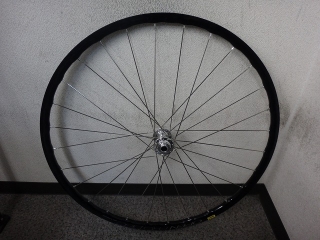
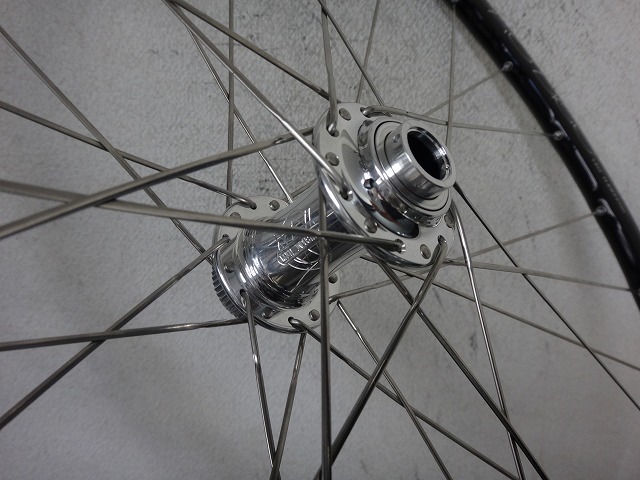
I built a front wheel with an Open Pro Disc UST tubeless rim.
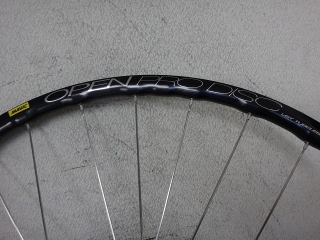
The rim has a shape kind of like a Pondering Doughnut.
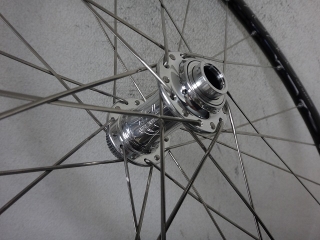
The hub is a White Industries CLD 28H
built with CX-RAY reverse Italian (64-spoke cross) lacing.
I'll do the spoke tie-downs later.
I'm writing this casually, but there's been a lot to think about getting to this point.
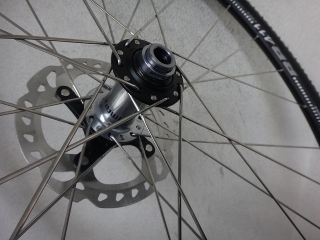
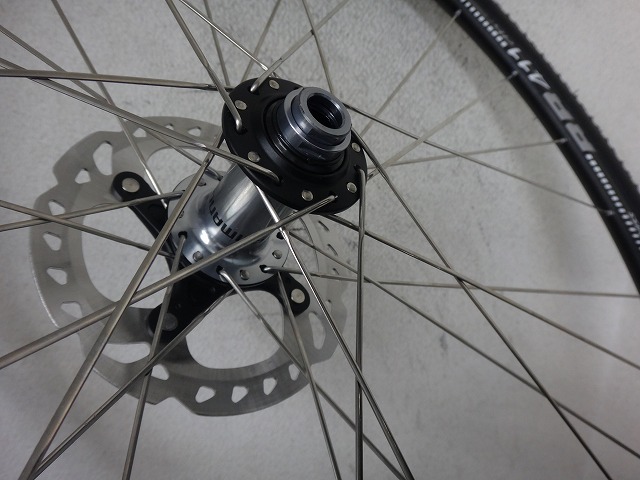
↑This is the front wheel I built the other day with an RS770 hub and RR411 disc rim,
also built with CX-RAY reverse Italian lacing.
With that one, I judged that spoke tie-downs weren't necessary, or at least weren't critical,
so I didn't bother doing them.
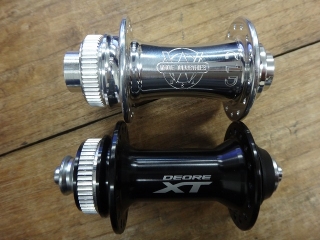
↑I've aligned the spoke ends.
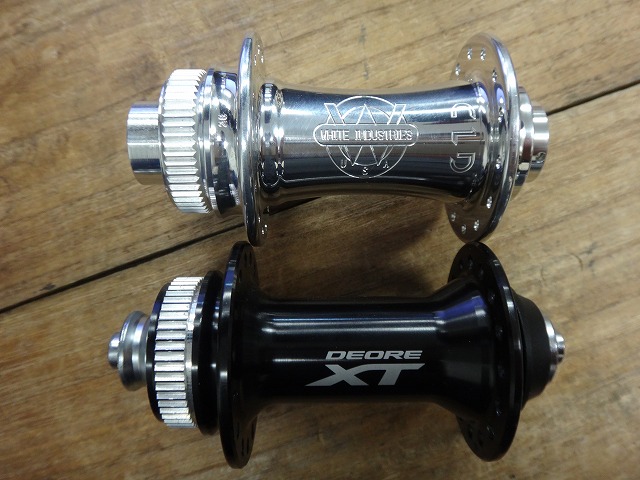
Comparing White disc hubs to Shimano ones,
the flange widths don't differ that much, but White's are narrower.
So you'd think the lateral offset (dish) would be less on the White side... but that's not actually the case, which is the problem.
The left-right flange width difference (right side minus left side) is 14.5mm on White and 12.0mm on Shimano.
So if the rim conditions and wheel building method are the same,
Shimano hubs will have more balanced spoke tension left and right.
On top of that, with these two wheels,
the one built with the Shimano hub uses an offset rim,
so the left-right spoke tension difference becomes even greater. Naturally,
both front wheels are built perfectly centered,
but on the White hub the tension on the non-rotor side is noticeably looser.
Moreover, the tension on the rotor side is actually slightly higher on the wheel I just built.
So by my thinking, the wheel I built today requires spoke tie-downs.
I know it wouldn't be like this if I'd built it semi-competitively (semi-comp lacing),
but the customer wanted CX-RAY and is lightweight,
so I chose full CX-RAY with tie-downs.
The before/after shots of ZIPP, Reynolds, and Shimano rear wheel rebuilds,
and if I could keep various sample wheels on hand—
like front wheels built the same way: 28H full CX-RAY reverse Italian, but with different rim and hub dimensions—
it would make talking to customers about wheels easier when they visit.
Separately, I've noticed something pretty striking.
This Open Pro Disc rim, while dimensionally not an offset rim,
is shaped like an offset rim.
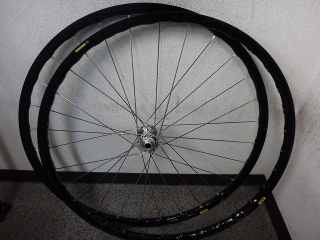
↑Today I built a 28H front wheel,
and the customer also left me a 32H rim for the rear wheel.
Around the single-eyeleted spoke holes on this rim,
not only is the rim depth high, but it bulges out in a rounded way.
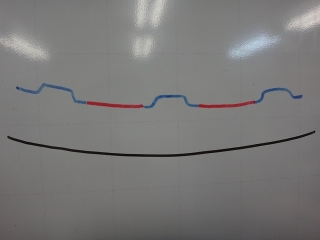
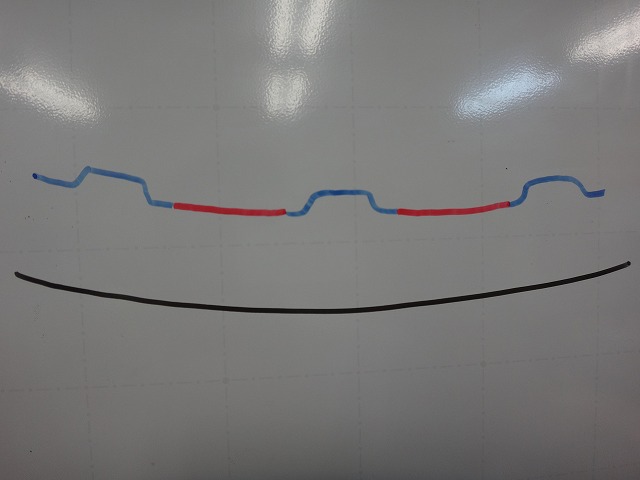
If I draw the spoke hole area bulges in blue and the sections between them in red
to sketch the rim's cross-section,
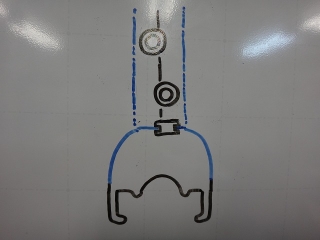
↑it looks like this.
The spoke holes do have offset (true offset), but
the position is offset equally from the rim centerline,
so it's not an offset rim.
However...
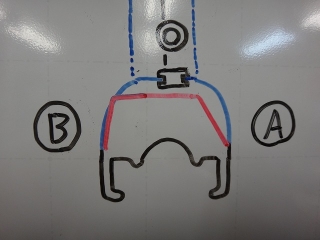
When I sketch in the sections between the spoke holes, it looks like this.
I've exaggerated it a bit, but there's a left-right difference you can feel by touch.
Calling one side of the rim A and the other side B,
the B side is clearly nearly a sheer cliff face,
and if you run your finger along the rim sides, the A side is noticeably rougher too.
Whether this is intentional for some reason
or an unavoidable result of the manufacturing process is unclear.
It's possible that there was originally a complete wheel with this rim shape,
and this single-eyeleted hand-build rim version is derived from that.
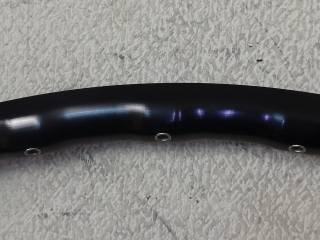
↑A side
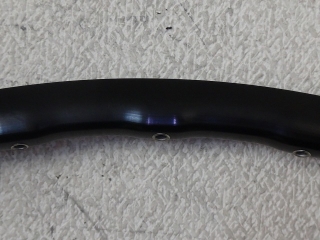
↑B side
If you touch the rim, the difference is immediately obvious,
but I sought out the angle that best shows the difference under fluorescent light,
and this was about as good as it got.
Since disc front hubs have an offset (dish), disc brake rims like the DT RR411 do it
with offset rim specs, so there's no particular problem.
The Open Pro Disc's spoke holes
clearly don't have offset (apart from the equal-offset true offset),
so building the wheel without worrying about orientation
shouldn't affect spoke tension imbalance left-to-right.
But if you split the rim down the middle,
the B side is distinctly heavier, so there's a weight imbalance in that sense.
So I'd think of it as an offset rim in that meaning,
and when building a front wheel, I'd put side A on the left (rotor side),
and when building a rear wheel, I'd put side A on the right (freewheel side)—
it might be better that way.
At least, that's what I'll do.

I built a front wheel with an Open Pro Disc UST tubeless rim.
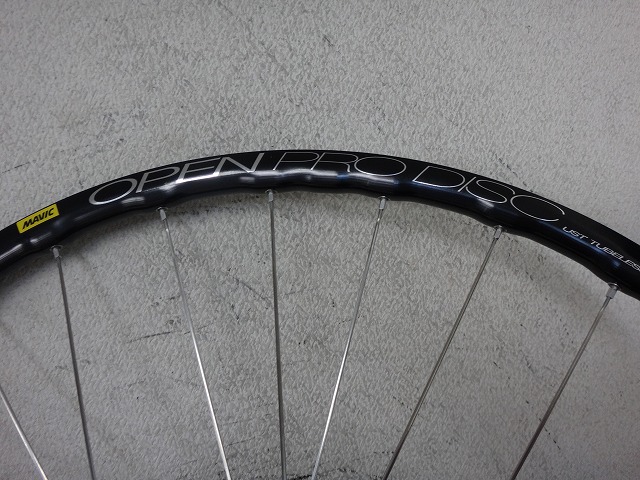
The rim has a shape kind of like a Pondering Doughnut.
The hub is a White Industries CLD 28H
built with CX-RAY reverse Italian (64-spoke cross) lacing.
I'll do the spoke tie-downs later.
I'm writing this casually, but there's been a lot to think about getting to this point.
↑This is the front wheel I built the other day with an RS770 hub and RR411 disc rim,
also built with CX-RAY reverse Italian lacing.
With that one, I judged that spoke tie-downs weren't necessary, or at least weren't critical,
so I didn't bother doing them.
↑I've aligned the spoke ends.
Comparing White disc hubs to Shimano ones,
the flange widths don't differ that much, but White's are narrower.
So you'd think the lateral offset (dish) would be less on the White side... but that's not actually the case, which is the problem.
The left-right flange width difference (right side minus left side) is 14.5mm on White and 12.0mm on Shimano.
So if the rim conditions and wheel building method are the same,
Shimano hubs will have more balanced spoke tension left and right.
On top of that, with these two wheels,
the one built with the Shimano hub uses an offset rim,
so the left-right spoke tension difference becomes even greater. Naturally,
both front wheels are built perfectly centered,
but on the White hub the tension on the non-rotor side is noticeably looser.
Moreover, the tension on the rotor side is actually slightly higher on the wheel I just built.
So by my thinking, the wheel I built today requires spoke tie-downs.
I know it wouldn't be like this if I'd built it semi-competitively (semi-comp lacing),
but the customer wanted CX-RAY and is lightweight,
so I chose full CX-RAY with tie-downs.
The before/after shots of ZIPP, Reynolds, and Shimano rear wheel rebuilds,
and if I could keep various sample wheels on hand—
like front wheels built the same way: 28H full CX-RAY reverse Italian, but with different rim and hub dimensions—
it would make talking to customers about wheels easier when they visit.
Separately, I've noticed something pretty striking.
This Open Pro Disc rim, while dimensionally not an offset rim,
is shaped like an offset rim.

↑Today I built a 28H front wheel,
and the customer also left me a 32H rim for the rear wheel.
Around the single-eyeleted spoke holes on this rim,
not only is the rim depth high, but it bulges out in a rounded way.
If I draw the spoke hole area bulges in blue and the sections between them in red
to sketch the rim's cross-section,
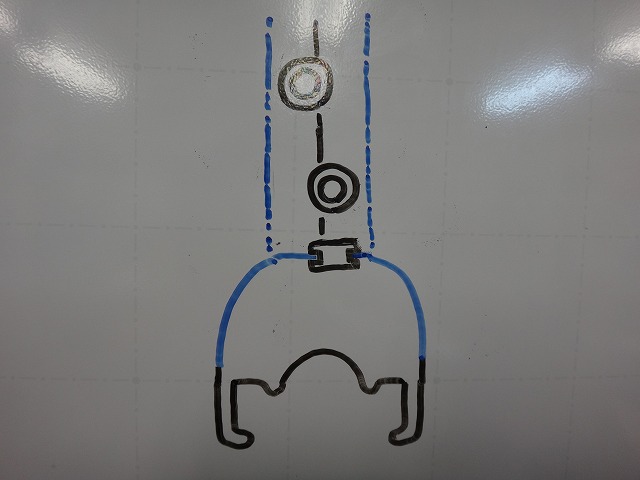
↑it looks like this.
The spoke holes do have offset (true offset), but
the position is offset equally from the rim centerline,
so it's not an offset rim.
However...

When I sketch in the sections between the spoke holes, it looks like this.
I've exaggerated it a bit, but there's a left-right difference you can feel by touch.
Calling one side of the rim A and the other side B,
the B side is clearly nearly a sheer cliff face,
and if you run your finger along the rim sides, the A side is noticeably rougher too.
Whether this is intentional for some reason
or an unavoidable result of the manufacturing process is unclear.
It's possible that there was originally a complete wheel with this rim shape,
and this single-eyeleted hand-build rim version is derived from that.
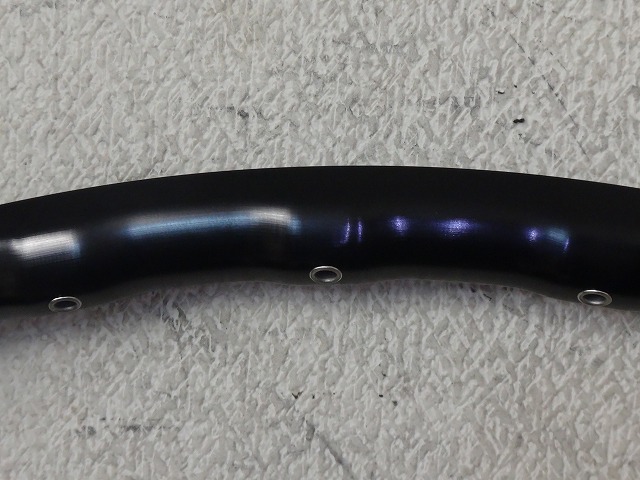
↑A side
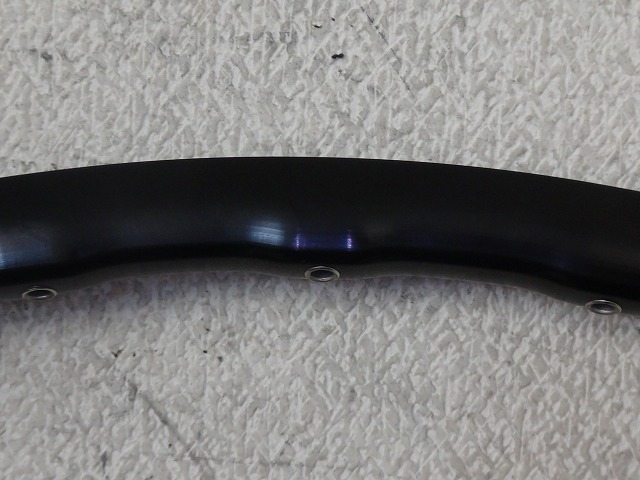
↑B side
If you touch the rim, the difference is immediately obvious,
but I sought out the angle that best shows the difference under fluorescent light,
and this was about as good as it got.
Since disc front hubs have an offset (dish), disc brake rims like the DT RR411 do it
with offset rim specs, so there's no particular problem.
The Open Pro Disc's spoke holes
clearly don't have offset (apart from the equal-offset true offset),
so building the wheel without worrying about orientation
shouldn't affect spoke tension imbalance left-to-right.
But if you split the rim down the middle,
the B side is distinctly heavier, so there's a weight imbalance in that sense.
So I'd think of it as an offset rim in that meaning,
and when building a front wheel, I'd put side A on the left (rotor side),
and when building a rear wheel, I'd put side A on the right (freewheel side)—
it might be better that way.
At least, that's what I'll do.