A customer dropped off a rear wheel built with a ZIPP 404 rim.
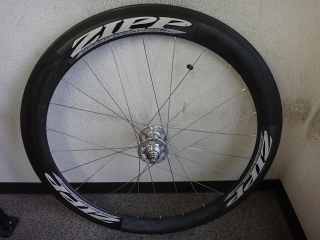
One of the nipples was broken and the wheel had runout.
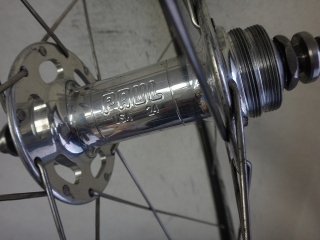
The hub has one side of the pole set up for a fixed gear,

and the other side serves as a platform for a freewheel—it's a 24-hole fixed/free hub built with Sapim Race 44 JIS lacing.
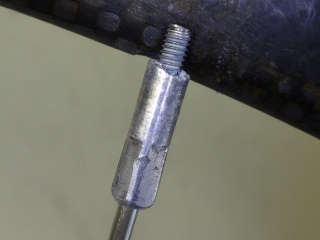
Here's the broken nipple—it's a Sapim 16mm aluminum nipple. The Race spokes come with 12mm brass nipples, so there must have been some intent behind using these, but I'm not sure what. It wasn't a case of incorrect spoke length being masked over.
This relates to something I wrote just yesterday, but the reason I consider proper spoke length to be measured to the nipple face is to prevent this kind of breakage.
The condition in the photo above isn't the actual fracture state—it's been turned further in the tightening direction since then.
In this case, despite the spoke length being correct to the nipple face, breakage still occurred. Based on my experience, I really can't trust Sapim aluminum nipples. Just because they come with CX-RAY spokes doesn't mean you should use them—it causes problems down the line. I knew this before Nomu Lab opened, but the very first Nomu Lab wheel actually had CX-RAY nipples on it, and clearly worse things happened compared to DT nipples (cracks aside, we also got white corrosion and such).
Spoke length seems to be a factor in this too—12mm aluminum nipples aren't that bad.
In this case, the customer already recovered the broken piece, and since all the other nipples are already loosened, a complete nipple replacement is definitely the safest and fastest approach. At least when I'm the one doing it. With ZIPP rims from around this era, some have oval nipple washers sandwiched between the rim and nipple, and others don't. This one doesn't. Even if I wanted to add washers contrary to the original spec, non-washer rims have small holes on the outer side, so oval washers won't fit. Round washers will fit, but they do almost nothing for distributing spoke tension load, so there's barely any point.
Also, ZIPP carbon rims have high friction with the nipple, making it difficult to tension beyond a certain point without some kind of workaround. If you use darker-colored aluminum nipples, it becomes even harder.
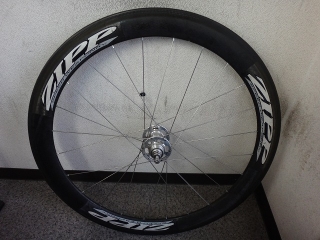
I did a complete nipple replacement.
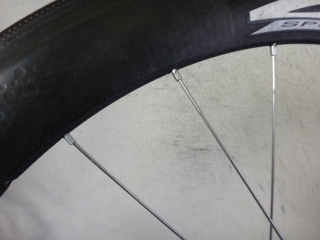
I went with DT 12mm silver aluminum. Since I replaced the nipples one by one, this job doesn't really fit the "Wheel [something or other]" format today (and so on).
Also, I worked while the customer was here, and the step that took the most time was removing the tube from inside the rim—for good reason.

One of the nipples was broken and the wheel had runout.

The hub has one side of the pole set up for a fixed gear,
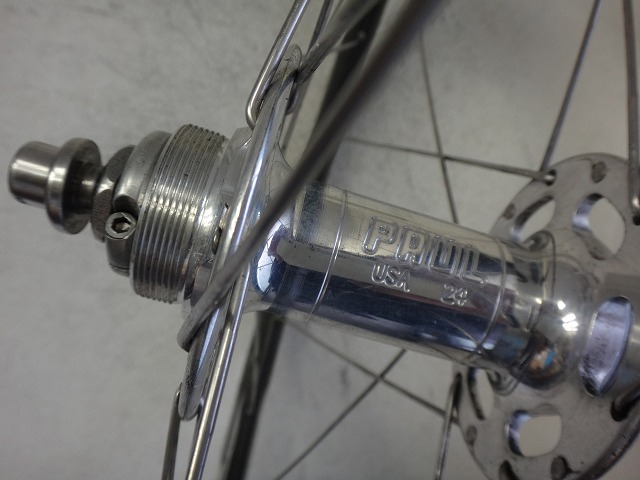
and the other side serves as a platform for a freewheel—it's a 24-hole fixed/free hub built with Sapim Race 44 JIS lacing.
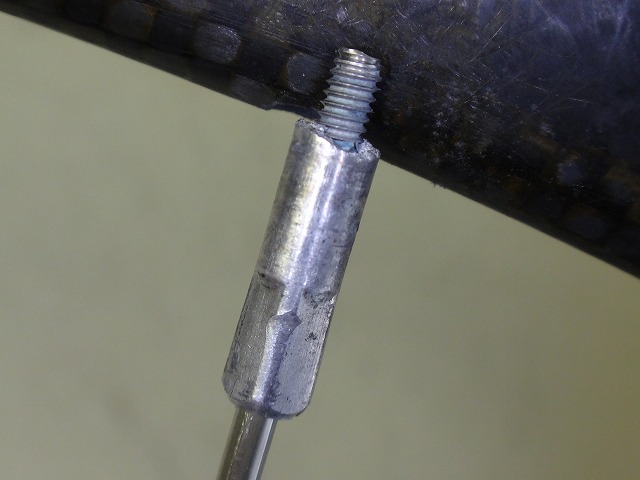
Here's the broken nipple—it's a Sapim 16mm aluminum nipple. The Race spokes come with 12mm brass nipples, so there must have been some intent behind using these, but I'm not sure what. It wasn't a case of incorrect spoke length being masked over.
This relates to something I wrote just yesterday, but the reason I consider proper spoke length to be measured to the nipple face is to prevent this kind of breakage.
The condition in the photo above isn't the actual fracture state—it's been turned further in the tightening direction since then.
In this case, despite the spoke length being correct to the nipple face, breakage still occurred. Based on my experience, I really can't trust Sapim aluminum nipples. Just because they come with CX-RAY spokes doesn't mean you should use them—it causes problems down the line. I knew this before Nomu Lab opened, but the very first Nomu Lab wheel actually had CX-RAY nipples on it, and clearly worse things happened compared to DT nipples (cracks aside, we also got white corrosion and such).
Spoke length seems to be a factor in this too—12mm aluminum nipples aren't that bad.
In this case, the customer already recovered the broken piece, and since all the other nipples are already loosened, a complete nipple replacement is definitely the safest and fastest approach. At least when I'm the one doing it. With ZIPP rims from around this era, some have oval nipple washers sandwiched between the rim and nipple, and others don't. This one doesn't. Even if I wanted to add washers contrary to the original spec, non-washer rims have small holes on the outer side, so oval washers won't fit. Round washers will fit, but they do almost nothing for distributing spoke tension load, so there's barely any point.
Also, ZIPP carbon rims have high friction with the nipple, making it difficult to tension beyond a certain point without some kind of workaround. If you use darker-colored aluminum nipples, it becomes even harder.
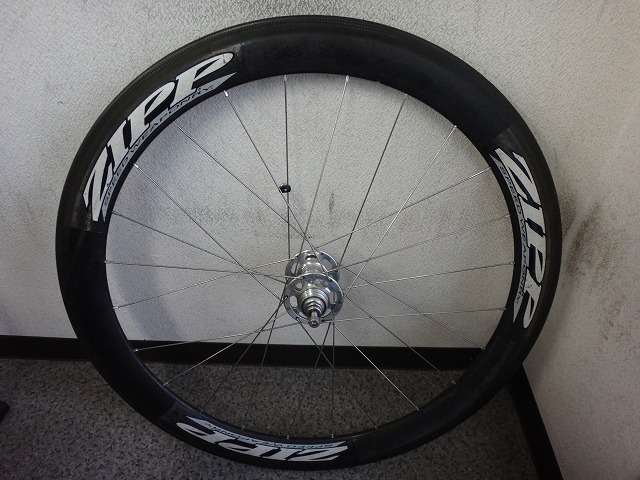
I did a complete nipple replacement.
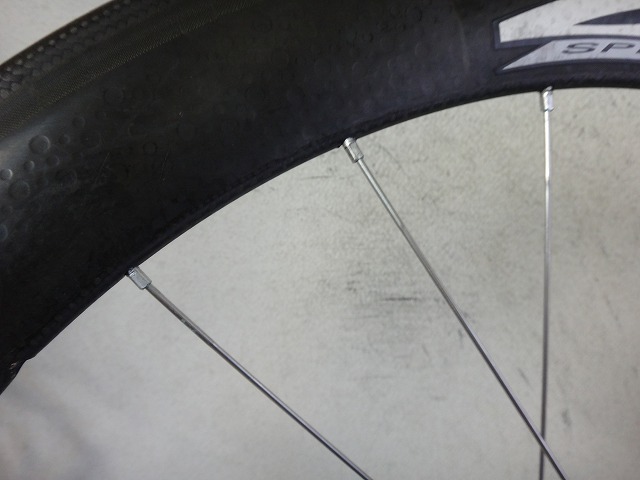
I went with DT 12mm silver aluminum. Since I replaced the nipples one by one, this job doesn't really fit the "Wheel [something or other]" format today (and so on).
Also, I worked while the customer was here, and the step that took the most time was removing the tube from inside the rim—for good reason.