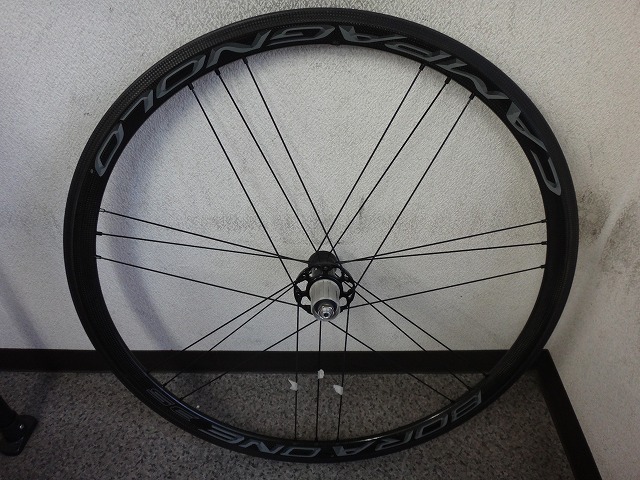
A customer brought in a Bora One for me to work on.
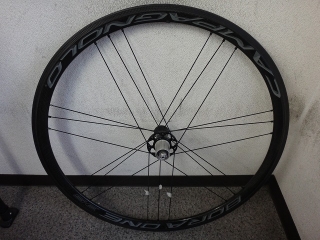
Starting with the rear wheel.
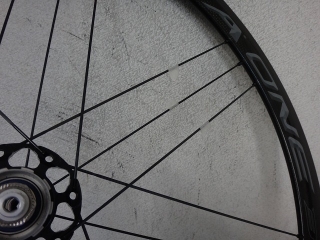
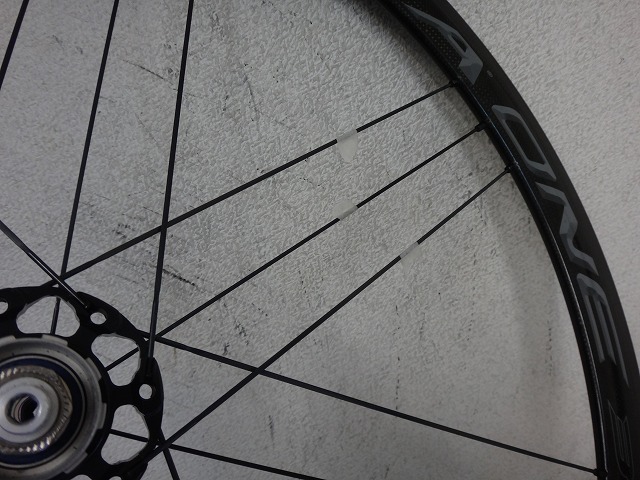
There's a reference tape on the G3 spokes (three of them, marked opposite the valve hole), and the customer wants one spoke on the front wheel painted red for a stylish look, but unfortunately Bora—or rather, Campagnolo and Fulcrum steel spokes—don't come in red, so I can't do that. Sorry about that.
They're also asking for CULT (ceramic) bearing conversion and valve bush replacement.
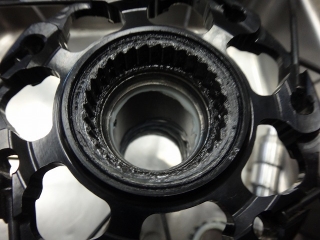
I disassembled the rear hub.
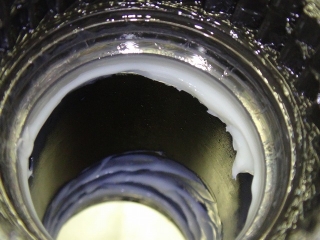
With Campagnolo, there are models with aluminum hub shells and cup-and-cone bearings (specifically Eurus and Zonda) that have a plastic ring inside to prevent grease from flowing through the hub shell.
The part number is HB-EU025—HB stands for front hub (rear is FH for freehub)—and EU means Eurus. The catalog name for this is the grease shield.
The Bora One has an aluminum hub shell but no grease shield, and as you can see in the photo, grease is leaking inside the hub shell.
The reason aluminum hub shells without a grease shield don't have one is that you'd need a groove inside the hub shell to snap the grease shield into, which is why carbon hub shells like the Shamal Ultra don't have a grease shield either.
The Bora One's aluminum hub shell has no groove for the grease shield, so I can't install one.
As for the grease shield itself, I don't think it's a critical functional component. There are cases where it cracks or rubs against the rotating hub axle, and since it's not in the Shamal Ultra or Bora One anyway, I wonder if it's really necessary. In some situations it can actually cause problems, so after explaining this to the customer, I sometimes remove it deliberately.
With CULT bearings, you don't grease the hub bearings in the first place, so the grease shield becomes unnecessary.
By the way, on high-end Shimano hubs, there's something called a grease sleeve that's a much more substantial component permanently attached inside the hub shell.
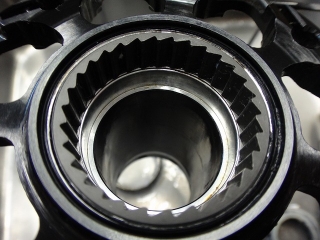
After cleaning, I removed the USB bearing unit.
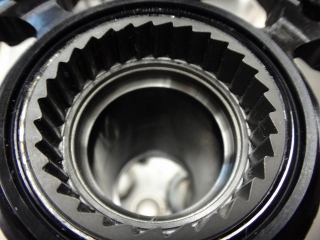
I pressed in the CULT bearing unit.

The pawl return spring on the freebody showed no deformation.
Now for what the customer requested: they wanted a quieter ratchet sound, so I've packed extra grease around the pawls.
The ratchet sound will get louder as the grease dries out, but that won't happen immediately. If you pack too much hard grease, the pawl engagement suffers, so I balanced the amount and consistency to ensure the ratchet quietness didn't compromise function.

↑This is the rear wheel after CULT conversion but before truing. There was no hub centering offset.
Swapping the bearing unit can shift wheel center by about a sheet of paper, so I didn't check the interim center when it had the USB bearing.
There was slight runout, but truing didn't change the center offset.
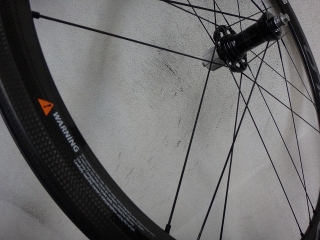
For the rear wheel, the WARNING sticker is positioned "left WARNING" on the left side.
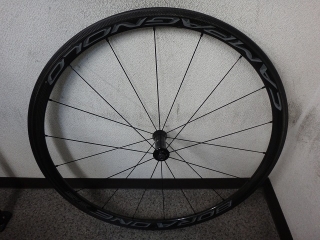
Now for the front wheel.
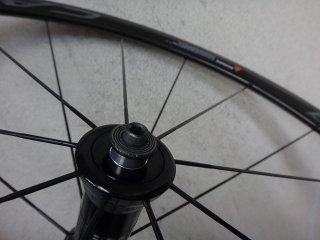
Originally it was "right WARNING," but
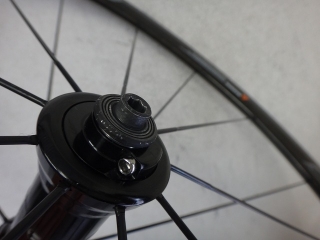
(the timeline of these photos jumps around)
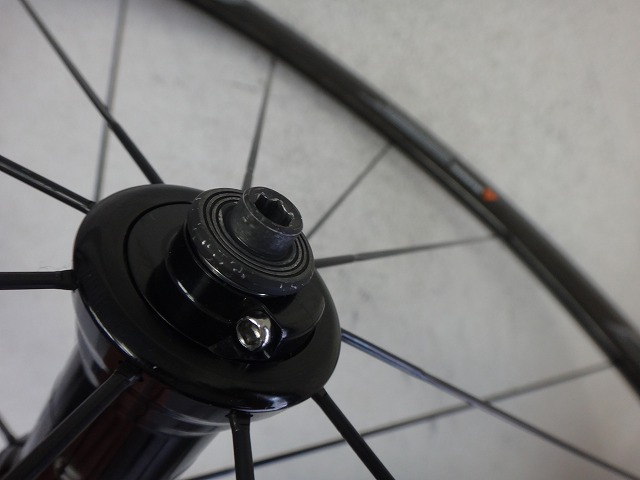
Per the customer's request, while disassembling the hub, I changed it to "left WARNING."
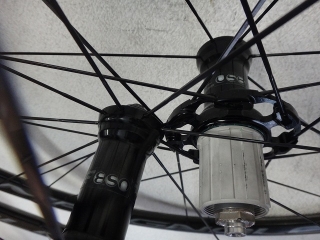
However, this means the hub shell sticker orientation when viewed from the right is now opposite between front and rear wheels.
After the conversion, since it's no longer USB bearing, you'd either remove the hub shell sticker, keep the hub shell sticker as-is and remove the WARNING stickers from both rims, or simply not worry about the consistency. Different people have different preferences.
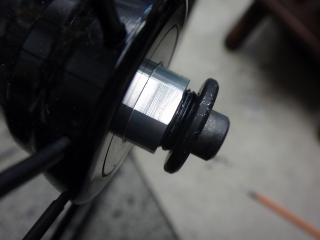
The front hub was a potential new-shaft "explosive burst" candidate, so
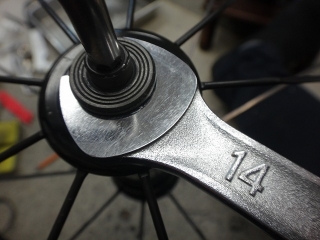
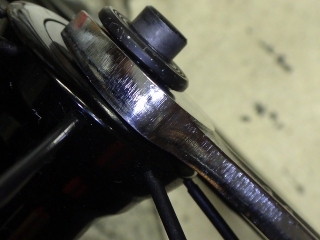
using a custom 14mm wrench filed to the exact width, I gripped the hub axle while
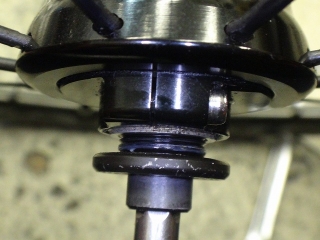
loosening the left end cap with a 5mm Allen key. This time it was unusually tight.
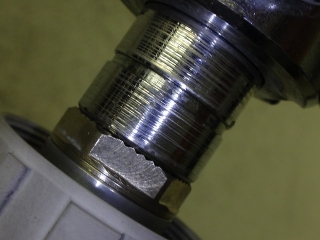
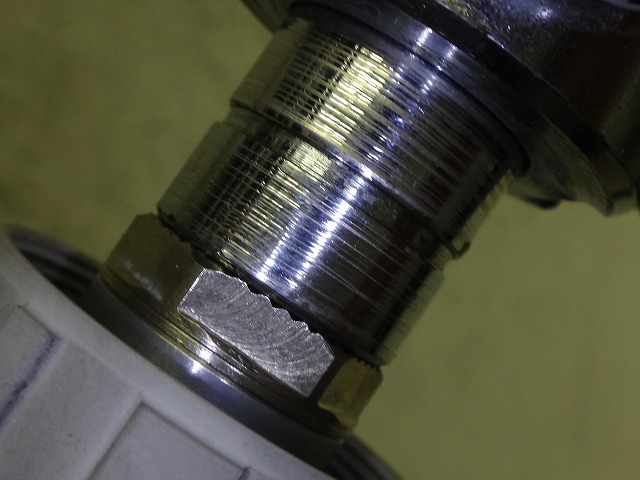
Also, as shown in the photo above, I learned from Japan's most knowledgeable Campagnolo specialist at a parts distributor that "loosening the bearing adjustment nut's locknut allows the left end cap to come off."
According to them, "loosening the bearing adjustment nut will easily loosen the left end cap on all front hubs, meaning the new-shaft explosion problem couldn't occur." But that's not quite right.
Even with the locknut completely loosened, there are many cases where the left end cap won't come off easily. I've seen instances where things went wrong from there and led to the new-shaft explosion. Quite a few times, actually.
Also, loosening the locknut is something I do "just to be safe." With a proper 14mm wrench, you can remove the left end cap even with the bearing adjustment nut tightened.
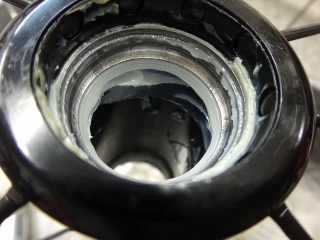
The front hub also originally had no grease shield and was leaking grease inside.
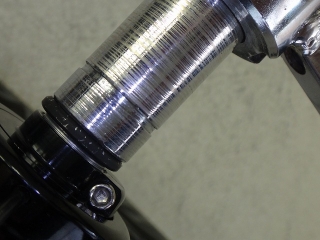

Like the rear wheel, this is after CULT conversion but before truing.
I didn't check the interim center.
For a Bora, the centering offset is quite large, but that's not an amount that would shift from bearing replacement, so I think it was like that from the start. Or maybe someone trued it without a dishing gauge.
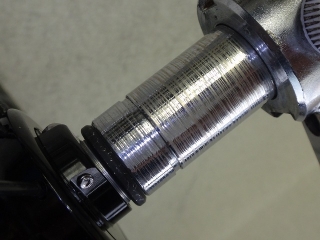

Using tighter-side tensioning and fine lateral truing, I centered the wheel.
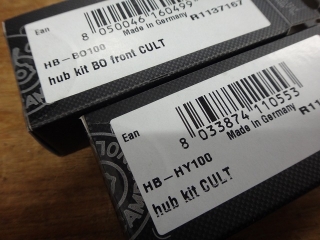
The CULT bearing kit has the part number HB-HY100 since Hyperon is where it first appeared.
Campagnolo downsized front hub bearings from 2015 onward, and the CULT bearing kit for that smaller size is the HB-BO100, which started with Bora Ultra.
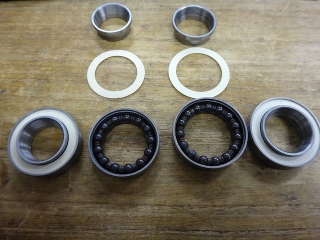
↑This is the USB bearing I removed, cleaned up.
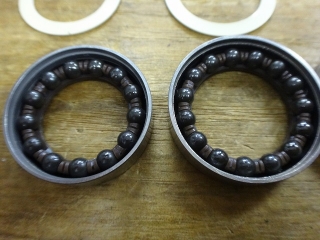
The bearings are different diameters.
The ceramic ball size is the same, but the smaller one has two fewer balls.
When I previously wrote that the small bearing had one fewer ball, I got corrected by the most knowledgeable Campagnolo specialist at a distributor—"it's two," they said. I've since corrected that. Thanks for that.
Anyway, the condition is good enough to reuse, but to answer the customer's question about whether these could be used on their separate Racing 3: both front and rear hubs on their Racing 3 use the larger bearings, so a one-way steel-to-USB conversion is possible on either front or rear, but not both.
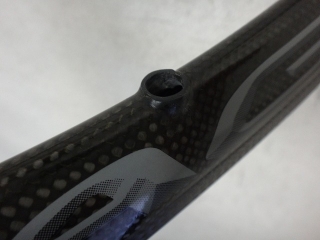
Regarding the valve bush: the customer had already removed it and wants a 4-claw type instead.
This is tricky. Without the original valve bush, I can't determine what goes where.
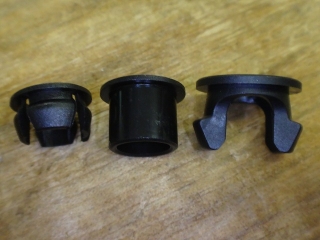
First, Campagnolo/Fulcrum valve bushes come in three types with no interchangeability.
From left to right in the photo above:
4-claw type for aluminum rims (2WAY-FIT),
pipe type for carbon rims like Bora and Spyder,
2-claw type for Racing Zero Carbon only.
The rightmost is Racing Zero Carbon exclusive since there's no Shamal Ultra Carbon model.
Bora valve bushes used to be 2-claw, but Campagnolo switched to pipe type without changing the part number, and the 2-claw is now discontinued.
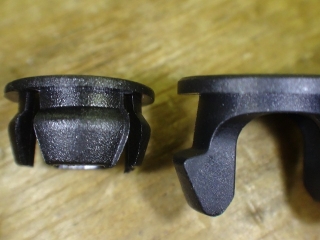
The claw shape is designed for different rim thicknesses, so as I mentioned, these claws aren't interchangeable.
The 4-claw aluminum rim type won't fit a Bora either.
Here's where the problem comes in: if the valve bush the customer removed was pipe type, I wouldn't need to replace it with a pipe type from our stock.
If it was 2-claw, that's hard to thread the valve through from the outside, so it needs to be pipe type.
...So I ended up replacing it with a pipe type anyway.
If the original valve bush turned out to be pipe type, my stock will be doubled up, but since valve bushes can fly off when threading the valve, having a spare makes sense.
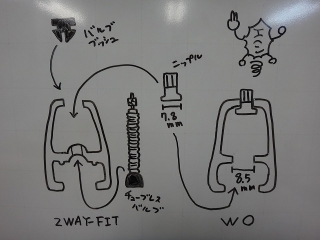
Finally, not related to Bora, but about why only 2WAY-FIT rims have valve bushes.
The flange diameter of aluminum-spoke nipples is about 7.8mm, and the hole diameter on the outer side of a WO rim is about 8.5mm, so Shamal Ultra and Racing Zero WO rims have nipples that insert and remove from outside the valve hole.
With 2WAY-FIT (tubeless compatible) rims, an 8.5mm hole on the valve hole's outer edge would interfere with tubeless valve installation, so 2WAY-FIT rims have nipples that insert from inside the valve hole.
To bridge the gap between the inner diameter of the valve hole and the outer diameter of the tubeless valve, the valve bush becomes a functional component.
Starting with the rear wheel.
There's a reference tape on the G3 spokes (three of them, marked opposite the valve hole), and the customer wants one spoke on the front wheel painted red for a stylish look, but unfortunately Bora—or rather, Campagnolo and Fulcrum steel spokes—don't come in red, so I can't do that. Sorry about that.
They're also asking for CULT (ceramic) bearing conversion and valve bush replacement.
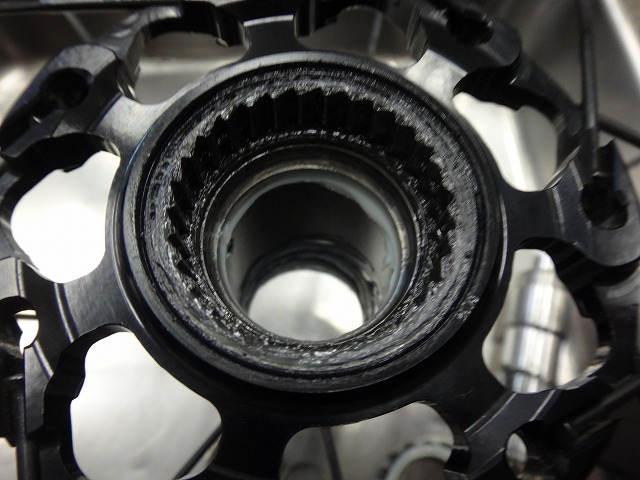
I disassembled the rear hub.
With Campagnolo, there are models with aluminum hub shells and cup-and-cone bearings (specifically Eurus and Zonda) that have a plastic ring inside to prevent grease from flowing through the hub shell.
The part number is HB-EU025—HB stands for front hub (rear is FH for freehub)—and EU means Eurus. The catalog name for this is the grease shield.
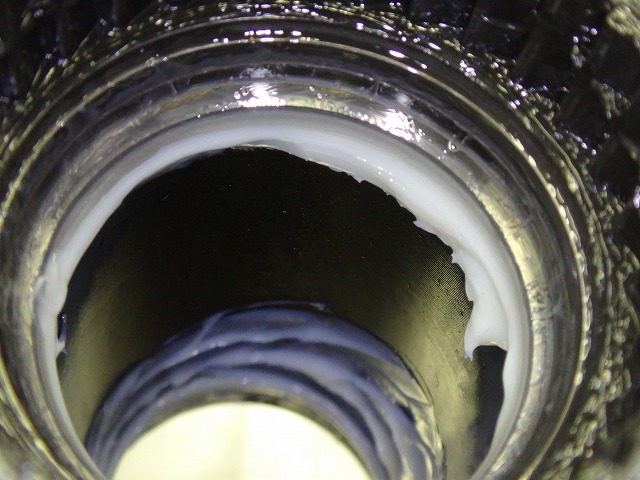
The Bora One has an aluminum hub shell but no grease shield, and as you can see in the photo, grease is leaking inside the hub shell.
The reason aluminum hub shells without a grease shield don't have one is that you'd need a groove inside the hub shell to snap the grease shield into, which is why carbon hub shells like the Shamal Ultra don't have a grease shield either.
The Bora One's aluminum hub shell has no groove for the grease shield, so I can't install one.
As for the grease shield itself, I don't think it's a critical functional component. There are cases where it cracks or rubs against the rotating hub axle, and since it's not in the Shamal Ultra or Bora One anyway, I wonder if it's really necessary. In some situations it can actually cause problems, so after explaining this to the customer, I sometimes remove it deliberately.
With CULT bearings, you don't grease the hub bearings in the first place, so the grease shield becomes unnecessary.
By the way, on high-end Shimano hubs, there's something called a grease sleeve that's a much more substantial component permanently attached inside the hub shell.
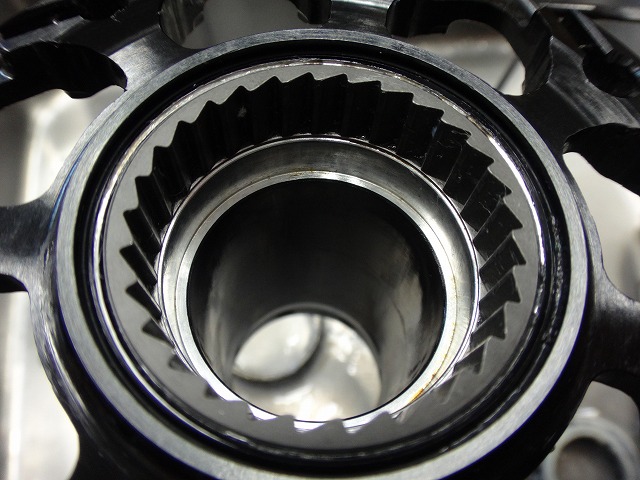
After cleaning, I removed the USB bearing unit.

I pressed in the CULT bearing unit.
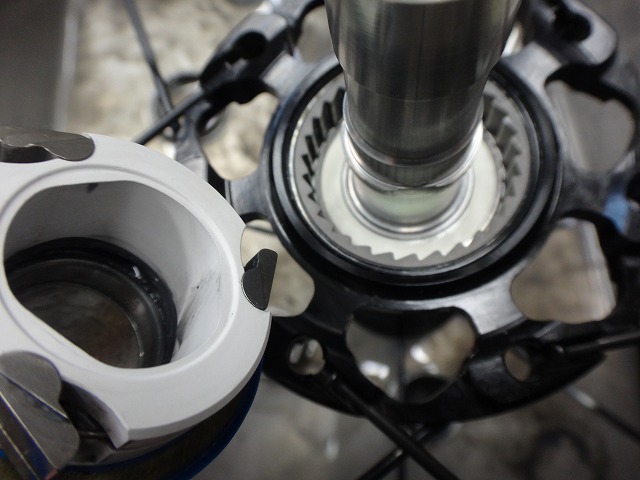
The pawl return spring on the freebody showed no deformation.
Now for what the customer requested: they wanted a quieter ratchet sound, so I've packed extra grease around the pawls.
The ratchet sound will get louder as the grease dries out, but that won't happen immediately. If you pack too much hard grease, the pawl engagement suffers, so I balanced the amount and consistency to ensure the ratchet quietness didn't compromise function.

↑This is the rear wheel after CULT conversion but before truing. There was no hub centering offset.
Swapping the bearing unit can shift wheel center by about a sheet of paper, so I didn't check the interim center when it had the USB bearing.
There was slight runout, but truing didn't change the center offset.
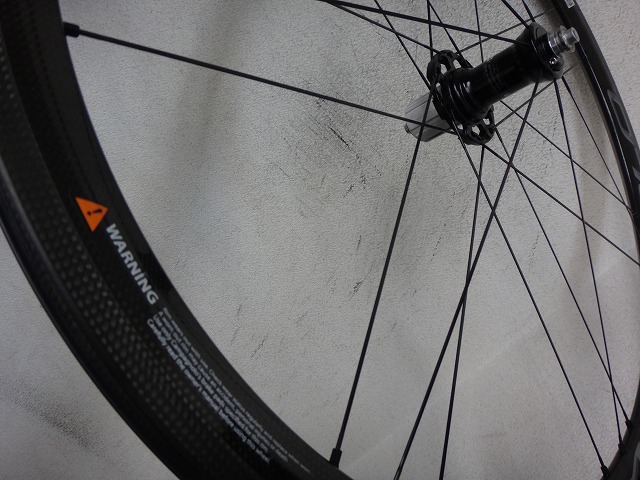
For the rear wheel, the WARNING sticker is positioned "left WARNING" on the left side.
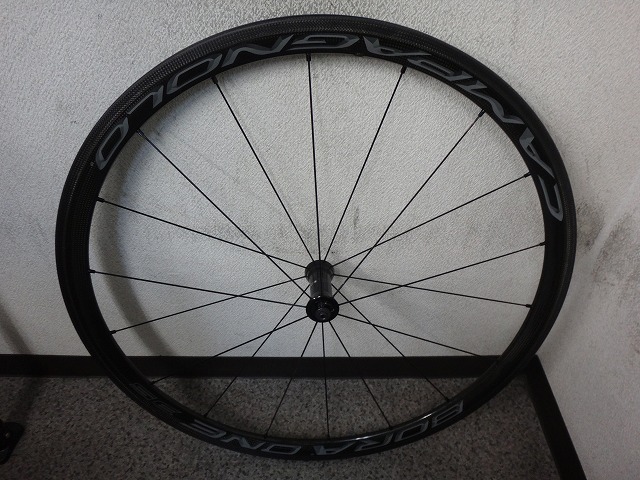
Now for the front wheel.

Originally it was "right WARNING," but
(the timeline of these photos jumps around)
Per the customer's request, while disassembling the hub, I changed it to "left WARNING."
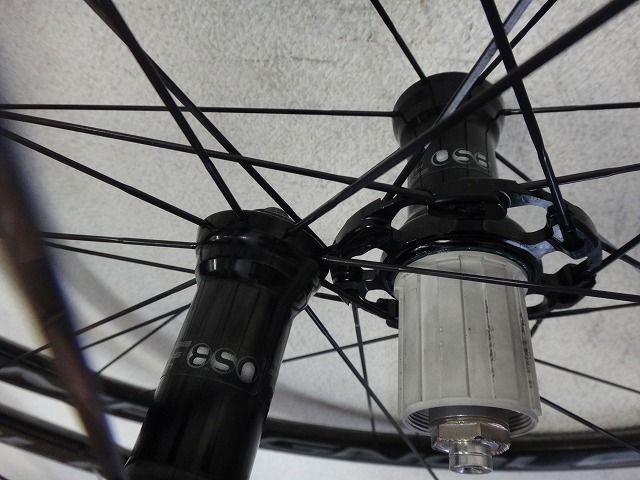
However, this means the hub shell sticker orientation when viewed from the right is now opposite between front and rear wheels.
After the conversion, since it's no longer USB bearing, you'd either remove the hub shell sticker, keep the hub shell sticker as-is and remove the WARNING stickers from both rims, or simply not worry about the consistency. Different people have different preferences.
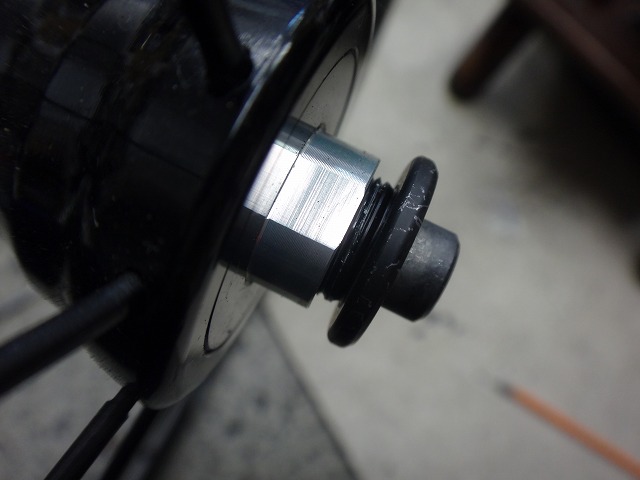
The front hub was a potential new-shaft "explosive burst" candidate, so
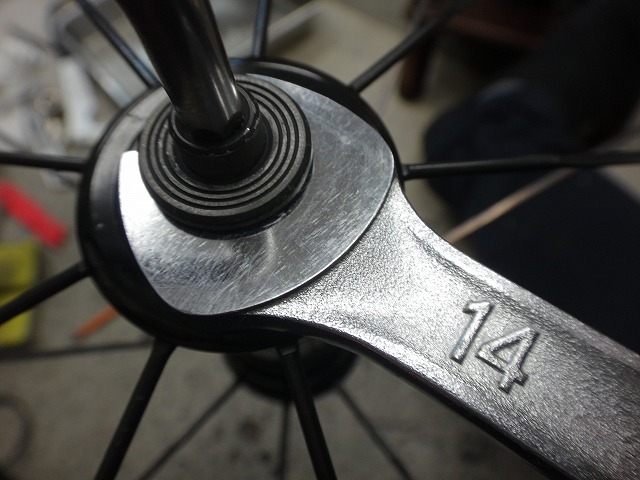
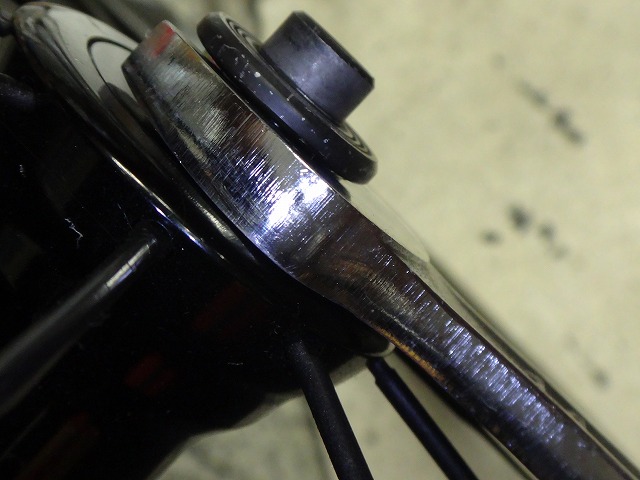
using a custom 14mm wrench filed to the exact width, I gripped the hub axle while

loosening the left end cap with a 5mm Allen key. This time it was unusually tight.
Also, as shown in the photo above, I learned from Japan's most knowledgeable Campagnolo specialist at a parts distributor that "loosening the bearing adjustment nut's locknut allows the left end cap to come off."
According to them, "loosening the bearing adjustment nut will easily loosen the left end cap on all front hubs, meaning the new-shaft explosion problem couldn't occur." But that's not quite right.
Even with the locknut completely loosened, there are many cases where the left end cap won't come off easily. I've seen instances where things went wrong from there and led to the new-shaft explosion. Quite a few times, actually.
Also, loosening the locknut is something I do "just to be safe." With a proper 14mm wrench, you can remove the left end cap even with the bearing adjustment nut tightened.

The front hub also originally had no grease shield and was leaking grease inside.
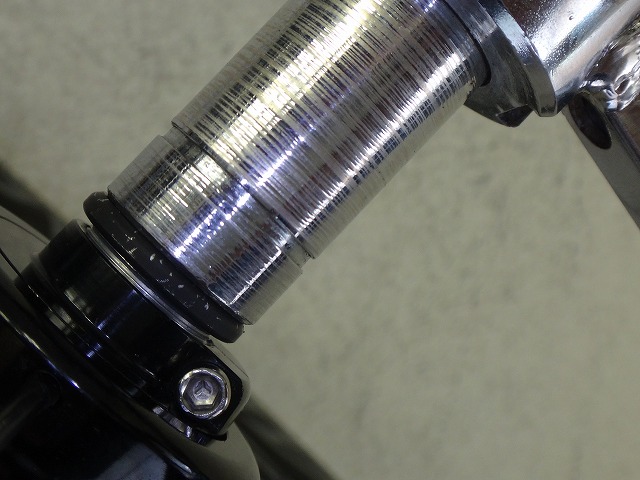
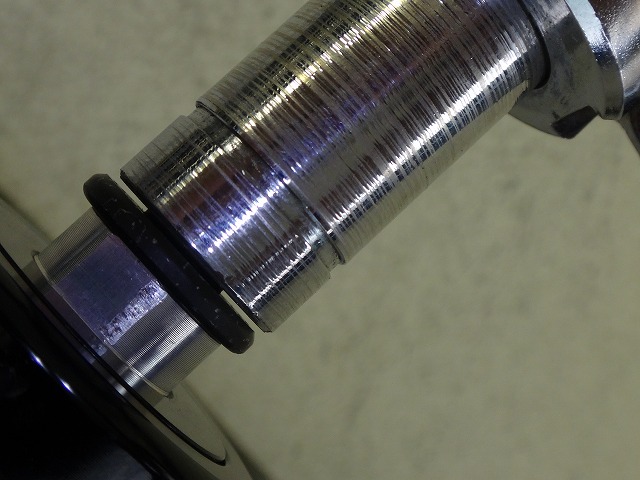
Like the rear wheel, this is after CULT conversion but before truing.
I didn't check the interim center.
For a Bora, the centering offset is quite large, but that's not an amount that would shift from bearing replacement, so I think it was like that from the start. Or maybe someone trued it without a dishing gauge.

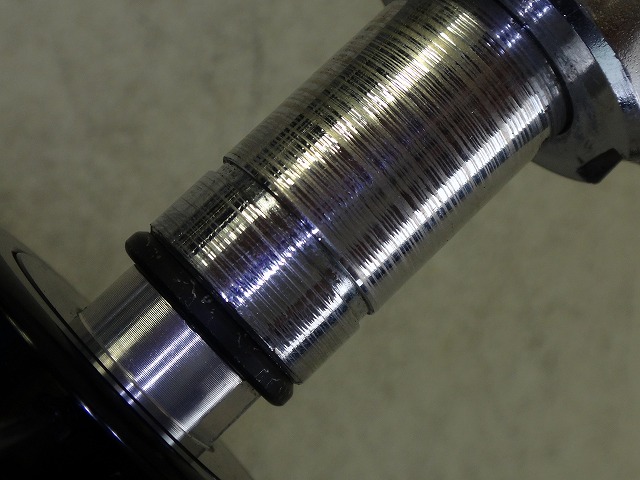
Using tighter-side tensioning and fine lateral truing, I centered the wheel.
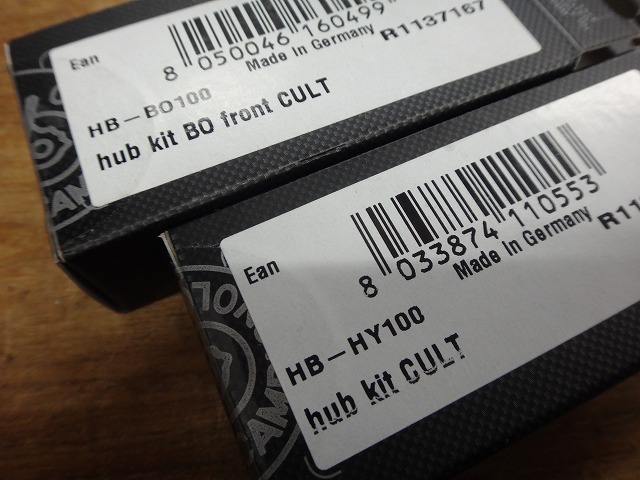
The CULT bearing kit has the part number HB-HY100 since Hyperon is where it first appeared.
Campagnolo downsized front hub bearings from 2015 onward, and the CULT bearing kit for that smaller size is the HB-BO100, which started with Bora Ultra.
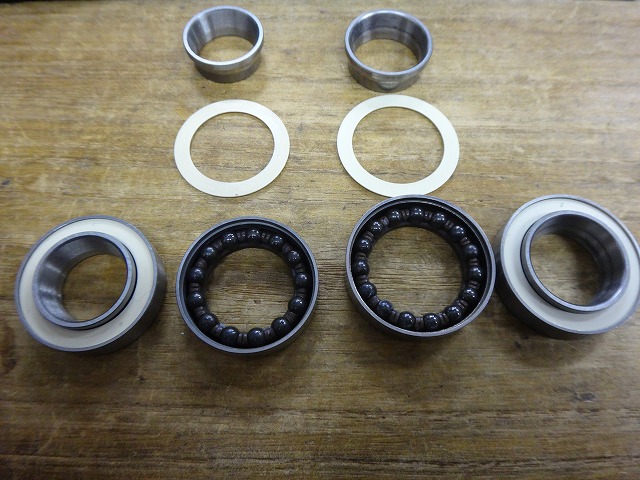
↑This is the USB bearing I removed, cleaned up.

The bearings are different diameters.
The ceramic ball size is the same, but the smaller one has two fewer balls.
When I previously wrote that the small bearing had one fewer ball, I got corrected by the most knowledgeable Campagnolo specialist at a distributor—"it's two," they said. I've since corrected that. Thanks for that.
Anyway, the condition is good enough to reuse, but to answer the customer's question about whether these could be used on their separate Racing 3: both front and rear hubs on their Racing 3 use the larger bearings, so a one-way steel-to-USB conversion is possible on either front or rear, but not both.
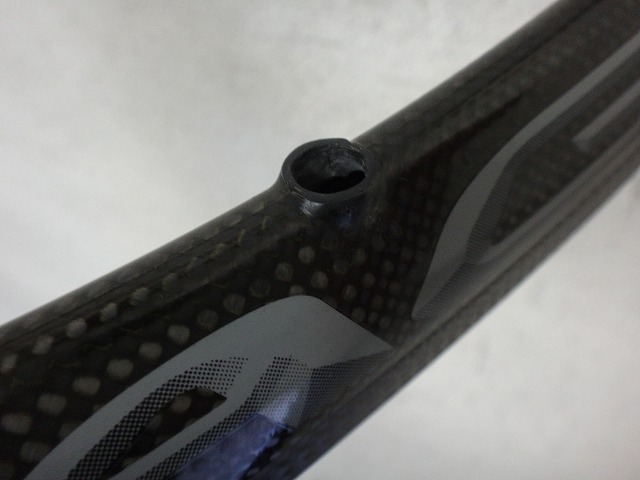
Regarding the valve bush: the customer had already removed it and wants a 4-claw type instead.
This is tricky. Without the original valve bush, I can't determine what goes where.
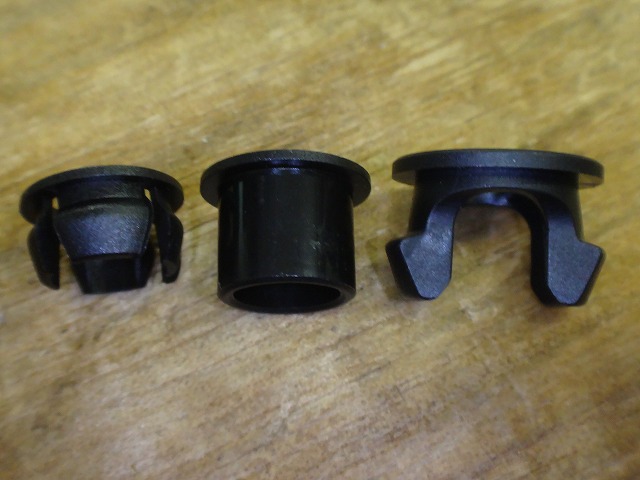
First, Campagnolo/Fulcrum valve bushes come in three types with no interchangeability.
From left to right in the photo above:
4-claw type for aluminum rims (2WAY-FIT),
pipe type for carbon rims like Bora and Spyder,
2-claw type for Racing Zero Carbon only.
The rightmost is Racing Zero Carbon exclusive since there's no Shamal Ultra Carbon model.
Bora valve bushes used to be 2-claw, but Campagnolo switched to pipe type without changing the part number, and the 2-claw is now discontinued.

The claw shape is designed for different rim thicknesses, so as I mentioned, these claws aren't interchangeable.
The 4-claw aluminum rim type won't fit a Bora either.
Here's where the problem comes in: if the valve bush the customer removed was pipe type, I wouldn't need to replace it with a pipe type from our stock.
If it was 2-claw, that's hard to thread the valve through from the outside, so it needs to be pipe type.
...So I ended up replacing it with a pipe type anyway.
If the original valve bush turned out to be pipe type, my stock will be doubled up, but since valve bushes can fly off when threading the valve, having a spare makes sense.
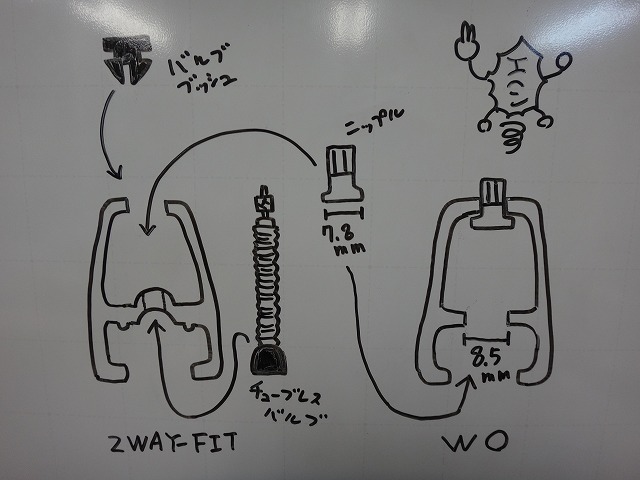
Finally, not related to Bora, but about why only 2WAY-FIT rims have valve bushes.
The flange diameter of aluminum-spoke nipples is about 7.8mm, and the hole diameter on the outer side of a WO rim is about 8.5mm, so Shamal Ultra and Racing Zero WO rims have nipples that insert and remove from outside the valve hole.
With 2WAY-FIT (tubeless compatible) rims, an 8.5mm hole on the valve hole's outer edge would interfere with tubeless valve installation, so 2WAY-FIT rims have nipples that insert from inside the valve hole.
To bridge the gap between the inner diameter of the valve hole and the outer diameter of the tubeless valve, the valve bush becomes a functional component.