A front wheel I built earlier with a DT XR331 rim and HB-RS770 hub
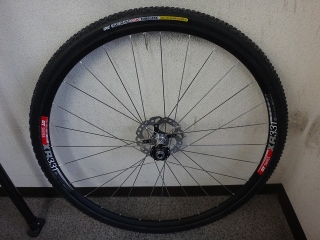
has never been ridden, so I rebuilt it from semi-comp to full CX-RAY spokes.
Had to replace the rim tape and sealant. Actually, I had no choice about that.
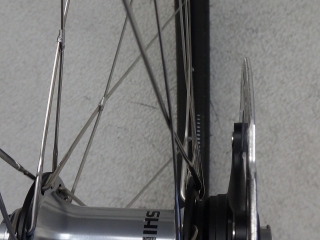
↑ Rotor side with 4-spoke CX-RAY lacing
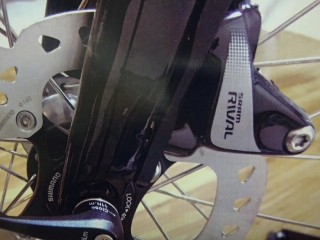
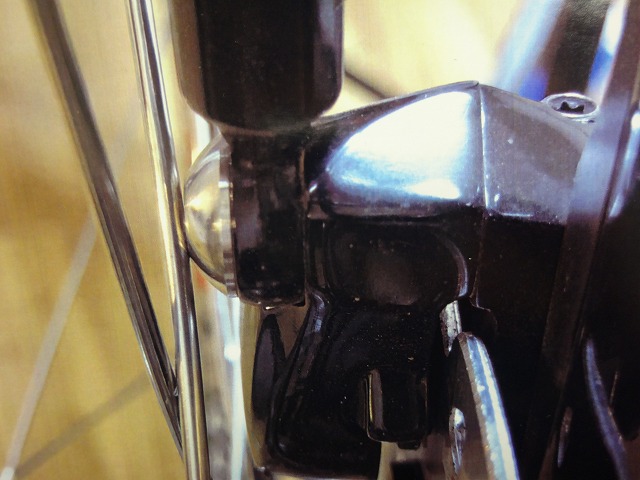
This is an image the customer sent me,
showing the SRAM Rival hydraulic brake caliper
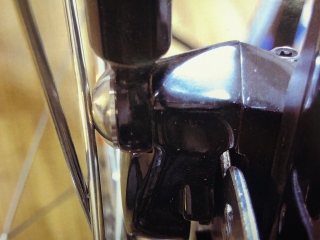
where the bolt head securing the banjo fitting at the hose end
is making contact near the final cross of the comp lacing.
The front hub doesn't have extreme dimensions or anything,
and 28H 4-spoke lacing isn't an unconventional build method either,
but since the contact is actually happening, something needs to be done.
So I tried changing the spokes to CX-RAY.
Haven't seen results yet, but if that doesn't work,
I'll have to go with a 6-spoke CX-RAY build on the rotor side.
As a similar issue,
with semi-comp rear wheels, spokes can contact the rear derailleur pulley cage
when in the low gear. When building the wheel, if you tap the base of the comp-side inpoke
with a plastic mallet to seat it flush against the hub flange,
it mostly doesn't happen. And in that case anyway,
shift adjustment and rear dropout alignment are bigger factors.
The biggest factor outside the wheel itself for this contact issue
is using a 140mm rotor
(with a 160mm rotor, the caliper would sit a bit further out on the wheel rim),
but the customer's bike is an older GIANT TCX
where the 140mm rotor is the standard spec.
It's not that GIANT is bad, but looking at the 2019 models,
the TCX SLR2 used a CONDUCT cable-pull hydraulic brake made by GIANT,
with 140mm rotors front and rear.
The next tier up, TCX Advanced,
has SRAM Apex brakes with 160mm rotors front and rear.
The tier above that, TCX Advanced Pro 2,
has SRAM Rival brakes with 140mm rotors front and rear.
And at the very top, TCX Advanced Pro 1,
has SRAM Force brakes with 160mm front and 140mm rear rotors.
Getting off topic a bit, that CONDUCT brake I mentioned earlier
came out around 2017, but due to brake power ratio compatibility,
it works with 9000-series Dura-Ace and related stuff (like 6800)
but supposedly doesn't work with R9100 Dura-Ace or R8000 Ultegra.
But the 2019 TCX SLR2's components (especially the brake levers)
use SRAM Apex, and SRAM's brake power ratio is way more different
between their models than the gap between 9000 and R9100.
So if 9000 is OK and R9100 is no good, then logically SRAM should also be no good.
Anyway, the takeaway is: with a 140mm front rotor and a handbuilt wheel,
you need to account for spoke-to-caliper contact. Learned something there.

Separate from that—something I've come to realize again,
or maybe I just know it better now.
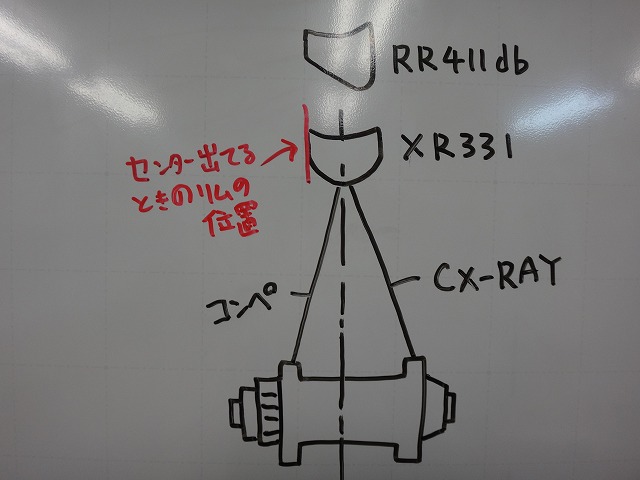
I went with semi-comp because the XR331 is a non-offset rim.
If the rim were an RR411db (offset rim) instead,
I'd think "sure, full CX-RAY is fine"—
the left-right tension difference gets small enough that way,
based on my experience.
The XR331 rim is lighter,
and comparing XR331 semi-comp to RR411db full CX-RAY,
the XR331 wheel ends up lighter overall.
XR331 with full CX-RAY is the ultra-light spec,
but in my opinion, without lacing the outpoke side
it feels like "hmm... not quite right" (though I do lace it).
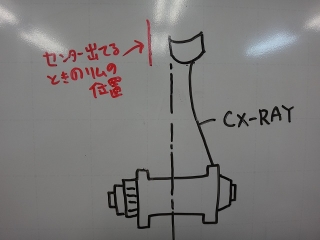
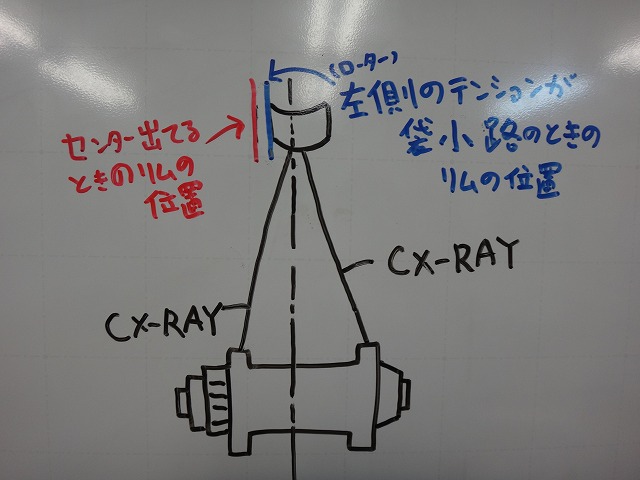
So I cleanly disassembled the comp lacing on the rotor side and changed it to CX-RAY,
then tried to center the wheel by tightening only the CX-RAY spokes routed through the rotor side...
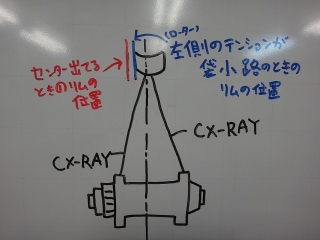
Even when the rotor-side tension reached the limit,
the wheel still wouldn't center.
So I had to loosen the outpoke-side CX-RAY spokes a bit
to get the centering right.
But really, this is obvious.
I'm just experiencing the flip side of the fact that semi-comp can run
a bit more loose on the low-tension side than full CX-RAY.
This only happens when you've had the high-tension side wound up to near its limit.
If the pre-rebuild state had been loose tension,
changing from semi-comp to full CX-RAY wouldn't have required
loosening the outpoke side—just tightening the rotor side would've done it.
While I'm at it: I don't know if other builders copied me or arrived at this independently,
but I sometimes see semi-comp rear wheels built by people who don't quite understand this—
they just loosely built a semi-comp without really getting it.
With those wheels, this phenomenon doesn't occur.
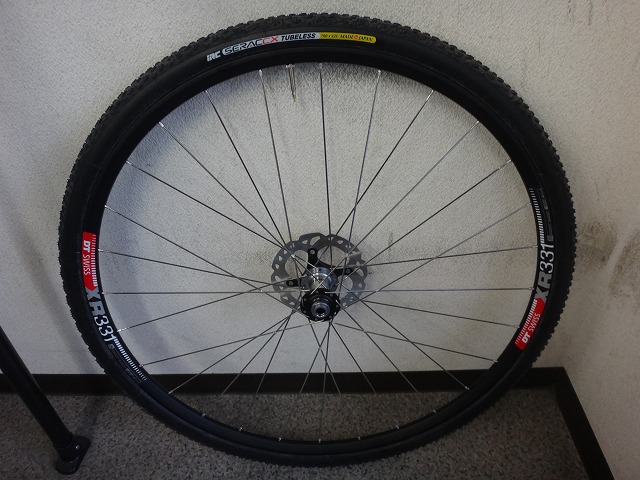
has never been ridden, so I rebuilt it from semi-comp to full CX-RAY spokes.
Had to replace the rim tape and sealant. Actually, I had no choice about that.
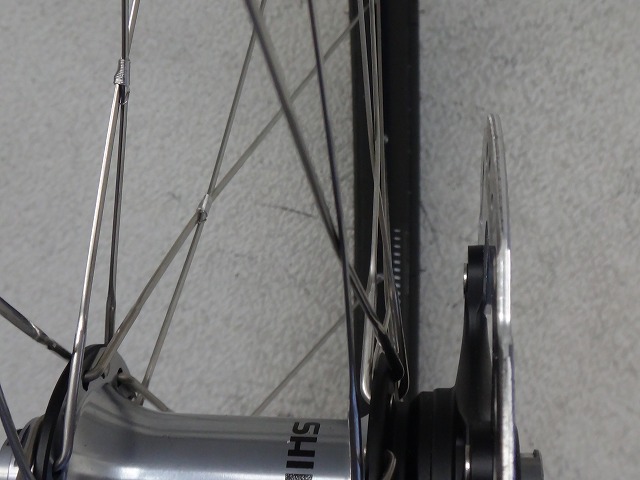
↑ Rotor side with 4-spoke CX-RAY lacing

This is an image the customer sent me,
showing the SRAM Rival hydraulic brake caliper
where the bolt head securing the banjo fitting at the hose end
is making contact near the final cross of the comp lacing.
The front hub doesn't have extreme dimensions or anything,
and 28H 4-spoke lacing isn't an unconventional build method either,
but since the contact is actually happening, something needs to be done.
So I tried changing the spokes to CX-RAY.
Haven't seen results yet, but if that doesn't work,
I'll have to go with a 6-spoke CX-RAY build on the rotor side.
As a similar issue,
with semi-comp rear wheels, spokes can contact the rear derailleur pulley cage
when in the low gear. When building the wheel, if you tap the base of the comp-side inpoke
with a plastic mallet to seat it flush against the hub flange,
it mostly doesn't happen. And in that case anyway,
shift adjustment and rear dropout alignment are bigger factors.
The biggest factor outside the wheel itself for this contact issue
is using a 140mm rotor
(with a 160mm rotor, the caliper would sit a bit further out on the wheel rim),
but the customer's bike is an older GIANT TCX
where the 140mm rotor is the standard spec.
It's not that GIANT is bad, but looking at the 2019 models,
the TCX SLR2 used a CONDUCT cable-pull hydraulic brake made by GIANT,
with 140mm rotors front and rear.
The next tier up, TCX Advanced,
has SRAM Apex brakes with 160mm rotors front and rear.
The tier above that, TCX Advanced Pro 2,
has SRAM Rival brakes with 140mm rotors front and rear.
And at the very top, TCX Advanced Pro 1,
has SRAM Force brakes with 160mm front and 140mm rear rotors.
Getting off topic a bit, that CONDUCT brake I mentioned earlier
came out around 2017, but due to brake power ratio compatibility,
it works with 9000-series Dura-Ace and related stuff (like 6800)
but supposedly doesn't work with R9100 Dura-Ace or R8000 Ultegra.
But the 2019 TCX SLR2's components (especially the brake levers)
use SRAM Apex, and SRAM's brake power ratio is way more different
between their models than the gap between 9000 and R9100.
So if 9000 is OK and R9100 is no good, then logically SRAM should also be no good.
Anyway, the takeaway is: with a 140mm front rotor and a handbuilt wheel,
you need to account for spoke-to-caliper contact. Learned something there.
Separate from that—something I've come to realize again,
or maybe I just know it better now.
I went with semi-comp because the XR331 is a non-offset rim.
If the rim were an RR411db (offset rim) instead,
I'd think "sure, full CX-RAY is fine"—
the left-right tension difference gets small enough that way,
based on my experience.
The XR331 rim is lighter,
and comparing XR331 semi-comp to RR411db full CX-RAY,
the XR331 wheel ends up lighter overall.
XR331 with full CX-RAY is the ultra-light spec,
but in my opinion, without lacing the outpoke side
it feels like "hmm... not quite right" (though I do lace it).

So I cleanly disassembled the comp lacing on the rotor side and changed it to CX-RAY,
then tried to center the wheel by tightening only the CX-RAY spokes routed through the rotor side...
Even when the rotor-side tension reached the limit,
the wheel still wouldn't center.
So I had to loosen the outpoke-side CX-RAY spokes a bit
to get the centering right.
But really, this is obvious.
I'm just experiencing the flip side of the fact that semi-comp can run
a bit more loose on the low-tension side than full CX-RAY.
This only happens when you've had the high-tension side wound up to near its limit.
If the pre-rebuild state had been loose tension,
changing from semi-comp to full CX-RAY wouldn't have required
loosening the outpoke side—just tightening the rotor side would've done it.
While I'm at it: I don't know if other builders copied me or arrived at this independently,
but I sometimes see semi-comp rear wheels built by people who don't quite understand this—
they just loosely built a semi-comp without really getting it.
With those wheels, this phenomenon doesn't occur.