I disassembled the STI shifter levers from the 600 Altegra, which was from the Dura-Ace 7400 series era—the world's first STI levers.
The shifter was experiencing slippage during lever operation and wasn't taking up cable.
Since it's not quite as much of a black box as current models,
repairs that don't require parts replacement are possible.

When a bike hasn't been ridden for a long time, the grease can harden and
the ratchet pawls stop moving.
This symptom rarely happens on bikes that are ridden regularly.
By softening the grease with oil or parts cleaner and
repeatedly lifting the ratchet pawls with the tip of a screwdriver or an awl,
it will function normally again.
The same symptom appears in older MTB shifters too.
It happens especially often in winter, so there's definitely a relationship between grease hardness and temperature.
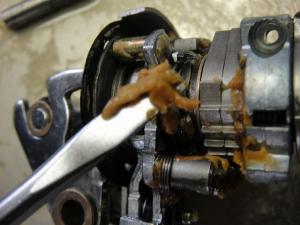
↑It's hardened to a peanut butter-like consistency,
but the fact that it remains inside the STI without flowing away—since it's not completely waterproof—
is actually part of its design. Once you wash it out,
deciding what grease to use next becomes tricky.
Current STI shifters show this symptom far less frequently,
but if one does fail, replace the entire lever body (called "atama-gumi" in shop terminology).
The shifter was experiencing slippage during lever operation and wasn't taking up cable.
Since it's not quite as much of a black box as current models,
repairs that don't require parts replacement are possible.
When a bike hasn't been ridden for a long time, the grease can harden and
the ratchet pawls stop moving.
This symptom rarely happens on bikes that are ridden regularly.
By softening the grease with oil or parts cleaner and
repeatedly lifting the ratchet pawls with the tip of a screwdriver or an awl,
it will function normally again.
The same symptom appears in older MTB shifters too.
It happens especially often in winter, so there's definitely a relationship between grease hardness and temperature.

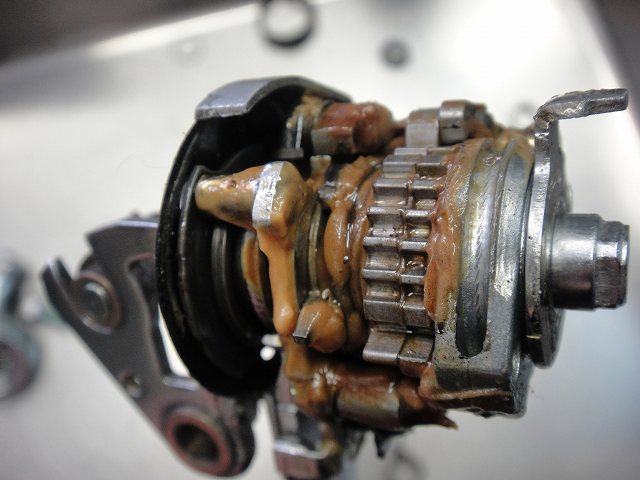
↑It's hardened to a peanut butter-like consistency,
but the fact that it remains inside the STI without flowing away—since it's not completely waterproof—
is actually part of its design. Once you wash it out,
deciding what grease to use next becomes tricky.
Current STI shifters show this symptom far less frequently,
but if one does fail, replace the entire lever body (called "atama-gumi" in shop terminology).