A customer brought in a Colima (carbon disc wheel) disc wheel for service.
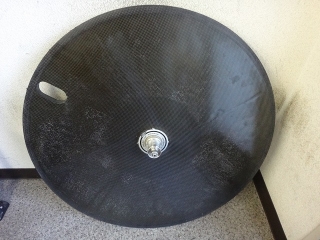
The sticker has been removed, so I can't tell if it's HR (High Resistance) or
HM (High Modulus), but it's probably HR.
HM is said to be about 20% stiffer than HR,
and HM is more expensive, but HR is lighter in weight.
In current models, HR equivalent is called CN,
and HM equivalent has changed to the designation C+2D.
With this wheel,
there's a suspicion that some parts around the hub axle are missing,
and the hub bearings are rough, so the customer wants them replaced.
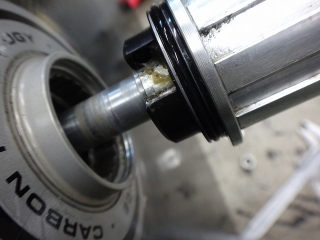
I'm not sure if parts are actually missing,
but the over-locknut dimension is only about 129mm,
so parts are probably missing.
I add spacers to center the wheel, but
since I remove and insert the freebody multiple times, I've removed the pawls
(this doesn't affect left-right dimensions).
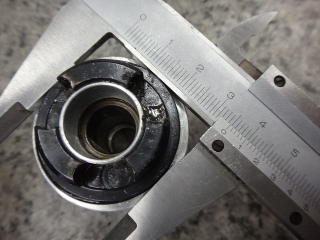
This wheel's freebody had a Shimano 10-speed version installed.
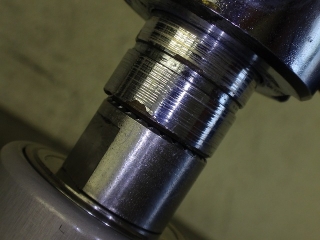
For Colima freebodies, if the diameter of the section shown in the image above is 32.5mm,
it's relatively recent and uses the same specs as current models, so 11-speed conversion is possible.
If it's 34.7mm, there's no 11-speed freebody available, so 11-speed conversion isn't possible.
This would be an older model.
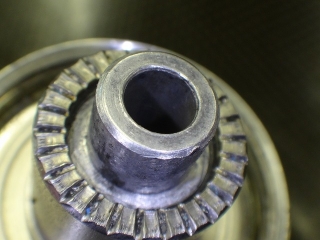
The hub axle outer diameter is 12mm,
a dimension that was commonly seen in cartridge bearing hubs back in the day.
Tni's Evolite hub had Evo hubs before it, with versions I and II.
The older type I has a 12mm diameter shaft,
while the newer type II and Evolite hub have 15mm diameter shafts.
Evo hub I has a 5mm hex socket at the shaft end because it's a steel shaft,
but this Colima hub axle has a round hole, so
end position adjustment involves holding the hub axle with a specialized fixture
and turning it with a hub wrench.
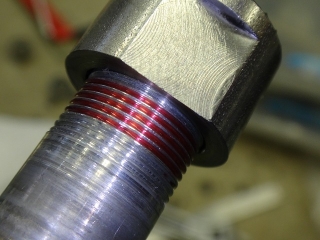
The hub axle has no left-right distinction; you just fix the same end at any position.
Having one side essentially integral with the hub axle makes adjustment easier,
and when using a hub wrench (15mm) on both sides to loosen,
I want to ensure the left side (non-freewheel side) always loosens.
So I semi-fixed the right side with heavy-duty threadlocker.
The right end's threads rotate stiffly (the threads are somewhat stripped),
and there's already so much resistance that it can't be turned by hand, which actually works out well.
(If the left side had been tight, I would have swapped them).
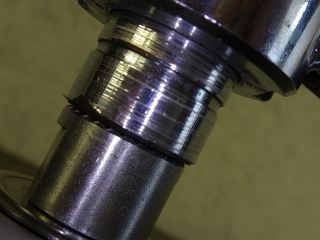
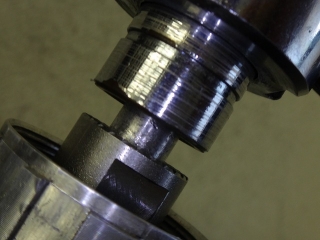
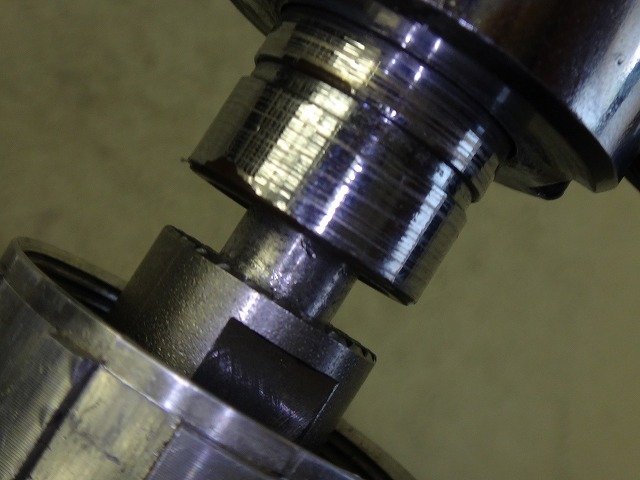
It was this far off.
In theory, I should add spacers to the right end by half this gap,
but extending the right end changes the derailleur adjustment position, so
it wouldn't match shifting with other Shimano 10-speed wheels.
Since this is a disc wheel, it will probably be used on a TT bike-type bike,
so it probably isn't much of an issue anyway.
One more thing. I haven't checked all frame manufacturers, but
when frames or complete bikes include an inspection sheet,
the rear end width tolerance for a 130mm frame
is often listed as "plus 2mm / minus 0mm".
In other words, the acceptable range is 130–132mm,
and anything less than 130mm is not acceptable, even by 0.1mm.
Whether we're matching this or not is unclear,
but the Evolite hub's actual measured width is also around 131mm.
With DT hubs, the Shimano 10-speed and Shimano 11-speed versions
have different length parts on the right end—a ridiculous design.
This wheel starts at around 129mm,
so I want to keep it within 132mm once the wheel is centered.
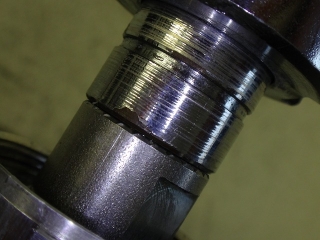
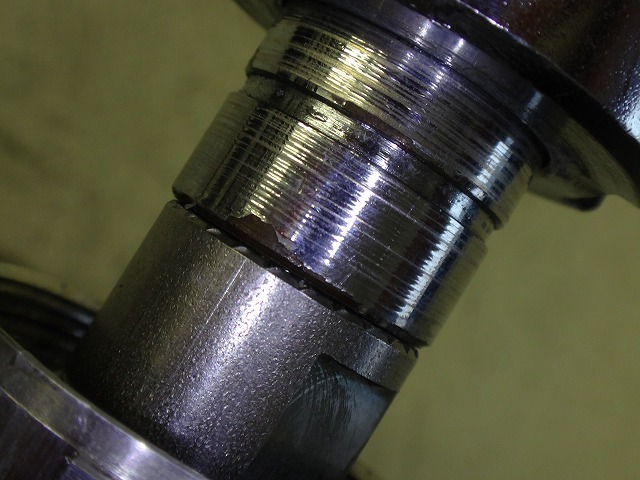
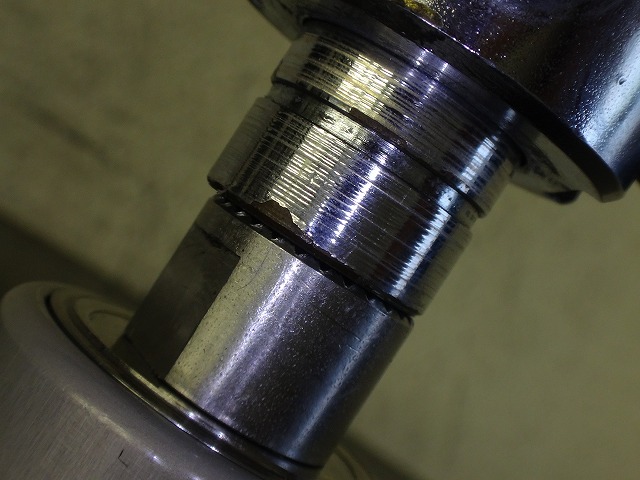
The wheel is now centered.
Reynolds' RZR, a lightweight-style wheel,
always has the rim offset to the left,
and centering is done by optionally adding thin spacers to the left end.
The offset to the left means the derailleur adjustment doesn't change
with the number or thickness of spacers (probably).
I'm using the same centering adjustment method,
but in this case the initial offset is on the right side,
and the spacers are ones I prepared myself—
not Colima parts, which is the difference.
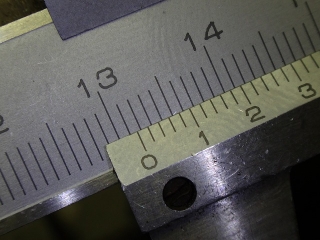
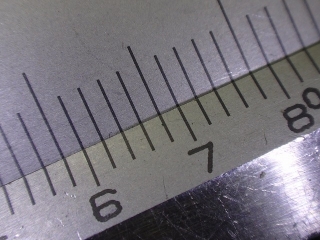
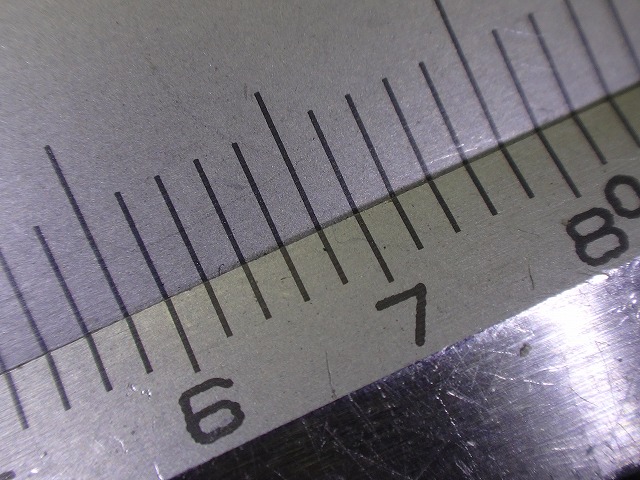
We settled on somewhere between 131.6mm or 131.7mm.
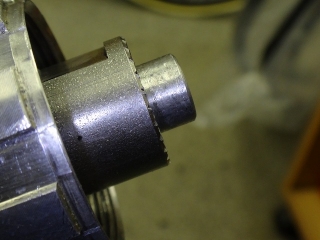
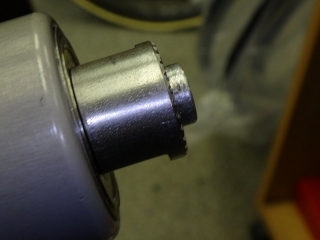
When at 129mm width, I made the left and right axle projections equal,
so after centering they became unequal.
Someone apparently didn't foresee this and applied threadlocker to the right end,
but I managed to loosen it and then applied threadlocker again after adjustment.
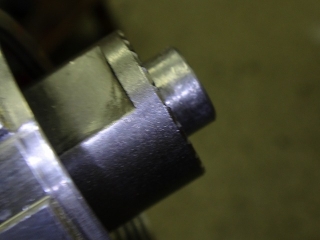
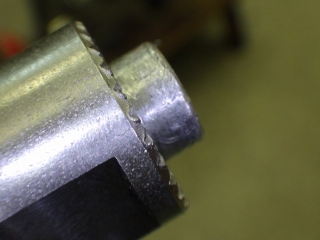
I made the left and right end projections equal.
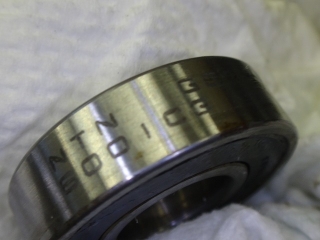
I also replaced the hub bearings.
Standard size 6001 specification: 12mm inner diameter, 28mm outer diameter, 8mm thick.
With a 12mm hub axle, the advantage is being able to have a large difference between the bearing's outer and inner races
(which means the steel balls inside can be larger),
but recent hub axles are mostly 15mm diameter, and there are also 17mm versions,
probably because they want to accommodate 12mm through axles.
(The shift to 15mm shafts happened before the through-axle trend, though).
For 15mm inner diameter bearings,
the 6802 has 15mm inner diameter and 24mm outer diameter,
commonly seen in freebodies and hub bodies on the left side,
but with the 6001 having a 16mm difference between outer and inner races, the 6802 has only 9mm,
so it feels a bit underdone.
The 6903 has 15mm inner diameter and 28mm outer diameter with a 13mm difference,
but when adopting this, either the ratchet diameter in the freebody needs enlarging,
or it's avoided because it gets heavier—
recently many hubs adopt the 15267,
which is 2mm smaller in outer diameter than the 6903
while maintaining the same inner diameter.
The C3 after 6001 refers to "C3 clearance,"
meaning one of the clearance specifications that takes larger clearance
compared to CN (normal clearance) standard.
※I've corrected the text based on comments received about C3 clearance.
Thanks for the comment.
NTN is a Japanese manufacturer, but

this one appears to be German-made.

The sticker has been removed, so I can't tell if it's HR (High Resistance) or
HM (High Modulus), but it's probably HR.
HM is said to be about 20% stiffer than HR,
and HM is more expensive, but HR is lighter in weight.
In current models, HR equivalent is called CN,
and HM equivalent has changed to the designation C+2D.
With this wheel,
there's a suspicion that some parts around the hub axle are missing,
and the hub bearings are rough, so the customer wants them replaced.
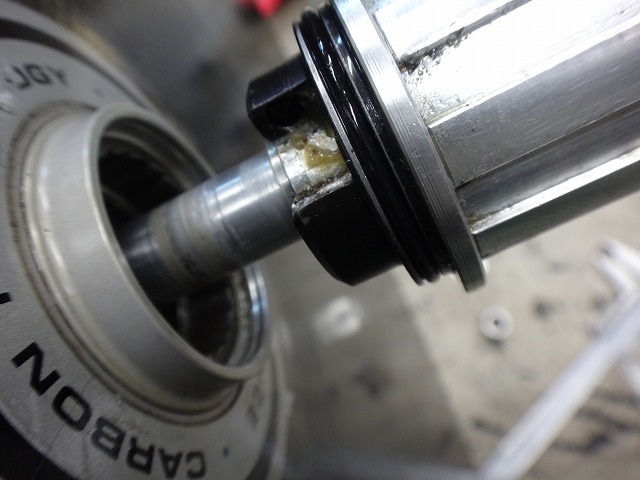
I'm not sure if parts are actually missing,
but the over-locknut dimension is only about 129mm,
so parts are probably missing.
I add spacers to center the wheel, but
since I remove and insert the freebody multiple times, I've removed the pawls
(this doesn't affect left-right dimensions).
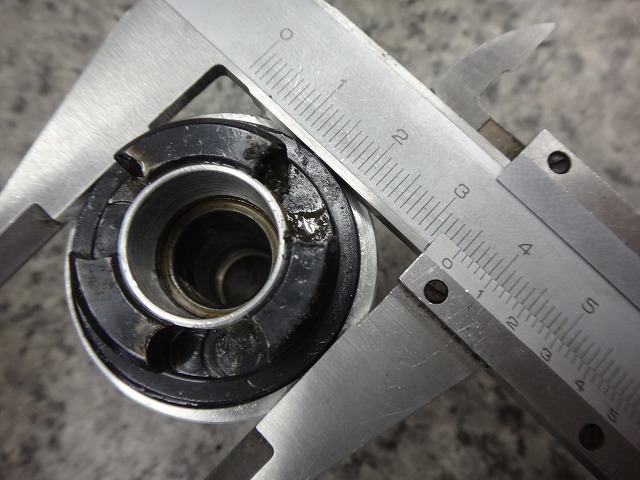
This wheel's freebody had a Shimano 10-speed version installed.
For Colima freebodies, if the diameter of the section shown in the image above is 32.5mm,
it's relatively recent and uses the same specs as current models, so 11-speed conversion is possible.
If it's 34.7mm, there's no 11-speed freebody available, so 11-speed conversion isn't possible.
This would be an older model.
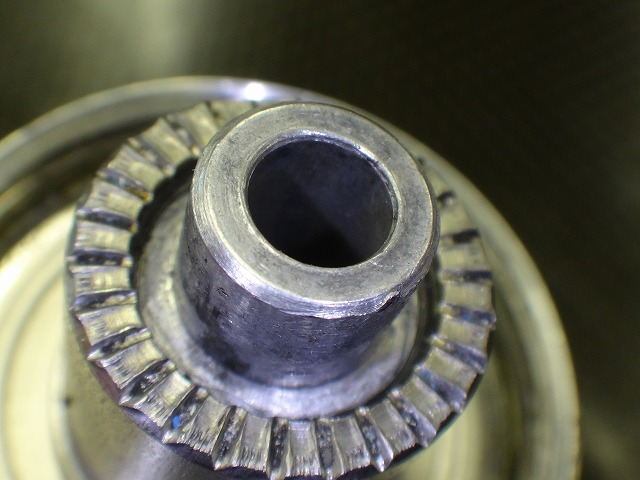
The hub axle outer diameter is 12mm,
a dimension that was commonly seen in cartridge bearing hubs back in the day.
Tni's Evolite hub had Evo hubs before it, with versions I and II.
The older type I has a 12mm diameter shaft,
while the newer type II and Evolite hub have 15mm diameter shafts.
Evo hub I has a 5mm hex socket at the shaft end because it's a steel shaft,
but this Colima hub axle has a round hole, so
end position adjustment involves holding the hub axle with a specialized fixture
and turning it with a hub wrench.
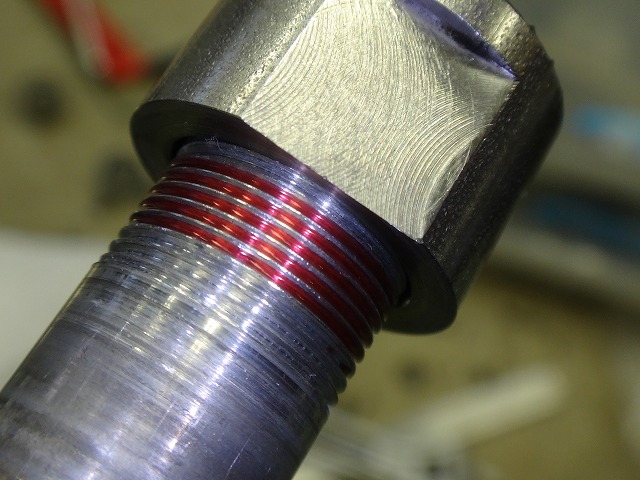
The hub axle has no left-right distinction; you just fix the same end at any position.
Having one side essentially integral with the hub axle makes adjustment easier,
and when using a hub wrench (15mm) on both sides to loosen,
I want to ensure the left side (non-freewheel side) always loosens.
So I semi-fixed the right side with heavy-duty threadlocker.
The right end's threads rotate stiffly (the threads are somewhat stripped),
and there's already so much resistance that it can't be turned by hand, which actually works out well.
(If the left side had been tight, I would have swapped them).

It was this far off.
In theory, I should add spacers to the right end by half this gap,
but extending the right end changes the derailleur adjustment position, so
it wouldn't match shifting with other Shimano 10-speed wheels.
Since this is a disc wheel, it will probably be used on a TT bike-type bike,
so it probably isn't much of an issue anyway.
One more thing. I haven't checked all frame manufacturers, but
when frames or complete bikes include an inspection sheet,
the rear end width tolerance for a 130mm frame
is often listed as "plus 2mm / minus 0mm".
In other words, the acceptable range is 130–132mm,
and anything less than 130mm is not acceptable, even by 0.1mm.
Whether we're matching this or not is unclear,
but the Evolite hub's actual measured width is also around 131mm.
With DT hubs, the Shimano 10-speed and Shimano 11-speed versions
have different length parts on the right end—a ridiculous design.
This wheel starts at around 129mm,
so I want to keep it within 132mm once the wheel is centered.
The wheel is now centered.
Reynolds' RZR, a lightweight-style wheel,
always has the rim offset to the left,
and centering is done by optionally adding thin spacers to the left end.
The offset to the left means the derailleur adjustment doesn't change
with the number or thickness of spacers (probably).
I'm using the same centering adjustment method,
but in this case the initial offset is on the right side,
and the spacers are ones I prepared myself—
not Colima parts, which is the difference.

We settled on somewhere between 131.6mm or 131.7mm.
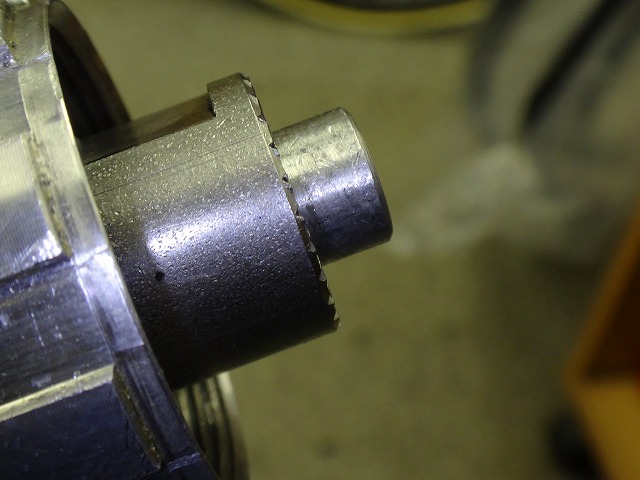

When at 129mm width, I made the left and right axle projections equal,
so after centering they became unequal.
Someone apparently didn't foresee this and applied threadlocker to the right end,
but I managed to loosen it and then applied threadlocker again after adjustment.
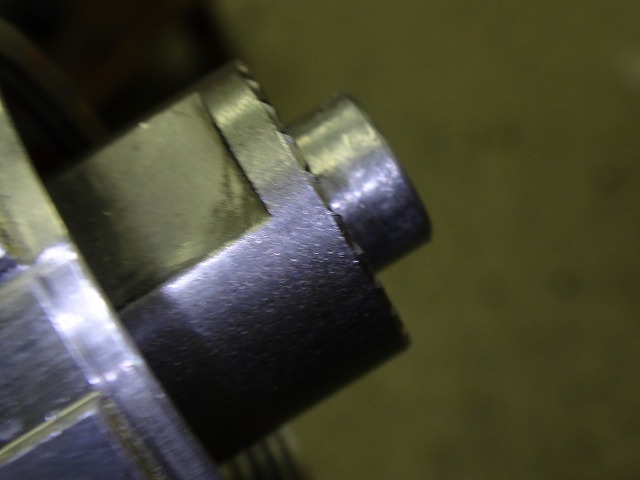
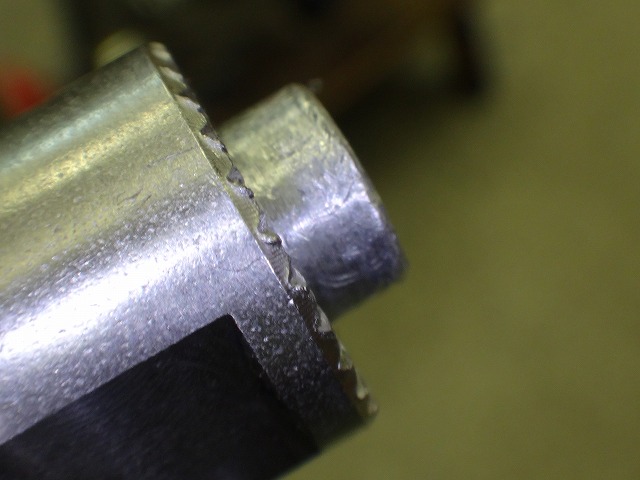
I made the left and right end projections equal.
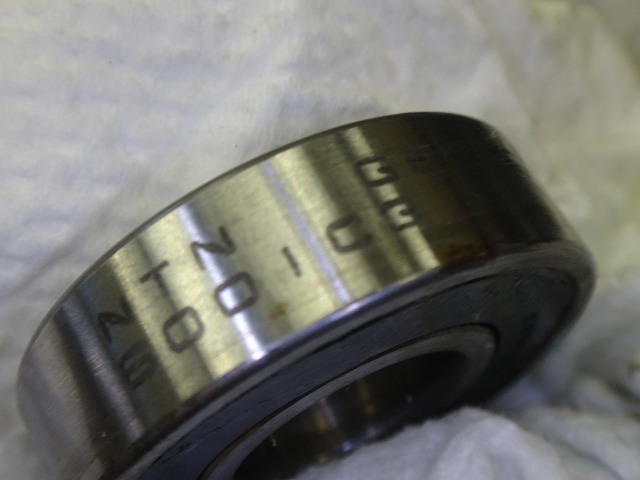
I also replaced the hub bearings.
Standard size 6001 specification: 12mm inner diameter, 28mm outer diameter, 8mm thick.
With a 12mm hub axle, the advantage is being able to have a large difference between the bearing's outer and inner races
(which means the steel balls inside can be larger),
but recent hub axles are mostly 15mm diameter, and there are also 17mm versions,
probably because they want to accommodate 12mm through axles.
(The shift to 15mm shafts happened before the through-axle trend, though).
For 15mm inner diameter bearings,
the 6802 has 15mm inner diameter and 24mm outer diameter,
commonly seen in freebodies and hub bodies on the left side,
but with the 6001 having a 16mm difference between outer and inner races, the 6802 has only 9mm,
so it feels a bit underdone.
The 6903 has 15mm inner diameter and 28mm outer diameter with a 13mm difference,
but when adopting this, either the ratchet diameter in the freebody needs enlarging,
or it's avoided because it gets heavier—
recently many hubs adopt the 15267,
which is 2mm smaller in outer diameter than the 6903
while maintaining the same inner diameter.
The C3 after 6001 refers to "C3 clearance,"
meaning one of the clearance specifications that takes larger clearance
compared to CN (normal clearance) standard.
※I've corrected the text based on comments received about C3 clearance.
Thanks for the comment.
NTN is a Japanese manufacturer, but
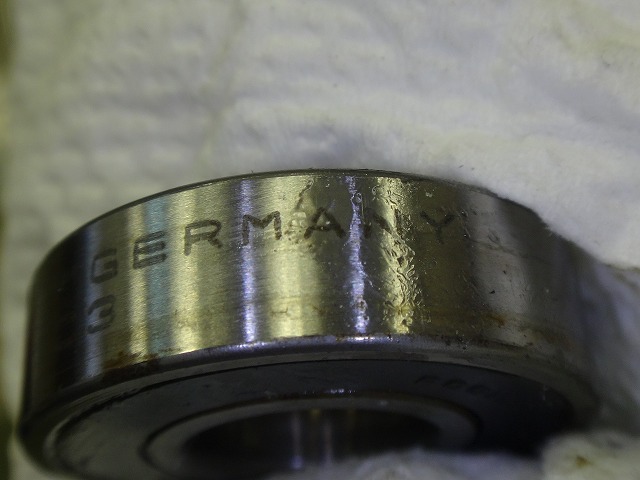
this one appears to be German-made.