My spoke wholesaler has started carrying the CX Sprint.
It's slightly thicker than the CX-RAY,
or as we say here, a spoke with "larger spoke specific gravity".
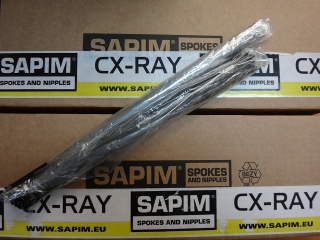
The box in the image is not the CX Sprint but a large box of CX-RAY.
The specifications of the CX Sprint sold by Japanese wholesalers are somewhat unique,
and like the replacement CX-RAY straight spokes,
they have no threads, a longer plain section on the threaded end,
and spoke cutter adjustment range down to minus 40mm.
The lineup comes in silver and black colors, with bent neck and straight options,
and lengths of 310 (down to 270) mm and 270 (down to 240) mm, for a total of 8 types.
For use as replacement spokes,
I've decided to stock the 310mm and 270mm black straight versions.
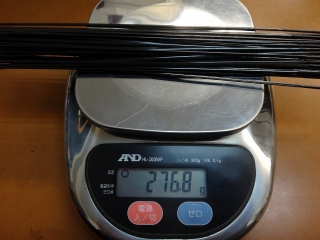
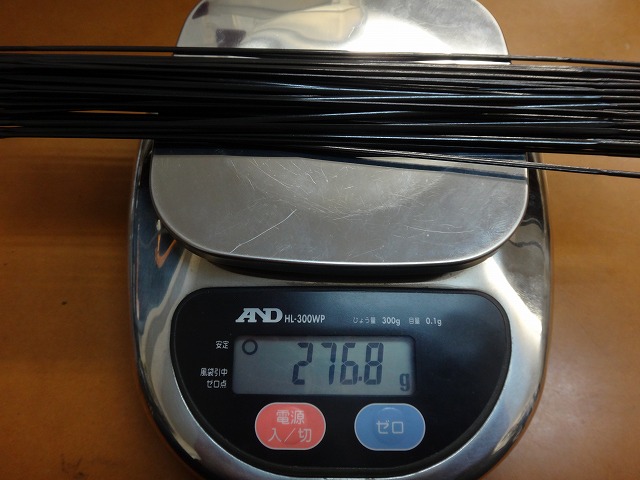
50 pieces of 270mm weigh 276.8g.
There are fleeting moments where it wavers to 276.7g,
but it stabilizes at 276.8g, so I'll use that figure.
Since the scale has a resolution of 0.1g,
this has the same accuracy as measuring 500 pieces of 270mm at 2768g on a 1g resolution scale,
allowing precise spoke specific gravity calculation with fewer pieces.
Calculating the spoke specific gravity of this 270mm spoke
gives 0.79766..., which comes out to approximately 79.8%.
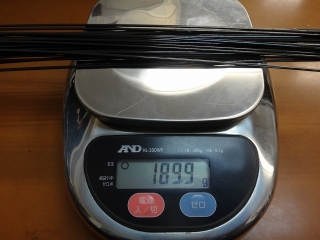
Here we have 30 pieces of 310mm.
Calculating this gives 0.79451..., which is approximately 79.5%.
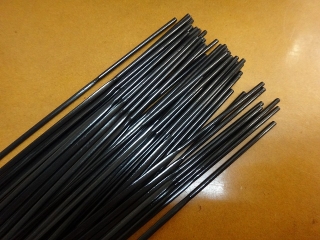
However, this CX Sprint specification
has a longer plain section on the threaded end,
so in the uncut state, the spoke specific gravity comes out higher.
According to the manufacturer's stated value of 60 pieces of 260mm weighing 334g,
calculating from this gives 0.78093..., which is approximately 78.1%.
As a rough estimate, you could say about 80%.
DT's Comp is estimated at roughly 85%,
but actual measurement shows it's more like 86.5%,
so if you use Comp on the freewheel side and CX Sprint on the non-freewheel side,
you absolutely won't end up with reversed different-diameter lacing on the left and right—
it might be useful to remember that.
If aero spokes with spoke specific gravity near 85% were ever stably supplied,
would I switch out the Comp side of a half-Comp lacing for them?
No, almost certainly not.
There's a workshop philosophy that the freewheel side should be a round-section spoke.
The only exception is spokes around 100% specific gravity like the CX (101.3%),
where using aero spokes on the freewheel side raises no structural concerns.
It would be heavier than Comp, though.
In other words, a left-right different-diameter combination of CX Sprint and CX-RAY
using both-sides aero spokes lighter than half-Comp
is, when you weigh the factors, overall inferior to half-Comp,
in my opinion.
However, for things like incorporating subtle different-diameter lacing in a 2:1 rear wheel,
or finishing a disc brake front wheel (which has less dish than a rim brake wheel)
somewhere between all CX-RAY and half-Comp,
I think it could be useful. For the latter case,
I might end up using it frequently going forward.
I've actually received a comment about this CX Sprint,
and that covers what I wanted to say about spoke specific gravity.
The comment asked if it could be a replacement spoke for Bora or Zonda—
unfortunately that's not possible.
As a makeshift measure after promising to definitely switch to genuine parts,
it's just barely usable, if we stretch it.
By the way, the CX Sprint's butted section measures
2.25mm width / 1.25mm depth for elliptical aero,
while the CX-RAY is 2.2mm width / 0.9mm depth elliptical aero,
and Bora and Zonda spokes are square aero.
The Bora WTO spoke is elliptical aero,
but roughly speaking it has CX-RAY width
and CX Sprint depth—an exceptionally unique spoke.
Someone asked for the spoke specific gravity of Sapim's non-NJS 14-number aero star bright,
so I'll mention this first: it's approximately 91%.
Actually, I've had the product on hand for quite some time.
I'll eventually write about this spoke too, but
I'll cover it together with "the story of when Sapim called with such an absurd proposal,"
so please wait a bit longer.
Writing this in advance too: I will never buy this spoke again.
It's slightly thicker than the CX-RAY,
or as we say here, a spoke with "larger spoke specific gravity".

The box in the image is not the CX Sprint but a large box of CX-RAY.
The specifications of the CX Sprint sold by Japanese wholesalers are somewhat unique,
and like the replacement CX-RAY straight spokes,
they have no threads, a longer plain section on the threaded end,
and spoke cutter adjustment range down to minus 40mm.
The lineup comes in silver and black colors, with bent neck and straight options,
and lengths of 310 (down to 270) mm and 270 (down to 240) mm, for a total of 8 types.
For use as replacement spokes,
I've decided to stock the 310mm and 270mm black straight versions.
50 pieces of 270mm weigh 276.8g.
There are fleeting moments where it wavers to 276.7g,
but it stabilizes at 276.8g, so I'll use that figure.
Since the scale has a resolution of 0.1g,
this has the same accuracy as measuring 500 pieces of 270mm at 2768g on a 1g resolution scale,
allowing precise spoke specific gravity calculation with fewer pieces.
Calculating the spoke specific gravity of this 270mm spoke
gives 0.79766..., which comes out to approximately 79.8%.

Here we have 30 pieces of 310mm.
Calculating this gives 0.79451..., which is approximately 79.5%.

However, this CX Sprint specification
has a longer plain section on the threaded end,
so in the uncut state, the spoke specific gravity comes out higher.
According to the manufacturer's stated value of 60 pieces of 260mm weighing 334g,
calculating from this gives 0.78093..., which is approximately 78.1%.
As a rough estimate, you could say about 80%.
DT's Comp is estimated at roughly 85%,
but actual measurement shows it's more like 86.5%,
so if you use Comp on the freewheel side and CX Sprint on the non-freewheel side,
you absolutely won't end up with reversed different-diameter lacing on the left and right—
it might be useful to remember that.
If aero spokes with spoke specific gravity near 85% were ever stably supplied,
would I switch out the Comp side of a half-Comp lacing for them?
No, almost certainly not.
There's a workshop philosophy that the freewheel side should be a round-section spoke.
The only exception is spokes around 100% specific gravity like the CX (101.3%),
where using aero spokes on the freewheel side raises no structural concerns.
It would be heavier than Comp, though.
In other words, a left-right different-diameter combination of CX Sprint and CX-RAY
using both-sides aero spokes lighter than half-Comp
is, when you weigh the factors, overall inferior to half-Comp,
in my opinion.
However, for things like incorporating subtle different-diameter lacing in a 2:1 rear wheel,
or finishing a disc brake front wheel (which has less dish than a rim brake wheel)
somewhere between all CX-RAY and half-Comp,
I think it could be useful. For the latter case,
I might end up using it frequently going forward.
I've actually received a comment about this CX Sprint,
and that covers what I wanted to say about spoke specific gravity.
The comment asked if it could be a replacement spoke for Bora or Zonda—
unfortunately that's not possible.
As a makeshift measure after promising to definitely switch to genuine parts,
it's just barely usable, if we stretch it.
By the way, the CX Sprint's butted section measures
2.25mm width / 1.25mm depth for elliptical aero,
while the CX-RAY is 2.2mm width / 0.9mm depth elliptical aero,
and Bora and Zonda spokes are square aero.
The Bora WTO spoke is elliptical aero,
but roughly speaking it has CX-RAY width
and CX Sprint depth—an exceptionally unique spoke.
Someone asked for the spoke specific gravity of Sapim's non-NJS 14-number aero star bright,
so I'll mention this first: it's approximately 91%.
Actually, I've had the product on hand for quite some time.
I'll eventually write about this spoke too, but
I'll cover it together with "the story of when Sapim called with such an absurd proposal,"
so please wait a bit longer.
Writing this in advance too: I will never buy this spoke again.