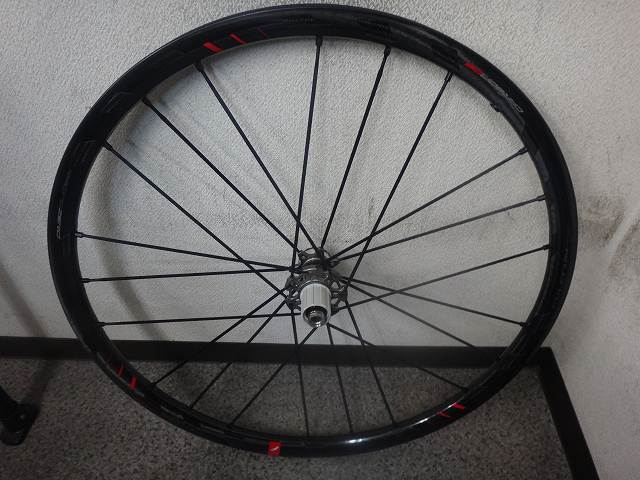
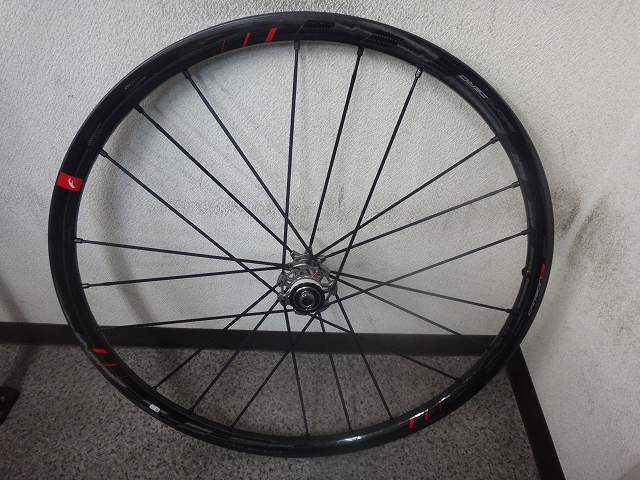
I received a Racing Zero Carbon DB from a customer.
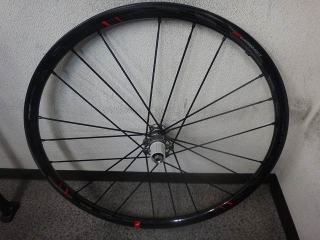
Brand new. I inspected the rear wheel first, so let's start there.
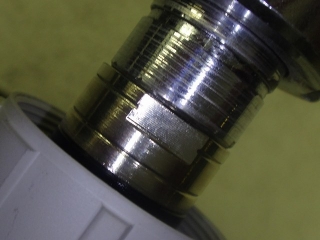
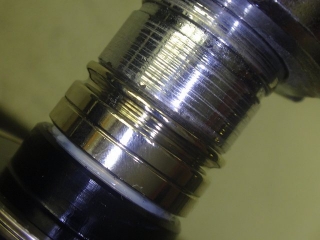
Perfect centering, virtually no runout.
The front wheel was similar, though I didn't take photos.
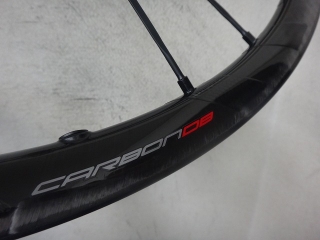
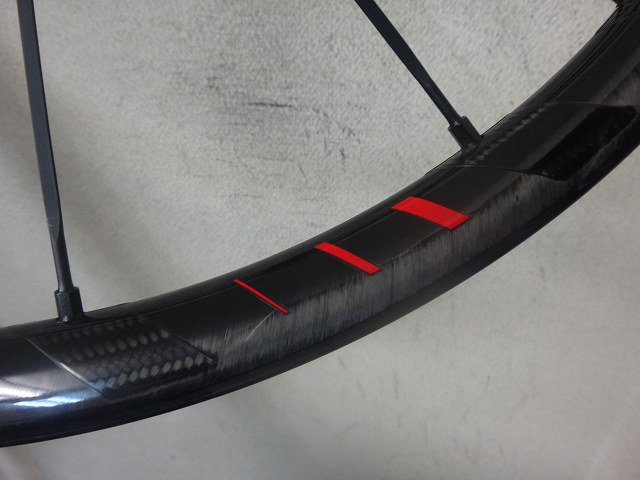
This carbon rim basically has a unidirectional weave pattern.
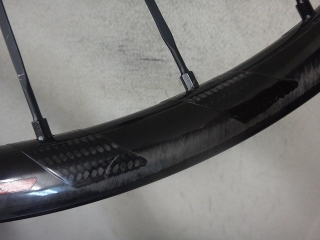
But only around the spoke holes it becomes a cross-weave pattern.
This is supposedly for reinforcement purposes, but
the spoke tension isn't extremely higher than rim brake models,
so I suspect the reinforced section has the same thickness
as rim brake models, while the other areas are thinner
since they're not designed for rim brakes—
resulting in an overall lighter rim compared to rim brake versions.
I might find out someday if we do a rim replacement.
Though I'm not about to tell them.
↑wow this guy's got some attitude
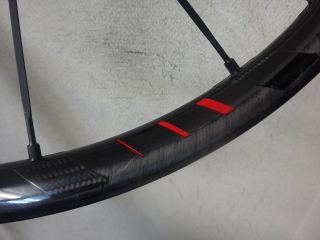
Since the reinforcement is at the spoke holes, it's not in the rest position.
The centering gauge picks up the thickness of the sticker on the rim,
so with disc brake rims that have stickers on the rim sidewalls,
you need to apply the centering gauge to the phase without stickers.
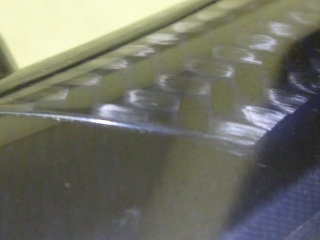
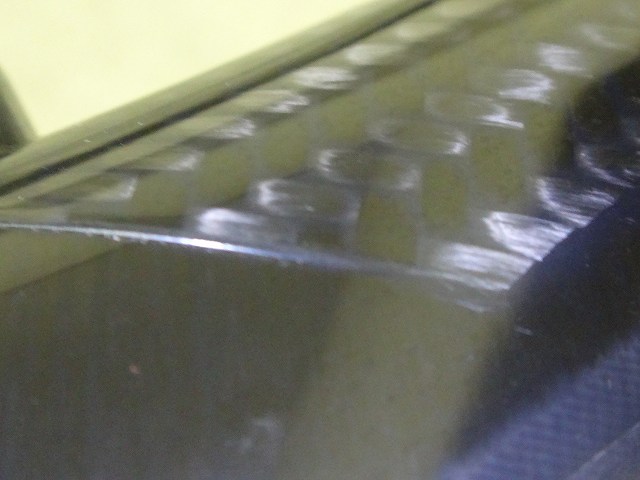
This reinforcement has considerable thickness,
so the centering gauge cannot be applied at that phase.
That means I need to apply it very carefully to only specific phases.
Or maybe I could check between the reinforced phases themselves.
This is something to be careful about,
but that's my concern, not the customer's.
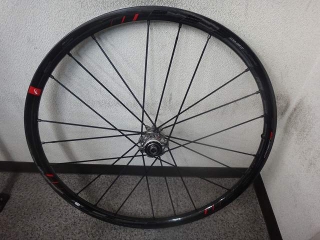
I inspected the front wheel too.
As I said earlier, barely needed any work.
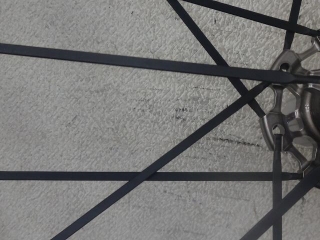
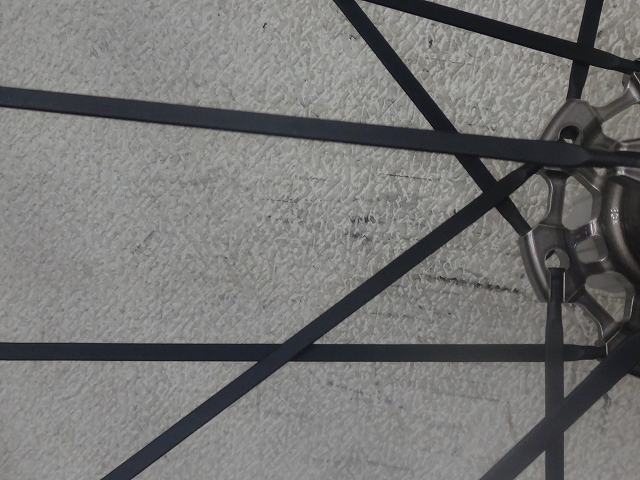
On both wheels, in the 2:1 spoke configuration,
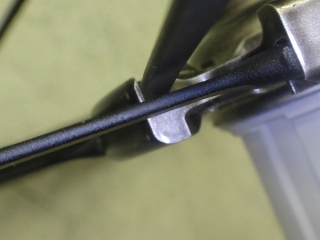
The spokes on the side 1
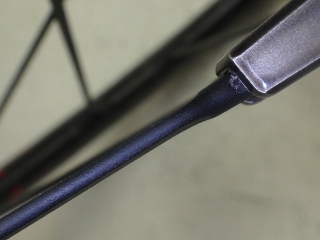
are thicker than those on side 2.
The width is the same.
This is the "third aluminum spoke type" I mentioned writing about before.
I was planning to cover it on another occasion and have photos ready,
but for now I'll just mention it.
Why make the spokes on side 1—the fewer-spoke side of the asymmetrical pairing—thicker?
For rear wheels, it's likely because the disc rotor side uses radial lacing.
But on this wheel, side 1 on the front is also thick-spoked.
For rear wheels with reverse-alternating diameter lacing as a counter
to asymmetrical spoke patterns, there's Colima's 12:8H wheel,
but that's rim brake, so disc brake considerations don't apply
to why the non-freewheel side spokes are thicker.
Initially, Campagnolo had two disc brake wheel models: Zonda DB and Bora One 50DB,
and only the Zonda DB uses reverse-alternating diameter lacing.
The current Bora DB comes in 50, 35, and WTO 45 versions,
but all use same-diameter lacing on both sides.
The first time I saw reverse-alternating diameter lacing
with aluminum spokes was on the Shamal Ultra DB.
Even on higher rim heights in the Colima 12:8H rear wheel,
it doesn't use reverse-alternating diameter lacing.
Neither Campagnolo/Fulcrum nor Colima use reverse-alternating diameter lacing
when rim height gets to a certain point.
When considering the magnitude of a certain factor,
I believe they decide on reverse-alternating diameter lacing based on spoke shortness
rather than rim height, so if Zonda had a 24-inch version,
I'd expect same-diameter lacing.
I think the criteria or factors that Campagnolo/Fulcrum and Colima
use to decide on reverse-alternating diameter lacing are the same or broadly similar,
but I can't get into the details without triggering some proprietary knowledge code.
When I saw the Zonda DB, I thought if they made disc brake versions
of Shamal Ultra or Racing Zero in the future,
they might actually prepare spokes with different width or thickness
specifically for reverse-alternating diameter lacing on at least the front wheel.
They actually did it, so I was surprised.
With 2:1 rim brake complete wheels,
the front and rear left spokes often share the same length,
but for manufacturers that can design hub dimensions from the ground up,
you could think: "since disc brake 2:1 wheels have larger flanges on the rear
—meaning if flange diameter is the same, rear right and front left
would have different spoke lengths—we could adjust the front hub dimensions
so they end up the same length,"
making rear right and front left spokes identical.
But when I actually checked,
the Bora WTO 45DB has rear right and front left the same,
and rear left and front right the same,
meaning two different spoke types for front and rear wheels.
Campagnolo wouldn't skip something simple like that.
Or so I thought—but it turns out
Bora One 50DB, 35DB, and Zonda DB have rear right and front left with the same spokes,
but rear left and front right at different lengths, so three spoke types total.
The Shamal Ultra DB has all different lengths—four spoke types total.
The inventory management for spare spokes is aaaaargh—
Brand new. I inspected the rear wheel first, so let's start there.
Perfect centering, virtually no runout.
The front wheel was similar, though I didn't take photos.
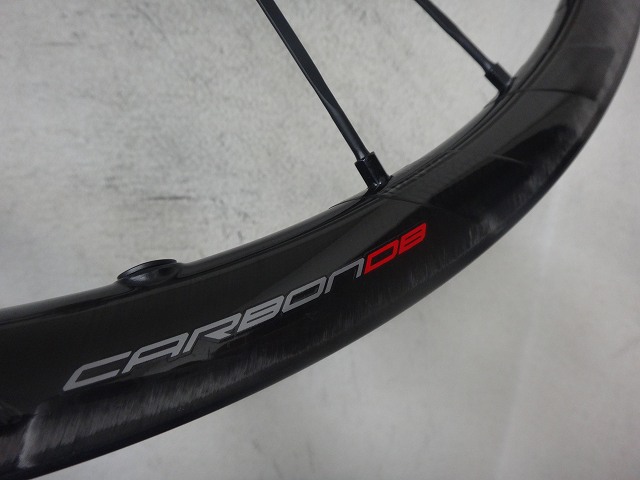
This carbon rim basically has a unidirectional weave pattern.
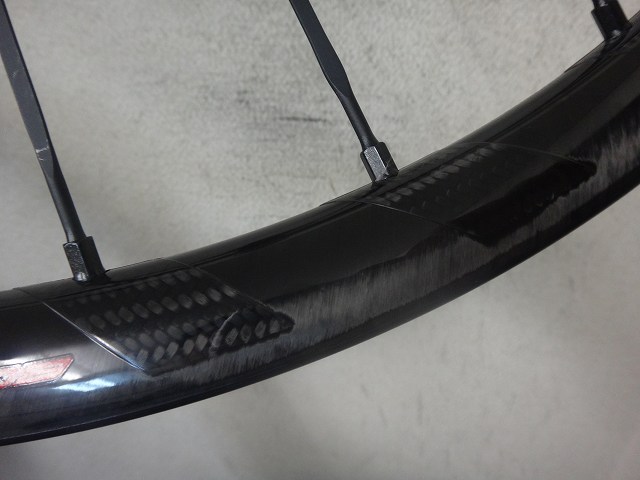
But only around the spoke holes it becomes a cross-weave pattern.
This is supposedly for reinforcement purposes, but
the spoke tension isn't extremely higher than rim brake models,
so I suspect the reinforced section has the same thickness
as rim brake models, while the other areas are thinner
since they're not designed for rim brakes—
resulting in an overall lighter rim compared to rim brake versions.
I might find out someday if we do a rim replacement.
Though I'm not about to tell them.
↑wow this guy's got some attitude
Since the reinforcement is at the spoke holes, it's not in the rest position.
The centering gauge picks up the thickness of the sticker on the rim,
so with disc brake rims that have stickers on the rim sidewalls,
you need to apply the centering gauge to the phase without stickers.
This reinforcement has considerable thickness,
so the centering gauge cannot be applied at that phase.
That means I need to apply it very carefully to only specific phases.
Or maybe I could check between the reinforced phases themselves.
This is something to be careful about,
but that's my concern, not the customer's.
I inspected the front wheel too.
As I said earlier, barely needed any work.
On both wheels, in the 2:1 spoke configuration,
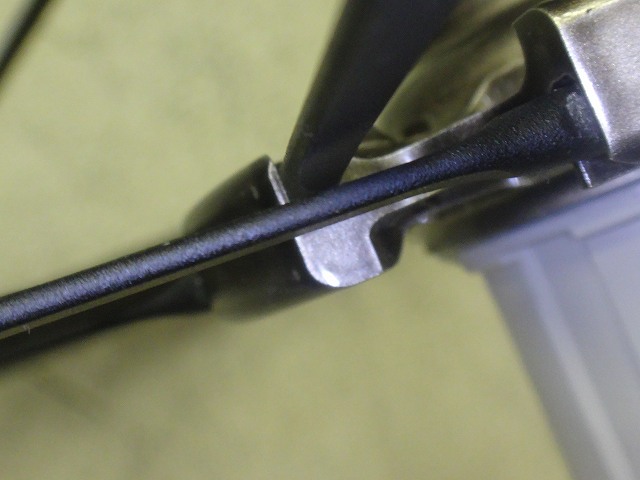
The spokes on the side 1
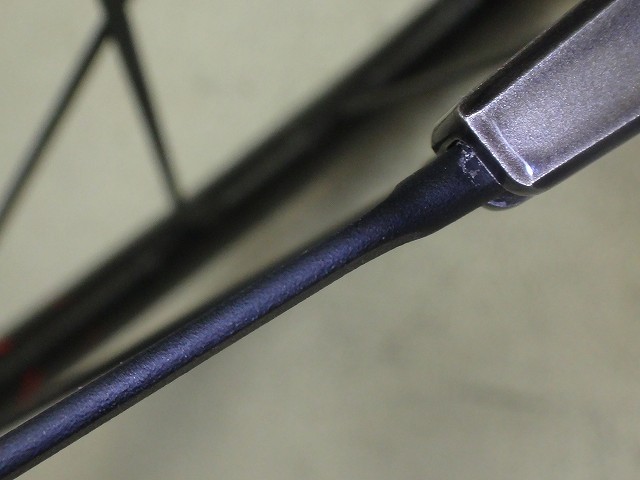
are thicker than those on side 2.
The width is the same.
This is the "third aluminum spoke type" I mentioned writing about before.
I was planning to cover it on another occasion and have photos ready,
but for now I'll just mention it.
Why make the spokes on side 1—the fewer-spoke side of the asymmetrical pairing—thicker?
For rear wheels, it's likely because the disc rotor side uses radial lacing.
But on this wheel, side 1 on the front is also thick-spoked.
For rear wheels with reverse-alternating diameter lacing as a counter
to asymmetrical spoke patterns, there's Colima's 12:8H wheel,
but that's rim brake, so disc brake considerations don't apply
to why the non-freewheel side spokes are thicker.
Initially, Campagnolo had two disc brake wheel models: Zonda DB and Bora One 50DB,
and only the Zonda DB uses reverse-alternating diameter lacing.
The current Bora DB comes in 50, 35, and WTO 45 versions,
but all use same-diameter lacing on both sides.
The first time I saw reverse-alternating diameter lacing
with aluminum spokes was on the Shamal Ultra DB.
Even on higher rim heights in the Colima 12:8H rear wheel,
it doesn't use reverse-alternating diameter lacing.
Neither Campagnolo/Fulcrum nor Colima use reverse-alternating diameter lacing
when rim height gets to a certain point.
When considering the magnitude of a certain factor,
I believe they decide on reverse-alternating diameter lacing based on spoke shortness
rather than rim height, so if Zonda had a 24-inch version,
I'd expect same-diameter lacing.
I think the criteria or factors that Campagnolo/Fulcrum and Colima
use to decide on reverse-alternating diameter lacing are the same or broadly similar,
but I can't get into the details without triggering some proprietary knowledge code.
When I saw the Zonda DB, I thought if they made disc brake versions
of Shamal Ultra or Racing Zero in the future,
they might actually prepare spokes with different width or thickness
specifically for reverse-alternating diameter lacing on at least the front wheel.
They actually did it, so I was surprised.
With 2:1 rim brake complete wheels,
the front and rear left spokes often share the same length,
but for manufacturers that can design hub dimensions from the ground up,
you could think: "since disc brake 2:1 wheels have larger flanges on the rear
—meaning if flange diameter is the same, rear right and front left
would have different spoke lengths—we could adjust the front hub dimensions
so they end up the same length,"
making rear right and front left spokes identical.
But when I actually checked,
the Bora WTO 45DB has rear right and front left the same,
and rear left and front right the same,
meaning two different spoke types for front and rear wheels.
Campagnolo wouldn't skip something simple like that.
Or so I thought—but it turns out
Bora One 50DB, 35DB, and Zonda DB have rear right and front left with the same spokes,
but rear left and front right at different lengths, so three spoke types total.
The Shamal Ultra DB has all different lengths—four spoke types total.
The inventory management for spare spokes is aaaaargh—