Hamilton makes military watches, and their civilian version line has a series called
"Khaki."

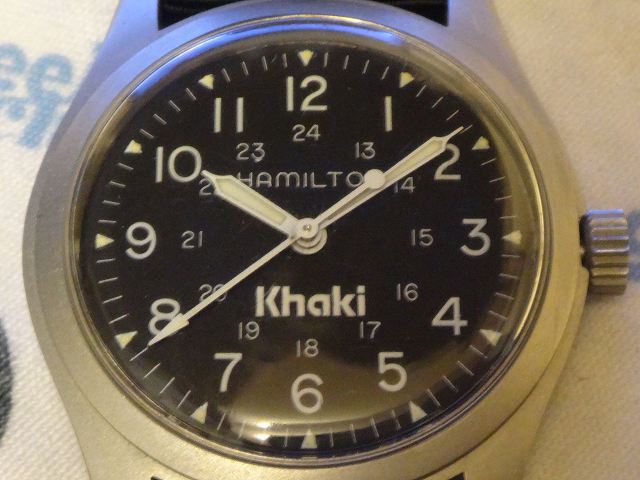
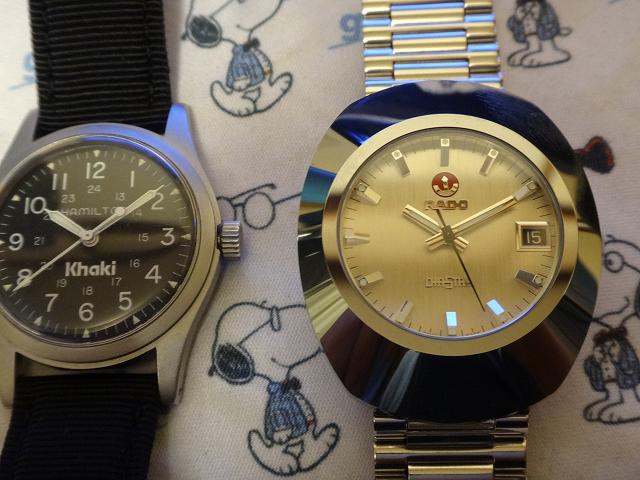
↑This is one from the Khaki line, model number "9415A,"
which was produced across a pretty long span of years
so there are tons of variations,
but this is a relatively newer one.
It has a plastic crystal, manual wind, and no date window, and
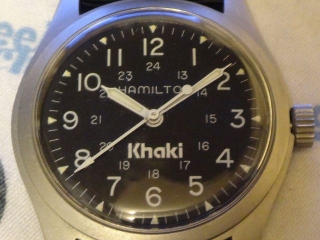
the logo reads HAMILTON,
but it's in italics,
and some versions have a bowtie-shaped H logo above it.
If you're interested, try searching for 9415A.
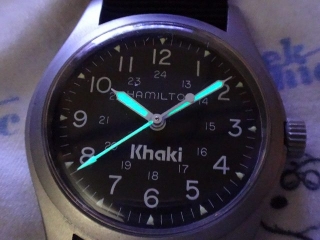
The lume on the hands is Luminova.
Older ones used tritium,
and with tritium you'd sometimes find it only on the center of the small triangles at the hour indices,
or sometimes the entire circular indices would be painted with tritium.
Speaking of this 9415A, Hamilton recently released a reissue model.
The maker's own website explicitly calls it a "reissue"—not just retail sites.
The model number is H69439931. If interested, search for it (you know the drill).
The lume on the hands and indices is Luminova,
but it's colored to resemble aged tritium.
The maker's site says "faithfully reissued from the original 1960s model,"
but the movement is state-of-the-art with an 80-hour power reserve.
Plus, the crystal is sapphire glass, not plastic.
It's called a reissue, but the original 9415A case is about 33mm,
while the H69439931 is 38mm.
Manual wind, no date—specs that don't seem to have much demand
(though they're actually pretty common in high-end dress watches)
with an 80-hour power reserve fitted into a 33mm case is a movement that probably doesn't exist,
so that might be one reason why,
but upsizing the case on so-called reissue models to modern standards is pretty common.
As I've written before, Tudor's Heritage Ranger (→here) does the same thing.
But with this self-proclaimed reissue Khaki, the hands and indices are
cleverly enlarged to maintain the balance of the original model,
so at first glance you don't notice the case is 5mm larger.
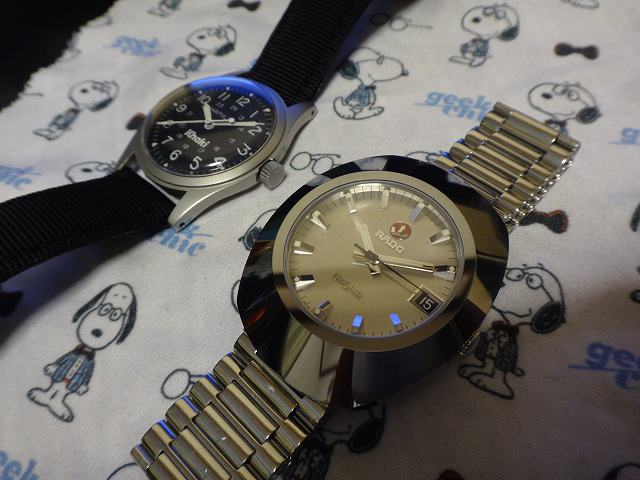
It's a different story if you have something to compare sizes side-by-side with (→here).
Anyway, a true "reissue" should faithfully reproduce the original down to size and specs,
and if the specs are that different, I'd call it an "homage" instead.
I'm writing this because it relates to what's probably going to be
a Fulcrum post coming up tomorrow or so.
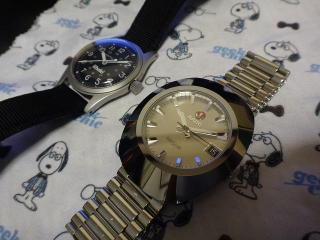
Something that could legitimately be called a "reissue," case size included,
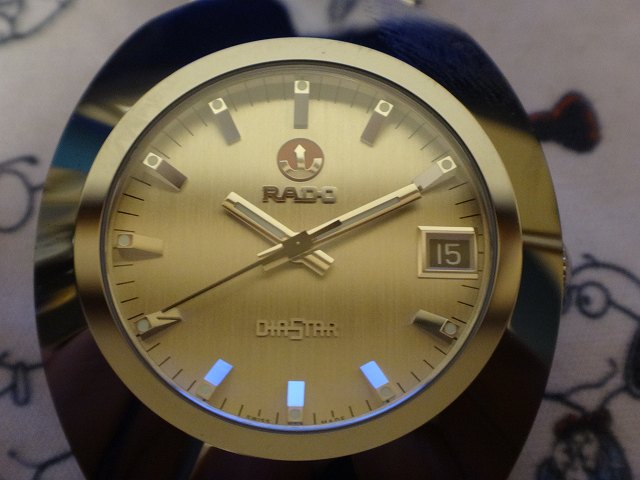
is this Rado DiaStar.
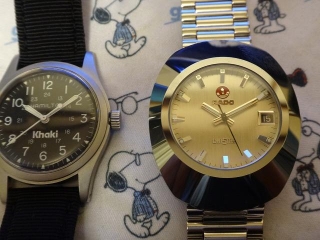
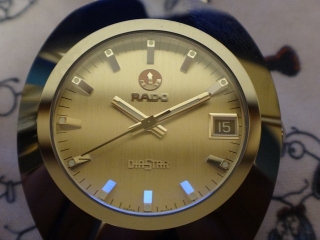
It pretty well recreates the original look, case size included,
but it's unnaturally pristine, and
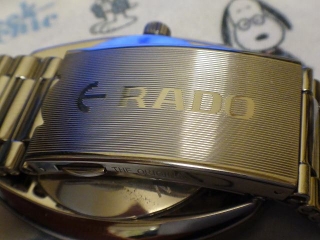
the fine details are still different from the original,
so of course you can tell them apart.
If you literally couldn't tell them apart from the original
that would be problematic in its own way, so that's fine.
With Selle Italia saddles, for example,
the Flight 1990 is easy to distinguish from the original Flight,
but the Turbo 1980 is so faithfully reproduced you can't say for certain unless you look at the underside.
Addendum:
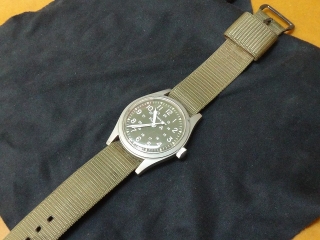
The same day I posted this article,
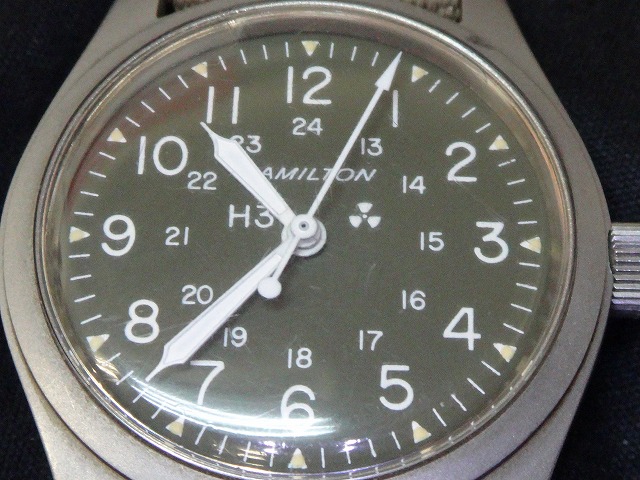
a customer (technically) came by to show off their Hamilton military watch,
so I got permission to take some photos.
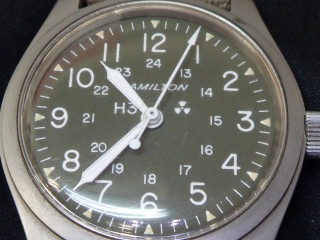
It's quite old,
from before the "Khaki" nickname was even established.
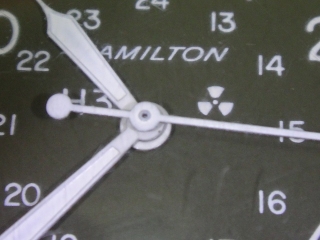
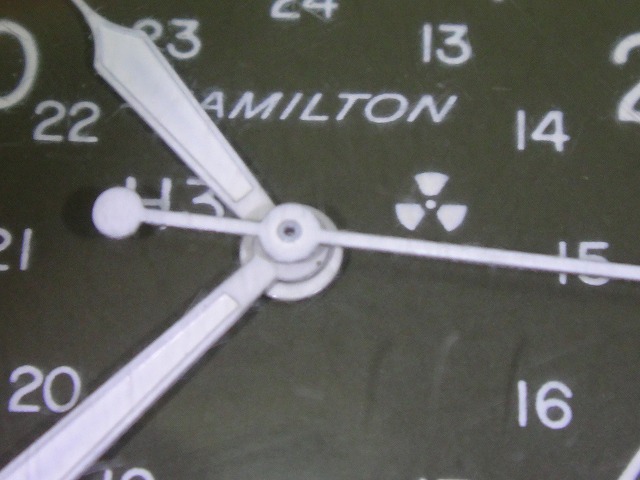
The "H3" marking stands for tritium (tritiated hydrogen),
used in the lume on the hands and indices
(its half-life has long since passed, so
it no longer functions as lume).
Since tritium is a radioactive isotope,
a radioactive hazard symbol is also printed on it.
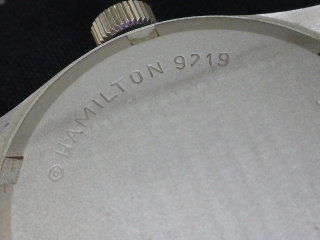
The model number was 9219.
Even with the 9219, later production runs
had "Khaki" printed on the dial.
"Khaki."

↑This is one from the Khaki line, model number "9415A,"
which was produced across a pretty long span of years
so there are tons of variations,
but this is a relatively newer one.
It has a plastic crystal, manual wind, and no date window, and
the logo reads HAMILTON,
but it's in italics,
and some versions have a bowtie-shaped H logo above it.
If you're interested, try searching for 9415A.

The lume on the hands is Luminova.
Older ones used tritium,
and with tritium you'd sometimes find it only on the center of the small triangles at the hour indices,
or sometimes the entire circular indices would be painted with tritium.
Speaking of this 9415A, Hamilton recently released a reissue model.
The maker's own website explicitly calls it a "reissue"—not just retail sites.
The model number is H69439931. If interested, search for it (you know the drill).
The lume on the hands and indices is Luminova,
but it's colored to resemble aged tritium.
The maker's site says "faithfully reissued from the original 1960s model,"
but the movement is state-of-the-art with an 80-hour power reserve.
Plus, the crystal is sapphire glass, not plastic.
It's called a reissue, but the original 9415A case is about 33mm,
while the H69439931 is 38mm.
Manual wind, no date—specs that don't seem to have much demand
(though they're actually pretty common in high-end dress watches)
with an 80-hour power reserve fitted into a 33mm case is a movement that probably doesn't exist,
so that might be one reason why,
but upsizing the case on so-called reissue models to modern standards is pretty common.
As I've written before, Tudor's Heritage Ranger (→here) does the same thing.
But with this self-proclaimed reissue Khaki, the hands and indices are
cleverly enlarged to maintain the balance of the original model,
so at first glance you don't notice the case is 5mm larger.
It's a different story if you have something to compare sizes side-by-side with (→here).
Anyway, a true "reissue" should faithfully reproduce the original down to size and specs,
and if the specs are that different, I'd call it an "homage" instead.
I'm writing this because it relates to what's probably going to be
a Fulcrum post coming up tomorrow or so.
Something that could legitimately be called a "reissue," case size included,
is this Rado DiaStar.
It pretty well recreates the original look, case size included,
but it's unnaturally pristine, and

the fine details are still different from the original,
so of course you can tell them apart.
If you literally couldn't tell them apart from the original
that would be problematic in its own way, so that's fine.
With Selle Italia saddles, for example,
the Flight 1990 is easy to distinguish from the original Flight,
but the Turbo 1980 is so faithfully reproduced you can't say for certain unless you look at the underside.
Addendum:

The same day I posted this article,
a customer (technically) came by to show off their Hamilton military watch,
so I got permission to take some photos.
It's quite old,
from before the "Khaki" nickname was even established.
The "H3" marking stands for tritium (tritiated hydrogen),
used in the lume on the hands and indices
(its half-life has long since passed, so
it no longer functions as lume).
Since tritium is a radioactive isotope,
a radioactive hazard symbol is also printed on it.
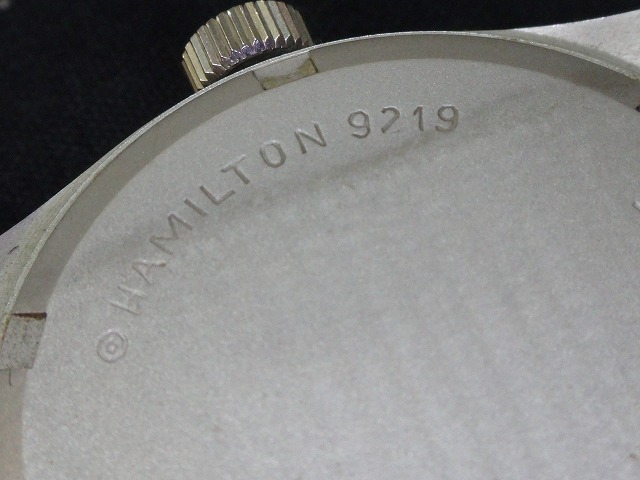
The model number was 9219.
Even with the 9219, later production runs
had "Khaki" printed on the dial.