I touched on skewers in the previous post
but since then I've written a lot more about skewers
so I've made it a separate article.
In the case of this freebody and quick-release end combination,
it's safer to avoid using skewers. That's the continuation of what I wrote.
While I'm at it, I'll add this:
separately, the other day with Prime's front wheel (Novatech hub),
there was an issue where using a skewer would cause the hub rotation to seize up.
When you tighten the skewer firmly, the hub rotation becomes abnormally heavy.
If you tighten the skewer while spinning the wheel,
there's a threshold tightness where the wheel spin time becomes extremely short.
So, under the same conditions, with a Shimano quick-release (←chosen because it tightens particularly well)
tightened to the barely-closeable limit of the lever—an unusually tight way to do it—
the hub rotation didn't become stiff.
In other words, the tightness you casually apply when using a skewer
lightly exceeds the case of tightening a well-locking quick-release firmly.
In other words, the cam portion of a quick-release has
afool-proofidiot-proof feature built in that prevents over-tightening
no matter how much you try to tighten it.
People often say things like "skewers lock tighter than quick-releases,"
but the problem IS that they lock too tight.
If instead of turning a quick-release lever hard, you turn it with normal strength,
and you apply the same degree of tightness with a skewer, it feels somewhat under-tightened,
but if you're not confident in controlling this, you should go with a quick-release.
As a classic lightweight part, USE made something called Spin Sticks
(now handled under TULA, USE's aero parts brand),
and that has a short lever length making it
extremely difficult to tighten more than a quick-release.
But actually, that specification is "something the maker knows about and does intentionally."
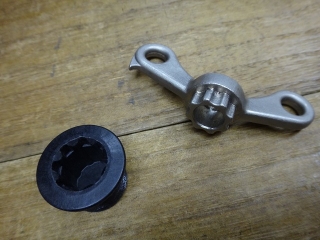
The genuine tool for tightening the bearing adjustment on the left crank side of Shimano's Hollowtech II
is also made with a small size and difficult to turn,
but that's also the maker's intention.
The image above shows a Park Tools wing nut-type tool,
and using this, in places where the genuine tool can't tighten enough,
you can easily tighten it to the point where the crank rotation becomes stiff.
And like with skewers, when you reproduce the same tightness as the genuine tool
with this tool, it feels somewhat under-tightened.
The crank should have no side play and the rotation shouldn't be stiff
(it's not that sensitive and the range seems fairly wide)
which requires adjusting carefully with attention to over-tightening.
If you let a general user use this tool with no explanation,
there's a possibility they'll set the crank rotation to be heavy
and cause premature bearing damage,
and that's what you see happening with hub skewers.
Unlike thru-axles, I don't think there are frames or forks where
"this dedicated skewer is the only thing that can secure the wheel,"
so personally I think quick-releases are fine (you don't need to switch to skewers),
but the fact is there are many people who say
"it came with the complete bike or wheel so I just use it,"
"with a quick-release the lever position relative to the rear triangle of the frame sits awkwardly,"
or "I just prefer skewers."
Anyway, just be careful not to tighten it so much that you damage the hub bearing.
I really see it a lot.
but since then I've written a lot more about skewers
so I've made it a separate article.
In the case of this freebody and quick-release end combination,
it's safer to avoid using skewers. That's the continuation of what I wrote.
While I'm at it, I'll add this:
separately, the other day with Prime's front wheel (Novatech hub),
there was an issue where using a skewer would cause the hub rotation to seize up.
When you tighten the skewer firmly, the hub rotation becomes abnormally heavy.
If you tighten the skewer while spinning the wheel,
there's a threshold tightness where the wheel spin time becomes extremely short.
So, under the same conditions, with a Shimano quick-release (←chosen because it tightens particularly well)
tightened to the barely-closeable limit of the lever—an unusually tight way to do it—
the hub rotation didn't become stiff.
In other words, the tightness you casually apply when using a skewer
lightly exceeds the case of tightening a well-locking quick-release firmly.
In other words, the cam portion of a quick-release has
a
no matter how much you try to tighten it.
People often say things like "skewers lock tighter than quick-releases,"
but the problem IS that they lock too tight.
If instead of turning a quick-release lever hard, you turn it with normal strength,
and you apply the same degree of tightness with a skewer, it feels somewhat under-tightened,
but if you're not confident in controlling this, you should go with a quick-release.
As a classic lightweight part, USE made something called Spin Sticks
(now handled under TULA, USE's aero parts brand),
and that has a short lever length making it
extremely difficult to tighten more than a quick-release.
But actually, that specification is "something the maker knows about and does intentionally."

The genuine tool for tightening the bearing adjustment on the left crank side of Shimano's Hollowtech II
is also made with a small size and difficult to turn,
but that's also the maker's intention.
The image above shows a Park Tools wing nut-type tool,
and using this, in places where the genuine tool can't tighten enough,
you can easily tighten it to the point where the crank rotation becomes stiff.
And like with skewers, when you reproduce the same tightness as the genuine tool
with this tool, it feels somewhat under-tightened.
The crank should have no side play and the rotation shouldn't be stiff
(it's not that sensitive and the range seems fairly wide)
which requires adjusting carefully with attention to over-tightening.
If you let a general user use this tool with no explanation,
there's a possibility they'll set the crank rotation to be heavy
and cause premature bearing damage,
and that's what you see happening with hub skewers.
Unlike thru-axles, I don't think there are frames or forks where
"this dedicated skewer is the only thing that can secure the wheel,"
so personally I think quick-releases are fine (you don't need to switch to skewers),
but the fact is there are many people who say
"it came with the complete bike or wheel so I just use it,"
"with a quick-release the lever position relative to the rear triangle of the frame sits awkwardly,"
or "I just prefer skewers."
Anyway, just be careful not to tighten it so much that you damage the hub bearing.
I really see it a lot.