Recently, I've been telling customers more often that "please use tubeless-specific tape for tubeless-ready rims."
To which they often reply, "But the tires I'm using aren't tubeless..."
When you apply stretch band-type rim tape to a tubeless-ready rim,
it gets dragged into the center depression (bead shelf recess) of the rim
and loses its proper width,
resulting in rim holes becoming visible from the tape's edge,
which can cause pinch flats from the inside.
So regardless of the type of tires being used, I strongly recommend
using tape-type rim tape on tubeless-ready rims.
Among the wheels that come with complete bikes,
those that aren't from complete wheel brands—
such as frame brand private-label parts brands
or anonymous hand-built wheels—
often have thin, flimsy rim tape that's weak against air pressure,
or rim tape that doesn't match the rim's inner width,
and it's common for both conditions to exist simultaneously.
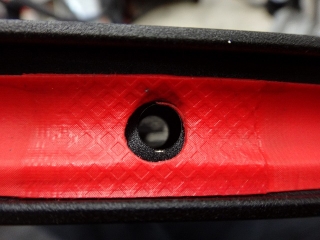
↑For example, this. It's the tape that came on a wheel with a complete bike—
it has improper width and low durability.
At the valve hole position, the tape won't shift much left and right
because the valve needs to pass through,
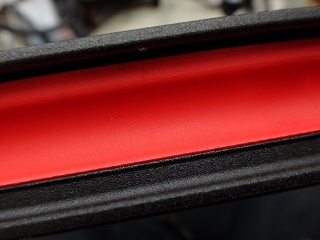
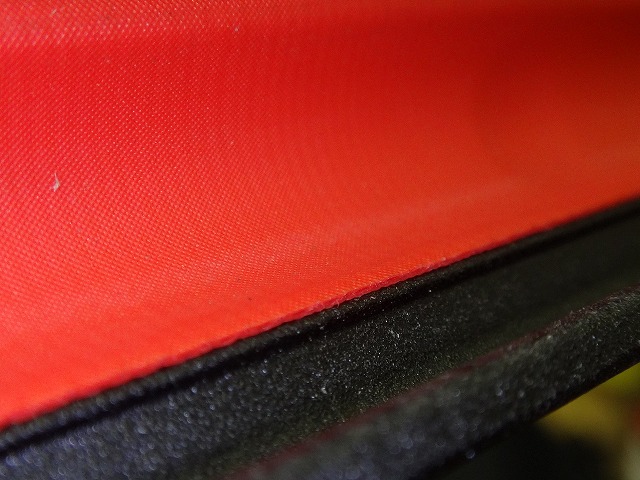
but at other positions, the rim tape
tends to shift to one side or the other in most areas.
The phenomenon I mentioned earlier—being dragged into the rim's center depression—also occurs here.
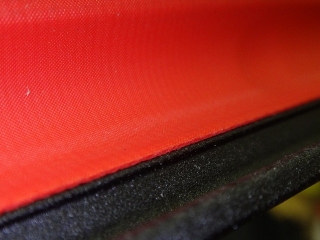
In this area, the hump can't be cleared,
and the protrusion becomes the boundary between the tape and the rim.
This is also commonly seen.
When rim tape shifts to one side, it doesn't shift to just one side uniformly around the entire circumference—
rather, it tends to meander, shifting right and left alternately (more on this later).
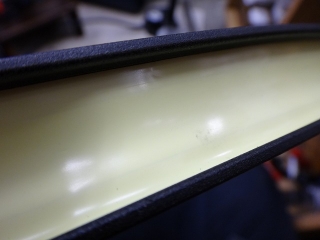
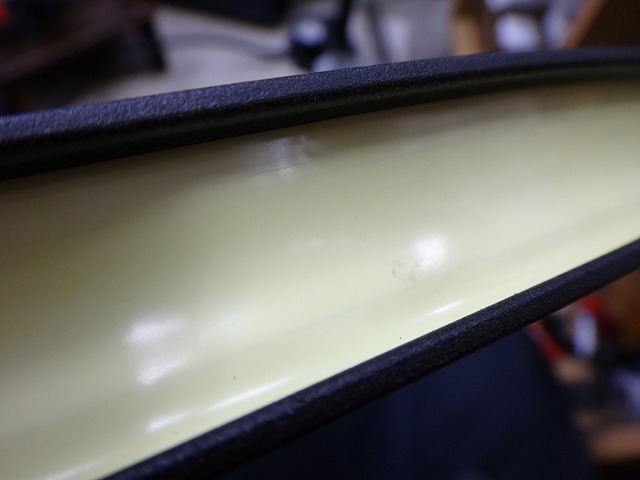
I applied Stans tubeless tape.
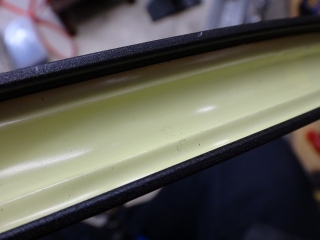
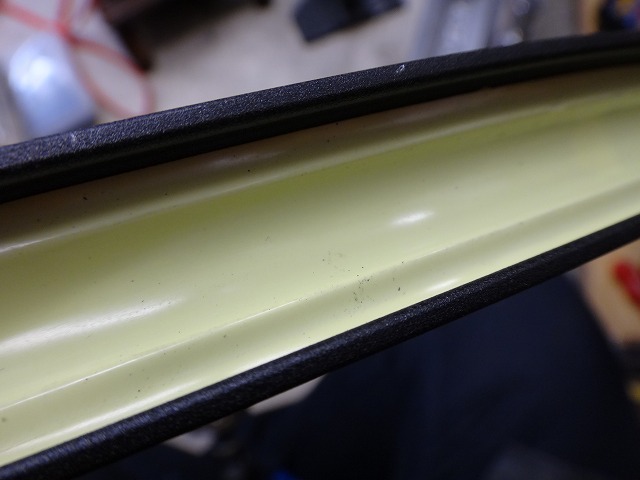
For the article's photos, I mounted the tire and tube and pressurized it,
then removed them.
You can see how the rim tape deforms cleanly along the rim's center depression.
Even with tape-type rim tape, there's some width loss,
but it's virtually nonexistent compared to stretch band types.
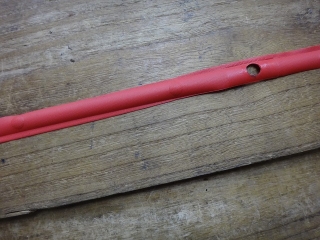
↑Original rim tape
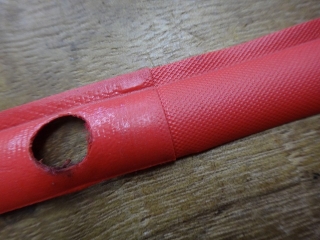
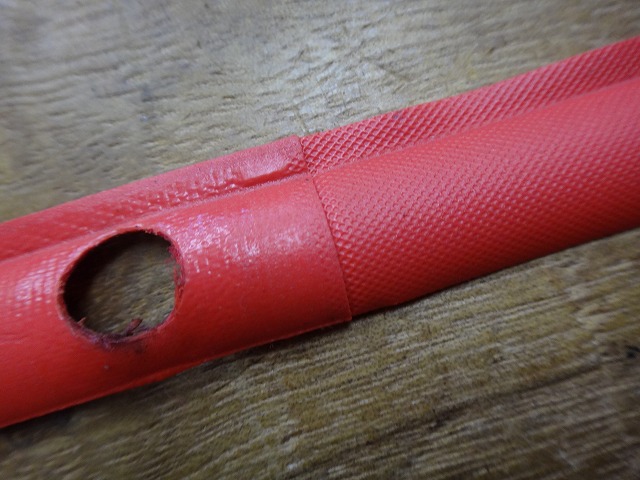
Even directly below the valve hole, the hump mark remained unevenly.
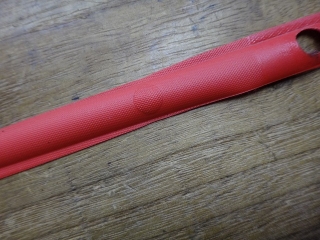
Like this, the direction the tape shifts left and right changes in a meandering pattern.
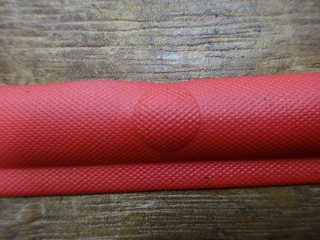
This section is right at the rim hole limit, and if the deformation becomes greater,
there's a possibility of a pinch flat from the inside caused by
the pressurized tube dropping into the slit-like exposed rim hole.
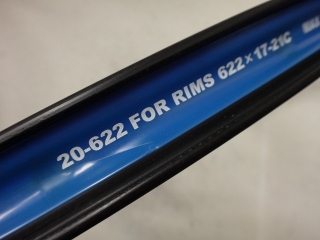
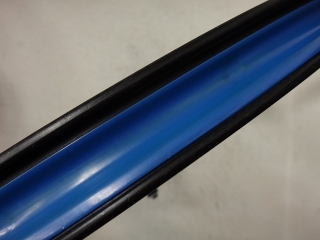
↑This is a Prime wheel that had images in the previous article,
fitted with Shimano stretch band-type rim tape that's the wrong width.
This is not how Prime ships these wheels.
Photographed from the same side,
but this also shifts right and left depending on position.
The rim tape itself is thick and stiff, so I don't think
it develops enough depression at the rim hole to cause punctures,
but the tire bead height differs between left and right.
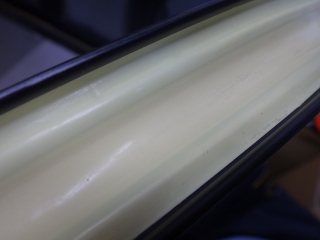
↑This is the rear wheel of a WTB rim where I recently replaced the hub
from a no-name brand to a DT 350.
When re-lacing the wheel and peeling off the rim tape, I noticed something
of value for this article, so I hurriedly shot this phase before it was fully removed.
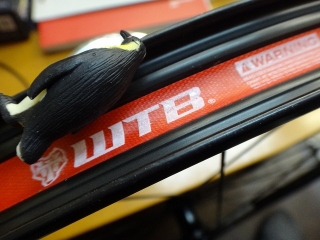
The tape above looks like Stans rim tape,
but it's probably WTB's original "TCS rim tape."
Stans rim tape comes in widths of
21, 25, 27, 30, 33, 36, and 39mm,
and if 25mm were 24mm, they'd all line up at 3mm increments,
or if there were a 23mm between 21mm and 25mm, it'd be convenient,
but it's frustrating as is.
In fact, even when using Stans tape on Stans rims, 21mm can be slightly narrow
and 25mm slightly wide (like on Grail or Iron Cross).
The manufacturer site has a reference table for rim width (strangely, outer width)
and rim tape compatibility, but it's quite loose,
so in practice it's self-judgment based on the actual fit.
Stans rim tape comes in 10-yard and 60-yard lengths,
which according to the meter conversion on the package
are 9.14m and 54.9m respectively.
In contrast, WTB's TCS tape has widths of
24, 28, 34, 40, 45, and 50mm.
The width increments seem odd, but that's because they
correspond precisely to the company's
i19, i23, i29, i35, i40, and i45 rims
(the difference between rim and tape numbers is exactly 5 in all combinations).
The rim in the image above is i23, so it's 28mm wide
(after re-lacing, Stans' 27mm width fit perfectly,
so I used that).
WTB's TCS tape comes in one length: 11m.
This isn't from converting yards or feet into meters,
but rather when used on a 700C rim with only the valve area double-wrapped
and the rest single-wrapped,
the 10m length wouldn't be enough for 5 wheels,
so they made it 11m (just enough for 5 wheels if used efficiently).
WTB's TCS tape has completely different width and length options than Stans,
but the tape's color, texture, hardness, and thickness are strikingly similar to Stans,
so it's likely an OEM product with sizes specified precisely for their own rims.
Now, here's where the article gets valuable:
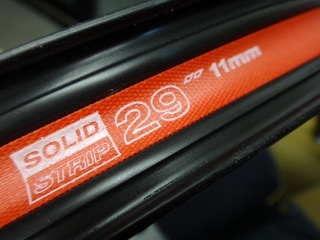
When I peeled off the TCS tape (probably), underneath was an 11mm-wide "solid strip"
stretch band-type rim tape that fills the center depression of the rim.
Here, "strip" refers to the noun meaning "a long narrow piece,"
not the verb "to remove."
It's a rim tape that feels extremely resistant to air pressure,
and because it fits perfectly into the depression, it doesn't shift.
By the way, this rim's hump doesn't have a narrow peak but rather
a flat surface like those seen on ENVE and similar rims.
WTB's tubeless-ready rim spec is called
TCS (Tubeless Compatible System),
and the new standard is now TCS 2.0,
and this i23 rim is also TCS 2.0 compatible.
It's not explicitly stated whether the solid strip alone is sufficient
when using tubed tires.
When using as TCS 2.0 tubeless, a separate tape-type rim tape called
TCS 2.0 Flex rim tape (different from TCS tape) must be used together with the solid strip.
"Solid" (durable) and "Flex" (flexible) are antonyms,
indicating they're meant to be used together.
The TCS 2.0 Flex tape is a semi-transparent brown color,
clearly not made by Stans.
The wheel in its original state had
TCS 2.0 compatible rim + TCS tape + solid strip,
and this combination works fine as a tubeless-ready rim.
After re-lacing, it has Stans rim tape, which is also fine.
Now, here's what I really wanted to write about:
With 29-inch and 27.5-inch rims,
low-profile rims where the inner and outer rim holes are very close
are becoming increasingly common.
This rim is like that, and so are Stans' Crest and
DT's XR331, among others.
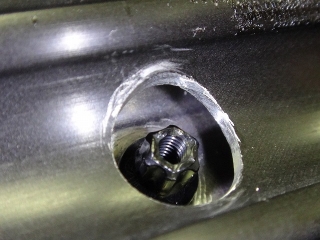
I haven't actually used them, but I fitted
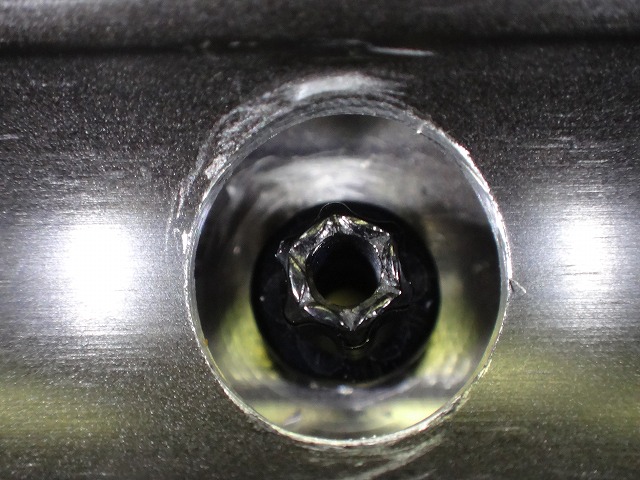
DT's Squorx nipple through the WTB i23 rim.
Squorx nipples are 3mm extended outward on the outer circumference
compared to standard nipples,
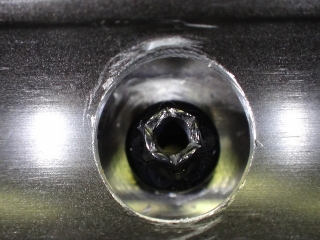
and with this rim combination,
the nipple's end face is very close to the rim's tape surface.
After applying Stans rim tape in a single layer and pushing hard with my finger,
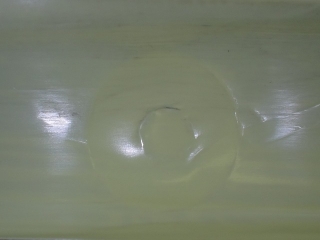
↑it turned out like this.
The nipple's shape shows through.
With actual pressurized use over time with a tube or tubeless,
the tape sinks deeper into the rim hole,
creating small holes that can cause flats—and actually do.
On my personal XR331 rim with Stans rim tape
wound single-layer except directly below the valve hole (I was trying to save rotational weight),
the tape came into contact with the nipple over time,
creating a small crack in the rim in the front-to-back direction,
which caused the tube to pinch flat.
I used it tubeless for a while, and when I peeled off the tape,
there was sealant packed into the nipple hole as if carefully inserted with a dropper,
so it must have started cracking before I switched to tubed.
The sealant was doing its job and no obvious air leak occurred,
so I didn't notice the crack while using it tubeless.
With WTB or Stans rims, you don't need to specifically use Squorx nipples,
but with DT (I've suffered painful lessons from this in the past) you must.
With XR331 and XR361, like the WTB rim earlier, the nipple's end face
is very close to the rim's tape surface, so
when applying Stans rim tape,
it's better to do double layers (triple only directly below the valve hole)
(though I've been saying "directly below the valve hole," some prefer
the overlap on the opposite side of the valve).
With RR411-series rims, there's slightly more clearance between the nipple end and the tape,
not as tight as XR331,
but when I inspected the rear wheel of an RR411 rim (for rim brakes)
that I'd built in the past, the customer had applied
a second piece about 5cm long at the rim hole position,
like a Velox patch.
DT rim's center depression isn't as tight and crisp
as WTB's, so I'm not sure if a solid strip fits cleanly.
If mounted anyway, using it with Stans tape would secure it
so it wouldn't shift left and right.
The reason I use Stans rim tape despite knowing
it deforms flexibly against the rim while being somewhat prone to
compression from air pressure
is that after peeling off the tape, there's almost no adhesive residue on the rim,
and even if there is, it's easy to remove.
Stans rims use their own BSD (Bead Socket Technology) standard
instead of ETRTO spec, with a unique bead design.
According to the maker's intention, the bead hook height is extremely low,
and when applying Stans' own tape in double layers
(though the maker specifies single-layer anyway),
the tape covers the bead hook height,
making the tire bead seat poorly.
I've heard that with MTB tires, there have been cases
of the tire coming off when applied in double layers.
DT rim with Stans tape: double-layer recommended,
DT rim with WTB solid strip: want to try it,
Stans rim with Stans tape: strict single-layer compliance,
is what this article meant to convey.
I wrote that stretch band-type rim tape doesn't work with tubeless-ready rims,
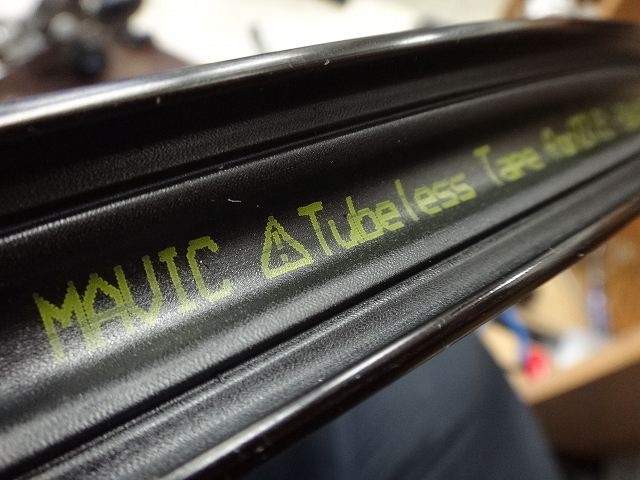
but there are exceptions: purpose-made products for specific rims.

This is a wheel from the next article,
and it conveniently had a stretch band-type
tubeless-ready rim tape, so I photographed it.
The rim is a Mavic 419 DISC.

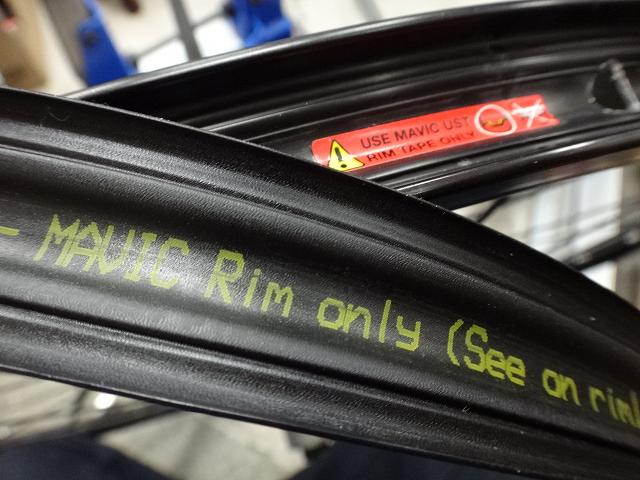
It's stretch band-type but has custom indentations that follow
the rim's shape and are tubeless-ready compatible.
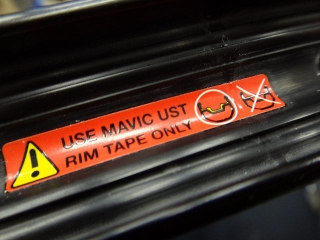
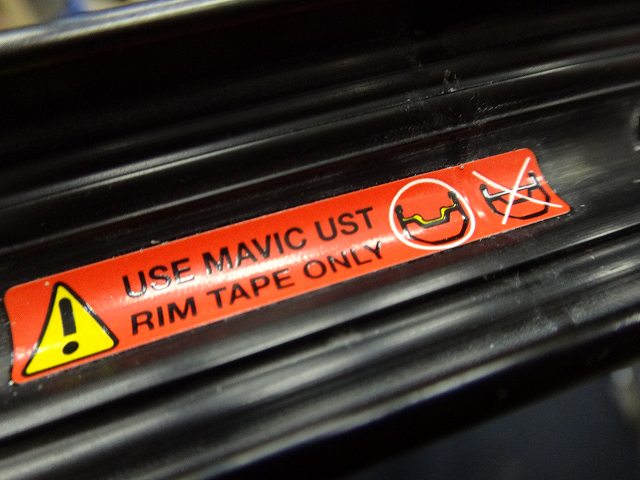
I removed the rim tape to replace a broken nipple.
It's a single-eyed rim with decent rim height, allowing the nipple to pass through the rim,
so if it couldn't be reused after removal, I thought I'd use
the magnet-pull method like Zonda or Racing 3
(a single nipple isn't too much trouble),
but it came off fairly easily.
Bontrager has similar-purpose rim tape
(of course, custom-made for their rims),
but that one fits so tightly and bites into the rim
that I'm very careful not to damage it when removing it during wheel repairs.
To which they often reply, "But the tires I'm using aren't tubeless..."
When you apply stretch band-type rim tape to a tubeless-ready rim,
it gets dragged into the center depression (bead shelf recess) of the rim
and loses its proper width,
resulting in rim holes becoming visible from the tape's edge,
which can cause pinch flats from the inside.
So regardless of the type of tires being used, I strongly recommend
using tape-type rim tape on tubeless-ready rims.
Among the wheels that come with complete bikes,
those that aren't from complete wheel brands—
such as frame brand private-label parts brands
or anonymous hand-built wheels—
often have thin, flimsy rim tape that's weak against air pressure,
or rim tape that doesn't match the rim's inner width,
and it's common for both conditions to exist simultaneously.
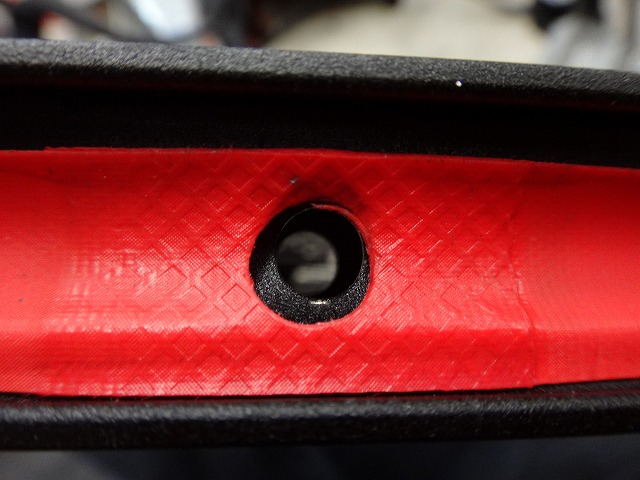
↑For example, this. It's the tape that came on a wheel with a complete bike—
it has improper width and low durability.
At the valve hole position, the tape won't shift much left and right
because the valve needs to pass through,
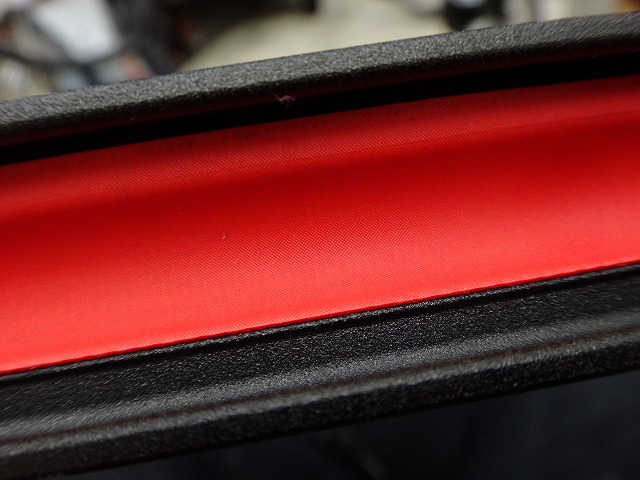
but at other positions, the rim tape
tends to shift to one side or the other in most areas.
The phenomenon I mentioned earlier—being dragged into the rim's center depression—also occurs here.
In this area, the hump can't be cleared,
and the protrusion becomes the boundary between the tape and the rim.
This is also commonly seen.
When rim tape shifts to one side, it doesn't shift to just one side uniformly around the entire circumference—
rather, it tends to meander, shifting right and left alternately (more on this later).
I applied Stans tubeless tape.
For the article's photos, I mounted the tire and tube and pressurized it,
then removed them.
You can see how the rim tape deforms cleanly along the rim's center depression.
Even with tape-type rim tape, there's some width loss,
but it's virtually nonexistent compared to stretch band types.

↑Original rim tape
Even directly below the valve hole, the hump mark remained unevenly.
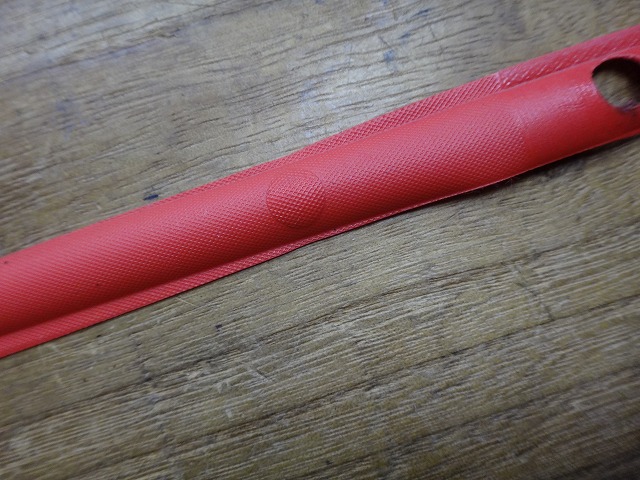
Like this, the direction the tape shifts left and right changes in a meandering pattern.
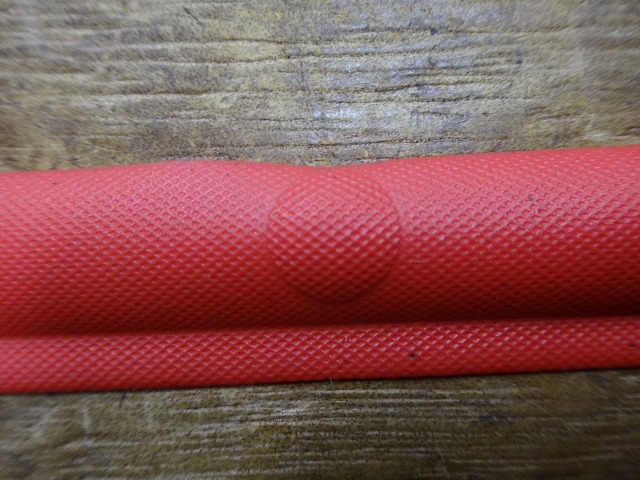
This section is right at the rim hole limit, and if the deformation becomes greater,
there's a possibility of a pinch flat from the inside caused by
the pressurized tube dropping into the slit-like exposed rim hole.
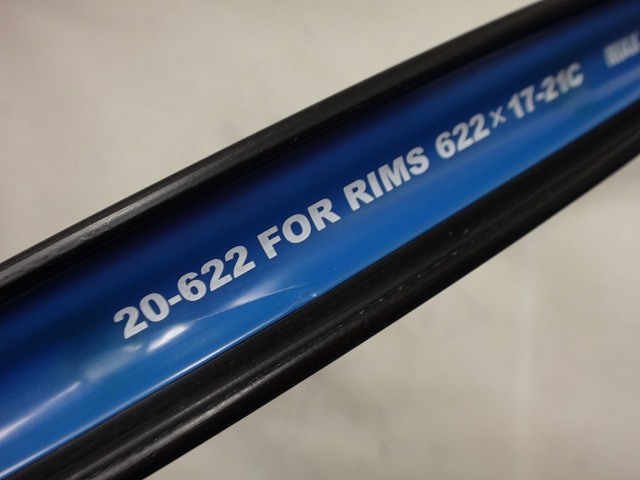
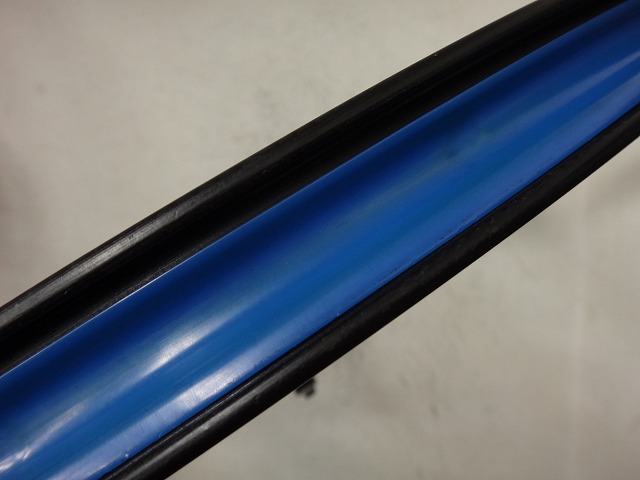
↑This is a Prime wheel that had images in the previous article,
fitted with Shimano stretch band-type rim tape that's the wrong width.
This is not how Prime ships these wheels.
Photographed from the same side,
but this also shifts right and left depending on position.
The rim tape itself is thick and stiff, so I don't think
it develops enough depression at the rim hole to cause punctures,
but the tire bead height differs between left and right.
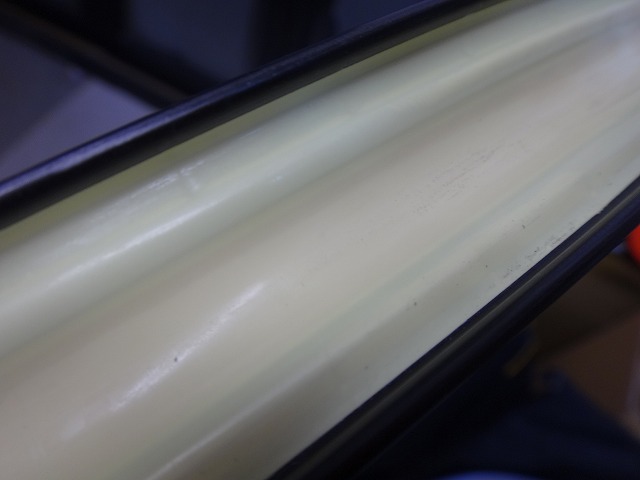
↑This is the rear wheel of a WTB rim where I recently replaced the hub
from a no-name brand to a DT 350.
When re-lacing the wheel and peeling off the rim tape, I noticed something
of value for this article, so I hurriedly shot this phase before it was fully removed.
The tape above looks like Stans rim tape,
but it's probably WTB's original "TCS rim tape."
Stans rim tape comes in widths of
21, 25, 27, 30, 33, 36, and 39mm,
and if 25mm were 24mm, they'd all line up at 3mm increments,
or if there were a 23mm between 21mm and 25mm, it'd be convenient,
but it's frustrating as is.
In fact, even when using Stans tape on Stans rims, 21mm can be slightly narrow
and 25mm slightly wide (like on Grail or Iron Cross).
The manufacturer site has a reference table for rim width (strangely, outer width)
and rim tape compatibility, but it's quite loose,
so in practice it's self-judgment based on the actual fit.
Stans rim tape comes in 10-yard and 60-yard lengths,
which according to the meter conversion on the package
are 9.14m and 54.9m respectively.
In contrast, WTB's TCS tape has widths of
24, 28, 34, 40, 45, and 50mm.
The width increments seem odd, but that's because they
correspond precisely to the company's
i19, i23, i29, i35, i40, and i45 rims
(the difference between rim and tape numbers is exactly 5 in all combinations).
The rim in the image above is i23, so it's 28mm wide
(after re-lacing, Stans' 27mm width fit perfectly,
so I used that).
WTB's TCS tape comes in one length: 11m.
This isn't from converting yards or feet into meters,
but rather when used on a 700C rim with only the valve area double-wrapped
and the rest single-wrapped,
the 10m length wouldn't be enough for 5 wheels,
so they made it 11m (just enough for 5 wheels if used efficiently).
WTB's TCS tape has completely different width and length options than Stans,
but the tape's color, texture, hardness, and thickness are strikingly similar to Stans,
so it's likely an OEM product with sizes specified precisely for their own rims.
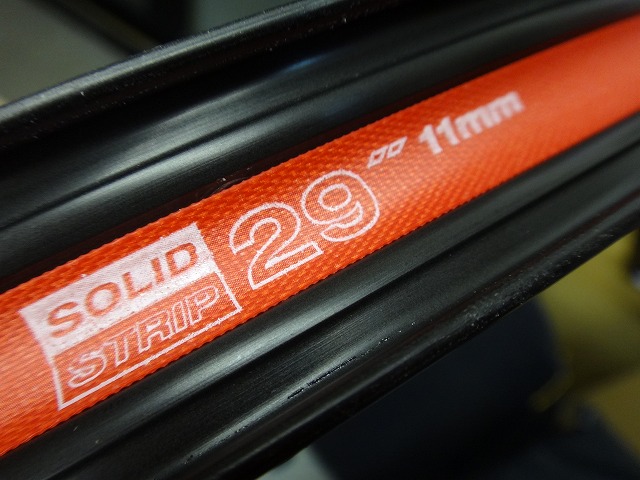
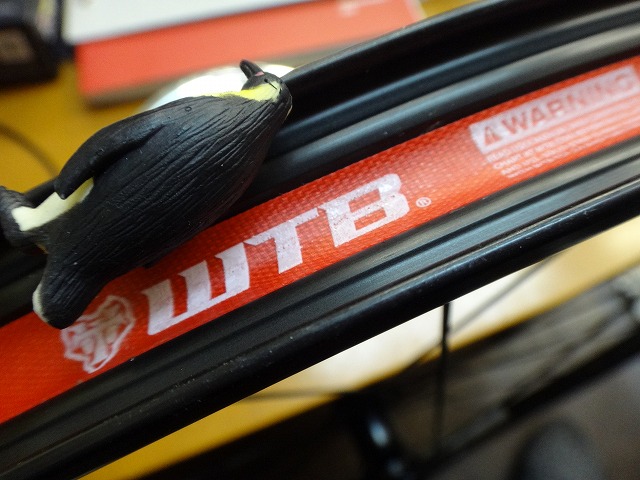
Now, here's where the article gets valuable:
When I peeled off the TCS tape (probably), underneath was an 11mm-wide "solid strip"
stretch band-type rim tape that fills the center depression of the rim.
Here, "strip" refers to the noun meaning "a long narrow piece,"
not the verb "to remove."
It's a rim tape that feels extremely resistant to air pressure,
and because it fits perfectly into the depression, it doesn't shift.
By the way, this rim's hump doesn't have a narrow peak but rather
a flat surface like those seen on ENVE and similar rims.
WTB's tubeless-ready rim spec is called
TCS (Tubeless Compatible System),
and the new standard is now TCS 2.0,
and this i23 rim is also TCS 2.0 compatible.
It's not explicitly stated whether the solid strip alone is sufficient
when using tubed tires.
When using as TCS 2.0 tubeless, a separate tape-type rim tape called
TCS 2.0 Flex rim tape (different from TCS tape) must be used together with the solid strip.
"Solid" (durable) and "Flex" (flexible) are antonyms,
indicating they're meant to be used together.
The TCS 2.0 Flex tape is a semi-transparent brown color,
clearly not made by Stans.
The wheel in its original state had
TCS 2.0 compatible rim + TCS tape + solid strip,
and this combination works fine as a tubeless-ready rim.
After re-lacing, it has Stans rim tape, which is also fine.
Now, here's what I really wanted to write about:
With 29-inch and 27.5-inch rims,
low-profile rims where the inner and outer rim holes are very close
are becoming increasingly common.
This rim is like that, and so are Stans' Crest and
DT's XR331, among others.
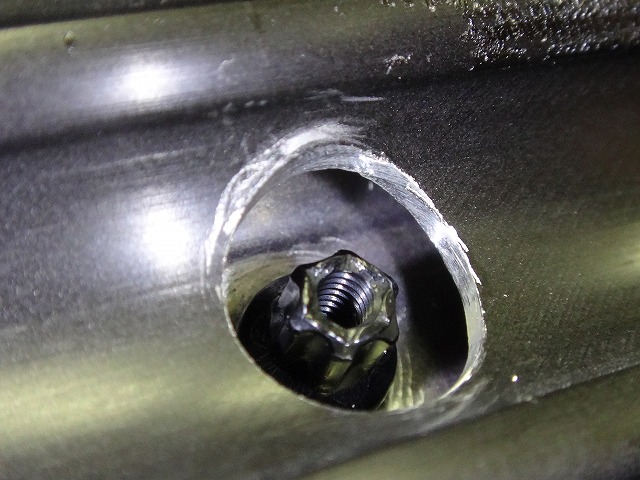
I haven't actually used them, but I fitted
DT's Squorx nipple through the WTB i23 rim.
Squorx nipples are 3mm extended outward on the outer circumference
compared to standard nipples,
and with this rim combination,
the nipple's end face is very close to the rim's tape surface.
After applying Stans rim tape in a single layer and pushing hard with my finger,

↑it turned out like this.
The nipple's shape shows through.
With actual pressurized use over time with a tube or tubeless,
the tape sinks deeper into the rim hole,
creating small holes that can cause flats—and actually do.
On my personal XR331 rim with Stans rim tape
wound single-layer except directly below the valve hole (I was trying to save rotational weight),
the tape came into contact with the nipple over time,
creating a small crack in the rim in the front-to-back direction,
which caused the tube to pinch flat.
I used it tubeless for a while, and when I peeled off the tape,
there was sealant packed into the nipple hole as if carefully inserted with a dropper,
so it must have started cracking before I switched to tubed.
The sealant was doing its job and no obvious air leak occurred,
so I didn't notice the crack while using it tubeless.
With WTB or Stans rims, you don't need to specifically use Squorx nipples,
but with DT (I've suffered painful lessons from this in the past) you must.
With XR331 and XR361, like the WTB rim earlier, the nipple's end face
is very close to the rim's tape surface, so
when applying Stans rim tape,
it's better to do double layers (triple only directly below the valve hole)
(though I've been saying "directly below the valve hole," some prefer
the overlap on the opposite side of the valve).
With RR411-series rims, there's slightly more clearance between the nipple end and the tape,
not as tight as XR331,
but when I inspected the rear wheel of an RR411 rim (for rim brakes)
that I'd built in the past, the customer had applied
a second piece about 5cm long at the rim hole position,
like a Velox patch.
DT rim's center depression isn't as tight and crisp
as WTB's, so I'm not sure if a solid strip fits cleanly.
If mounted anyway, using it with Stans tape would secure it
so it wouldn't shift left and right.
The reason I use Stans rim tape despite knowing
it deforms flexibly against the rim while being somewhat prone to
compression from air pressure
is that after peeling off the tape, there's almost no adhesive residue on the rim,
and even if there is, it's easy to remove.
Stans rims use their own BSD (Bead Socket Technology) standard
instead of ETRTO spec, with a unique bead design.
According to the maker's intention, the bead hook height is extremely low,
and when applying Stans' own tape in double layers
(though the maker specifies single-layer anyway),
the tape covers the bead hook height,
making the tire bead seat poorly.
I've heard that with MTB tires, there have been cases
of the tire coming off when applied in double layers.
DT rim with Stans tape: double-layer recommended,
DT rim with WTB solid strip: want to try it,
Stans rim with Stans tape: strict single-layer compliance,
is what this article meant to convey.
I wrote that stretch band-type rim tape doesn't work with tubeless-ready rims,
but there are exceptions: purpose-made products for specific rims.
This is a wheel from the next article,
and it conveniently had a stretch band-type
tubeless-ready rim tape, so I photographed it.
The rim is a Mavic 419 DISC.
It's stretch band-type but has custom indentations that follow
the rim's shape and are tubeless-ready compatible.
I removed the rim tape to replace a broken nipple.
It's a single-eyed rim with decent rim height, allowing the nipple to pass through the rim,
so if it couldn't be reused after removal, I thought I'd use
the magnet-pull method like Zonda or Racing 3
(a single nipple isn't too much trouble),
but it came off fairly easily.
Bontrager has similar-purpose rim tape
(of course, custom-made for their rims),
but that one fits so tightly and bites into the rim
that I'm very careful not to damage it when removing it during wheel repairs.