Another day with wheels (and so on).
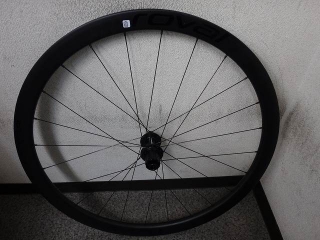
Continuing from the other day.
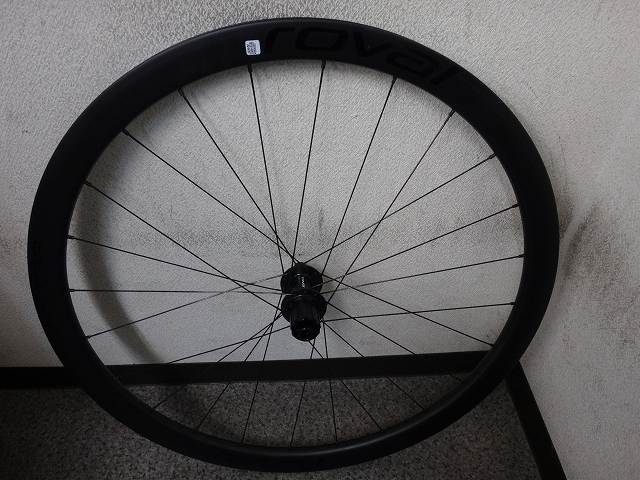
I'm rebuilding the rear wheel of the Roval C38 as well.
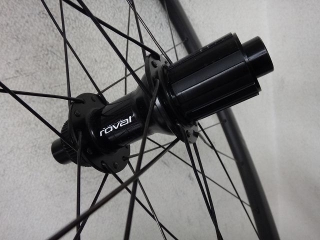
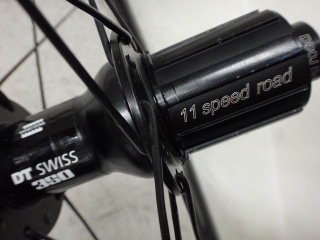
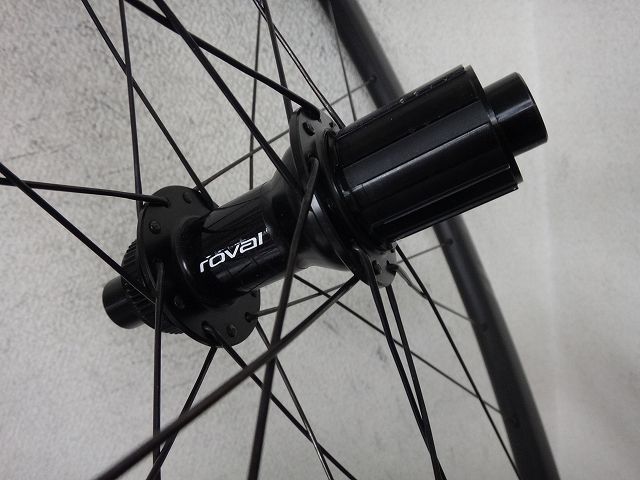
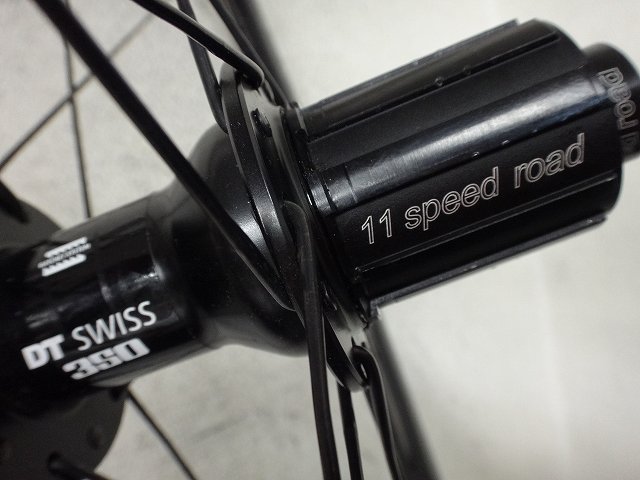
The hub is a DT350 with a dual-branded Roval specification,
and it's an old Star Ratchet freewheel body hub.
The over-locknut dimension—or rather, the over-axle-end dimension—
measured exactly 143mm.
The spokes are black Competition Race on both sides, same as the front wheel,
24H with JIS 4-cross lacing.
The original state had no centering issues,
and the tension on the freewheel side was tensioned right at the upper limit of what was possible with this spoke.
This couldn't be done any other way.
When building a wheel and turning the nipples to tighten them,
the rotation amount enters a zone where it barely reflects in the reduction of spoke deformation.
This is what we call a plateau—but this plateau means that up until that point,
the trend was increasing.
With a hub that has significant dish, one side reaches the plateau while
the other side stops halfway through the increasing trend.
The reason the high-tension side plateaus is either tension dead-end on the rim side,
or spoke warp ("unyon") on the spoke side.
If we're going to maintain the fundamental principle of centering the wheel at the center,
then no matter how loose the non-freewheel side of the rear wheel is,
we can't tension it further.
In the case of this rear wheel, where the spoke reaches its limit before the rim does,
and especially when using identical diameter, identical count, identical lacing,
the tension on the non-freewheel side stops at a fairly low point in the increasing trend.
The lower the tension, the greater the variation in spoke tension,
and when you loosen the nipples on such a rear wheel by about half a turn while maintaining center
(if the non-freewheel side is exactly half a turn, the freewheel side is slightly more),
the freewheel side becomes only slightly loose in comparison,
while the non-freewheel side's spoke tension drops dramatically,
and when you pinch and shake the spokes with your fingers, some become rattlingly loose.
To disguise this somewhat, there's no choice but to tension the freewheel side as tight as possible.
The tensioning showed signs of real effort applied with that strategy in mind.
Competition Race and Revolution are lightweight butted spokes that can still be used on wheels around 32H,
but 24H is a bit tough, and 20H or less should probably be avoided.
Especially on hubs with significant dish.
The front wheel had a rather ridiculous radial lacing on the non-rotor-mount side,
and it barely functions as a wheel precisely because the hub has some dish.
If this rear wheel's stock spec had been Competition instead of Competition Race,
it would have been better (or rather, a normal wheel),
but...
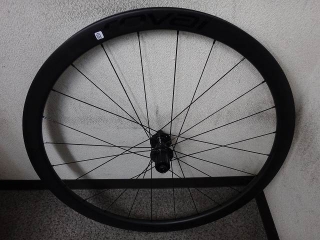
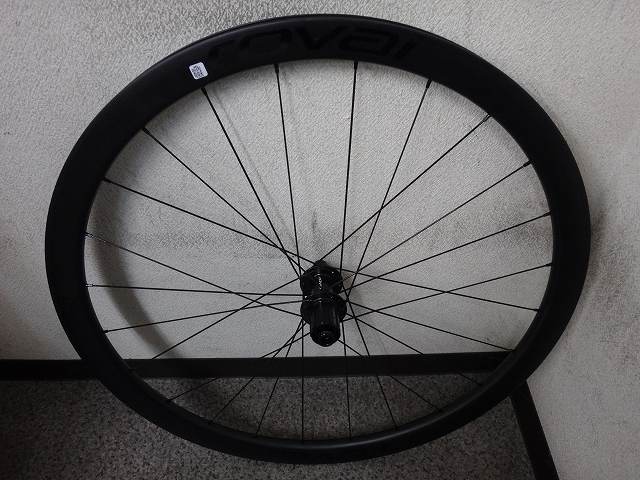
Built.
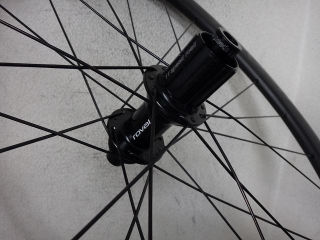
Black half-Competition 4-cross JIS lacing.
I'll do the spoke dressing later.
On the Japanese manufacturer's website, this wheel is described with the phrase:
"There isn't a road cyclist who doesn't want carbon wheels.
They just can't afford them because of the price tag."
I see. So to hook people who have the understanding that any carbon rim is fine,
the way is to push the rim material front and center.
Regarding weight, it lists the "wheel set total weight" as 1560g,
but this information doesn't include what's fundamental to the wheel's nature
(strictly speaking, it's not that it's not included, but rather mixed with unnecessary things).
And the price—they're bold enough to claim people can't afford them because of the tag,
but looking at what it actually costs: ¥143,000 (tax included). It's not particularly cheap.
In my view, the stock condition of this wheel is like a semi-finished product that's unusable without modification—
the rim and hub, plus spokes and nipples that are destined for the trash,
all bundled together, that's my understanding.
"There isn't a road cyclist who doesn't want carbon wheels," it says.
But my priority ranking for rim performance is:
1: Absolute weight (actual measured rim-only value)
2: Rim's allowable tension limit
3: Relative weight (the lightness evaluation relative to rim depth)
Whether it's a carbon rim or not has no direct relationship to riding performance
(though it does affect buckling resistance.
With an aluminum rim, if the bead hook collapses under buckling,
a carbon rim can withstand it without permanent external deformation).
First, is the rim light? Next, is it a rim you can tension?
Finally, if the weight is the same, a deeper rim is basically superior
(though there are exceptions and limits to this).
When researching this wheel and searching "roval c38" on Google,
the autocomplete shows "roval c38 rim weight."
But from what I could see, many sources list the manufacturer's claimed wheel weight as 1560g,
but I couldn't find anywhere that mentions the actual measured weight of the rim.
Also unrelated, but regarding spokes,
some places write things like "J-bend Competition so spoke breakage and other unexpected situations are easy to handle,"
but the spokes are Competition Race, not Competition, and these are hard to source. Do your research before you write.
Of course I'm weighing the rim this time too.
At this timing, it might become particularly valuable information when compared to the measured weight of the Hologram's 35mm-deep rim.
And precisely because I know that... I'm not going to tell you.
↑Ugh, holding out like this and then this? The worst.
Sorry for the wait! Please check out this image!
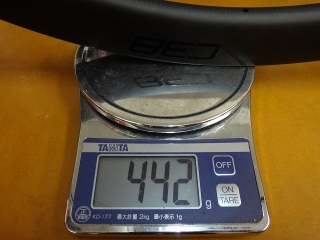
Front rim!
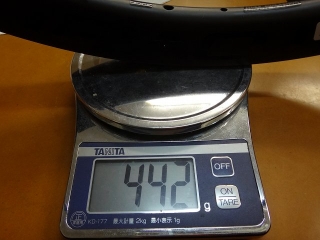
Rear rim!
↑Stop it!
Continuing from the other day.
I'm rebuilding the rear wheel of the Roval C38 as well.
The hub is a DT350 with a dual-branded Roval specification,
and it's an old Star Ratchet freewheel body hub.
The over-locknut dimension—or rather, the over-axle-end dimension—
measured exactly 143mm.
The spokes are black Competition Race on both sides, same as the front wheel,
24H with JIS 4-cross lacing.
The original state had no centering issues,
and the tension on the freewheel side was tensioned right at the upper limit of what was possible with this spoke.
This couldn't be done any other way.
When building a wheel and turning the nipples to tighten them,
the rotation amount enters a zone where it barely reflects in the reduction of spoke deformation.
This is what we call a plateau—but this plateau means that up until that point,
the trend was increasing.
With a hub that has significant dish, one side reaches the plateau while
the other side stops halfway through the increasing trend.
The reason the high-tension side plateaus is either tension dead-end on the rim side,
or spoke warp ("unyon") on the spoke side.
If we're going to maintain the fundamental principle of centering the wheel at the center,
then no matter how loose the non-freewheel side of the rear wheel is,
we can't tension it further.
In the case of this rear wheel, where the spoke reaches its limit before the rim does,
and especially when using identical diameter, identical count, identical lacing,
the tension on the non-freewheel side stops at a fairly low point in the increasing trend.
The lower the tension, the greater the variation in spoke tension,
and when you loosen the nipples on such a rear wheel by about half a turn while maintaining center
(if the non-freewheel side is exactly half a turn, the freewheel side is slightly more),
the freewheel side becomes only slightly loose in comparison,
while the non-freewheel side's spoke tension drops dramatically,
and when you pinch and shake the spokes with your fingers, some become rattlingly loose.
To disguise this somewhat, there's no choice but to tension the freewheel side as tight as possible.
The tensioning showed signs of real effort applied with that strategy in mind.
Competition Race and Revolution are lightweight butted spokes that can still be used on wheels around 32H,
but 24H is a bit tough, and 20H or less should probably be avoided.
Especially on hubs with significant dish.
The front wheel had a rather ridiculous radial lacing on the non-rotor-mount side,
and it barely functions as a wheel precisely because the hub has some dish.
If this rear wheel's stock spec had been Competition instead of Competition Race,
it would have been better (or rather, a normal wheel),
but...
Built.
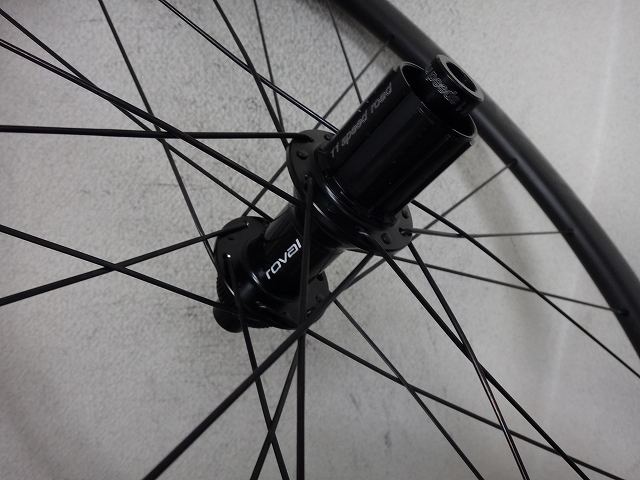
Black half-Competition 4-cross JIS lacing.
I'll do the spoke dressing later.
On the Japanese manufacturer's website, this wheel is described with the phrase:
"There isn't a road cyclist who doesn't want carbon wheels.
They just can't afford them because of the price tag."
I see. So to hook people who have the understanding that any carbon rim is fine,
the way is to push the rim material front and center.
Regarding weight, it lists the "wheel set total weight" as 1560g,
but this information doesn't include what's fundamental to the wheel's nature
(strictly speaking, it's not that it's not included, but rather mixed with unnecessary things).
And the price—they're bold enough to claim people can't afford them because of the tag,
but looking at what it actually costs: ¥143,000 (tax included). It's not particularly cheap.
In my view, the stock condition of this wheel is like a semi-finished product that's unusable without modification—
the rim and hub, plus spokes and nipples that are destined for the trash,
all bundled together, that's my understanding.
"There isn't a road cyclist who doesn't want carbon wheels," it says.
But my priority ranking for rim performance is:
1: Absolute weight (actual measured rim-only value)
2: Rim's allowable tension limit
3: Relative weight (the lightness evaluation relative to rim depth)
Whether it's a carbon rim or not has no direct relationship to riding performance
(though it does affect buckling resistance.
With an aluminum rim, if the bead hook collapses under buckling,
a carbon rim can withstand it without permanent external deformation).
First, is the rim light? Next, is it a rim you can tension?
Finally, if the weight is the same, a deeper rim is basically superior
(though there are exceptions and limits to this).
When researching this wheel and searching "roval c38" on Google,
the autocomplete shows "roval c38 rim weight."
But from what I could see, many sources list the manufacturer's claimed wheel weight as 1560g,
but I couldn't find anywhere that mentions the actual measured weight of the rim.
Also unrelated, but regarding spokes,
some places write things like "J-bend Competition so spoke breakage and other unexpected situations are easy to handle,"
but the spokes are Competition Race, not Competition, and these are hard to source. Do your research before you write.
Of course I'm weighing the rim this time too.
At this timing, it might become particularly valuable information when compared to the measured weight of the Hologram's 35mm-deep rim.
And precisely because I know that... I'm not going to tell you.
↑Ugh, holding out like this and then this? The worst.
Sorry for the wait! Please check out this image!

Front rim!
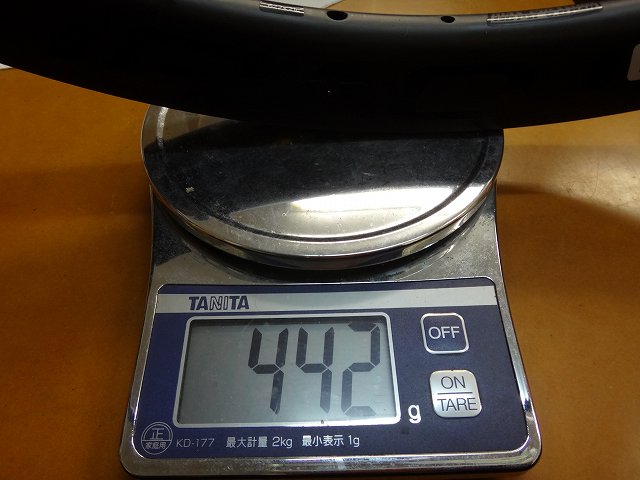
Rear rim!
↑Stop it!