Another day of wheel building (and so on).
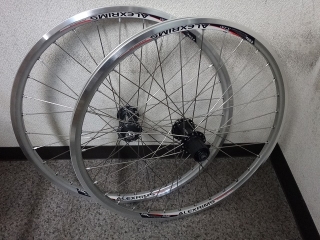
Built a rear wheel with an R390 20-inch WO rim.

FH-RS300, 32-hole, all Champion 14/15 gauge, four-cross lacing with no spoke ties.
I noticed during wheel building that
this rear wheel turned out with a very small difference
in spoke deflection between left and right sides.
That said, the main cause isn't because it uses
different diameter and different spoke counts on left and right.
You can't confuse the relative importance of various factors
with the result of having small left-right differences.
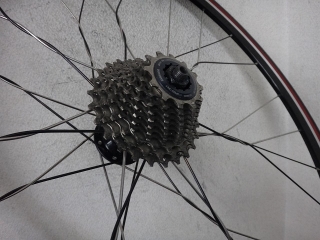
↑This is my personal rear wheel,
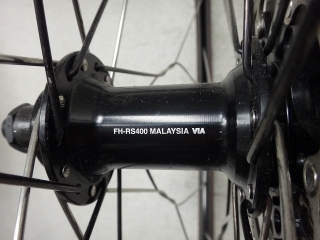
The hub is a Shimano FH-RS400 with an 11-speed freebody.
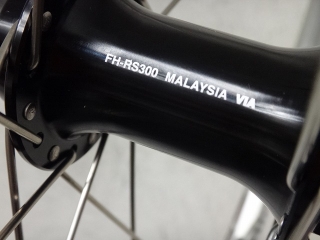
The hub on this rear wheel is an FH-RS300,
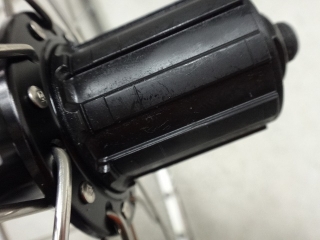
with a 10-speed freebody.
These two hubs don't actually share the hub body
apart from the freebody section—
The RS400 has flange hole center spacing of 45/44mm with subtle high-low flanges,
which matches Dura-Ace hubs like the FH-9000,
whereas the RS300 has 45mm on both sides.
The flange width also differs:
RS-400 is 56.9mm, RS-300 is 57.9mm.
It might look like just a 1mm difference, but
the "ochoko" amount (Shimano's term) is
RS-400 at 9.75mm and RS-300 at 8.4mm,
so the left and right flange widths become
RS-400 at 56.9/2 ±9.75mm,
RS-300 at 57.9/2 ±8.4mm, and
calculating this specifically with right flange width/left flange width in that order:
RS-400 is 18.7/38.2mm,
RS-300 is 20.55/37.35mm—
the right flange width differs by nearly 2mm.
This is an extremely significant difference.
Despite the constraint that 11-speed sprockets can't be fitted,
the FH-RS300 is dimensionally far superior to the FH-9000, Evobrite hubs,
or Chris King's R45.
This is the primary reason—the biggest factor—why this wheel
showed so little left-right difference when building it.
Update:
I received a comment saying that with small-diameter rims,
the spoke angle on the freewheel side lies back more than on 700C,
which is also significant.
Actually, in my draft stage there was a section about "because it's a small-diameter rim..."
but when the rim gets smaller, or rather when spokes get shorter,
(structurally the spokes are the same whether it's this 24-inch or
a 700C rim around 110mm tall)
the spoke deflection itself becomes smaller,
so regarding the evaluation of which factor is larger—
the smallness of the rim inner diameter or the spoke angle—
I couldn't tell for certain, so I deliberately didn't write about it.
There's something strange about evaluating the importance and weighting of factors:
The finished wheels that come from people who have tools
like finite element analysis and wind tunnel testing
are, frankly, pretty mediocre work,
and I'm often told they improve when I rebuild them—
this happens because factors are being misweighted.
Especially there's a tendency to overestimate aerodynamics.
This applies to things like thoughtlessly reducing spoke count, or
specs that say if the rim is aerodynamically superior (which is clear from wind tunnel testing,
so I don't doubt that part) it's fine even if the rim gets heavier.
Also, there was some idiot who said spoke ties have no meaning because he couldn't
(within the means available to him)
quantify their effect, but that guy seems to have vanished.
What I really think is dangerous isn't that wheel,
but the aerobars bolted with just a single bolt, grabbing
the excess steerer tube above the stem.
It's true you can get a high and close position,
but that structure could literally kill someone if it snaps while riding,
and if they sell any decent number of them,
there might be cases from user mishandling (insufficient bolt tightness, etc.),
but I think it'll break somewhere eventually.

Built a rear wheel with an R390 20-inch WO rim.
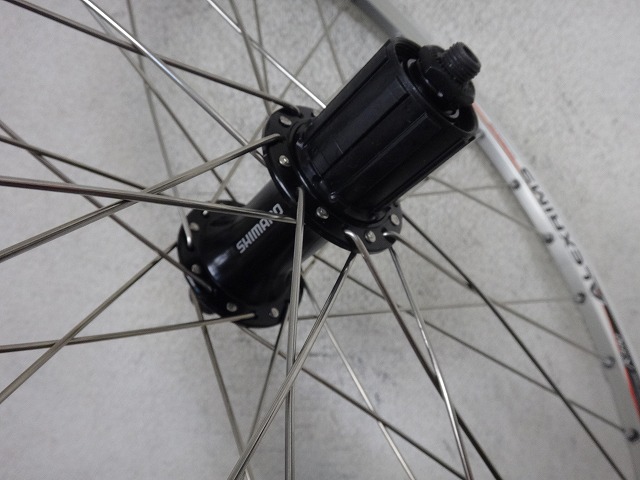
FH-RS300, 32-hole, all Champion 14/15 gauge, four-cross lacing with no spoke ties.
I noticed during wheel building that
this rear wheel turned out with a very small difference
in spoke deflection between left and right sides.
That said, the main cause isn't because it uses
different diameter and different spoke counts on left and right.
You can't confuse the relative importance of various factors
with the result of having small left-right differences.
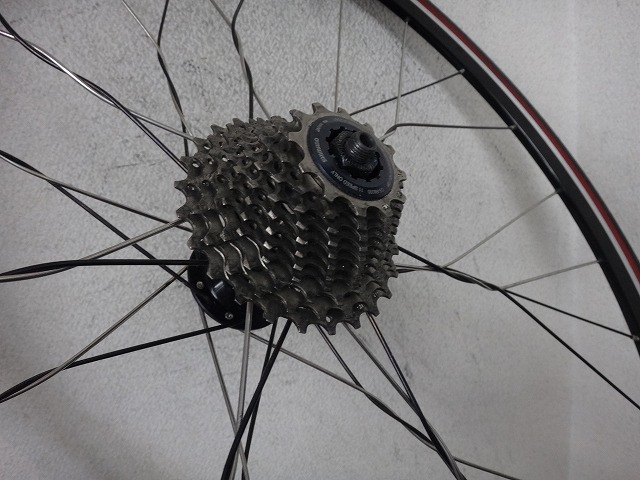
↑This is my personal rear wheel,
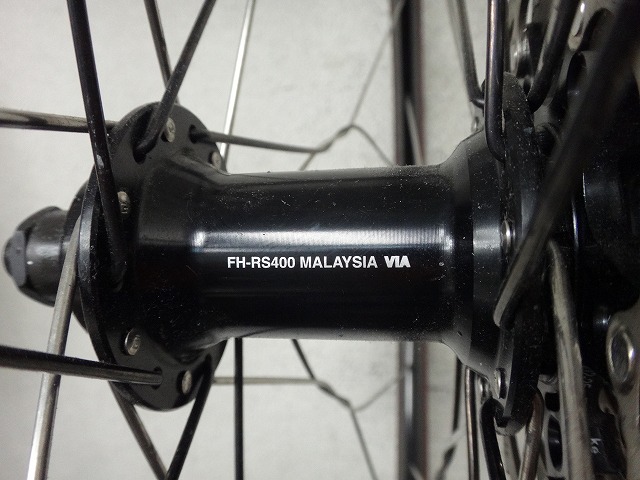
The hub is a Shimano FH-RS400 with an 11-speed freebody.
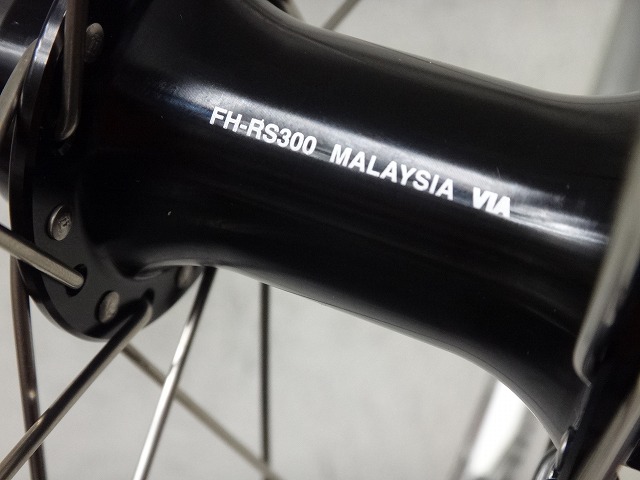
The hub on this rear wheel is an FH-RS300,
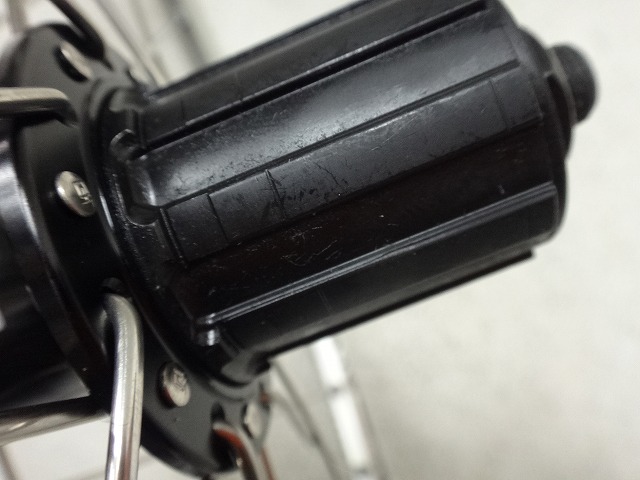
with a 10-speed freebody.
These two hubs don't actually share the hub body
apart from the freebody section—
The RS400 has flange hole center spacing of 45/44mm with subtle high-low flanges,
which matches Dura-Ace hubs like the FH-9000,
whereas the RS300 has 45mm on both sides.
The flange width also differs:
RS-400 is 56.9mm, RS-300 is 57.9mm.
It might look like just a 1mm difference, but
the "ochoko" amount (Shimano's term) is
RS-400 at 9.75mm and RS-300 at 8.4mm,
so the left and right flange widths become
RS-400 at 56.9/2 ±9.75mm,
RS-300 at 57.9/2 ±8.4mm, and
calculating this specifically with right flange width/left flange width in that order:
RS-400 is 18.7/38.2mm,
RS-300 is 20.55/37.35mm—
the right flange width differs by nearly 2mm.
This is an extremely significant difference.
Despite the constraint that 11-speed sprockets can't be fitted,
the FH-RS300 is dimensionally far superior to the FH-9000, Evobrite hubs,
or Chris King's R45.
This is the primary reason—the biggest factor—why this wheel
showed so little left-right difference when building it.
Update:
I received a comment saying that with small-diameter rims,
the spoke angle on the freewheel side lies back more than on 700C,
which is also significant.
Actually, in my draft stage there was a section about "because it's a small-diameter rim..."
but when the rim gets smaller, or rather when spokes get shorter,
(structurally the spokes are the same whether it's this 24-inch or
a 700C rim around 110mm tall)
the spoke deflection itself becomes smaller,
so regarding the evaluation of which factor is larger—
the smallness of the rim inner diameter or the spoke angle—
I couldn't tell for certain, so I deliberately didn't write about it.
There's something strange about evaluating the importance and weighting of factors:
The finished wheels that come from people who have tools
like finite element analysis and wind tunnel testing
are, frankly, pretty mediocre work,
and I'm often told they improve when I rebuild them—
this happens because factors are being misweighted.
Especially there's a tendency to overestimate aerodynamics.
This applies to things like thoughtlessly reducing spoke count, or
specs that say if the rim is aerodynamically superior (which is clear from wind tunnel testing,
so I don't doubt that part) it's fine even if the rim gets heavier.
Also, there was some idiot who said spoke ties have no meaning because he couldn't
(within the means available to him)
quantify their effect, but that guy seems to have vanished.
What I really think is dangerous isn't that wheel,
but the aerobars bolted with just a single bolt, grabbing
the excess steerer tube above the stem.
It's true you can get a high and close position,
but that structure could literally kill someone if it snaps while riding,
and if they sell any decent number of them,
there might be cases from user mishandling (insufficient bolt tightness, etc.),
but I think it'll break somewhere eventually.