This is from a little while back, but
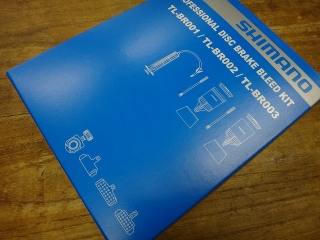
I picked up a Shimano Professional Disc Brake
Bleed Kit.
It comes with two types of funnels and four types of
yellow blocks that get clamped onto the brake body during bleeding,
plus a new-style syringe set.
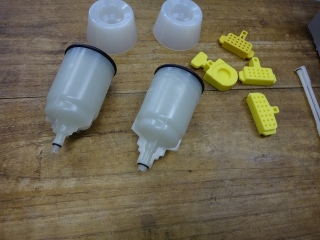
As for the yellow blocks,
some types included probably aren't ones we'd use at the shop,
and we already have everything else.
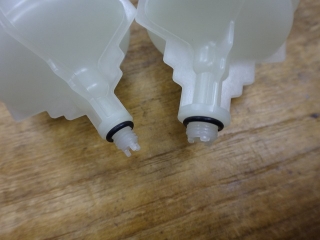
There are two types of funnels—
the one with the finer thread diameter (M5) is for flat bars,
and the thicker one (M7) is for road STI levers.
Until recently,
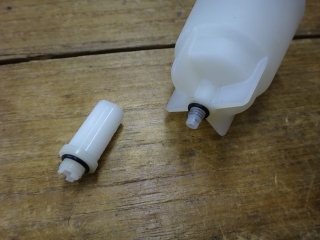
we had to use an adapter with the fine-diameter funnel to convert it to the thicker size.
With this adapter installed,
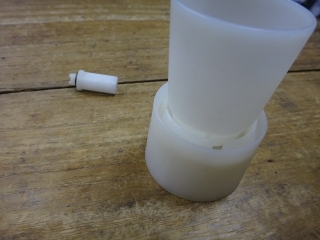
the base that works with the fine diameter couldn't be used,
but the new model comes with separate bases for each diameter.
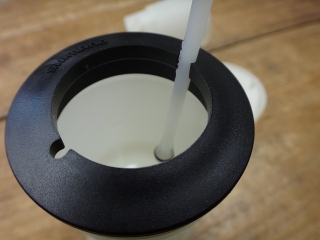
Recently, a black perforated cap was added
to reduce oil splashing.
The cap is removable, but
since it means more washing up afterwards,
we don't use it most of the time.
By the way, "funnel" written in kanji is "漏斗," and
"じょうご" written in kanji also becomes "漏斗."
This is what's called jukuji-kun (rare kanji readings),
like how "烏賊 (squid)," "灰汁 (lye)," and "足袋 (tabi socks)"
don't have individual readings for each character—
烏 isn't read as "i," 賊 isn't read as "ka," etc.
The manufacturer's official name for this part is "じょうご,"
but if we write it as 漏斗, it would likely be read as "ろうと,"
so I went with hiragana "じょうご."
It's a bit different, but reading mixed-gender siblings like
姉弟 or 兄妹 as "きょうだい" (siblings) is similar.
And on yet another note,
経緯 converted from "けいい" and 経緯 converted from "いきさつ"
look identical on the page.
Since the meanings are basically the same, there's no real problem.
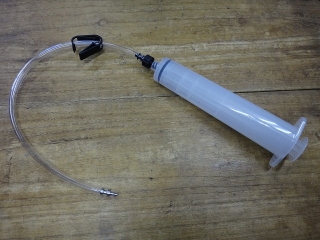
The star of this set is arguably the new syringe.
It has a stopper partway along the hose,
like you see on AVID syringes and others.

Only the outer diameter has a taper shape;
the inner bore of the telescopic section is a straight cylinder.
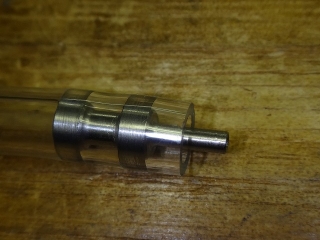
The part that goes into the brake caliper—
the key things are whether it stays put when pressure is applied
and whether oil splashes everywhere when you pull it out.
Either way, you hold it with a paper towel as you remove it.
For the syringe from this kit as a standalone item,
the part number is TL-BR001 and the list price (before tax) is ¥4,340.
The road funnel is TL-BR002 at ¥1,435,
and the flat bar funnel is TL-BR003 at ¥1,435.
If you add up the individual prices, that's ¥7,210,
but buying the kit costs ¥5,278 and includes all the yellow block types.
The part numbers TL-BR001, 002, and 003 look like
a brand new series, but
the fine-diameter funnel on its own had existed before
under the part number SM-DISC,
and a set with the old-style syringe
had the part number TL-BT03S.
(Obviously) I already have those.
So if I needed what I was missing, I could just buy
the thicker-diameter funnel and the new syringe,
but buying those two separately comes to ¥5,775,
which is more than the TL-BR001-003 kit at ¥5,278.
So even with the fine-diameter funnel and some duplicate yellow blocks,
buying the kit is the better deal—
and that's what I did.
It's like owning single records of songs released before an album came out,
then finding the same version on the album itself,
paying twice for the same song.
As for the title, the Beatles basically made a point of
ensuring that singles they sold to fans wouldn't be duplicated on albums.
This held true until their breakup, at least for UK releases,
with almost no exceptions.
Recent best-of albums are a different story, though.
Bonus
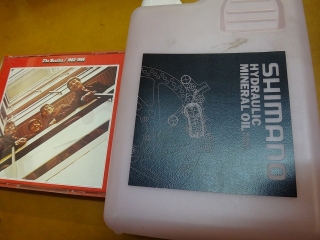
↑This is the old packaging (from quite a while back) for Shimano's mineral oil in a 1-liter container,
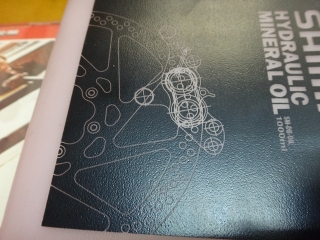
and it features what appears to be
a 6-hole rotor with a 4-piston XT BR-M755 brake,
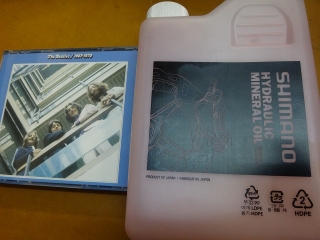
but with the current product,
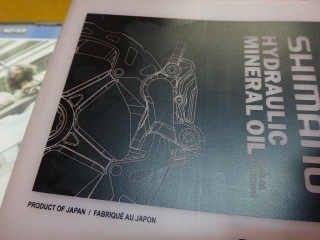
it now features a center-lock rotor with
what appears to be the 4-piston version of the M9100 series XTR,
the BR-M9120 brake.

I picked up a Shimano Professional Disc Brake
Bleed Kit.
It comes with two types of funnels and four types of
yellow blocks that get clamped onto the brake body during bleeding,
plus a new-style syringe set.

As for the yellow blocks,
some types included probably aren't ones we'd use at the shop,
and we already have everything else.

There are two types of funnels—
the one with the finer thread diameter (M5) is for flat bars,
and the thicker one (M7) is for road STI levers.
Until recently,

we had to use an adapter with the fine-diameter funnel to convert it to the thicker size.
With this adapter installed,

the base that works with the fine diameter couldn't be used,
but the new model comes with separate bases for each diameter.

Recently, a black perforated cap was added
to reduce oil splashing.
The cap is removable, but
since it means more washing up afterwards,
we don't use it most of the time.
By the way, "funnel" written in kanji is "漏斗," and
"じょうご" written in kanji also becomes "漏斗."
This is what's called jukuji-kun (rare kanji readings),
like how "烏賊 (squid)," "灰汁 (lye)," and "足袋 (tabi socks)"
don't have individual readings for each character—
烏 isn't read as "i," 賊 isn't read as "ka," etc.
The manufacturer's official name for this part is "じょうご,"
but if we write it as 漏斗, it would likely be read as "ろうと,"
so I went with hiragana "じょうご."
It's a bit different, but reading mixed-gender siblings like
姉弟 or 兄妹 as "きょうだい" (siblings) is similar.
And on yet another note,
経緯 converted from "けいい" and 経緯 converted from "いきさつ"
look identical on the page.
Since the meanings are basically the same, there's no real problem.

The star of this set is arguably the new syringe.
It has a stopper partway along the hose,
like you see on AVID syringes and others.

Only the outer diameter has a taper shape;
the inner bore of the telescopic section is a straight cylinder.

The part that goes into the brake caliper—
the key things are whether it stays put when pressure is applied
and whether oil splashes everywhere when you pull it out.
Either way, you hold it with a paper towel as you remove it.
For the syringe from this kit as a standalone item,
the part number is TL-BR001 and the list price (before tax) is ¥4,340.
The road funnel is TL-BR002 at ¥1,435,
and the flat bar funnel is TL-BR003 at ¥1,435.
If you add up the individual prices, that's ¥7,210,
but buying the kit costs ¥5,278 and includes all the yellow block types.
The part numbers TL-BR001, 002, and 003 look like
a brand new series, but
the fine-diameter funnel on its own had existed before
under the part number SM-DISC,
and a set with the old-style syringe
had the part number TL-BT03S.
(Obviously) I already have those.
So if I needed what I was missing, I could just buy
the thicker-diameter funnel and the new syringe,
but buying those two separately comes to ¥5,775,
which is more than the TL-BR001-003 kit at ¥5,278.
So even with the fine-diameter funnel and some duplicate yellow blocks,
buying the kit is the better deal—
and that's what I did.
It's like owning single records of songs released before an album came out,
then finding the same version on the album itself,
paying twice for the same song.
As for the title, the Beatles basically made a point of
ensuring that singles they sold to fans wouldn't be duplicated on albums.
This held true until their breakup, at least for UK releases,
with almost no exceptions.
Recent best-of albums are a different story, though.
Bonus

↑This is the old packaging (from quite a while back) for Shimano's mineral oil in a 1-liter container,

and it features what appears to be
a 6-hole rotor with a 4-piston XT BR-M755 brake,

but with the current product,

it now features a center-lock rotor with
what appears to be the 4-piston version of the M9100 series XTR,
the BR-M9120 brake.