A customer brought in a Bora Ultra 80 front wheel for track use.
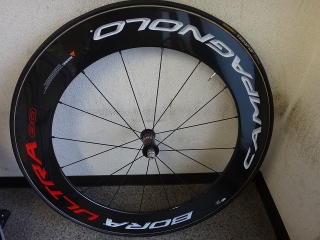
There used to be a road wheel with the same name.
With the 50mm and 35mm depth Bola wheels,
the front was 18H and the rear had G3 in 7 pairs for 21H,
but the 80mm depth Bora came with a front of 16H
and rear with G3 in 6 pairs for 18H.
The road Bora Ultra 80 was the first Bora
to move away from internal nipples,
and continued unchanged from 2012–2019.
In other words, it only existed in narrow rim (20mm width) specification.
This track-specific Bora Ultra 80 front wheel is a current product
that hasn't been discontinued.
By the way, in 2014 the Bora Ultra and One 35 came out,
and like the 80, they also came in narrow rim + external nipple configuration
as tubular only. However, the following year it went to wide rim,
so the Bora 35 narrow rim spec only came out in 2014.
This is one of what I consider the strongest wheels ever made.
The source for this information is here.
When I look things up related to wheels, this comes up a lot,
but I already know everything that guy writes about.
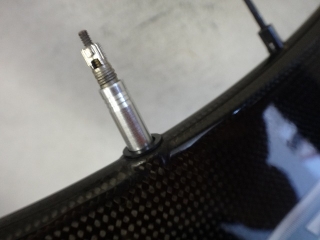
The valve extender is a non-OEM pass-through style
(because you can't pass it through the valve ferrule if you use the slip-on type),
and the customer wants it replaced with the genuine article.
The genuine version has threads cut into part of it,
allowing a valve nut to be installed.
Functionally, this non-OEM version works fine.
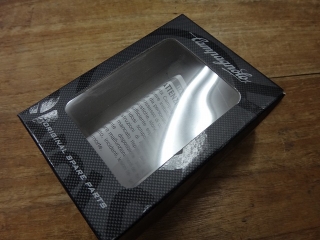
So I ordered one in.
The work itself takes less than a day, but sourcing took forever.
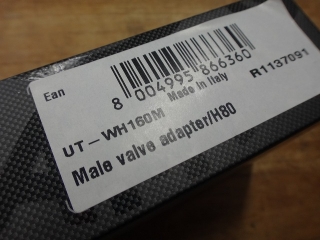
The part number is UT-WH160M, with the M at the end
referring to "Male" in the product name—a male-threaded valve extender.
There's also a UT-WH160 without the M at the end,
but that's a tool for attaching to Bullet and Bullet Ultra nipples
to guide with a magnet—only used during wheel building.
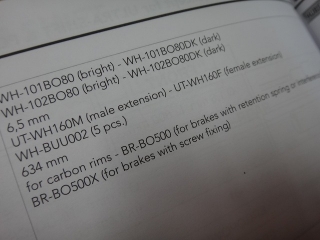
↑There used to be a female (slip-on) version,
the UT-WH160F, but that's been discontinued.
Since the slip-on style can't pass through the valve ferrule,
about the only use case you can imagine is
fitting it over a valve that only has the valve core exposed
to add air afterward. But since the Bora 80 only comes in tubular rim spec,
unlike clincher tubes, there's no tubular tire with a valve length
that's built in from the start for an 80mm rim.
In the first place, they'd absolutely be using a pass-through extender,
so needing a slip-on extender would be an extremely rare situation.
By the way, the terms male thread, female thread, and male/female
might someday become unusable for political correctness reasons
due to their sexual connotations.
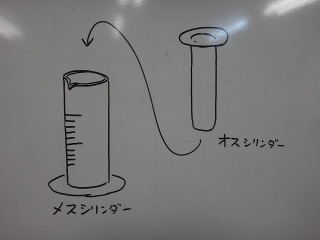
Now, what happens with laboratory equipment like graduated cylinders
or their counterpart male cylinders, I wonder.
Before I get a serious response, let me note that
"female" in graduated cylinder has no meaning of "female."
It's from the German word "messzylinder," written as one word—
you can't split it into "mess" and "zylinder."
Graduated cylinder in English gets its name from the verb "graduate,"
which usually means "to complete school," but besides the intransitive sense of "graduate"
and the transitive sense of "to graduate someone,"
it also has a transitive meaning of "to mark with graduations"
from the image of proceeding in stages.
German has the word "Schadenfreude,"
which in Japanese internet slang
corresponds to something like "meshiuma" (delighting in others' misfortune),
though the nuances differ slightly. In English-speaking regions,
because the subtle nuances are hard to translate fully,
it's used as a loanword in the original German spelling.
It's a bit different from that, but do English speakers
also use the German word "messzylinder"?
As for me, I'll just make up (※) the theory that
"the female cylinder was 'graduated' by the male cylinder
before shipping, during the manufacturing process,
which is why it's called that"—another explanation sure to get me in trouble.
※I'm converting "detsuzo" and not "netsuzo."
That's some pretty solid conversion. Anyway.
Dokudanjou → 独壇場
Dokusenjou → 独擅場
The latter is actually the correct Japanese,
and the second character is different too.
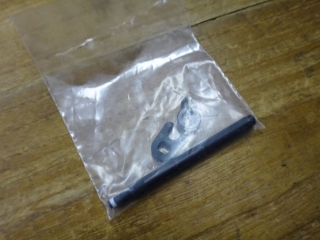
↑This thing
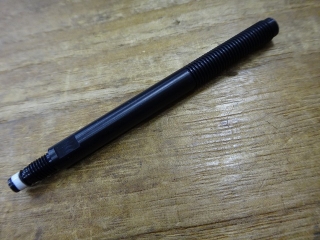
Partially threaded—though not in the same stupid way
as seen on Specialized tubes and tubeless valves,
or Mavic tubeless valves (here).
With those, the outer diameter has threads, and the unthreaded part
matches the root diameter of the thread.
But this male extender has threads on the inside,
and the unthreaded part matches the crest diameter of the thread.
Specialized's half-threaded valves have a narrow pump head opening diameter,
so the engagement is loose. If you're using a floor pump with a Flatfish head fitting,
you need to tighten it for that, which speeds up seal wear.
Also, when repairing roadside with a portable pump or CO₂ cartridge adapter,
air leaks from the fitting are more likely.
According to Specialized, the half-threading is because
the valve breaks less often than with full threading.
But I've never actually seen that happen, and while I won't say
it's absolutely impossible, designing around such an ultra-rare case
while creating bigger separate problems is just stupid thinking.
Though, to be fair, the valve nut with an O-ring in the internal recess
has high hand-turning resistance, so they might be reducing
the inner thread count for that reason.
Even considering that, I think full threading is better.
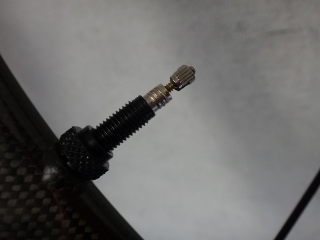
Jumping ahead in the timeline—this is after the valve swap with the tire mounted.
Even if there's variance in valve length between tires,
you can tighten the valve nut against the valve ferrule
by giving the thread range some width, though it's not that wide.
The male (pass-through) extender for the Bora 80mm depth has the part number
UT-WH160M as mentioned, but for the Bullet 80mm depth (which only comes in WO spec),
since it's a WO rim you need something slightly shorter,
so it's UT-WH140M. For the Bullet 50mm depth it's UT-WH130M.
The Bora 35mm doesn't have an extender option,
and for the Bora 50mm depth, whether WO or tubular,
it's UT-WH180M. Most of all, these things run about ¥3000–3500 each (excluding tax),
so if they don't come with the wheel, unless someone really cares,
I doubt many people use genuine parts.
Also, in the image above,
with the valve core loosened, you can't suppress air leaks—
in this case they're leaking noticeably enough to hear.
If you hand-tighten the valve core firmly (without tools)
the leaks stop, but without realizing that,
you might end up suspecting a slow puncture,
so I replaced the valve core.
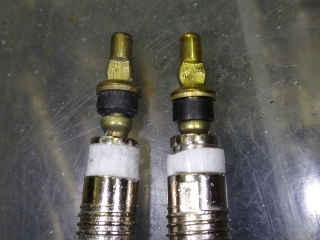
↑Old on the left, new on the right.

The tire is Continental Tempo II, used for track racing
or also used for road TT or hill climbs
with the understanding of puncture risk.
There's a similar tire called Podium TT with one puncture-resistant belt inside,
but according to Japanese distributors it's been discontinued.
It's still on the manufacturer site, so I'm not sure if it's really discontinued.
With tubulars, we don't stock things like Zonda Klasse II anyway.
Continental tires are made in Germany except for the Giro (their budget line),
but this Tempo II is unusual for Continental tubulars
in that the tape is white rather than black.
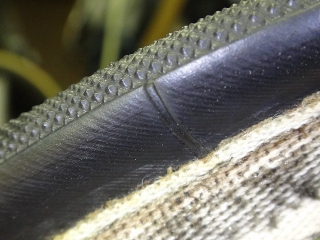
But the mold marks on the tread
match other models, so it's definitely German-made.
Also, among manufacturers/brands that make car tires too,
Continental is probably the only one where you can navigate from the main homepage
to select bicycle tires and jump to a dedicated page.
Among those that make car tires and do genuine
in-house manufacturing (not just OEM or licensing names),
it's probably also just Continental.
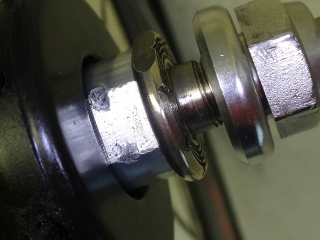
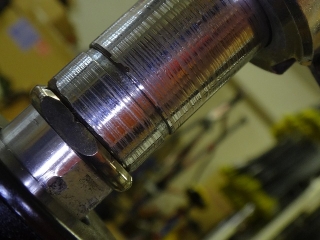
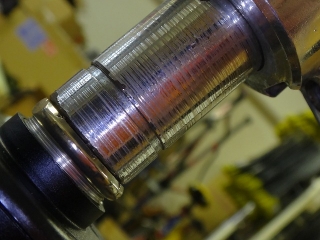
The side without the ball cup adjustment nut—the nominal right side wrench flats—
show marks like a thin hub wrench (hub wrenches are thin anyway)
was applied at an angle.
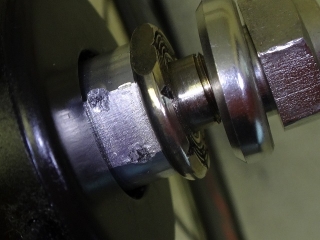
The opposite side at 180° shows the same tendency.
What's puzzling is that if these happened at the same time,
the wrench marks should be mirror images, but they're not.
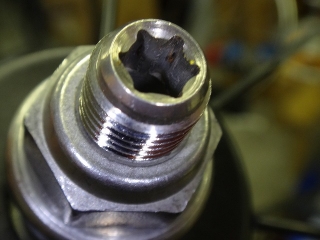
For just adjusting the ball cup nut, there's a Torx T30 hole
at the end of the hub axle, so you should be able to use that
without leaving extra marks.
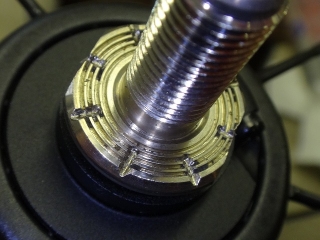
The end where it contacts the fork has a large contact area with knurling.
I'll talk about this in a separate post later.

The CULT bearing is well broken in—no need for greasing.
Given the material and length of the hub axle, it has decent weight,
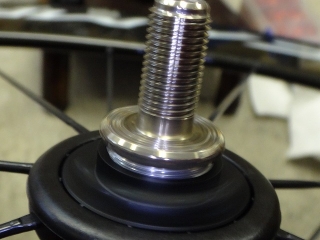
so when you spin the hub axle by hand, it coasts for a while.
The image above is what I'd call "sparrow drill" (coasting freely).
The temporary center was spot-on,
and the runout was minimal. Once I started truing,
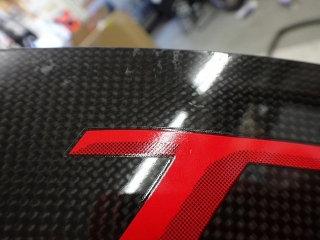
what remained was just the spoke truing stand
reacting to bits of tubular tape debris
scattered in what would be the brake zone.
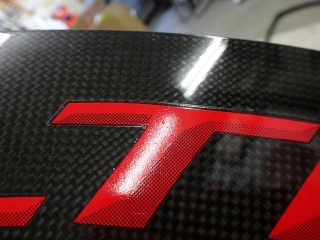
After wiping it clean,
there were no more bumps the truing stand could detect.
Since there's no braking, the debris stayed there the whole time.
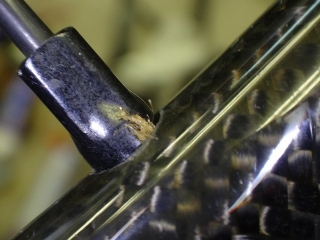
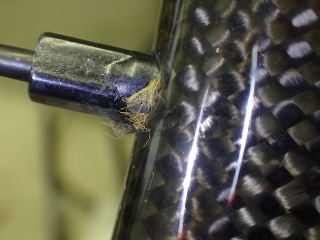
As for the Bora rim, there's something that looks like Kevlar sandwiched in,
and it probably does vibration damping work
(I don't think it's to prevent microcrack propagation when it eventually breaks).
This can sometimes stick out from the rim holes,
but since it's pinched under tension between the rim and the nipple,
you can't pull it out. It's not a problem if you leave it alone.

There used to be a road wheel with the same name.
With the 50mm and 35mm depth Bola wheels,
the front was 18H and the rear had G3 in 7 pairs for 21H,
but the 80mm depth Bora came with a front of 16H
and rear with G3 in 6 pairs for 18H.
The road Bora Ultra 80 was the first Bora
to move away from internal nipples,
and continued unchanged from 2012–2019.
In other words, it only existed in narrow rim (20mm width) specification.
This track-specific Bora Ultra 80 front wheel is a current product
that hasn't been discontinued.
By the way, in 2014 the Bora Ultra and One 35 came out,
and like the 80, they also came in narrow rim + external nipple configuration
as tubular only. However, the following year it went to wide rim,
so the Bora 35 narrow rim spec only came out in 2014.
This is one of what I consider the strongest wheels ever made.
The source for this information is here.
When I look things up related to wheels, this comes up a lot,
but I already know everything that guy writes about.

The valve extender is a non-OEM pass-through style
(because you can't pass it through the valve ferrule if you use the slip-on type),
and the customer wants it replaced with the genuine article.
The genuine version has threads cut into part of it,
allowing a valve nut to be installed.
Functionally, this non-OEM version works fine.

So I ordered one in.
The work itself takes less than a day, but sourcing took forever.

The part number is UT-WH160M, with the M at the end
referring to "Male" in the product name—a male-threaded valve extender.
There's also a UT-WH160 without the M at the end,
but that's a tool for attaching to Bullet and Bullet Ultra nipples
to guide with a magnet—only used during wheel building.

↑There used to be a female (slip-on) version,
the UT-WH160F, but that's been discontinued.
Since the slip-on style can't pass through the valve ferrule,
about the only use case you can imagine is
fitting it over a valve that only has the valve core exposed
to add air afterward. But since the Bora 80 only comes in tubular rim spec,
unlike clincher tubes, there's no tubular tire with a valve length
that's built in from the start for an 80mm rim.
In the first place, they'd absolutely be using a pass-through extender,
so needing a slip-on extender would be an extremely rare situation.
By the way, the terms male thread, female thread, and male/female
might someday become unusable for political correctness reasons
due to their sexual connotations.

Now, what happens with laboratory equipment like graduated cylinders
or their counterpart male cylinders, I wonder.
Before I get a serious response, let me note that
"female" in graduated cylinder has no meaning of "female."
It's from the German word "messzylinder," written as one word—
you can't split it into "mess" and "zylinder."
Graduated cylinder in English gets its name from the verb "graduate,"
which usually means "to complete school," but besides the intransitive sense of "graduate"
and the transitive sense of "to graduate someone,"
it also has a transitive meaning of "to mark with graduations"
from the image of proceeding in stages.
German has the word "Schadenfreude,"
which in Japanese internet slang
corresponds to something like "meshiuma" (delighting in others' misfortune),
though the nuances differ slightly. In English-speaking regions,
because the subtle nuances are hard to translate fully,
it's used as a loanword in the original German spelling.
It's a bit different from that, but do English speakers
also use the German word "messzylinder"?
As for me, I'll just make up (※) the theory that
"the female cylinder was 'graduated' by the male cylinder
before shipping, during the manufacturing process,
which is why it's called that"—another explanation sure to get me in trouble.
※I'm converting "detsuzo" and not "netsuzo."
That's some pretty solid conversion. Anyway.
Dokudanjou → 独壇場
Dokusenjou → 独擅場
The latter is actually the correct Japanese,
and the second character is different too.

↑This thing

Partially threaded—though not in the same stupid way
as seen on Specialized tubes and tubeless valves,
or Mavic tubeless valves (here).
With those, the outer diameter has threads, and the unthreaded part
matches the root diameter of the thread.
But this male extender has threads on the inside,
and the unthreaded part matches the crest diameter of the thread.
Specialized's half-threaded valves have a narrow pump head opening diameter,
so the engagement is loose. If you're using a floor pump with a Flatfish head fitting,
you need to tighten it for that, which speeds up seal wear.
Also, when repairing roadside with a portable pump or CO₂ cartridge adapter,
air leaks from the fitting are more likely.
According to Specialized, the half-threading is because
the valve breaks less often than with full threading.
But I've never actually seen that happen, and while I won't say
it's absolutely impossible, designing around such an ultra-rare case
while creating bigger separate problems is just stupid thinking.
Though, to be fair, the valve nut with an O-ring in the internal recess
has high hand-turning resistance, so they might be reducing
the inner thread count for that reason.
Even considering that, I think full threading is better.

Jumping ahead in the timeline—this is after the valve swap with the tire mounted.
Even if there's variance in valve length between tires,
you can tighten the valve nut against the valve ferrule
by giving the thread range some width, though it's not that wide.
The male (pass-through) extender for the Bora 80mm depth has the part number
UT-WH160M as mentioned, but for the Bullet 80mm depth (which only comes in WO spec),
since it's a WO rim you need something slightly shorter,
so it's UT-WH140M. For the Bullet 50mm depth it's UT-WH130M.
The Bora 35mm doesn't have an extender option,
and for the Bora 50mm depth, whether WO or tubular,
it's UT-WH180M. Most of all, these things run about ¥3000–3500 each (excluding tax),
so if they don't come with the wheel, unless someone really cares,
I doubt many people use genuine parts.
Also, in the image above,
with the valve core loosened, you can't suppress air leaks—
in this case they're leaking noticeably enough to hear.
If you hand-tighten the valve core firmly (without tools)
the leaks stop, but without realizing that,
you might end up suspecting a slow puncture,
so I replaced the valve core.

↑Old on the left, new on the right.

The tire is Continental Tempo II, used for track racing
or also used for road TT or hill climbs
with the understanding of puncture risk.
There's a similar tire called Podium TT with one puncture-resistant belt inside,
but according to Japanese distributors it's been discontinued.
It's still on the manufacturer site, so I'm not sure if it's really discontinued.
With tubulars, we don't stock things like Zonda Klasse II anyway.
Continental tires are made in Germany except for the Giro (their budget line),
but this Tempo II is unusual for Continental tubulars
in that the tape is white rather than black.

But the mold marks on the tread
match other models, so it's definitely German-made.
Also, among manufacturers/brands that make car tires too,
Continental is probably the only one where you can navigate from the main homepage
to select bicycle tires and jump to a dedicated page.
Among those that make car tires and do genuine
in-house manufacturing (not just OEM or licensing names),
it's probably also just Continental.

The side without the ball cup adjustment nut—the nominal right side wrench flats—
show marks like a thin hub wrench (hub wrenches are thin anyway)
was applied at an angle.

The opposite side at 180° shows the same tendency.
What's puzzling is that if these happened at the same time,
the wrench marks should be mirror images, but they're not.

For just adjusting the ball cup nut, there's a Torx T30 hole
at the end of the hub axle, so you should be able to use that
without leaving extra marks.

The end where it contacts the fork has a large contact area with knurling.
I'll talk about this in a separate post later.

The CULT bearing is well broken in—no need for greasing.
Given the material and length of the hub axle, it has decent weight,

so when you spin the hub axle by hand, it coasts for a while.
The image above is what I'd call "sparrow drill" (coasting freely).


The temporary center was spot-on,
and the runout was minimal. Once I started truing,

what remained was just the spoke truing stand
reacting to bits of tubular tape debris
scattered in what would be the brake zone.

After wiping it clean,
there were no more bumps the truing stand could detect.
Since there's no braking, the debris stayed there the whole time.


As for the Bora rim, there's something that looks like Kevlar sandwiched in,
and it probably does vibration damping work
(I don't think it's to prevent microcrack propagation when it eventually breaks).
This can sometimes stick out from the rim holes,
but since it's pinched under tension between the rim and the nipple,
you can't pull it out. It's not a problem if you leave it alone.