In the early days of MTB, before the concept of MTB even existed,
there naturally wasn't any "MTB-specific componentry."
Shimano's Deore was originally touring-oriented componentry.
※To be precise, there was a period when bikes were called ATB (All Terrain Bike)
before MTB, but let's not get into those details.
The gravel bike category has emerged in recent years,
and component makers are releasing dedicated groupsets while
frame makers are designing frames to match tire sizes,
all to promote the category. That's perfectly fine in itself, but
it seems like I'm seeing a lot of people lately who want to try
racing cyclocross on a gravel bike simply because they look kind of similar,
so I'm writing about that.
Gravel bikes come in wheel sizes other than 700C—650B for instance
(or sometimes one frame can accommodate both since they use disc brakes),
but even if a 700C gravel bike has 32C tires,
that doesn't necessarily mean it can be used as-is in cyclocross racing.
Most gravel bike complete bikes come with tires around 40C wide,
and with clincher-type rims rather than tubulars,
when you mount a nominally 32C tire on a rim with an inner width exceeding 23mm,
the actual measured tire width at 2 bar pressure will almost certainly exceed 33mm.
This constitutes a regulation violation
(except for lower-category races allowing flat bars and any tire width).
So you might think "just swap wheels then," but
gravel bikes have a geometry issue that makes them fundamentally unsuited to cyclocross—
something that can't be solved by swapping parts.
Specifically, it's "bottom bracket drop."
Also called "BB drop."
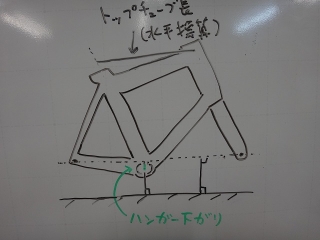
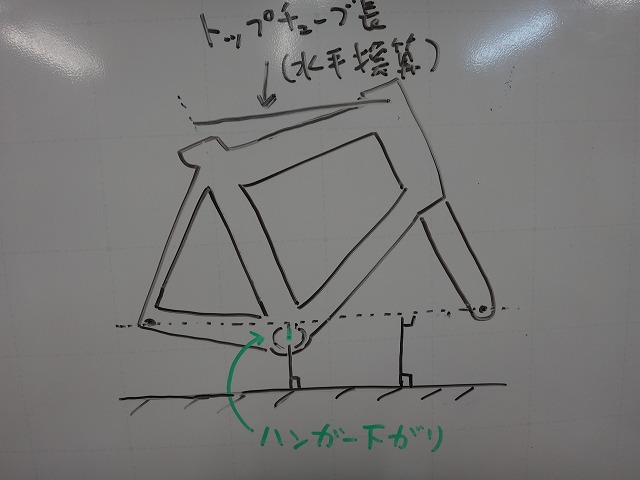
Bottom bracket drop is the shortest distance between
the line connecting the front and rear hub axle centers and the BB center.
This figure is generally set for each bike type,
with track bikes for racing typically around 45–50mm,
road bikes ranging from a shallow (small number) 65mm
to a deep (large number) 70mm or more.
In general, larger frame sizes have shallower drop, while
smaller sizes have deeper drop.
Not directly related to this article's main point,
but as exceptions: Bridgestone Anchor does the opposite—
their track bike TS9 is 50mm regardless of frame size,
while TE9 progresses from smallest to largest as
50→55→55→60mm.
Their road frame RP9 is 72mm regardless of frame size,
while RS8 progresses from smallest as
68→68→70→70→70mm.
Frames where larger sizes actually get deeper drop are extremely rare.
Besides BB drop in the diagram above,
I've also noted the top tube length in horizontal equivalent,
and I looked up various combinations of
frame size designation / top tube length / BB drop
for cyclocross and gravel frames from the same manufacturers.
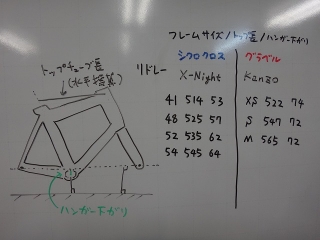
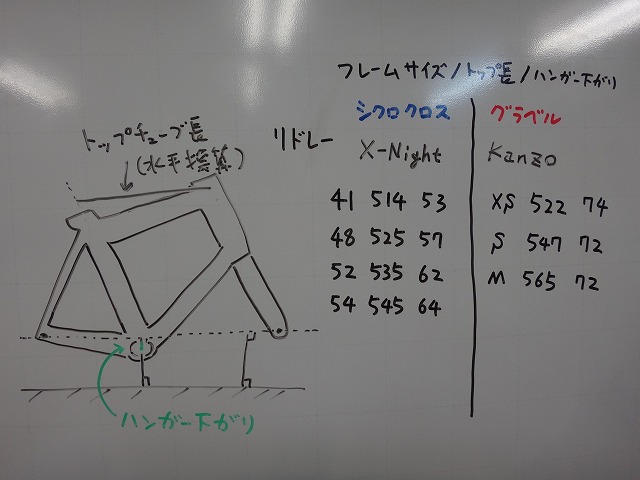
First, Ridley.
They once had great models like X-BOW (Crossbow) and X-FIRE (Crossfire)
where the "X-" was pronounced as "cross," but the models
currently handled by Japanese distributors are
X-NIGHT alone (though many people read this as "X-Night" rather than "Cross Night").
The old X-NIGHT was based on the road bike Damocles,
but the current model is a different machine with the same name.
In their home market they also offer X-NIGHT SL as a higher-end model
and X-RIDE as an entry model in the same form,
but these aren't distributed in Japan.
For gravel bikes, the model is called Kanzo (カンゾ),
and they're putting serious effort here with four models:
Kanzo, Fast, Speed, Adventure, and A.
This isn't unique to Ridley, but since gravel became popular,
many manufacturers and brands have shrunk their pure cyclocross racing lineups.
It seems like the gravel-style adventuring that was originally done on cyclocross bikes
has migrated to purpose-designed gravel bikes.
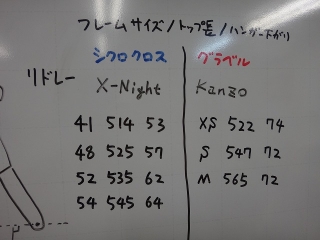
Now for the geometry discussion.
Since the manufacturing contractors differ,
frame size designations are different between Ridley's cyclocross and gravel lines.
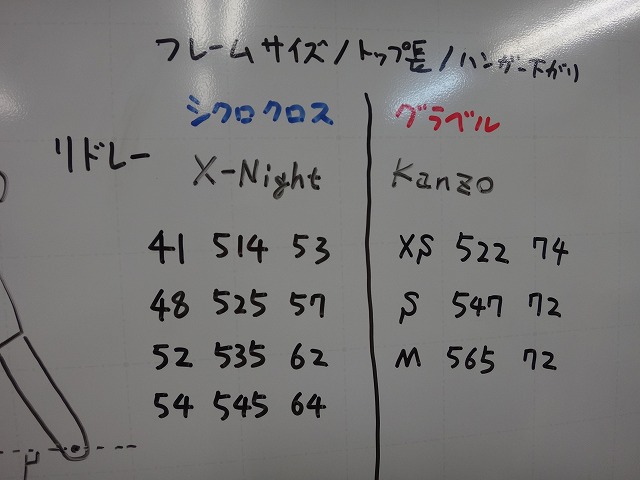
Looking purely at top tube length, the X-NIGHT 48
and Kanzo XS are roughly equivalent.
The cyclocross version has a very shallow BB drop tendency,
with fine adjustments per frame size.
The gravel version is extremely deep at 74–72mm.
While there are exceptions, generally from the same manufacturer
gravel bikes have deeper BB drop than cyclocross bikes.
The X-NIGHT 48 and Kanzo XS I mentioned as having similar sizing
differ by 17mm in BB drop—that's a significant difference for cornering,
where you'll pedal-strike or catch on chicanes more easily.
If you consider that a 15mm difference between 165mm and 180mm crank lengths is substantial,
then 17mm is considerable.
Also, as I mentioned earlier, frames that get deeper drop with larger sizes are extremely rare,
and Ridley's cyclocross also falls into this category.
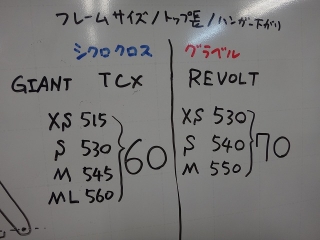
Next is GIANT.
Cyclocross is TCX, gravel is REVOLT.
The ML size available in TCX stands for "Medium Large,"
and there are even larger L and XL sizes,
but in Japan most models only go up to ML in the catalog.
Over 95% (source: my brain) of users will fit one of the four smaller sizes.
TCX has top tube in 15mm increments, REVOLT in 10mm increments—
so sizing feels slightly different at the same size designation.
TCX has uniform 60mm BB drop while REVOLT is 70mm,
a 10mm difference with gravel running deeper
(though I haven't checked sizes not sold in Japan).
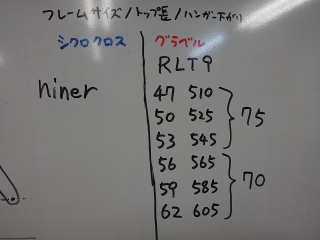
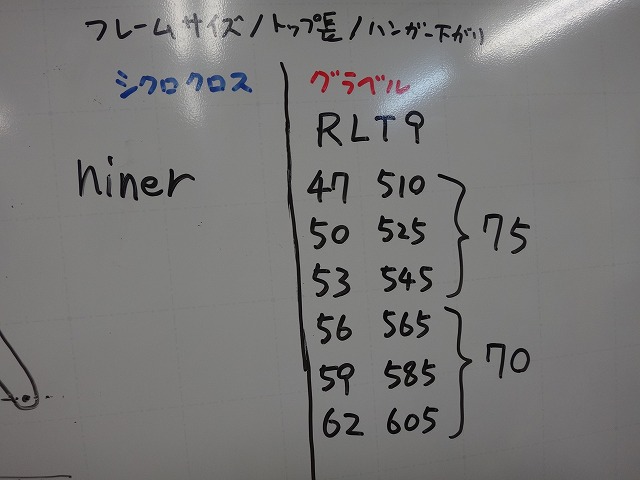
Next is Niner. This is a manufacturer that only offers gravel
among 700C bikes outside of MTB,
but I included them because their geometry is excellent
(though you can't tell from just these numbers).
The three smaller sizes have 75mm BB drop,
while the three larger sizes are 70mm.

Next is Cannondale.
This is the exception I mentioned earlier—
the gravel bike actually has shallower BB drop.
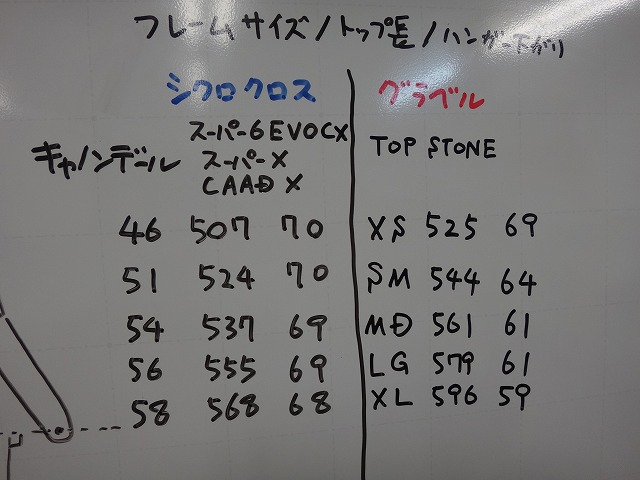
Since Cannondale uses different size designations for cyclocross and gravel,
they probably have different manufacturers.
First, Cannondale is a deep-drop manufacturer for road bikes.
For example, the Supersix EVO has sizes progressing as
74→74→74→72→72→69→69→69mm.
Their cyclocross is shallower than their road bikes.
That alone would just be "ah, they're a deep-drop manufacturer,"
but the gravel bike with a completely different philosophy regarding frame geometry
has created a somewhat odd situation.
There's no image for this, but
Trek's cyclocross Boone has BB drop of
70→70→68→68mm (fairly deep),
while their gravel Checkpoint goes
78→78→76→76→74mm (even deeper).
As shown in the diagrams, the Cannondale bikes classified as cyclocross—
Supersix EVO CX, SuperX, and CAADX—
share common geometry despite different frame materials.
There's a separate Supersix EVO SE that Cannondale classifies as a gravel bike,
but it doesn't share Topstone's geometry;
rather it shares cyclocross geometry with those three.
Also unrelated to BB drop, but
Topstone uses the same geometry for both aluminum and carbon frames, which is fine,
and the carbon frame + LEFTY suspension fork model
also uses essentially the same geometry (※).
I'd think the head tube angle should be adjusted though.
※Except that SM size differs by 0.1mm in stack,
and LG and XL sizes differ by 0.8–0.9mm in wheelbase, they're identical
Pure racing cyclocross frames like
Ridley's older X-NIGHT based on Damocles or
BH's RX-1 had zero bottle cage mounts on the frame.
Gravel bikes have bottle cage mounts not just in the front triangle
but also on the underside of the down tube, the front of the top tube,
and on some models even beside the fork blades.
This is more of a cosmetic gripe, but
things like that make gravel bikes look less like racing bikes,
which is another way they don't suit cyclocross
(though non-pure-racing cyclocross bikes also have
fenders and rear rack mounting bosses sometimes).
It is true though that many are shaped poorly for shouldering the bike.
Frame shape matters, but so does positioning of outer cage mounts.
So to summarize: using a gravel bike for cyclocross racing
is poorly suited from a design standpoint—BB drop and frame geometry—
and since wheels need inner rim width of 20mm or less to avoid
tire width regulation violations (essentially guaranteed with 23mm+, as I noted),
you'd practically need separate wheelsets anyway.
If you have money to retrofit things, why not just
buy a proper cyclocross bike instead?
Gravel bikes have longer chainstays (longer rear center),
so compared to same manufacturer and material, they'd have worse responsiveness,
gravel bikes designed for carrying loads would be heavier—
those things just make riding harder for the rider, so whatever,
but a bike that pedal-strikes or catches on obstacles in group cornering and chicanes
could create a safety hazard for others,
so I'd say
you shouldn't race gravel bikes in cyclocross events.
That's what I wanted to say.
Maybe there should be a rule that frames with 72mm+ BB drop
can't be used in cyclocross racing. Seriously.
Separate from that, in today's era where even road bikes have rims with inner widths exceeding 20mm,
I suspect tire width inadvertently exceeding 33mm will pop up more and more.
I'd love to see the "33mm police" at cyclocross race venues
systematically catch all the illegally wide gravel bikes.
While it would change the competitive nature
(making it easier to brute-force with leg power when technique fails),
I personally think cyclocross tire width limits might return to
the 35C maximum that was OK about ten years ago.
Addendum: The day after writing this,
I serviced a cyclocross bike with Fulcrum Racing 5 DB wheels
wearing Schwalbe 32C tubular WO tires,
and the actual tire outer width measured 34.8mm.
Racing 5 DB is a disc road wheel
(designed to mount 25C tires as a lower limit),
but when mounting nominally 32C tires
(currently, most cyclocross tire "nominal widths"
refer to size when mounted on old ETRTO rims)
on the new ETRTO wide rims, the tire width can easily exceed 33mm unintentionally.
With regulation violations resulting in relegation or disqualification,
intent or malice is irrelevant.
To accommodate new ETRTO, what was previously sold as 30C width
(achieving 30mm tire width on old ETRTO rims)
would need to be relabeled 32C.
Even at the same 32mm width, that tire on new ETRTO rims becomes
a square-sided kamaboko-profile stretched tire,
but road bike 25C tires are already doing that.
For whether narrow 29-inch MTB rims with 700C cyclocross tires
stay within 33mm tire width—see
here for real examples.
there naturally wasn't any "MTB-specific componentry."
Shimano's Deore was originally touring-oriented componentry.
※To be precise, there was a period when bikes were called ATB (All Terrain Bike)
before MTB, but let's not get into those details.
The gravel bike category has emerged in recent years,
and component makers are releasing dedicated groupsets while
frame makers are designing frames to match tire sizes,
all to promote the category. That's perfectly fine in itself, but
it seems like I'm seeing a lot of people lately who want to try
racing cyclocross on a gravel bike simply because they look kind of similar,
so I'm writing about that.
Gravel bikes come in wheel sizes other than 700C—650B for instance
(or sometimes one frame can accommodate both since they use disc brakes),
but even if a 700C gravel bike has 32C tires,
that doesn't necessarily mean it can be used as-is in cyclocross racing.
Most gravel bike complete bikes come with tires around 40C wide,
and with clincher-type rims rather than tubulars,
when you mount a nominally 32C tire on a rim with an inner width exceeding 23mm,
the actual measured tire width at 2 bar pressure will almost certainly exceed 33mm.
This constitutes a regulation violation
(except for lower-category races allowing flat bars and any tire width).
So you might think "just swap wheels then," but
gravel bikes have a geometry issue that makes them fundamentally unsuited to cyclocross—
something that can't be solved by swapping parts.
Specifically, it's "bottom bracket drop."
Also called "BB drop."
Bottom bracket drop is the shortest distance between
the line connecting the front and rear hub axle centers and the BB center.
This figure is generally set for each bike type,
with track bikes for racing typically around 45–50mm,
road bikes ranging from a shallow (small number) 65mm
to a deep (large number) 70mm or more.
In general, larger frame sizes have shallower drop, while
smaller sizes have deeper drop.
Not directly related to this article's main point,
but as exceptions: Bridgestone Anchor does the opposite—
their track bike TS9 is 50mm regardless of frame size,
while TE9 progresses from smallest to largest as
50→55→55→60mm.
Their road frame RP9 is 72mm regardless of frame size,
while RS8 progresses from smallest as
68→68→70→70→70mm.
Frames where larger sizes actually get deeper drop are extremely rare.
Besides BB drop in the diagram above,
I've also noted the top tube length in horizontal equivalent,
and I looked up various combinations of
frame size designation / top tube length / BB drop
for cyclocross and gravel frames from the same manufacturers.
First, Ridley.
They once had great models like X-BOW (Crossbow) and X-FIRE (Crossfire)
where the "X-" was pronounced as "cross," but the models
currently handled by Japanese distributors are
X-NIGHT alone (though many people read this as "X-Night" rather than "Cross Night").
The old X-NIGHT was based on the road bike Damocles,
but the current model is a different machine with the same name.
In their home market they also offer X-NIGHT SL as a higher-end model
and X-RIDE as an entry model in the same form,
but these aren't distributed in Japan.
For gravel bikes, the model is called Kanzo (カンゾ),
and they're putting serious effort here with four models:
Kanzo, Fast, Speed, Adventure, and A.
This isn't unique to Ridley, but since gravel became popular,
many manufacturers and brands have shrunk their pure cyclocross racing lineups.
It seems like the gravel-style adventuring that was originally done on cyclocross bikes
has migrated to purpose-designed gravel bikes.
Now for the geometry discussion.
Since the manufacturing contractors differ,
frame size designations are different between Ridley's cyclocross and gravel lines.
Looking purely at top tube length, the X-NIGHT 48
and Kanzo XS are roughly equivalent.
The cyclocross version has a very shallow BB drop tendency,
with fine adjustments per frame size.
The gravel version is extremely deep at 74–72mm.
While there are exceptions, generally from the same manufacturer
gravel bikes have deeper BB drop than cyclocross bikes.
The X-NIGHT 48 and Kanzo XS I mentioned as having similar sizing
differ by 17mm in BB drop—that's a significant difference for cornering,
where you'll pedal-strike or catch on chicanes more easily.
If you consider that a 15mm difference between 165mm and 180mm crank lengths is substantial,
then 17mm is considerable.
Also, as I mentioned earlier, frames that get deeper drop with larger sizes are extremely rare,
and Ridley's cyclocross also falls into this category.

Next is GIANT.
Cyclocross is TCX, gravel is REVOLT.
The ML size available in TCX stands for "Medium Large,"
and there are even larger L and XL sizes,
but in Japan most models only go up to ML in the catalog.
Over 95% (source: my brain) of users will fit one of the four smaller sizes.
TCX has top tube in 15mm increments, REVOLT in 10mm increments—
so sizing feels slightly different at the same size designation.
TCX has uniform 60mm BB drop while REVOLT is 70mm,
a 10mm difference with gravel running deeper
(though I haven't checked sizes not sold in Japan).
Next is Niner. This is a manufacturer that only offers gravel
among 700C bikes outside of MTB,
but I included them because their geometry is excellent
(though you can't tell from just these numbers).
The three smaller sizes have 75mm BB drop,
while the three larger sizes are 70mm.
Next is Cannondale.
This is the exception I mentioned earlier—
the gravel bike actually has shallower BB drop.
Since Cannondale uses different size designations for cyclocross and gravel,
they probably have different manufacturers.
First, Cannondale is a deep-drop manufacturer for road bikes.
For example, the Supersix EVO has sizes progressing as
74→74→74→72→72→69→69→69mm.
Their cyclocross is shallower than their road bikes.
That alone would just be "ah, they're a deep-drop manufacturer,"
but the gravel bike with a completely different philosophy regarding frame geometry
has created a somewhat odd situation.
There's no image for this, but
Trek's cyclocross Boone has BB drop of
70→70→68→68mm (fairly deep),
while their gravel Checkpoint goes
78→78→76→76→74mm (even deeper).
As shown in the diagrams, the Cannondale bikes classified as cyclocross—
Supersix EVO CX, SuperX, and CAADX—
share common geometry despite different frame materials.
There's a separate Supersix EVO SE that Cannondale classifies as a gravel bike,
but it doesn't share Topstone's geometry;
rather it shares cyclocross geometry with those three.
Also unrelated to BB drop, but
Topstone uses the same geometry for both aluminum and carbon frames, which is fine,
and the carbon frame + LEFTY suspension fork model
also uses essentially the same geometry (※).
I'd think the head tube angle should be adjusted though.
※Except that SM size differs by 0.1mm in stack,
and LG and XL sizes differ by 0.8–0.9mm in wheelbase, they're identical
Pure racing cyclocross frames like
Ridley's older X-NIGHT based on Damocles or
BH's RX-1 had zero bottle cage mounts on the frame.
Gravel bikes have bottle cage mounts not just in the front triangle
but also on the underside of the down tube, the front of the top tube,
and on some models even beside the fork blades.
This is more of a cosmetic gripe, but
things like that make gravel bikes look less like racing bikes,
which is another way they don't suit cyclocross
(though non-pure-racing cyclocross bikes also have
fenders and rear rack mounting bosses sometimes).
It is true though that many are shaped poorly for shouldering the bike.
Frame shape matters, but so does positioning of outer cage mounts.
So to summarize: using a gravel bike for cyclocross racing
is poorly suited from a design standpoint—BB drop and frame geometry—
and since wheels need inner rim width of 20mm or less to avoid
tire width regulation violations (essentially guaranteed with 23mm+, as I noted),
you'd practically need separate wheelsets anyway.
If you have money to retrofit things, why not just
buy a proper cyclocross bike instead?
Gravel bikes have longer chainstays (longer rear center),
so compared to same manufacturer and material, they'd have worse responsiveness,
gravel bikes designed for carrying loads would be heavier—
those things just make riding harder for the rider, so whatever,
but a bike that pedal-strikes or catches on obstacles in group cornering and chicanes
could create a safety hazard for others,
so I'd say
you shouldn't race gravel bikes in cyclocross events.
That's what I wanted to say.
can't be used in cyclocross racing. Seriously.
Separate from that, in today's era where even road bikes have rims with inner widths exceeding 20mm,
I suspect tire width inadvertently exceeding 33mm will pop up more and more.
systematically catch all the illegally wide gravel bikes.
While it would change the competitive nature
(making it easier to brute-force with leg power when technique fails),
I personally think cyclocross tire width limits might return to
the 35C maximum that was OK about ten years ago.
Addendum: The day after writing this,
I serviced a cyclocross bike with Fulcrum Racing 5 DB wheels
wearing Schwalbe 32C tubular WO tires,
and the actual tire outer width measured 34.8mm.
Racing 5 DB is a disc road wheel
(designed to mount 25C tires as a lower limit),
but when mounting nominally 32C tires
(currently, most cyclocross tire "nominal widths"
refer to size when mounted on old ETRTO rims)
on the new ETRTO wide rims, the tire width can easily exceed 33mm unintentionally.
With regulation violations resulting in relegation or disqualification,
intent or malice is irrelevant.
To accommodate new ETRTO, what was previously sold as 30C width
(achieving 30mm tire width on old ETRTO rims)
would need to be relabeled 32C.
Even at the same 32mm width, that tire on new ETRTO rims becomes
a square-sided kamaboko-profile stretched tire,
but road bike 25C tires are already doing that.
For whether narrow 29-inch MTB rims with 700C cyclocross tires
stay within 33mm tire width—see
here for real examples.