Another day with wheels (and so on).
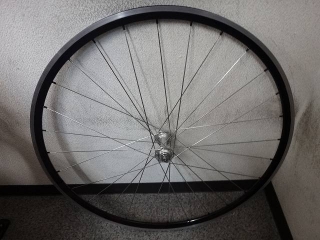
A customer brought in a front wheel built with a 7700 hub and
an American Classic CR350 rim.
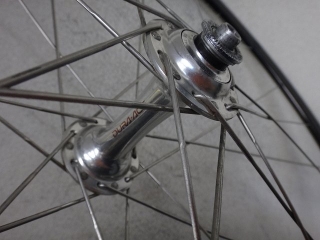
HB-7700, 28H, laced in standard JIS six-cross pattern,

with Asahi lightweight aero spokes.
These are among the strongest spokes I know of,
but the manufacturer has gone out of business, so they can't be obtained anymore.
Since the spoke length and thread pitch are based on 15-gauge standard,
spoke hop is prone to occur more easily, but for normal use
they don't develop the weird wobbling that other spokes do, and they were
the lightest weight spokes in their class until the CX-RAY came out.
The other top-tier spokes would be the CX-RAY and
Hoshi's old aero SB3. Currently, aside from CX-RAY, they're unobtainable.
Also, with Asahi spokes, whether round or flat-section,
when they're finished in black the coating always feels slick and oily,
and won't come off even with parts cleaner.
The pre-built wheels with the ADX-1S rim (late Aero 1 model) that Araya used to make—
the Pro Wheel (that's the model name)—
were also built with these black Asahi spokes.
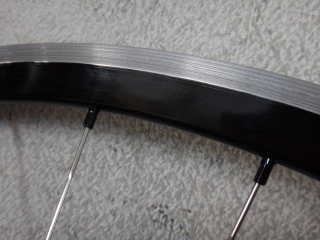
The rim is American Classic's CR350.
The model name means clincher rim, 350g.
There's also a higher-profile model called the CR420,
and while the actual weight is slightly heavier than claimed,
compared to Kinlin's XR200 and XR300,
they're almost the same rim height but have a better height-to-weight ratio.
However, both the CR350 and CR420 are extremely soft rims,
and when tensioned high, they lose to the spoke tension and
the rim starts snaking side to side.
Shimano's C24 clincher or tubeless rim also has
the same snaking issue on the 16H front wheel,
but that happens partly because it's a low-profile rim with 16H,
so the rim is slightly stiffer than the American Classic.
The reason you don't see wear marks typical of snaking rims in the image above
is because this one wasn't tensioned that hard.
Also, the CR350 and CR420
have a braking zone height of just under 7mm, extremely narrow,
and even Shimano's R55-series brake shoes from 7700 onward
will always overhang the braking zone.
You might be able to squeeze by with V-brake cartridge shoes at best.
Looking at the image above, you might think the braking zone doesn't look that narrow,
but that's because the black anodize that was on the taper section
inside the braking zone has already been scraped away by the brake shoes.
The brake shoes themselves also wear rounded on the lower side where they overhang.
The CR350 and CR420 rims come in silver versions too,
and on those it's less noticeable.
For images of the CR350 sticker still in existence and
spoke specific gravity info on the Asahi 15-gauge aero (→here).
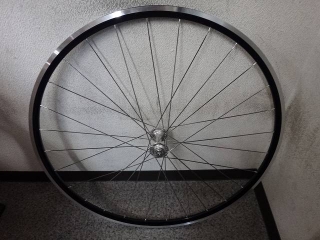
I rebuilt it with a Nomu-Lab Wheel No. 5 rim.

28H, CX-RAY, 4-cross Italian lacing.
I considered reusing the Asahi aeros,
but was concerned about repairs if a spoke broke,
so I switched them all out for CX-RAY.
Mixing even one spoke with significantly different specific gravity into a wheel means
that one spot will either have slack tension and the spoke will rattle around,
or be overly tight and ping with tension,
or develop radial runout at that one point. However, mixing a single CX-RAY with 14-gauge nipple
among the Asahi aeros is barely workable as a makeshift fix.
If the wheel from the beginning had come in with
just one broken spoke
for repair, I would explain to the customer that we're aware of the gauge difference
and different spoke specific gravity, and then repair it with CX-RAY.
With CX Sprint the specific gravity difference is too great and won't work
(you'd get one of the symptoms I mentioned above).
This is another situation where knowing your spoke specific gravity matters.

A customer brought in a front wheel built with a 7700 hub and
an American Classic CR350 rim.
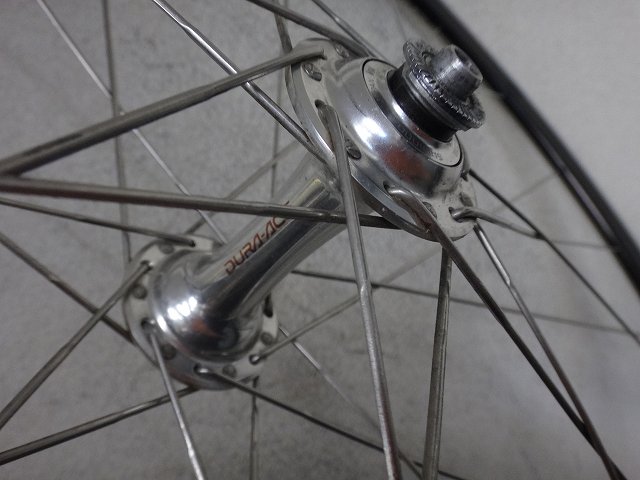
HB-7700, 28H, laced in standard JIS six-cross pattern,

with Asahi lightweight aero spokes.
These are among the strongest spokes I know of,
but the manufacturer has gone out of business, so they can't be obtained anymore.
Since the spoke length and thread pitch are based on 15-gauge standard,
spoke hop is prone to occur more easily, but for normal use
they don't develop the weird wobbling that other spokes do, and they were
the lightest weight spokes in their class until the CX-RAY came out.
The other top-tier spokes would be the CX-RAY and
Hoshi's old aero SB3. Currently, aside from CX-RAY, they're unobtainable.
Also, with Asahi spokes, whether round or flat-section,
when they're finished in black the coating always feels slick and oily,
and won't come off even with parts cleaner.
The pre-built wheels with the ADX-1S rim (late Aero 1 model) that Araya used to make—
the Pro Wheel (that's the model name)—
were also built with these black Asahi spokes.
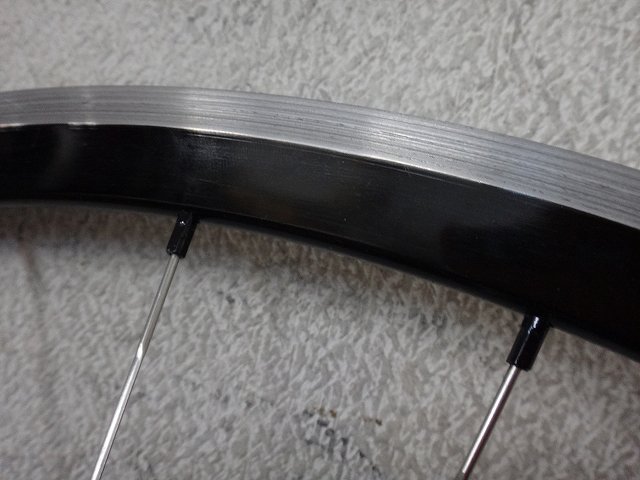
The rim is American Classic's CR350.
The model name means clincher rim, 350g.
There's also a higher-profile model called the CR420,
and while the actual weight is slightly heavier than claimed,
compared to Kinlin's XR200 and XR300,
they're almost the same rim height but have a better height-to-weight ratio.
However, both the CR350 and CR420 are extremely soft rims,
and when tensioned high, they lose to the spoke tension and
the rim starts snaking side to side.
Shimano's C24 clincher or tubeless rim also has
the same snaking issue on the 16H front wheel,
but that happens partly because it's a low-profile rim with 16H,
so the rim is slightly stiffer than the American Classic.
The reason you don't see wear marks typical of snaking rims in the image above
is because this one wasn't tensioned that hard.
Also, the CR350 and CR420
have a braking zone height of just under 7mm, extremely narrow,
and even Shimano's R55-series brake shoes from 7700 onward
will always overhang the braking zone.
You might be able to squeeze by with V-brake cartridge shoes at best.
Looking at the image above, you might think the braking zone doesn't look that narrow,
but that's because the black anodize that was on the taper section
inside the braking zone has already been scraped away by the brake shoes.
The brake shoes themselves also wear rounded on the lower side where they overhang.
The CR350 and CR420 rims come in silver versions too,
and on those it's less noticeable.
For images of the CR350 sticker still in existence and
spoke specific gravity info on the Asahi 15-gauge aero (→here).
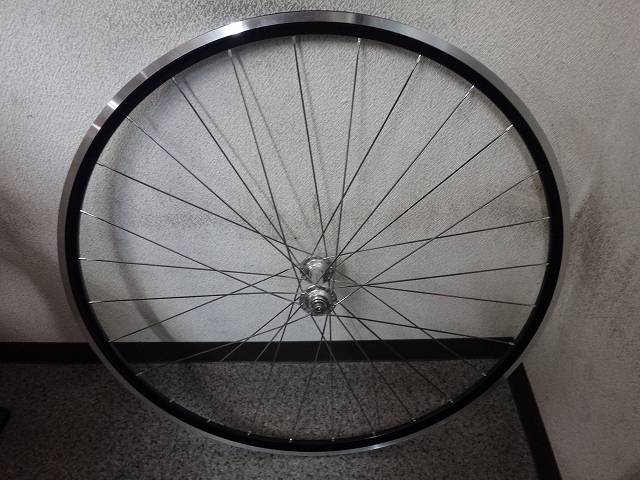
I rebuilt it with a Nomu-Lab Wheel No. 5 rim.
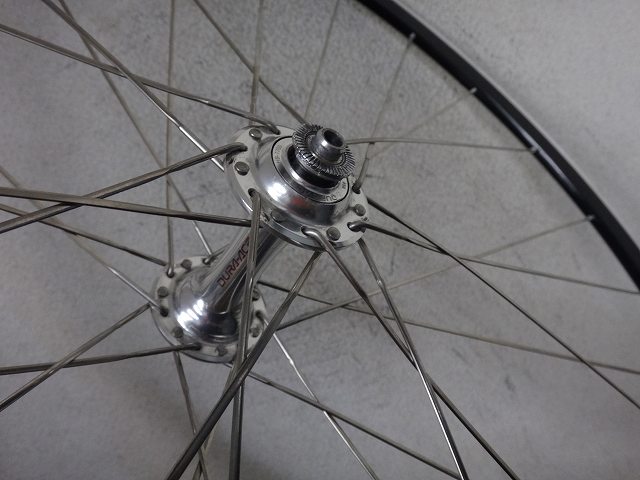
28H, CX-RAY, 4-cross Italian lacing.
I considered reusing the Asahi aeros,
but was concerned about repairs if a spoke broke,
so I switched them all out for CX-RAY.
Mixing even one spoke with significantly different specific gravity into a wheel means
that one spot will either have slack tension and the spoke will rattle around,
or be overly tight and ping with tension,
or develop radial runout at that one point. However, mixing a single CX-RAY with 14-gauge nipple
among the Asahi aeros is barely workable as a makeshift fix.
If the wheel from the beginning had come in with
just one broken spoke
for repair, I would explain to the customer that we're aware of the gauge difference
and different spoke specific gravity, and then repair it with CX-RAY.
With CX Sprint the specific gravity difference is too great and won't work
(you'd get one of the symptoms I mentioned above).
This is another situation where knowing your spoke specific gravity matters.