Another wheel day (and so on).
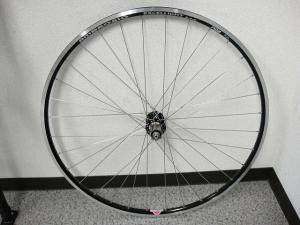
A customer left a wheel with me.
An Ambrosio Excellent Lite SSC rim with a current Record hub for the rear wheel.
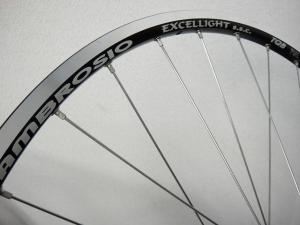
He bought it but never used it, apparently.
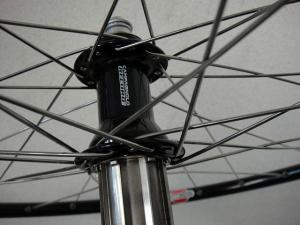
The spokes are DT Competition, laced in Italian cross pattern.
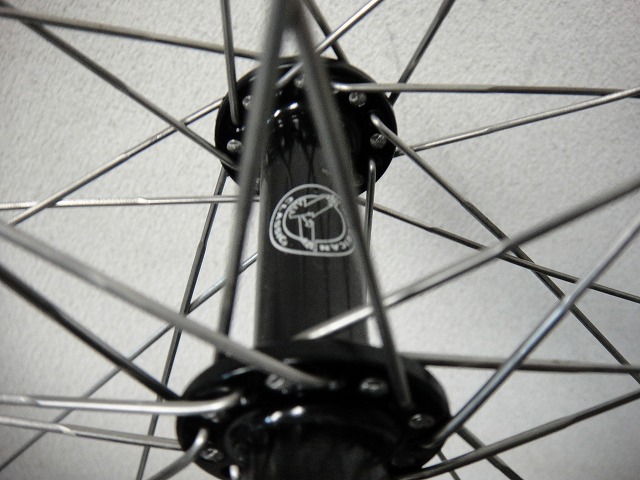
What I need this time is this hub.
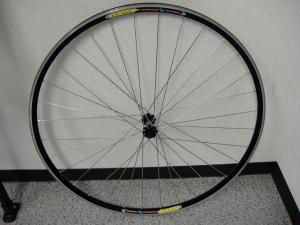
I've got another wheel on hand too.
An American Classic CR350 rim with the same brand's hub for the front wheel.

The spokes are Asahi No. 15 Aero.
The spoke head has Asahi's "A" mark on it.
These spokes are extremely light and stiff, but
being stiff makes them resistant to buckling, yet on the flip side they're prone to spoke neck breakage.
These spokes existed before CX-RAY came out,
and while the aero-butted section is slightly thicker than CX-RAY,
the threaded portion gauge is No. 15 (1.8mm diameter), so
they're thinner than CX-RAY which only exists in No. 14 (2.0mm diameter),
which gives them an advantage in terms of weight savings.
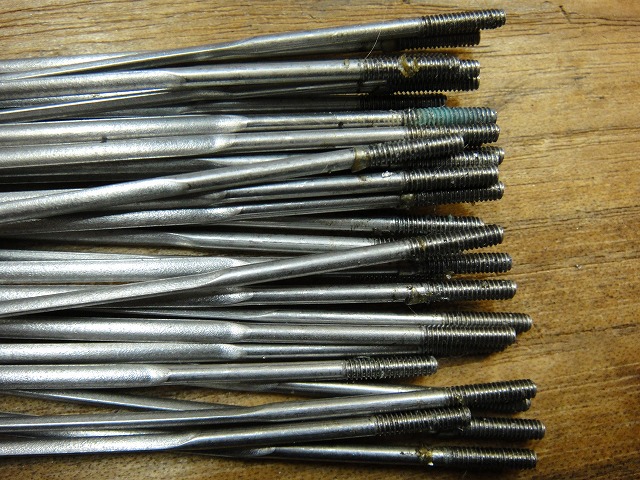
When I broke them down, 32 pieces at 294mm weighed 165.3g total.
Regarding the 294mm length—there's no evidence the spokes were cut to length,
so they have value as a sample for determining specific gravity.
165.3 (g) ÷ 32 (spokes) ÷ 294 (mm) equals 0.01757...
The baseline for 2.0mm plain spokes is 0.0257,
so this spoke's specific gravity works out to 68.3%.
The sample is small—just 32 spokes of one length—but
even if I kept measuring various lengths of the same spoke in reasonable quantities,
I don't think the variation would exceed plus or minus 1%.
CX-RAY is 64.5% (per my testing), so they're quite a bit thinner-walled.
You could argue it's impressive that CX-RAY is lighter despite being No. 14, but...
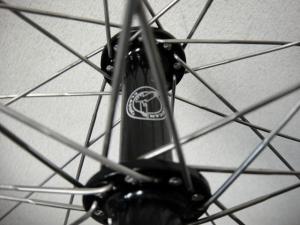
So the customer's request is to reuse these spokes to build a wheel with the CR-350 rim and the Record hub.
Since it's a discontinued spoke, rather than swapping them out for CX-RAY or something,
he'd rather use them if possible.
The front hub is small flange six-cross laced, while the rear hub is large flange,
so depending on the non-butted length of the threaded spoke portion,
it should be possible to reuse them by adjusting the length with a spoke cutter.
This customer has mostly hand-built wheels rather than factory-built ones,
and most of those hand-builds are ones he built himself, so he should be able to build wheels.
"Throw the spokes through the hub completely at random without worrying about right-drop or left-drop
→ get one side laced up to start
→ lace the other side so the spoke crossings don't straddle the valve hole"
That's JIS, reverse-JIS, Italian, reverse-Italian—all left to chance in these wild-built wheels,
but in terms of sheer number of wheels built, I'd wager he's got more under his belt than
your average shop mechanic, so he definitely knows how to build proper wheels.
But since he doesn't have a spoke cutter, he came to me this time.
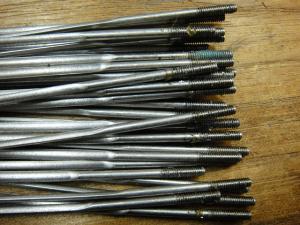
He said to reuse the spokes,
but he didn't say anything about NOT doing a 2-cross lace. Hehehehe.
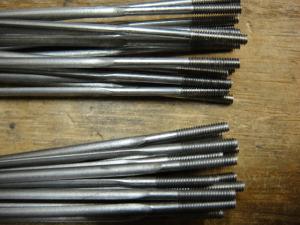
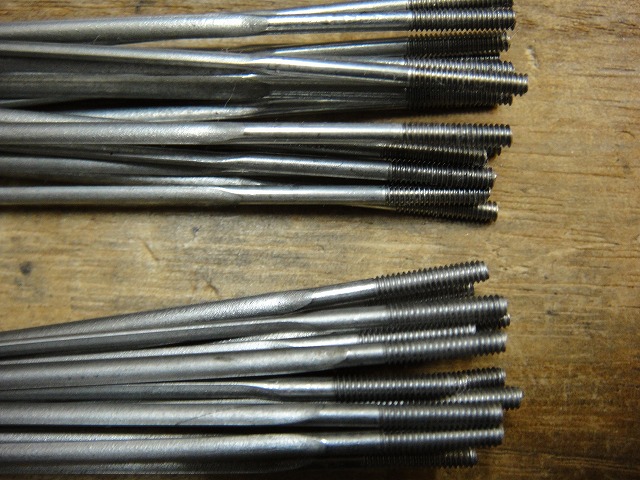
It was possible to cut them to the right length for a four-cross freewheel side, so I just had to do it.
The top bundle in the image is the six-cross non-freewheel side (I trimmed these a bit too),
the bottom bundle is for the four-cross freewheel side.
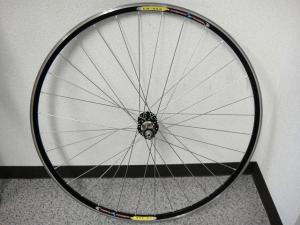
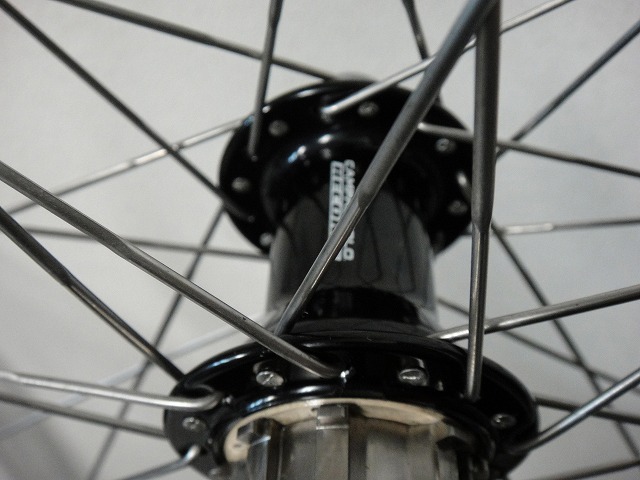
Built it.
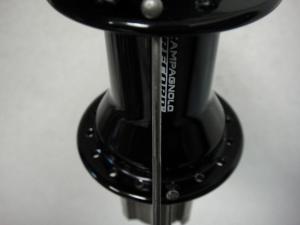
Right-drop
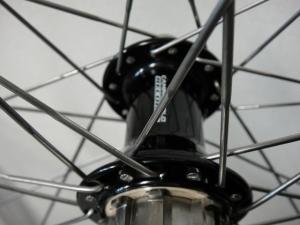
Italian lace!
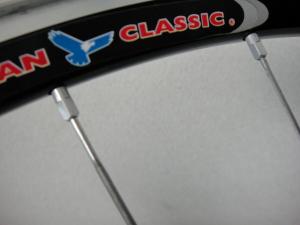
I didn't reuse the aluminum nipples—I went with new ones.
That was my call, not the customer's request.
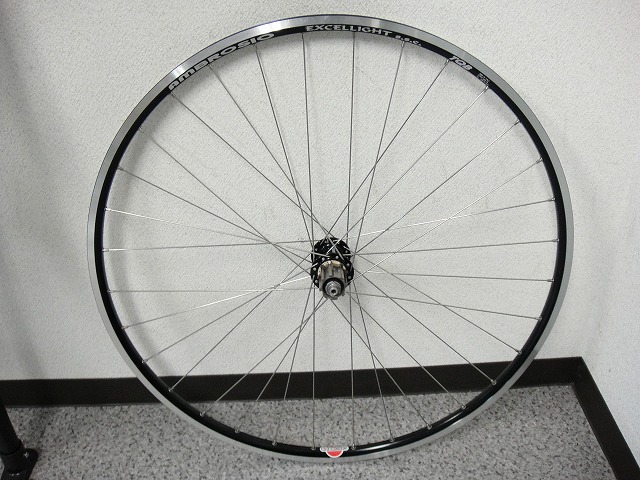
A customer left a wheel with me.
An Ambrosio Excellent Lite SSC rim with a current Record hub for the rear wheel.
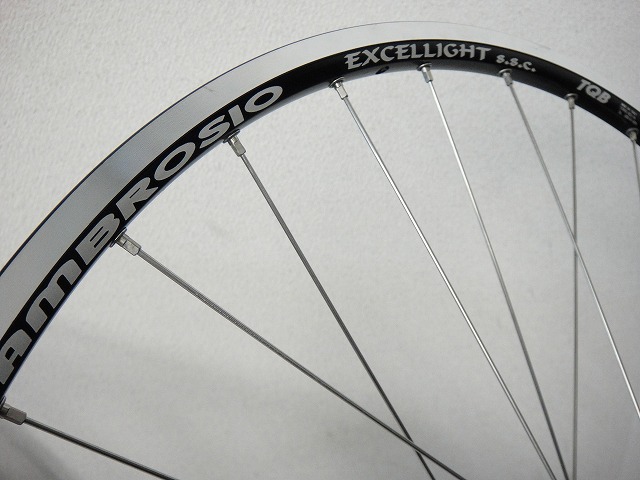
He bought it but never used it, apparently.
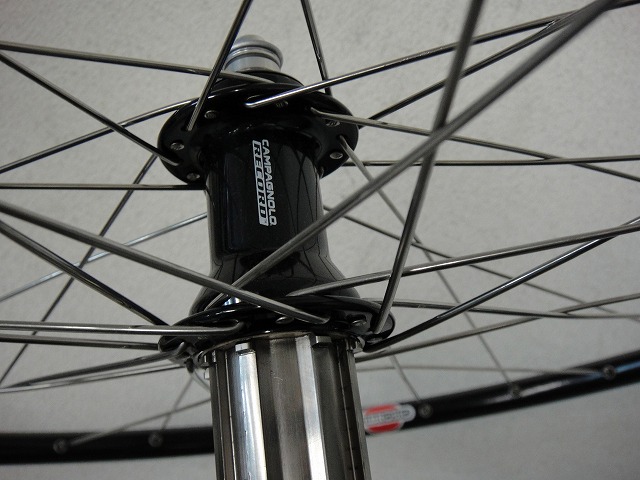
The spokes are DT Competition, laced in Italian cross pattern.
What I need this time is this hub.
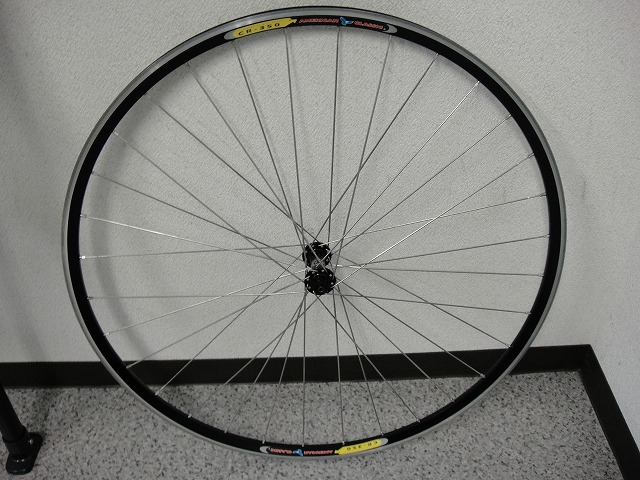
I've got another wheel on hand too.
An American Classic CR350 rim with the same brand's hub for the front wheel.
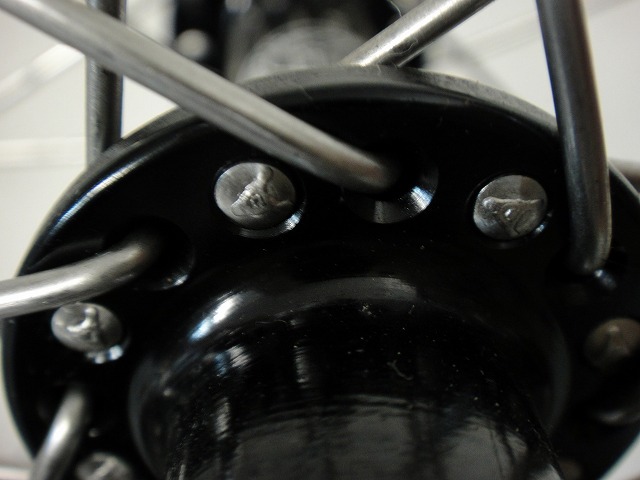
The spokes are Asahi No. 15 Aero.
The spoke head has Asahi's "A" mark on it.
These spokes are extremely light and stiff, but
being stiff makes them resistant to buckling, yet on the flip side they're prone to spoke neck breakage.
These spokes existed before CX-RAY came out,
and while the aero-butted section is slightly thicker than CX-RAY,
the threaded portion gauge is No. 15 (1.8mm diameter), so
they're thinner than CX-RAY which only exists in No. 14 (2.0mm diameter),
which gives them an advantage in terms of weight savings.
When I broke them down, 32 pieces at 294mm weighed 165.3g total.
Regarding the 294mm length—there's no evidence the spokes were cut to length,
so they have value as a sample for determining specific gravity.
165.3 (g) ÷ 32 (spokes) ÷ 294 (mm) equals 0.01757...
The baseline for 2.0mm plain spokes is 0.0257,
so this spoke's specific gravity works out to 68.3%.
The sample is small—just 32 spokes of one length—but
even if I kept measuring various lengths of the same spoke in reasonable quantities,
I don't think the variation would exceed plus or minus 1%.
CX-RAY is 64.5% (per my testing), so they're quite a bit thinner-walled.
You could argue it's impressive that CX-RAY is lighter despite being No. 14, but...
So the customer's request is to reuse these spokes to build a wheel with the CR-350 rim and the Record hub.
Since it's a discontinued spoke, rather than swapping them out for CX-RAY or something,
he'd rather use them if possible.
The front hub is small flange six-cross laced, while the rear hub is large flange,
so depending on the non-butted length of the threaded spoke portion,
it should be possible to reuse them by adjusting the length with a spoke cutter.
This customer has mostly hand-built wheels rather than factory-built ones,
and most of those hand-builds are ones he built himself, so he should be able to build wheels.
"Throw the spokes through the hub completely at random without worrying about right-drop or left-drop
→ get one side laced up to start
→ lace the other side so the spoke crossings don't straddle the valve hole"
That's JIS, reverse-JIS, Italian, reverse-Italian—all left to chance in these wild-built wheels,
but in terms of sheer number of wheels built, I'd wager he's got more under his belt than
your average shop mechanic, so he definitely knows how to build proper wheels.
But since he doesn't have a spoke cutter, he came to me this time.
He said to reuse the spokes,
but he didn't say anything about NOT doing a 2-cross lace. Hehehehe.
It was possible to cut them to the right length for a four-cross freewheel side, so I just had to do it.
The top bundle in the image is the six-cross non-freewheel side (I trimmed these a bit too),
the bottom bundle is for the four-cross freewheel side.

Built it.

Right-drop
Italian lace!
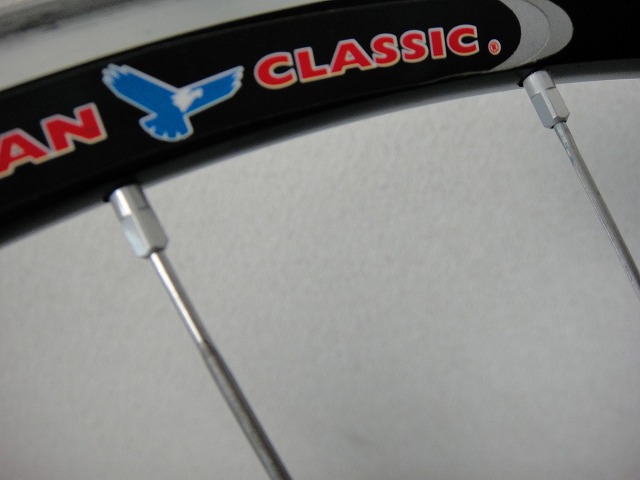
I didn't reuse the aluminum nipples—I went with new ones.
That was my call, not the customer's request.