This is a follow-up to a post I wrote a while back about hubs that absolutely cannot be built into wheels.
The day after that article, I got a phone call from Tange.
The first thing they asked me was:
"Is the rim a carbon rim?"
"Is the rim an offset rim?"
I was shocked because these questions came totally out of left field from all the hypothetical Q&As I'd been agonizing over overnight.
I had no idea what the rim material or offset specifications had to do with the phase misalignment issues described in the linked article.
After listening carefully to their explanation, the Tange representative said:
"We supply wheels to professional racing teams and those work fine" →
"Those are carbon rims with offset" →
"So if your rim is aluminum or not offset, it might not be possible to build a wheel, but that's not our fault"
That was their logic.
What the hell are you talking about?
When I told them that the reason the wheel won't build is fundamentally due to poor hub flange design, and that rim material and rim hole offset have nothing to do with it, they kept saying "But the professional team wheels..." So I explained that I actually know about those too—they're rear wheels built 2:1 using red-anodized hubs, which are completely different, and that's why they don't exhibit the phase twist happening with these blue hubs.
But they still wouldn't listen and kept saying "Let me check with the pro team first," so I got fed up and yelled into the phone: "Any idiot can see it instantly! I've got trial-built wheels right here—come look at them!!"
Not getting through on technical points to someone at the manufacturer is absolutely infuriating!
Someone told me "You've got a foul mouth, that's not good for business," so I apologized for that specifically, but honestly, we're paying for hub-shaped garbage that absolutely won't build wheels, so...
They kept insisting "Before we visit, let me check with the pro team first," so I said "The company is in Sakai and it's close by—I can bring them to you if you'd like," and they agreed to come to my shop.
The next day, the rep I'd yelled at came to visit—and it turned out to be the Tange president himself.
After explaining the whole situation from the linked article using a whiteboard, I showed him how to pass a spoke through the non-freehub side of the trial-built hub and asked, "Can you build a wheel this way?"
He admitted: "It's impossible."
And he also agreed to the hub return.
I've been saying from the start that I'm not fixated on getting a refund—all I wanted was to know if there's a way to build a wheel with this hub, and if so, please teach me how.
But if it did come down to a return, I didn't want them to think, "This guy from nomunLab shop is making a fuss, so we'll just refund him and call it even." What I really wanted was for them to acknowledge that this is a design-defective hub that absolutely cannot build wheels.
If the talks had fallen through and I couldn't return the hub, I actually had other ideas in mind.
I'm relieved I didn't have to act on them (or couldn't).
This hub, while listed in the catalog, has zero sales history in Japan. Well, that figures.
I had to scrap the trial spokes, but after mentioning that, the president voluntarily said they'd cover the spoke cost. I politely declined.
If I'd kept quiet about it, I was planning to charge them for it.
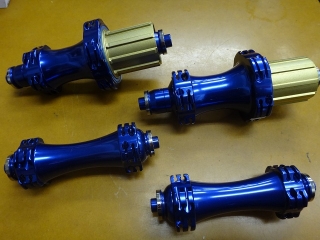
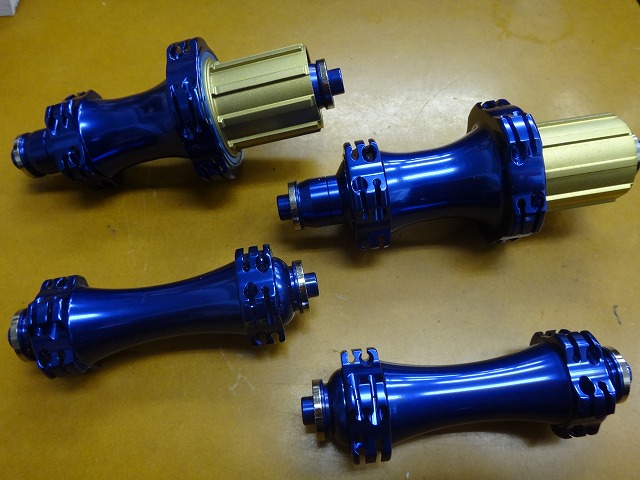
Here's the problem hub.
The catalog shows it with a silver hub body, but there's no inventory in Japan—just 2 pairs in Taiwan with blue hub bodies, so the customer wanted both pairs and we special-ordered them.
The customer didn't need a front hub, but since the front and rear are sold as a set, we bought them together.
By the way, "Tange wouldn't accept the return, so we can't refund you either" is not an acceptable answer, so I already refunded the customer before settling things with Tange.
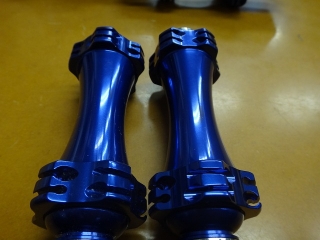
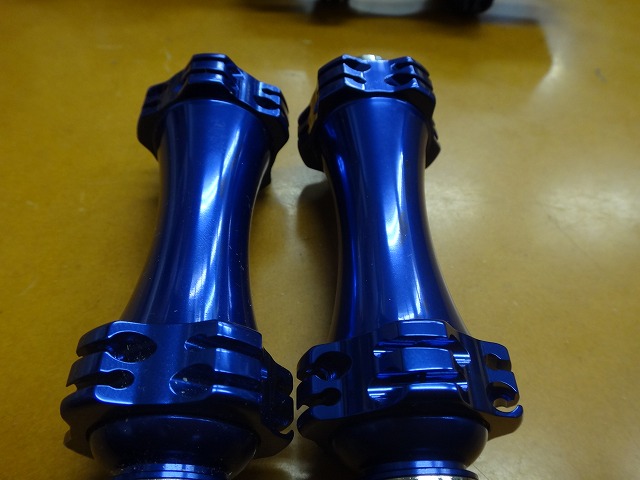
The front hub's flange phase is offset exactly in the middle at 3:1 on the opposite side, without alignment.
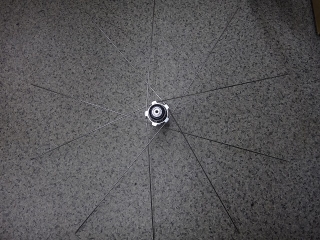
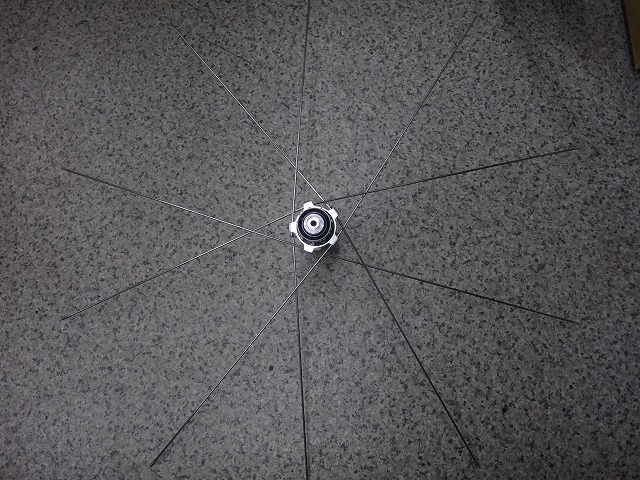
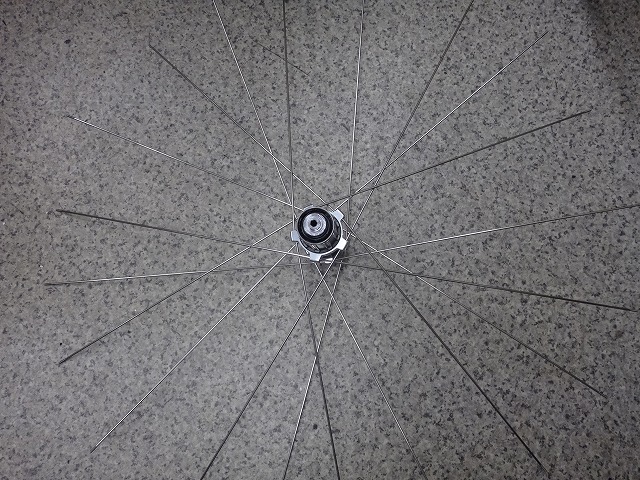
↑This is a 20H rear hub from a Dura-Ace complete wheel with only the freehub-side flange passed through with spokes.

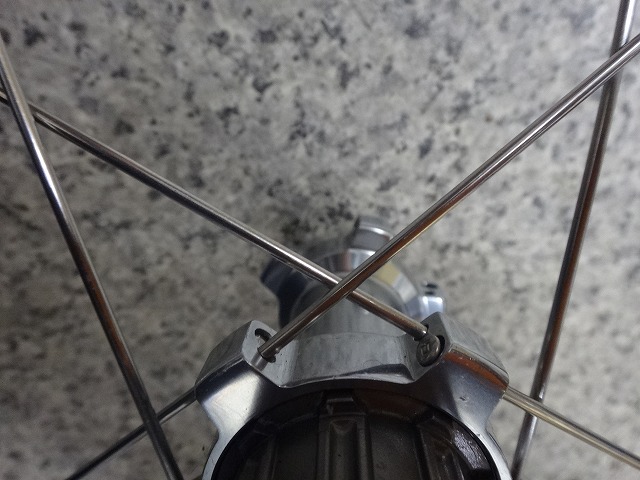
As mentioned in the linked article, because the opposite flange has phase offset,
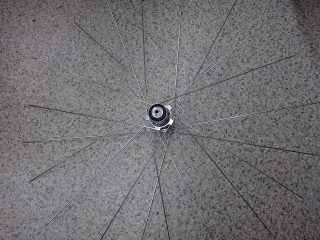
when you pass spokes through the non-freehub-side flange,
spoke patterns emerge that correspond to evenly-spaced rim holes.
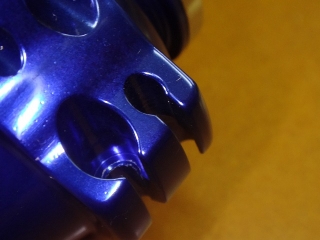
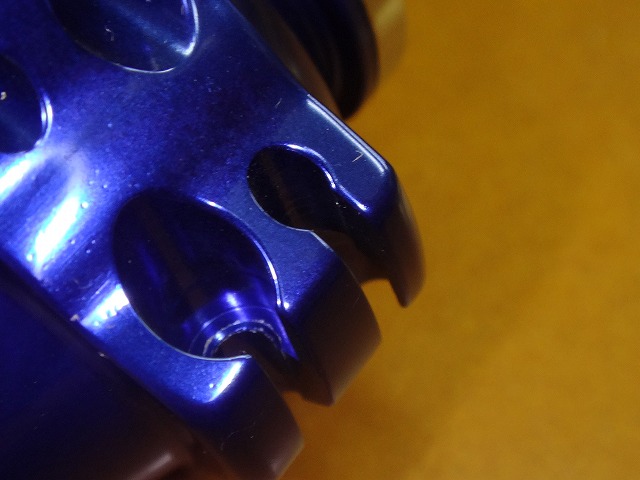
The front hub flanges are also left-right tangent-lacing, specifying the spoke insertion direction.
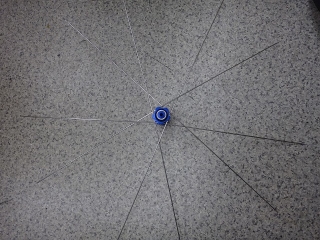
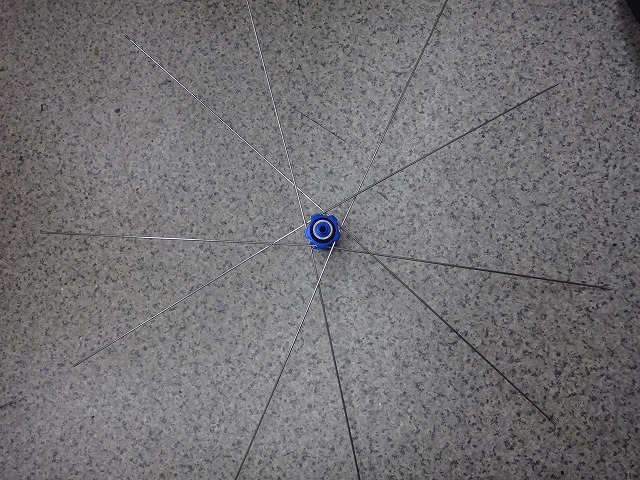
I passed spokes through just one flange.
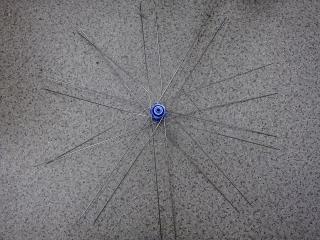
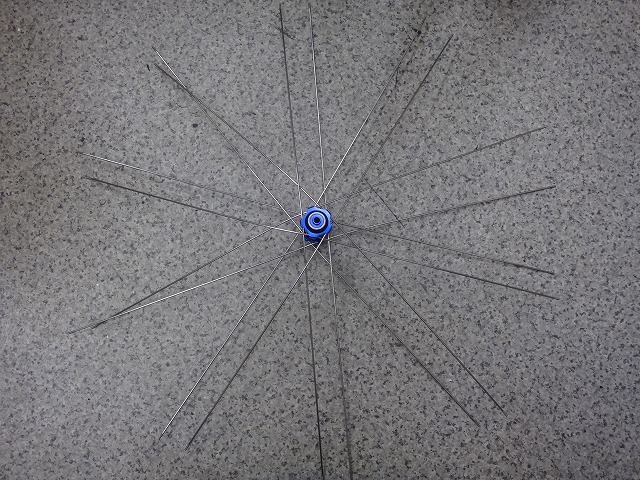
And the other side too.
It matches perfect paired-spoke phasing, but with a low-profile rim like a Bontrager or Rolf Prima with that level of spoke pairing,
it might be possible to build a wheel while incurring phase twist.
But with standard even-spaced-hole rims, it's impossible.
Anyway, that's the end of the Tange situation, but there's still some loose ends to tie up.
This hub doesn't have a listed price in the catalog, but it's pricier than expected—not quite Chris King level, but it's fairly expensive.
I sourced this hub from a distributor I don't usually buy from, but they've got a really dependable guy there.
I had him handle the special order and the negotiations with Tange after discovering the defect.
I owe him for his work.
With the hub return, a negative charge hit the distributor, and it's not normal for the distributor to pay a refund to the retailer.
Obviously, a prolonged situation like this—especially the accounting department—is something the distributor really hates (→here).
So I told him I'd be making purchases in the same month as the return that would exceed the cost of the 2 hub pairs, and I asked him to "just throw in whatever you want to get over X amount."
I basically ended up selecting most of the products myself.
The merchandise we sourced for this incident is being sold under the name "Tange Hub Return Sale" at a special price!
Everyone, make sure to thank Tange for making this sale possible!
The prices are too crazy to write out.
It's basically right-to-left. How you interpret "right-to-left" is up to you.
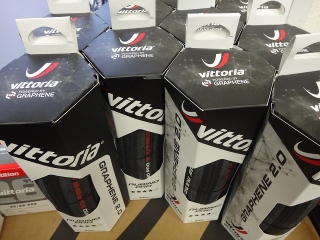
We sourced Vittoria Rubino G2.0 in 25C.
Currently, I think the best clincher tire is Continental's Grand Prix 5000, but that doesn't mean all Continental tires are better than competitors' offerings at the same price point—I'm just saying the Grand Prix 5000 is the best.
Vittoria makes tires in the Rubino grade, and they go Rubino, Rubino Pro, Rubino Pro 2, Rubino Pro 3, and the current model is Rubino Pro G2.0 with graphene 2.0 blended into the tread.
Internally, this is essentially Rubino Pro 4.
I don't know about the current models, but the previous Rubino Pro 3 was, in my opinion, "the best tire when compared at the same price point," so I went with the current Rubino Pro.
This tire comes in a tubeless-ready version, but what we sourced is a standard clincher.
I didn't choose the top-model Corsa because it has an uncharacteristic tread profile and thin sidewalls that harken back to the old Clement Criterium line that Vittoria bought out years ago. In fact, the Challenge tire made by ex-Clement members reassembled has a similar construction.
Technically a WO tire, but in the "open tubular" format—tubeless without stitching, just glued beads—which means when folded it has no roundness and is flat. Veloflex WO tires are also open tubular.
The Corsa has excellent rolling resistance, but for wet grip and cornering limits, I actually think the Rubino Pro 3 is better, so I passed. It's also prone to flats.
Plus, the Corsa gets ridiculously cheap on overseas online shops sometimes.
Recently a customer bought a Continental UltraSport from an online shop because it was cheap, and complained it had a really hard bead and felt heavy. So while doing spoke truing, I demonstrated removing the tire, and that tire had a steel bead, not Kevlar.
Same as a mama-chari tire.
It doesn't fold, so it comes in a box.
By the way, a steel bead doesn't specifically make it harder to seat on the rim either.
This is a budget version adopted in complete bikes, and since Japanese Continental distributors don't handle this spec, I haven't asked details, but it's definitely an overseas purchase.
After I went on saying "Wow, this tire's magnetic!" I mentioned that we'd be sourcing Rubino Pro soon as a sale item, and they asked me to hold one.
I said no, first-come-first-served.
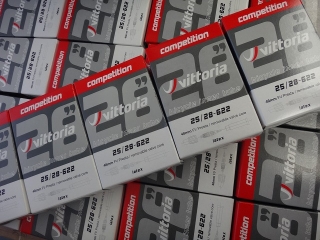
We sourced Vittoria latex tubes in 700×25-28C size.
Since disc road bikes have become more common, people seem to think "no brake heat on carbon rims, so latex tubes should be fine,"
and I've been seeing a lot of people using latex tubes in 25C and 28C sizes lately.
I see a lot of tubes when removing tires and tubes for wheel inspections—enough to be called statistics—and it seems to be quietly trendy.
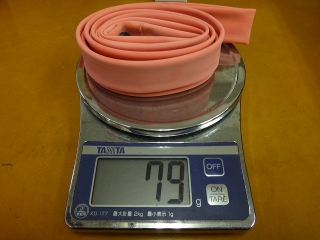
The box shows 85g, but they seem to run lighter than that.
As far as I know, Vittoria's stated tube weights are almost always lighter than actual measured weight...
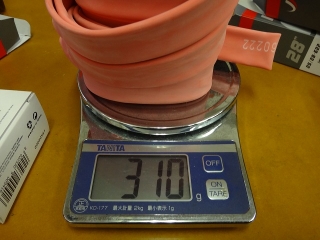
I tried stacking 5 but got a little unstable by the 4th, so I weighed 4 together. Average came to 77.5g.
I swear I just randomly pulled them out and weighed them.
Vittoria's 19-23C latex tubes are listed at 75g, but there are lighter ones in that size (→here).
Well, I guess "used to be" is more accurate.
Velodestin latex tubes aren't currently carried by distributors and can't be ordered anymore.
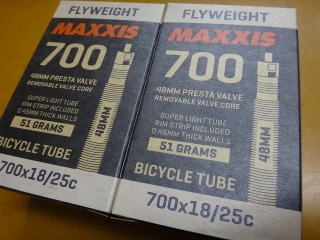
Speaking of something else, our shop has been moving a lot of Maxxis Flyweight as our super-lightweight butyl tube.
Rated at 51g, measuring 50-53g in practice.
This tube maxes out at 25C—no 28C version.
And Flyweight has no 28C-compatible size.
The next thickness up from Flyweight is Ultralight.
Then comes Welterweight. Listing thicknesses:
Flyweight 0.45mm
Ultralight 0.6mm
Welterweight 0.8mm
Looking at this lineup, I think they should've named Ultralight "Featherweight" or "Bantamweight," but originally only Ultralight existed.
Back when MTB was 26 inches, there was this paper-thin tire rated 330g called "Flyweight 330" that was basically for on-road hill climbs only, and the tube set with it was the start of the Flyweight series.
Welterweight came out way later in 2020, below Ultralight.
Both Ultralight and Welterweight have 28C-covering tubes, but while Welterweight covers a 25-32C range,
Ultralight had 18-25C and then jumped to 28-38C, making 28C the minimum.
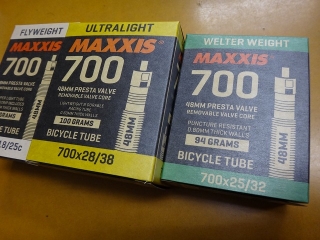
↑Like this
The box sizes are different.
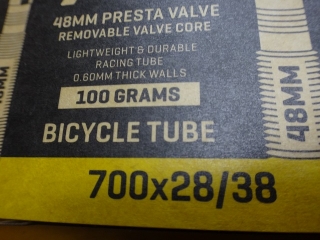
↑Ultralight 0.6mm thickness 100g
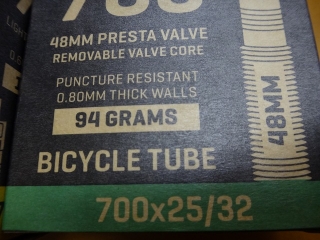
↑Welterweight 0.8mm thickness 94g
Because the size ranges differ, for 28C tires, the thicker Welterweight is actually lighter—a reversal!
I say "past tense" because Ultralight now comes in a 23-32C size (not 25-32C). Listed weight: 80g.
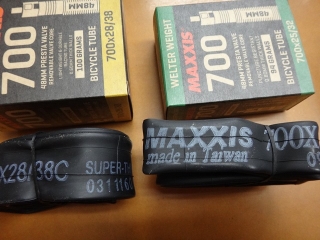
↑Ultralight is thinner but wider.
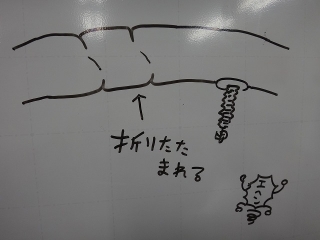
Using a 28C-minimum tube in a 28C tire is possible, but with aging it stretches, so when changing tires next time you have to fold and squeeze it in, which isn't ideal.
We've been using Welterweight for 28C-compatible lightweight butyl tubes, but whether to switch to the new 23-32C Ultralight is still under consideration.
It's only 100 yen difference in list price, but that's what makes it tricky.
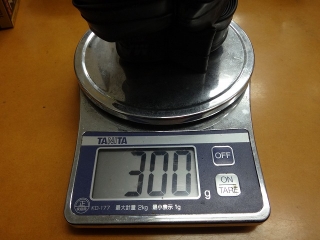
↑Actual weights of 3 rated-100g Ultralight

↑Actual weights of 3 rated-94g Welterweight (averaging 95g)
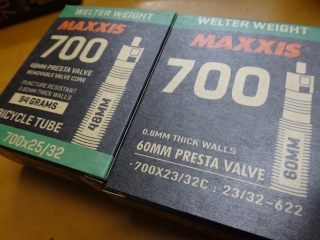
Also, the Welterweight with 60mm valve is listed in the catalog as covering 23-32C, not 25-32C, so I was skeptical it was a typo and sourced some—turns out it really is that way.
Maxxis tube size consistency, honestly, it's such a pain.
Anyway, what I'm trying to say is:
For 23C and 25C tubes, there's no longer a reason to choose latex for lightness alone—if it's just lightness, polyurethane tubes are even lighter.
But for 28C, Vittoria's actual-measured roughly-80g tube isn't lagging behind the lightest butyl tubes in weight.
The bad ride feel of polyurethane and the good ride feel of latex aren't placebos—you can feel them clearly at the sensation level. So if you don't mind the hassle of needing air every day, latex tubes might be pretty good.
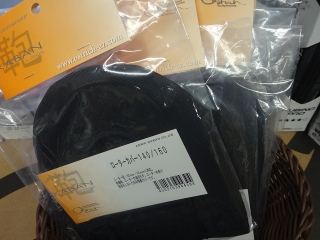
We also sourced Ostrich rotor covers.
140/160mm compatible.
I've been seeing similar items used for the same purpose a lot recently.
There are others, but I can't write about them here.
Also, this sale is for in-store visitors only, sorry.
As I mentioned, the prices are too crazy to write anywhere, so I had the teacher come over from the usual place with a comment.
Alright teacher, take it away.

↑Um, could you maybe stop saying stuff like that?
The day after that article, I got a phone call from Tange.
The first thing they asked me was:
"Is the rim a carbon rim?"
"Is the rim an offset rim?"
I was shocked because these questions came totally out of left field from all the hypothetical Q&As I'd been agonizing over overnight.
I had no idea what the rim material or offset specifications had to do with the phase misalignment issues described in the linked article.
After listening carefully to their explanation, the Tange representative said:
"We supply wheels to professional racing teams and those work fine" →
"Those are carbon rims with offset" →
"So if your rim is aluminum or not offset, it might not be possible to build a wheel, but that's not our fault"
That was their logic.
What the hell are you talking about?
When I told them that the reason the wheel won't build is fundamentally due to poor hub flange design, and that rim material and rim hole offset have nothing to do with it, they kept saying "But the professional team wheels..." So I explained that I actually know about those too—they're rear wheels built 2:1 using red-anodized hubs, which are completely different, and that's why they don't exhibit the phase twist happening with these blue hubs.
But they still wouldn't listen and kept saying "Let me check with the pro team first," so I got fed up and yelled into the phone: "Any idiot can see it instantly! I've got trial-built wheels right here—come look at them!!"
Not getting through on technical points to someone at the manufacturer is absolutely infuriating!
Someone told me "You've got a foul mouth, that's not good for business," so I apologized for that specifically, but honestly, we're paying for hub-shaped garbage that absolutely won't build wheels, so...
They kept insisting "Before we visit, let me check with the pro team first," so I said "The company is in Sakai and it's close by—I can bring them to you if you'd like," and they agreed to come to my shop.
The next day, the rep I'd yelled at came to visit—and it turned out to be the Tange president himself.
After explaining the whole situation from the linked article using a whiteboard, I showed him how to pass a spoke through the non-freehub side of the trial-built hub and asked, "Can you build a wheel this way?"
He admitted: "It's impossible."
And he also agreed to the hub return.
I've been saying from the start that I'm not fixated on getting a refund—all I wanted was to know if there's a way to build a wheel with this hub, and if so, please teach me how.
But if it did come down to a return, I didn't want them to think, "This guy from nomunLab shop is making a fuss, so we'll just refund him and call it even." What I really wanted was for them to acknowledge that this is a design-defective hub that absolutely cannot build wheels.
If the talks had fallen through and I couldn't return the hub, I actually had other ideas in mind.
I'm relieved I didn't have to act on them (or couldn't).
This hub, while listed in the catalog, has zero sales history in Japan. Well, that figures.
I had to scrap the trial spokes, but after mentioning that, the president voluntarily said they'd cover the spoke cost. I politely declined.
Here's the problem hub.
The catalog shows it with a silver hub body, but there's no inventory in Japan—just 2 pairs in Taiwan with blue hub bodies, so the customer wanted both pairs and we special-ordered them.
The customer didn't need a front hub, but since the front and rear are sold as a set, we bought them together.
By the way, "Tange wouldn't accept the return, so we can't refund you either" is not an acceptable answer, so I already refunded the customer before settling things with Tange.
The front hub's flange phase is offset exactly in the middle at 3:1 on the opposite side, without alignment.
↑This is a 20H rear hub from a Dura-Ace complete wheel with only the freehub-side flange passed through with spokes.
As mentioned in the linked article, because the opposite flange has phase offset,
when you pass spokes through the non-freehub-side flange,
spoke patterns emerge that correspond to evenly-spaced rim holes.
The front hub flanges are also left-right tangent-lacing, specifying the spoke insertion direction.
I passed spokes through just one flange.
And the other side too.
It matches perfect paired-spoke phasing, but with a low-profile rim like a Bontrager or Rolf Prima with that level of spoke pairing,
it might be possible to build a wheel while incurring phase twist.
But with standard even-spaced-hole rims, it's impossible.
Anyway, that's the end of the Tange situation, but there's still some loose ends to tie up.
This hub doesn't have a listed price in the catalog, but it's pricier than expected—not quite Chris King level, but it's fairly expensive.
I sourced this hub from a distributor I don't usually buy from, but they've got a really dependable guy there.
I had him handle the special order and the negotiations with Tange after discovering the defect.
I owe him for his work.
With the hub return, a negative charge hit the distributor, and it's not normal for the distributor to pay a refund to the retailer.
Obviously, a prolonged situation like this—especially the accounting department—is something the distributor really hates (→here).
So I told him I'd be making purchases in the same month as the return that would exceed the cost of the 2 hub pairs, and I asked him to "just throw in whatever you want to get over X amount."
I basically ended up selecting most of the products myself.
The merchandise we sourced for this incident is being sold under the name "Tange Hub Return Sale" at a special price!
Everyone, make sure to thank Tange for making this sale possible!
The prices are too crazy to write out.
It's basically right-to-left. How you interpret "right-to-left" is up to you.

We sourced Vittoria Rubino G2.0 in 25C.
Currently, I think the best clincher tire is Continental's Grand Prix 5000, but that doesn't mean all Continental tires are better than competitors' offerings at the same price point—I'm just saying the Grand Prix 5000 is the best.
Vittoria makes tires in the Rubino grade, and they go Rubino, Rubino Pro, Rubino Pro 2, Rubino Pro 3, and the current model is Rubino Pro G2.0 with graphene 2.0 blended into the tread.
Internally, this is essentially Rubino Pro 4.
I don't know about the current models, but the previous Rubino Pro 3 was, in my opinion, "the best tire when compared at the same price point," so I went with the current Rubino Pro.
This tire comes in a tubeless-ready version, but what we sourced is a standard clincher.
I didn't choose the top-model Corsa because it has an uncharacteristic tread profile and thin sidewalls that harken back to the old Clement Criterium line that Vittoria bought out years ago. In fact, the Challenge tire made by ex-Clement members reassembled has a similar construction.
Technically a WO tire, but in the "open tubular" format—tubeless without stitching, just glued beads—which means when folded it has no roundness and is flat. Veloflex WO tires are also open tubular.
The Corsa has excellent rolling resistance, but for wet grip and cornering limits, I actually think the Rubino Pro 3 is better, so I passed. It's also prone to flats.
Recently a customer bought a Continental UltraSport from an online shop because it was cheap, and complained it had a really hard bead and felt heavy. So while doing spoke truing, I demonstrated removing the tire, and that tire had a steel bead, not Kevlar.
Same as a mama-chari tire.
It doesn't fold, so it comes in a box.
By the way, a steel bead doesn't specifically make it harder to seat on the rim either.
This is a budget version adopted in complete bikes, and since Japanese Continental distributors don't handle this spec, I haven't asked details, but it's definitely an overseas purchase.
After I went on saying "Wow, this tire's magnetic!" I mentioned that we'd be sourcing Rubino Pro soon as a sale item, and they asked me to hold one.
I said no, first-come-first-served.
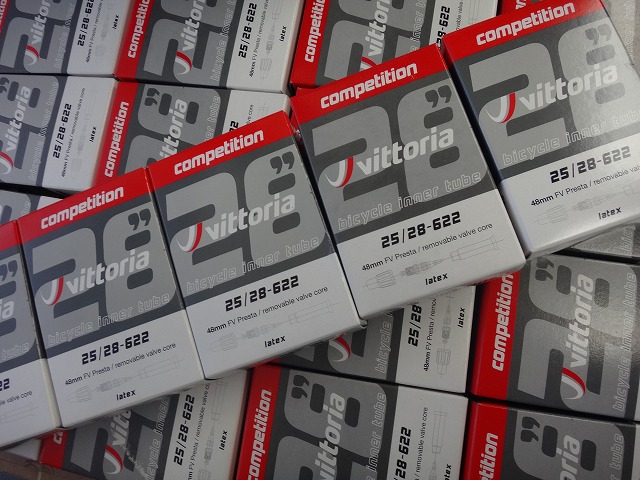
We sourced Vittoria latex tubes in 700×25-28C size.
Since disc road bikes have become more common, people seem to think "no brake heat on carbon rims, so latex tubes should be fine,"
and I've been seeing a lot of people using latex tubes in 25C and 28C sizes lately.
I see a lot of tubes when removing tires and tubes for wheel inspections—enough to be called statistics—and it seems to be quietly trendy.

The box shows 85g, but they seem to run lighter than that.
As far as I know, Vittoria's stated tube weights are almost always lighter than actual measured weight...
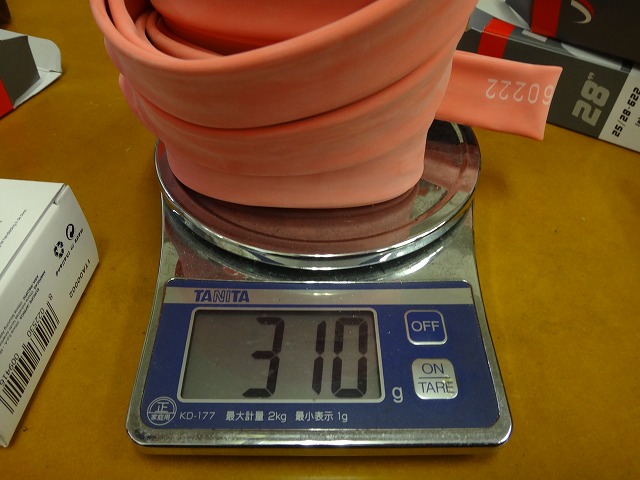
I tried stacking 5 but got a little unstable by the 4th, so I weighed 4 together. Average came to 77.5g.
I swear I just randomly pulled them out and weighed them.
Vittoria's 19-23C latex tubes are listed at 75g, but there are lighter ones in that size (→here).
Well, I guess "used to be" is more accurate.
Velodestin latex tubes aren't currently carried by distributors and can't be ordered anymore.
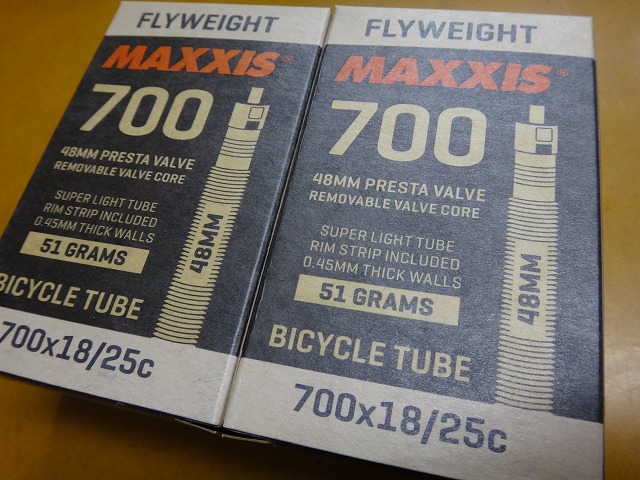
Speaking of something else, our shop has been moving a lot of Maxxis Flyweight as our super-lightweight butyl tube.
Rated at 51g, measuring 50-53g in practice.
This tube maxes out at 25C—no 28C version.
And Flyweight has no 28C-compatible size.
The next thickness up from Flyweight is Ultralight.
Then comes Welterweight. Listing thicknesses:
Flyweight 0.45mm
Ultralight 0.6mm
Welterweight 0.8mm
Looking at this lineup, I think they should've named Ultralight "Featherweight" or "Bantamweight," but originally only Ultralight existed.
Back when MTB was 26 inches, there was this paper-thin tire rated 330g called "Flyweight 330" that was basically for on-road hill climbs only, and the tube set with it was the start of the Flyweight series.
Welterweight came out way later in 2020, below Ultralight.
Both Ultralight and Welterweight have 28C-covering tubes, but while Welterweight covers a 25-32C range,
Ultralight had 18-25C and then jumped to 28-38C, making 28C the minimum.
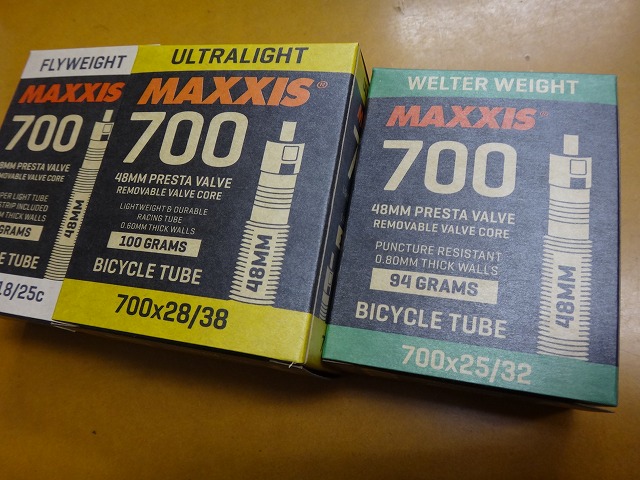
↑Like this
The box sizes are different.
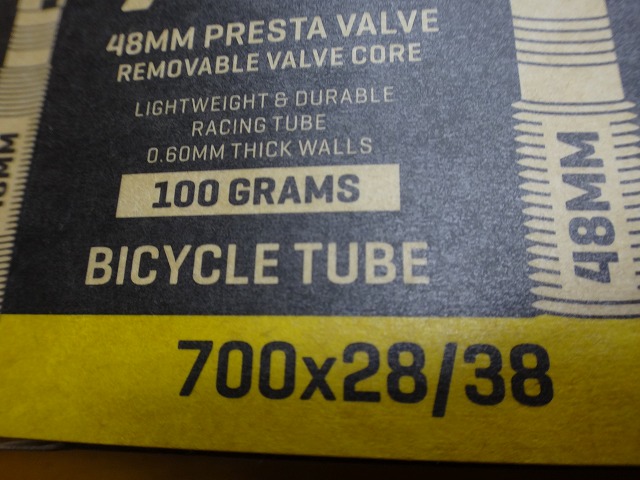
↑Ultralight 0.6mm thickness 100g
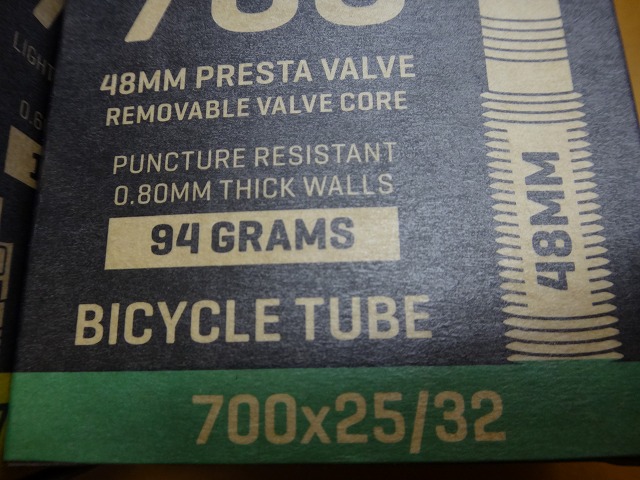
↑Welterweight 0.8mm thickness 94g
Because the size ranges differ, for 28C tires, the thicker Welterweight is actually lighter—a reversal!
I say "past tense" because Ultralight now comes in a 23-32C size (not 25-32C). Listed weight: 80g.
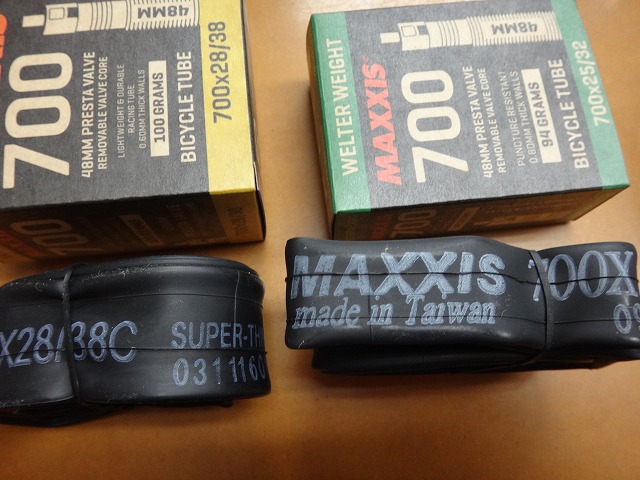
↑Ultralight is thinner but wider.
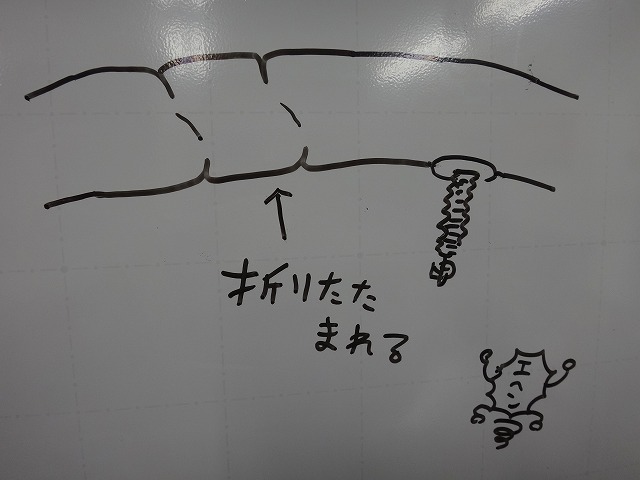
Using a 28C-minimum tube in a 28C tire is possible, but with aging it stretches, so when changing tires next time you have to fold and squeeze it in, which isn't ideal.
We've been using Welterweight for 28C-compatible lightweight butyl tubes, but whether to switch to the new 23-32C Ultralight is still under consideration.
It's only 100 yen difference in list price, but that's what makes it tricky.
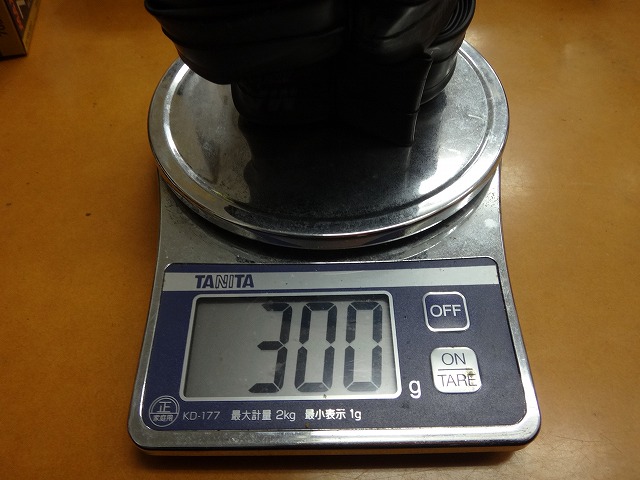
↑Actual weights of 3 rated-100g Ultralight
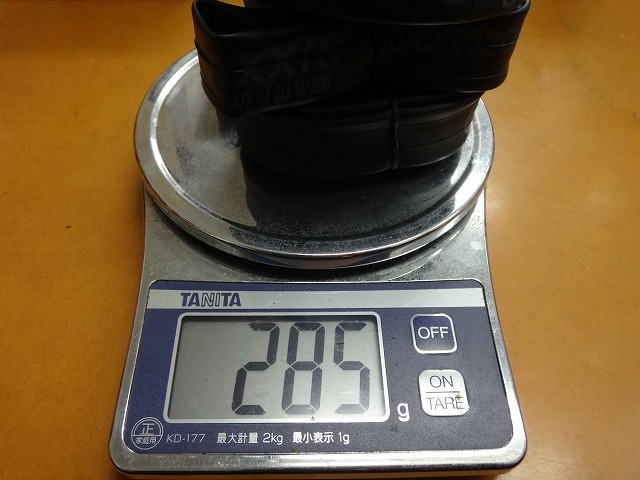
↑Actual weights of 3 rated-94g Welterweight (averaging 95g)
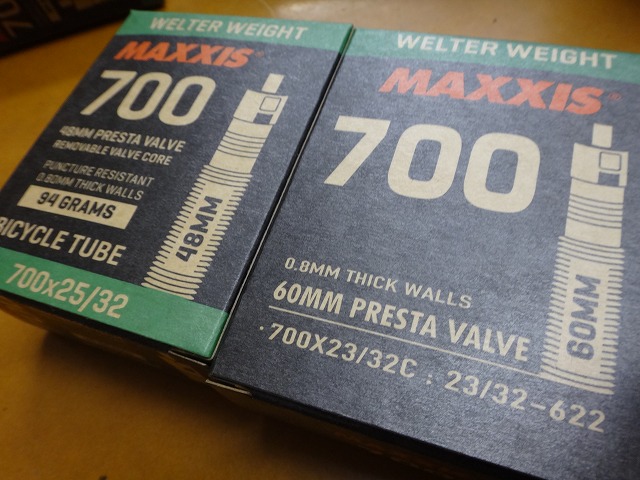
Also, the Welterweight with 60mm valve is listed in the catalog as covering 23-32C, not 25-32C, so I was skeptical it was a typo and sourced some—turns out it really is that way.
Maxxis tube size consistency, honestly, it's such a pain.
Anyway, what I'm trying to say is:
For 23C and 25C tubes, there's no longer a reason to choose latex for lightness alone—if it's just lightness, polyurethane tubes are even lighter.
But for 28C, Vittoria's actual-measured roughly-80g tube isn't lagging behind the lightest butyl tubes in weight.
The bad ride feel of polyurethane and the good ride feel of latex aren't placebos—you can feel them clearly at the sensation level. So if you don't mind the hassle of needing air every day, latex tubes might be pretty good.
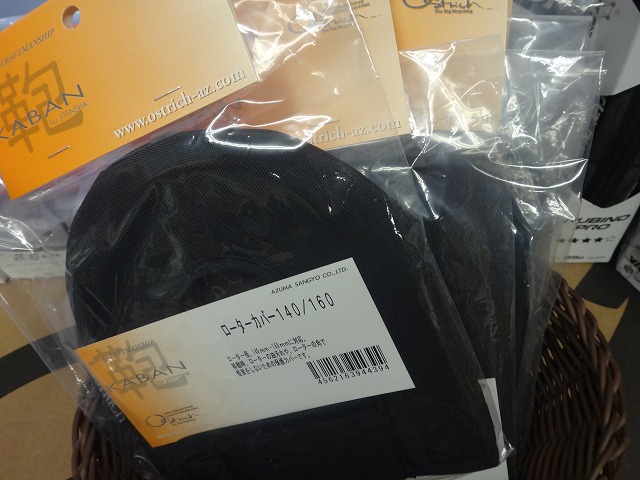
We also sourced Ostrich rotor covers.
140/160mm compatible.
I've been seeing similar items used for the same purpose a lot recently.
There are others, but I can't write about them here.
Also, this sale is for in-store visitors only, sorry.
As I mentioned, the prices are too crazy to write anywhere, so I had the teacher come over from the usual place with a comment.
Alright teacher, take it away.

↑Um, could you maybe stop saying stuff like that?