The title is just what happens with an 88mm rim height.
This is the fourth instance in this article, but there's no deeper meaning to it.
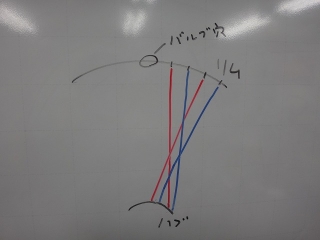
Now then, about wheel unfolded diagrams that I draw from time to time.
When viewing a wheel built with evenly-spaced rim holes and the valve hole pointing straight up from the side, the spoke of the adjacent rim hole coming clockwise from the valve hole emerges from the opposite flange as viewed from my position.
The diagram above is a left-right tangent-weave wheel, but if this is the rear wheel viewed from the freewheel side, the blue spokes are on the freewheel side and the red spokes are on the non-freewheel side.
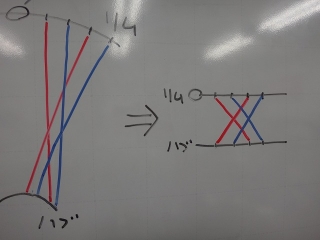
From the previous diagram, I change the scale of the hub and rim outline so they become parallel straight lines of equal length.
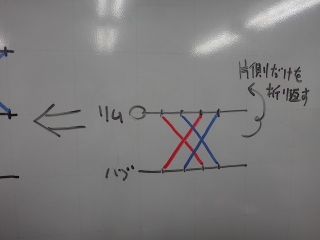
And when I fold back the hub line on just one side, it becomes
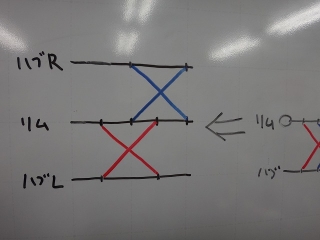
the wheel unfolded diagram.
This is a hub-rim-hub type unfolded diagram, but if it's easier to draw, I sometimes make it a rim-hub-rim type instead.
Unless there's a particular reason to consider it, the valve hole is usually omitted.
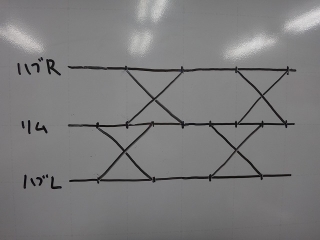
I drew in one more iteration of the four spokes from the final crossing pair, and since I'm going to use blue and red for different purposes later, I changed the spoke color to black.
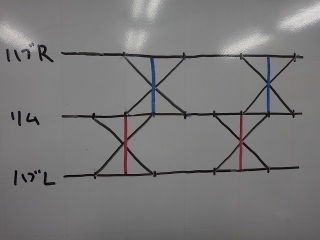
From there, I added radial guidelines through the final crossing.
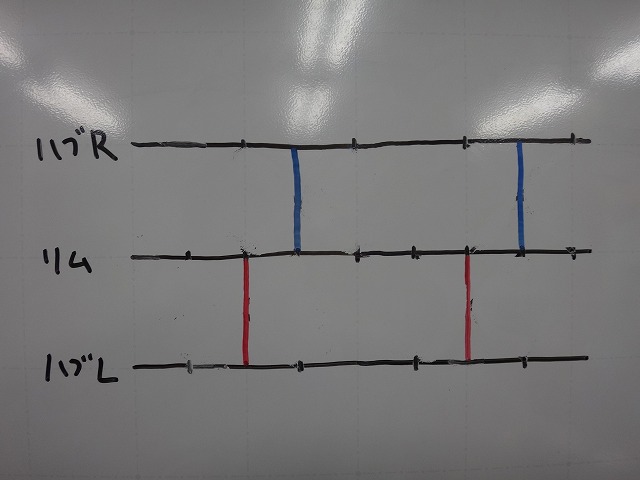
I made the freewheel side blue and the non-freewheel side red.
The radial lines are perpendicular to the rim and hub lines.
Whether all spokes that reach from hub to rim without crossing other spokes should be called radial weave is, strictly speaking, not accurate—at least not in my understanding.
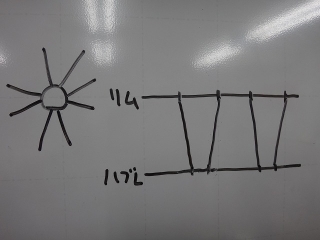
The zero-cross weave with dense-sparse phase on the hub side—which Shimano does on their rim brake front wheels and, recently, on disc brake rear wheels—doesn't have completely radial spoke trajectories, so while it is zero-cross weave, it's not "radial" weave.
So when expressing this in a wheel unfolded diagram, since the spoke head positions on the hub side are spaced with dense-sparse phase, they won't be perpendicular to the horizontal line.
Getting back to the point.
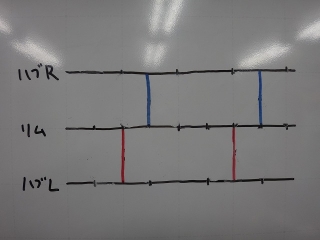
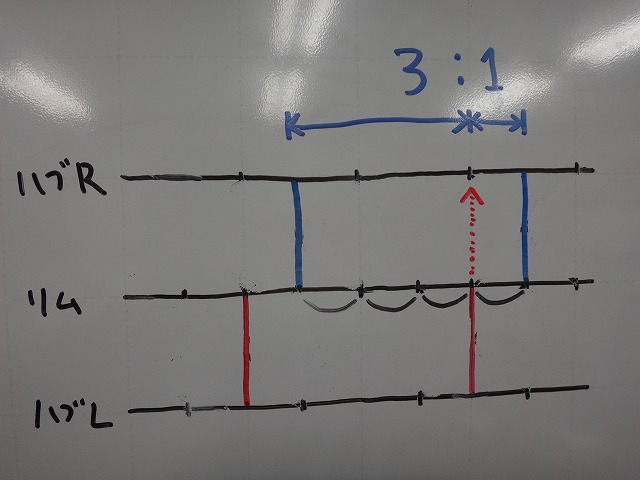
I erased the spoke lines from the previous diagram and kept only the radial guidelines through the final crossing.
What I want you to pay attention to this time is

that the phase of the red guideline as seen from the blue guideline is "not exactly in the middle" of the blue guideline.
Let me show you this in an actual wheel.

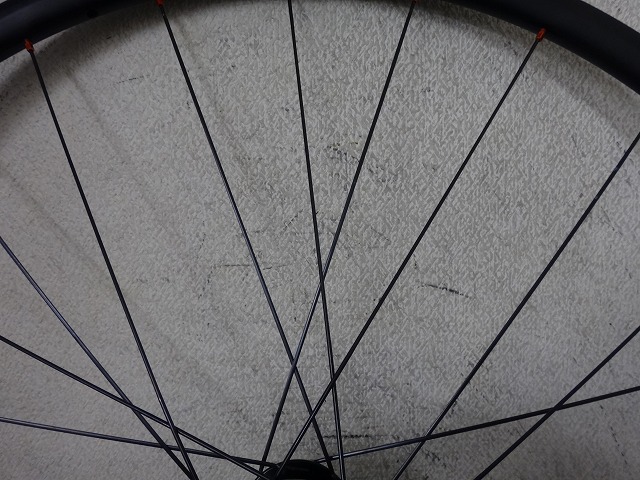
This is the rear wheel from Nomulab Wheel #8, with equal hole counts on rim and hub, evenly-spaced holes on both sides, and the same number of spokes on left and right. In other words, it's a "normal wheel."

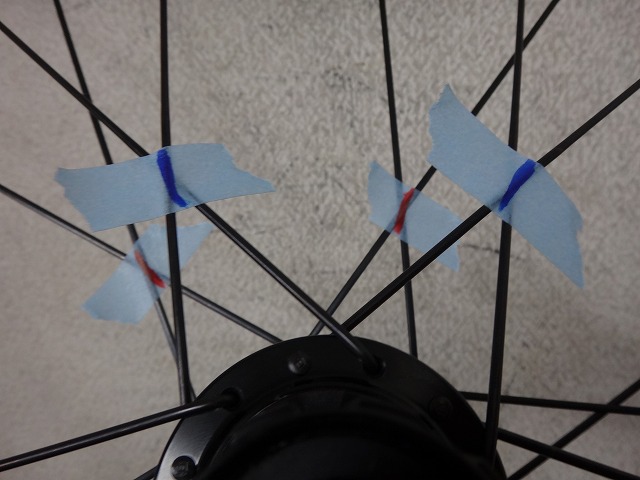
Looking at the phase of this final crossing, it has the same relationship as in the unfolded diagram.
Now let me check what happens with a left-right tangent-weave hub for straight spokes.
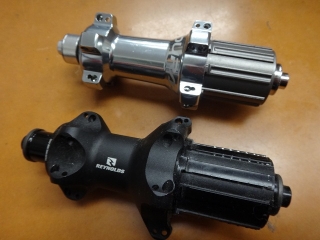
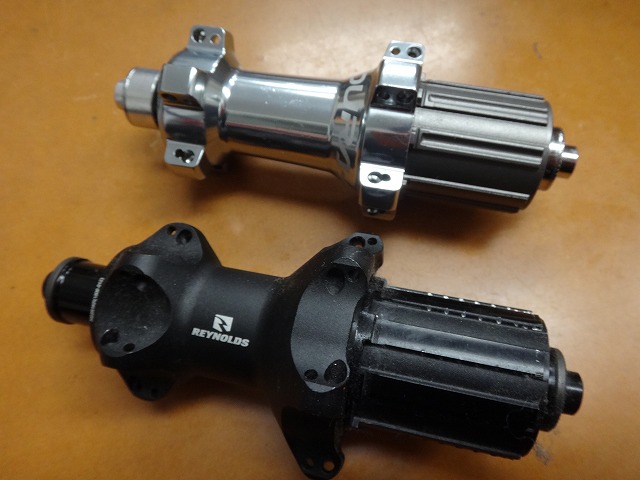
I prepared a Reynolds 24H hub and a Shimano 20H hub.
Both have two spokes coming from each flange boss, but the rims that were historically built with these hubs had evenly-spaced rim holes (←this is important).
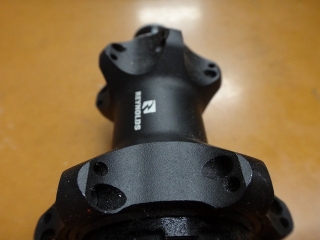
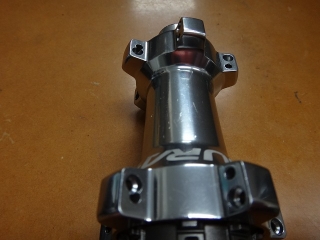
And with both, the phase of the non-freewheel side boss is not exactly in the middle of the freewheel side boss phase.
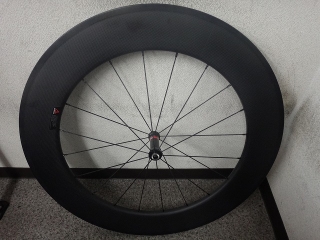
A customer brought in a 20H front wheel built with an 88mm-high carbon tubular rim.
It wasn't obtained in this condition—it was built at a different shop—but since there's no use for it in front (well then, why was it built as a front wheel?), they're asking us to rebuild it as a rear wheel.
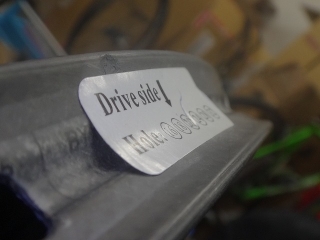
There's no sign of use—not even that a tire was ever mounted on it.
If it had been, the sticker in the image above would never have stayed in that soft, raised state.
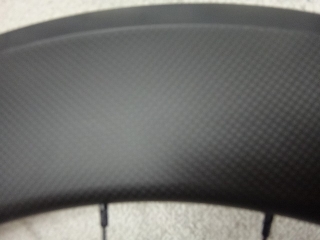
Eight Eight (88mm)!

The hub is a Novatech straight-spoke hub, the AS511SB, and
the spokes are Pillar black square aero spokes.
Dust had accumulated on the hub and spokes, so it seems the wheel was left sitting without a wheel bag for quite some time.
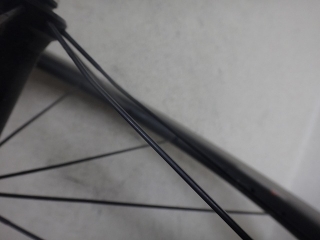
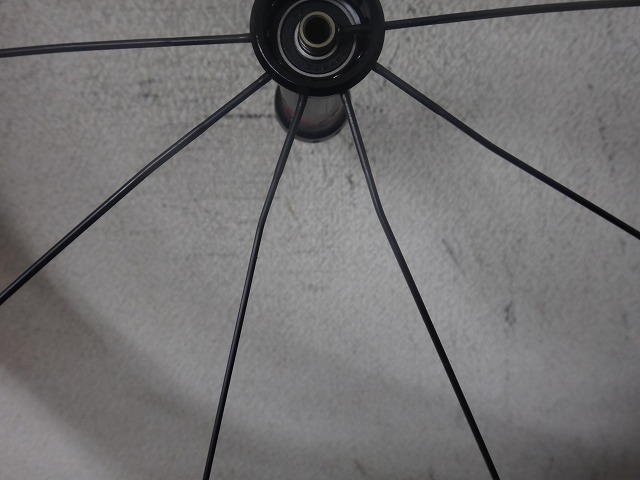
When I loosened the tension roughly, several spokes on one side showed continuous deformation.
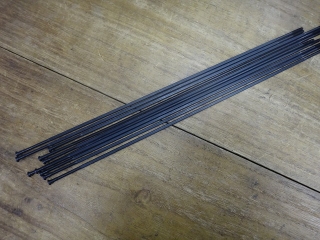
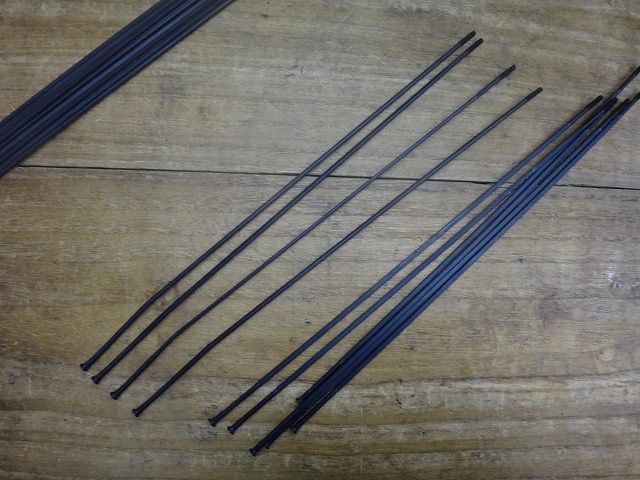
I removed all the spokes from the side that didn't have bent spokes.
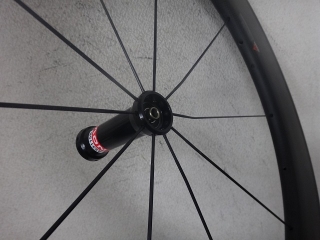
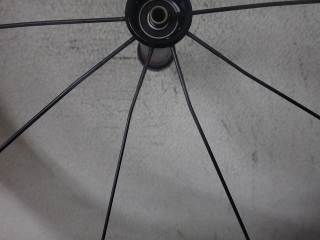
↑If you rotate the bent spoke 90 degrees, it looks like this
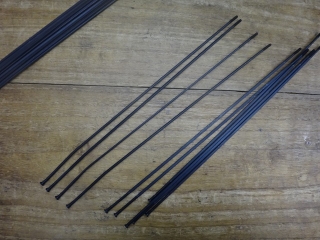
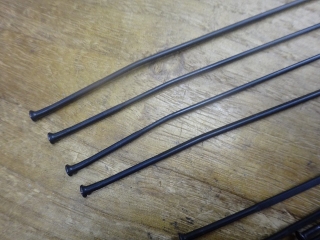
I also removed all the spokes from the bent side.
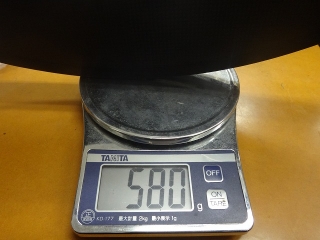
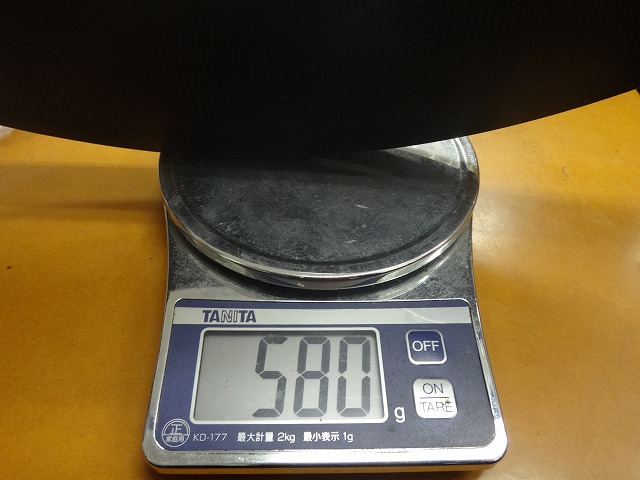
Since I won't be using that keyword, it won't remain in the archive, but here's the actual measured weight of the rim.
For anyone who later thinks "How much did that 88mm-high rim weigh again?", try searching the blog for "Eight Eight."
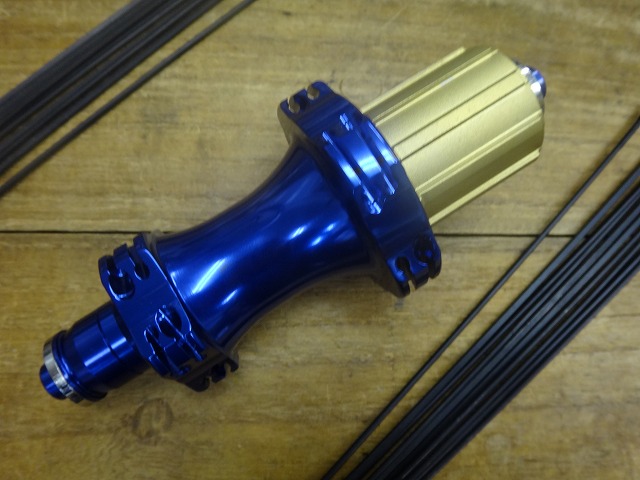
For a 20H rear hub, since the Evolite 20H is long discontinued and Shimano 11-speed freewheel body versions are practically impossible to find, the customer searched extensively and inquired with their distributor about a 20H straight-spoke rear hub, the HBRR-1001, from Tange (though whether it's actually Tange-made is unclear). The distributor said they could get it if they bought it as a set with the HBRF-1001 front hub. Even though the customer only needed the rear hub, they decided to get the set anyway (what can you do), and had it ordered.
By the way, both front and rear are left-right tangent-weave specification.
The catalog shows them with a silver-colored hub body, but they said that stock is already gone and they only have the blue anodized version, so
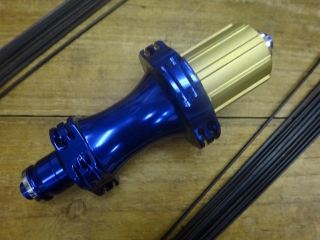
that's what we had ordered.

From the opening story, nothing but bad premonitions, but I'll continue.
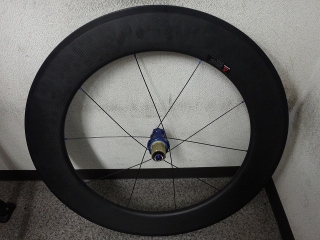
I did a rough temporary build of spokes on just one side with the proper length.
The spoke threads are aligned so they're just hidden by the end face of the nipple.
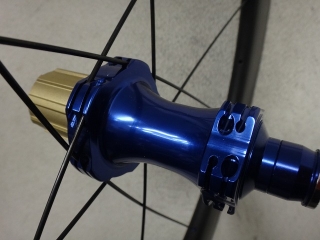
Yeah, that's impossible.
With this hub, it's impossible to build a wheel to a normal rim.
If this were a 36H hub with nine bosses on one flange, we might have barely managed while accepting some phase twist, but with this hub, it's not possible.
Examples of wheels built consciously accepting phase twist (where spoke trajectories in zero-cross or the auxiliary lines for final crossings in tangent-weave deviate from radial) include things like building zero-cross with 18H rim on a 36H hub, or building tangent-weave with 24H rim on a 36H hub while skipping hub holes.
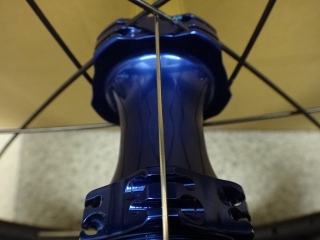
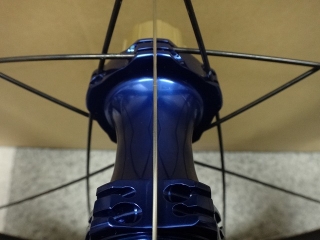
The positional relationship of the flange bosses is, when viewed from one side, exactly in the middle.
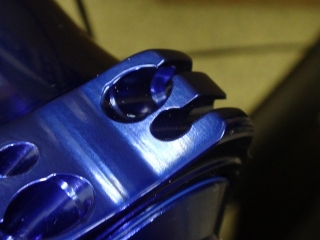
The hub flange slot is a fairly high-directional structure that specifies the orientation of the spoke head, and
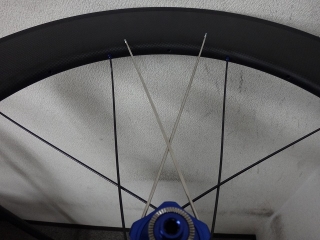
when you actually pass a spoke of the proper length through, it looks like this.
The rim height is so extreme that it appears slightly offset inward, but
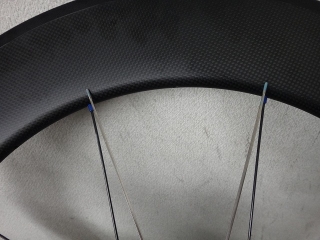
what it's actually pointing to is this phase—perfectly parallel pair spokes.
Wheels like that exist on XERO LITE and similar, but I was never told about this hub "it can only be built with rims that have perfectly-paired-spoke-phase holes, not evenly-spaced rim holes."
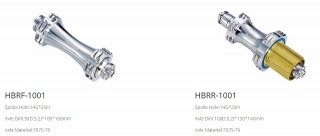
On the manufacturer's website too, the flange boss phase clearly appears to be exactly in the middle.
Whether there are any examples of wheels built with this hub is unclear, but according to the customer's extensive research, not a single example could be found.
Actually, I once serviced a rear wheel built with a 24H rear hub with the exact same flange shape in red anodizing at our shop, but that was built with radial weave on the non-freewheel side with no phase twist.
The flange shape being the same applies only to the freewheel side anyway.
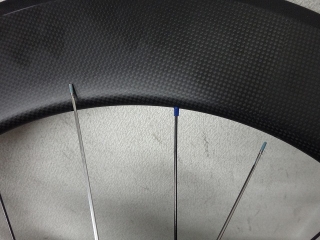
If I try to build consciously accepting phase twist and move the final crossing clockwise as seen from the non-freewheel side, it looks like this.
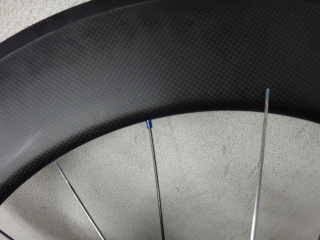
↑Counter-clockwise looks like this
If this were a universal flange for head-tube spokes, then including the freewheel side spokes, if you prepared different spoke lengths for each of the "porcupine" and "anti-porcupine" directions, you could technically make something that resembles a wheel, though whether it would be decent is another question.
But with this hub, the flange slot directional specificity is strong, and the spokes become quite bowed, so forcing them to tighten up into a wheel is impossible.
Even with a universal hub, I wouldn't think "let's try building this" if the spoke length differences were this extreme.
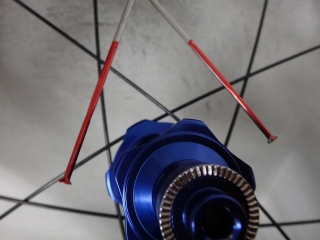
When arranging the non-freewheel side spokes in perfect pair-spoke configuration with no phase twist, the length from spoke head to final crossing comes to roughly 45mm, so I colored from the spoke head to the 45mm point.
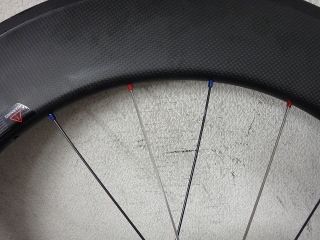
A non-freewheel side spoke of the proper length with the thread hidden just at the nipple end face
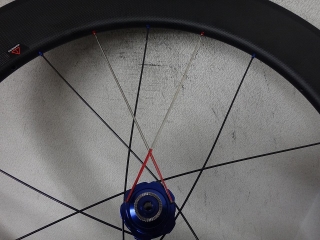
overlapping at the color change points on the spokes while bringing the spoke head to where the hub flange slot diameter is, and...
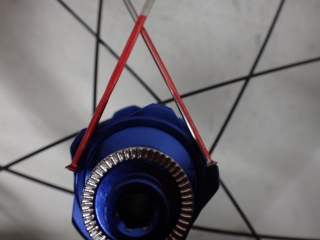
↑becomes this.
This is as seen from the non-freewheel side, and it shows that "it would be good if the non-freewheel side boss offset counter-clockwise from the exact middle relative to the freewheel side boss position."
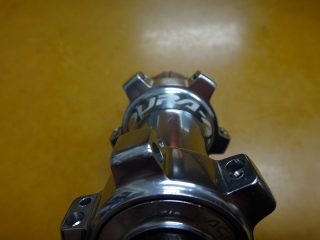
And for example, with the earlier Shimano hub, that's actually what it is.
How to build a wheel with this hub—I humbly asked the distributor to inquire with Tange, and I was told I'd get some kind of response today, but the phone never rang.
Any customer who happened to call our shop today, especially regulars, must have thought something was odd.
Me making a point to call back politely? That's unusual.
This is the fourth instance in this article, but there's no deeper meaning to it.
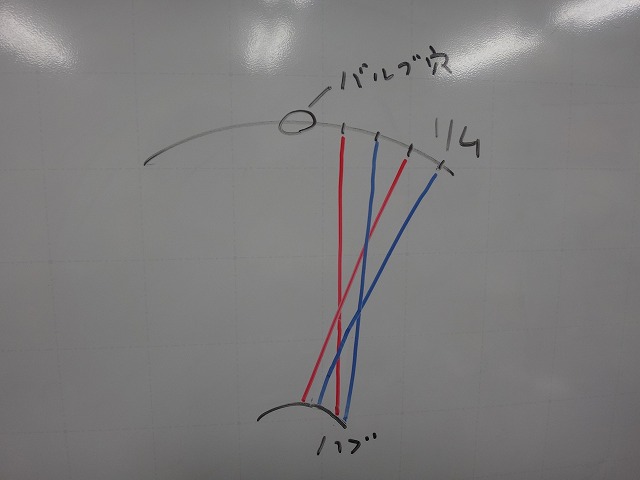
Now then, about wheel unfolded diagrams that I draw from time to time.
When viewing a wheel built with evenly-spaced rim holes and the valve hole pointing straight up from the side, the spoke of the adjacent rim hole coming clockwise from the valve hole emerges from the opposite flange as viewed from my position.
The diagram above is a left-right tangent-weave wheel, but if this is the rear wheel viewed from the freewheel side, the blue spokes are on the freewheel side and the red spokes are on the non-freewheel side.
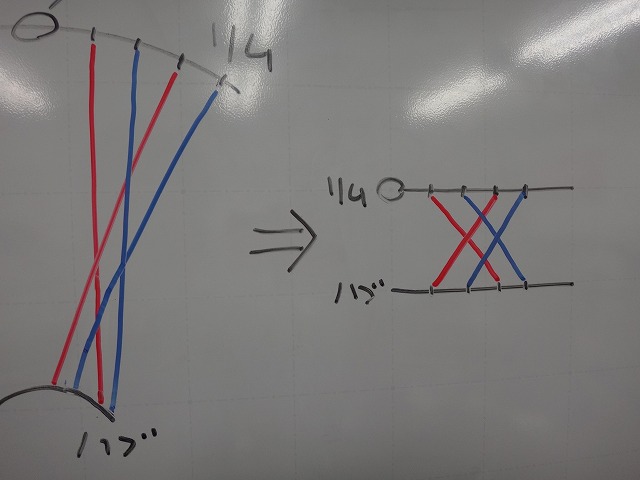
From the previous diagram, I change the scale of the hub and rim outline so they become parallel straight lines of equal length.
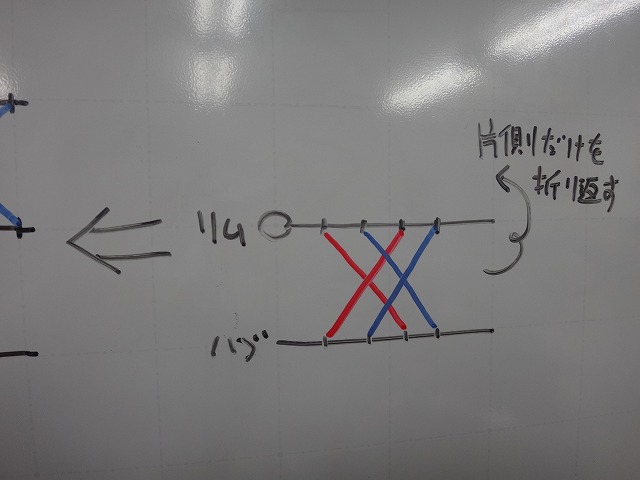
And when I fold back the hub line on just one side, it becomes

the wheel unfolded diagram.
This is a hub-rim-hub type unfolded diagram, but if it's easier to draw, I sometimes make it a rim-hub-rim type instead.
Unless there's a particular reason to consider it, the valve hole is usually omitted.
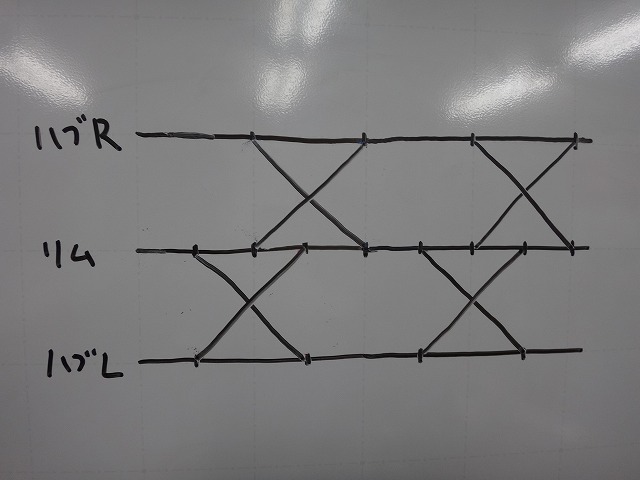
I drew in one more iteration of the four spokes from the final crossing pair, and since I'm going to use blue and red for different purposes later, I changed the spoke color to black.

From there, I added radial guidelines through the final crossing.
I made the freewheel side blue and the non-freewheel side red.
The radial lines are perpendicular to the rim and hub lines.
Whether all spokes that reach from hub to rim without crossing other spokes should be called radial weave is, strictly speaking, not accurate—at least not in my understanding.
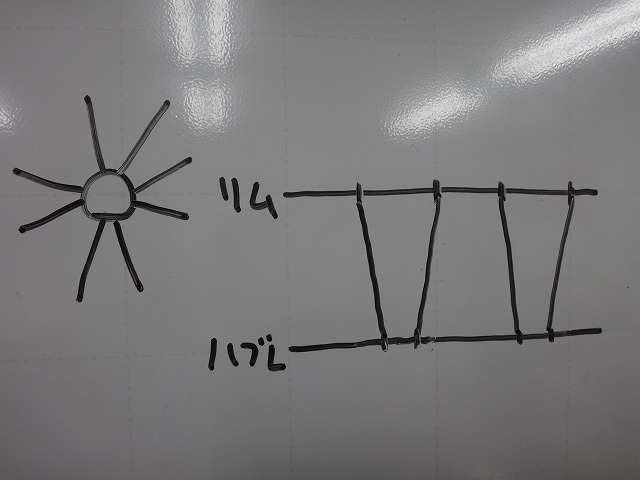
The zero-cross weave with dense-sparse phase on the hub side—which Shimano does on their rim brake front wheels and, recently, on disc brake rear wheels—doesn't have completely radial spoke trajectories, so while it is zero-cross weave, it's not "radial" weave.
So when expressing this in a wheel unfolded diagram, since the spoke head positions on the hub side are spaced with dense-sparse phase, they won't be perpendicular to the horizontal line.
Getting back to the point.
I erased the spoke lines from the previous diagram and kept only the radial guidelines through the final crossing.
What I want you to pay attention to this time is
that the phase of the red guideline as seen from the blue guideline is "not exactly in the middle" of the blue guideline.
Let me show you this in an actual wheel.
This is the rear wheel from Nomulab Wheel #8, with equal hole counts on rim and hub, evenly-spaced holes on both sides, and the same number of spokes on left and right. In other words, it's a "normal wheel."
Looking at the phase of this final crossing, it has the same relationship as in the unfolded diagram.
Now let me check what happens with a left-right tangent-weave hub for straight spokes.
I prepared a Reynolds 24H hub and a Shimano 20H hub.
Both have two spokes coming from each flange boss, but the rims that were historically built with these hubs had evenly-spaced rim holes (←this is important).
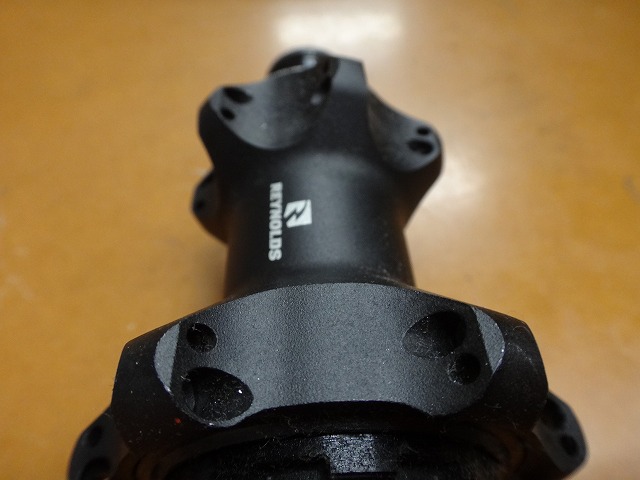
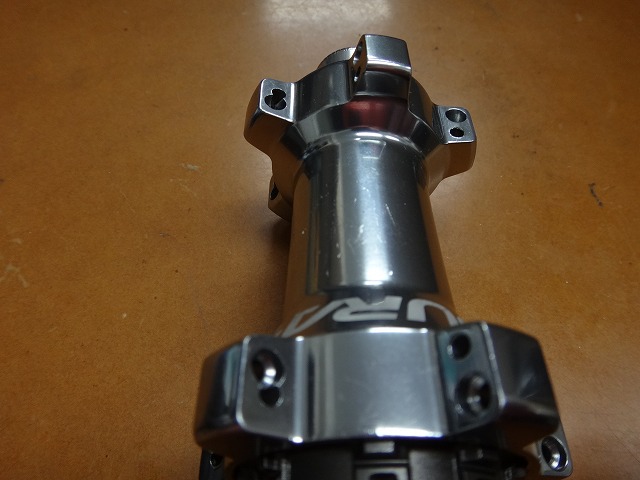
And with both, the phase of the non-freewheel side boss is not exactly in the middle of the freewheel side boss phase.
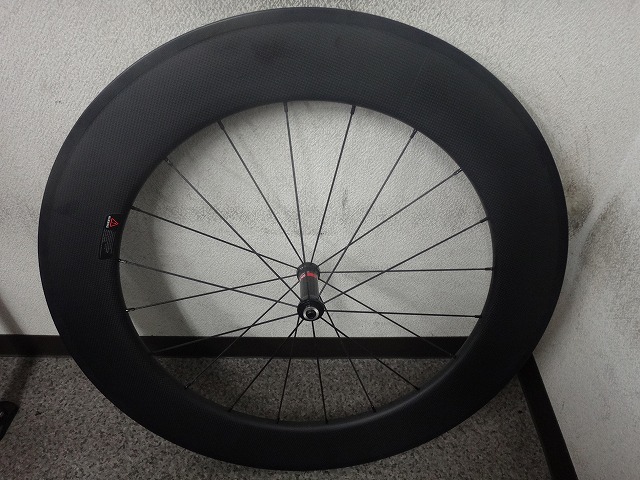
A customer brought in a 20H front wheel built with an 88mm-high carbon tubular rim.
It wasn't obtained in this condition—it was built at a different shop—but since there's no use for it in front (well then, why was it built as a front wheel?), they're asking us to rebuild it as a rear wheel.
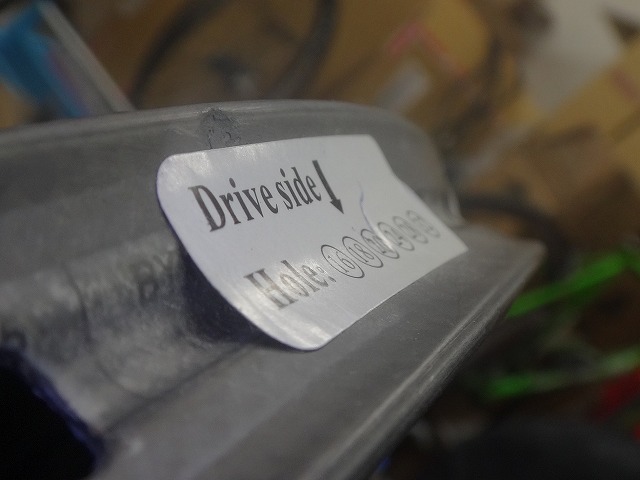
There's no sign of use—not even that a tire was ever mounted on it.
If it had been, the sticker in the image above would never have stayed in that soft, raised state.

Eight Eight (88mm)!
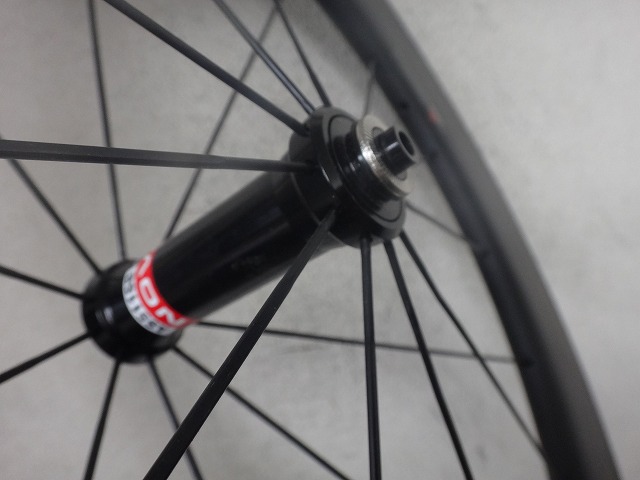
The hub is a Novatech straight-spoke hub, the AS511SB, and
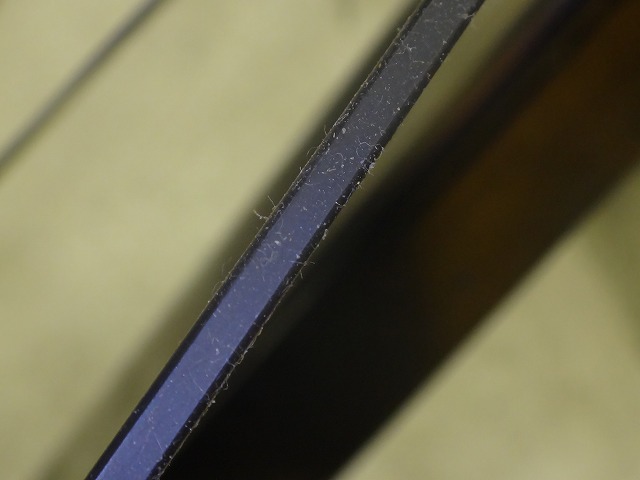
the spokes are Pillar black square aero spokes.
Dust had accumulated on the hub and spokes, so it seems the wheel was left sitting without a wheel bag for quite some time.

When I loosened the tension roughly, several spokes on one side showed continuous deformation.
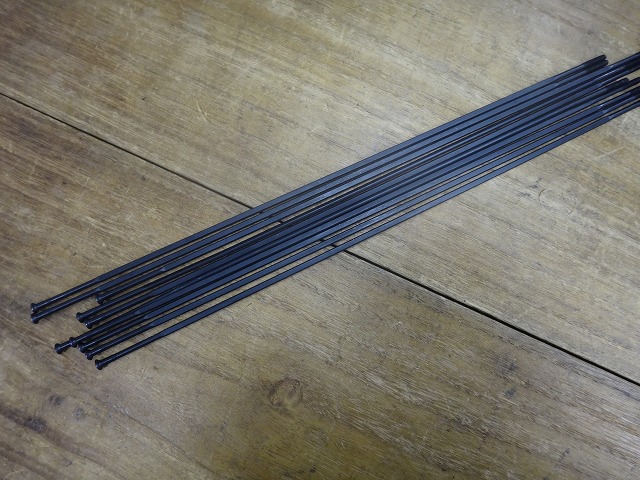
I removed all the spokes from the side that didn't have bent spokes.
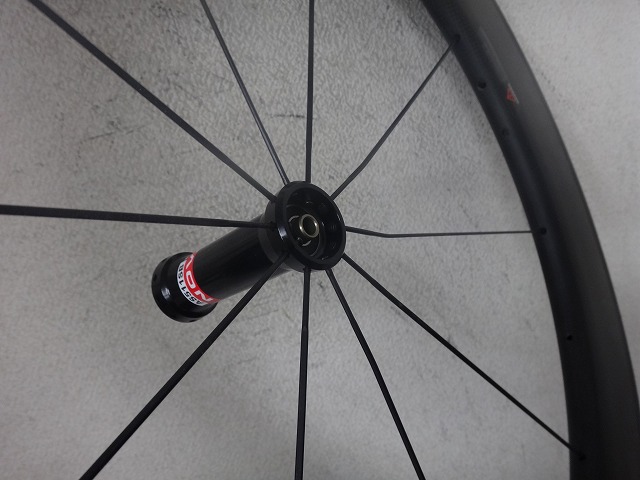
↑If you rotate the bent spoke 90 degrees, it looks like this

I also removed all the spokes from the bent side.
Since I won't be using that keyword, it won't remain in the archive, but here's the actual measured weight of the rim.
For anyone who later thinks "How much did that 88mm-high rim weigh again?", try searching the blog for "Eight Eight."
For a 20H rear hub, since the Evolite 20H is long discontinued and Shimano 11-speed freewheel body versions are practically impossible to find, the customer searched extensively and inquired with their distributor about a 20H straight-spoke rear hub, the HBRR-1001, from Tange (though whether it's actually Tange-made is unclear). The distributor said they could get it if they bought it as a set with the HBRF-1001 front hub. Even though the customer only needed the rear hub, they decided to get the set anyway (what can you do), and had it ordered.
By the way, both front and rear are left-right tangent-weave specification.
The catalog shows them with a silver-colored hub body, but they said that stock is already gone and they only have the blue anodized version, so
that's what we had ordered.

From the opening story, nothing but bad premonitions, but I'll continue.
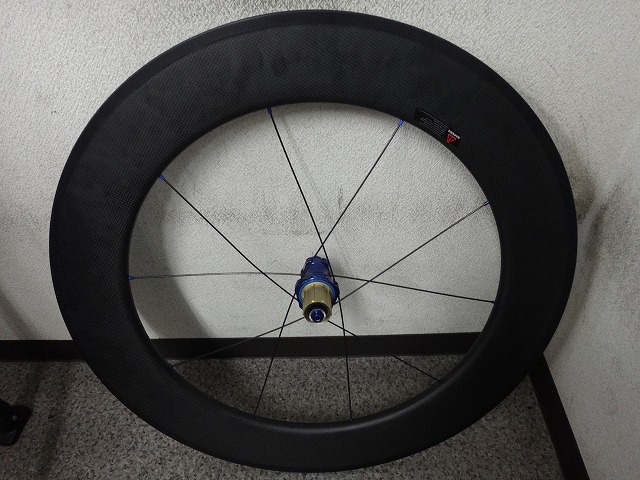
I did a rough temporary build of spokes on just one side with the proper length.
The spoke threads are aligned so they're just hidden by the end face of the nipple.
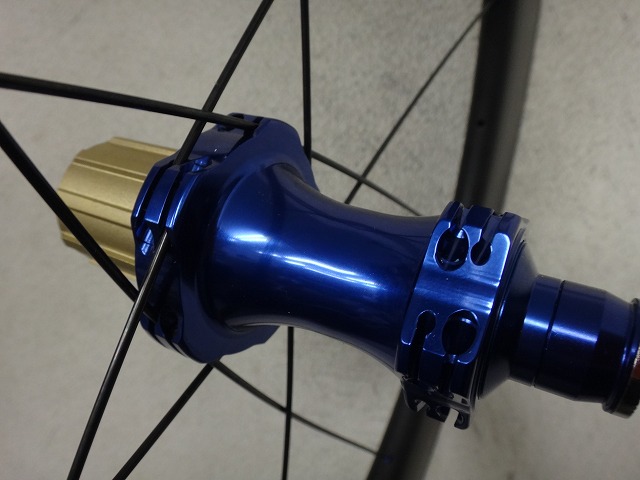
Yeah, that's impossible.
With this hub, it's impossible to build a wheel to a normal rim.
If this were a 36H hub with nine bosses on one flange, we might have barely managed while accepting some phase twist, but with this hub, it's not possible.
Examples of wheels built consciously accepting phase twist (where spoke trajectories in zero-cross or the auxiliary lines for final crossings in tangent-weave deviate from radial) include things like building zero-cross with 18H rim on a 36H hub, or building tangent-weave with 24H rim on a 36H hub while skipping hub holes.
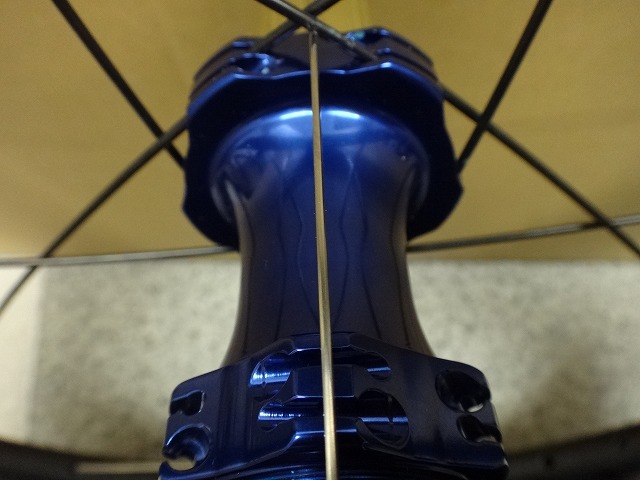
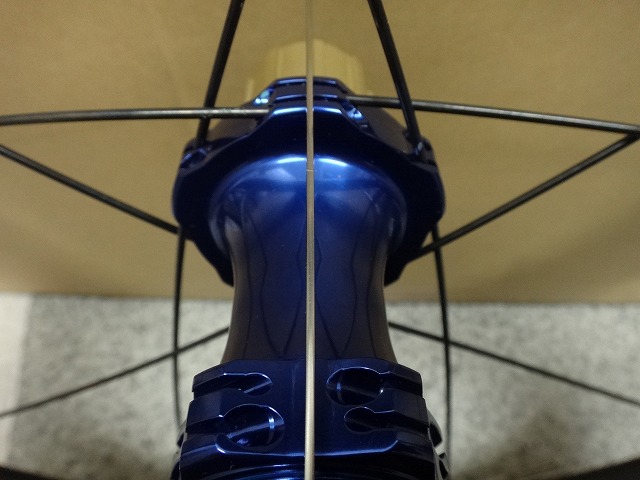
The positional relationship of the flange bosses is, when viewed from one side, exactly in the middle.
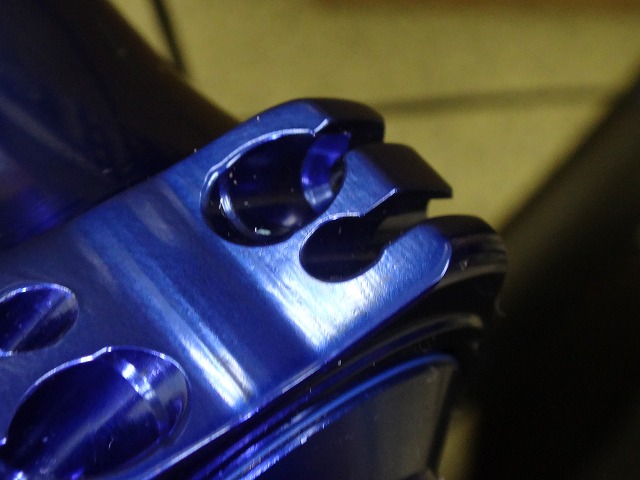
The hub flange slot is a fairly high-directional structure that specifies the orientation of the spoke head, and
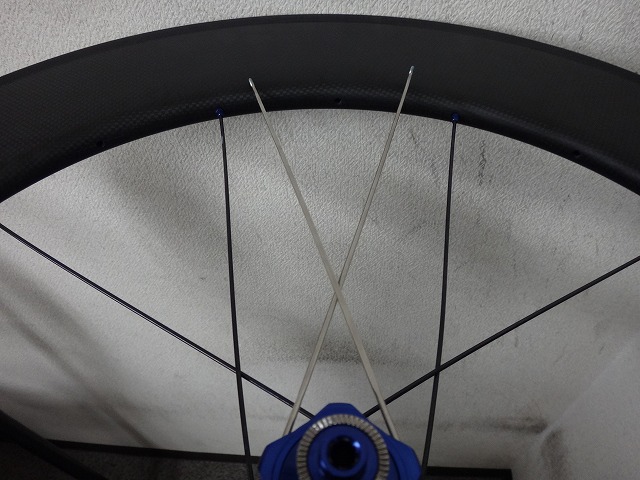
when you actually pass a spoke of the proper length through, it looks like this.
The rim height is so extreme that it appears slightly offset inward, but
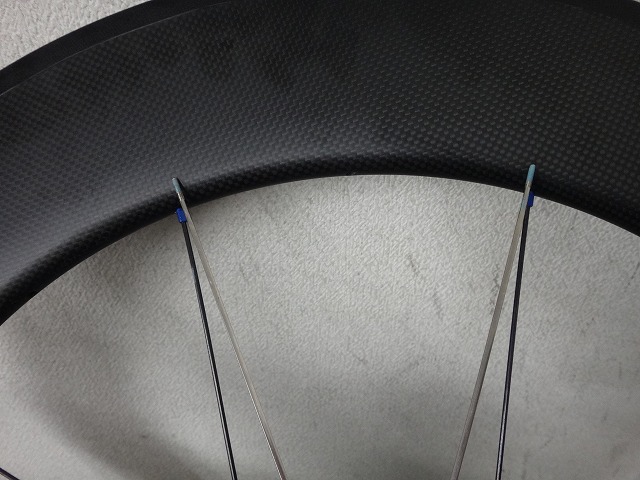
what it's actually pointing to is this phase—perfectly parallel pair spokes.
Wheels like that exist on XERO LITE and similar, but I was never told about this hub "it can only be built with rims that have perfectly-paired-spoke-phase holes, not evenly-spaced rim holes."
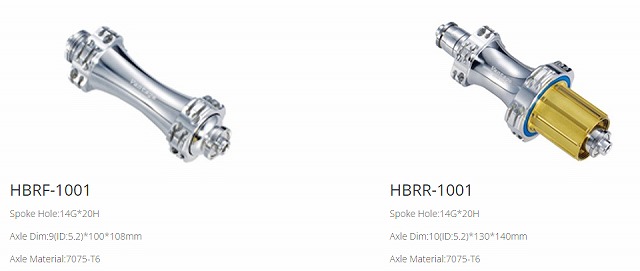
On the manufacturer's website too, the flange boss phase clearly appears to be exactly in the middle.
Whether there are any examples of wheels built with this hub is unclear, but according to the customer's extensive research, not a single example could be found.
Actually, I once serviced a rear wheel built with a 24H rear hub with the exact same flange shape in red anodizing at our shop, but that was built with radial weave on the non-freewheel side with no phase twist.
The flange shape being the same applies only to the freewheel side anyway.

If I try to build consciously accepting phase twist and move the final crossing clockwise as seen from the non-freewheel side, it looks like this.

↑Counter-clockwise looks like this
If this were a universal flange for head-tube spokes, then including the freewheel side spokes, if you prepared different spoke lengths for each of the "porcupine" and "anti-porcupine" directions, you could technically make something that resembles a wheel, though whether it would be decent is another question.
But with this hub, the flange slot directional specificity is strong, and the spokes become quite bowed, so forcing them to tighten up into a wheel is impossible.
Even with a universal hub, I wouldn't think "let's try building this" if the spoke length differences were this extreme.
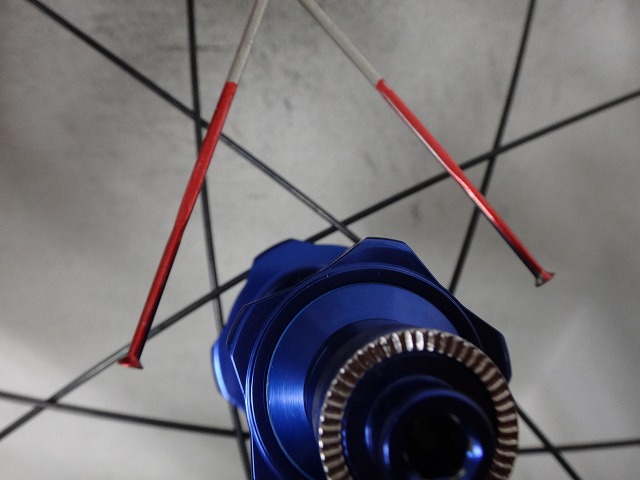
When arranging the non-freewheel side spokes in perfect pair-spoke configuration with no phase twist, the length from spoke head to final crossing comes to roughly 45mm, so I colored from the spoke head to the 45mm point.
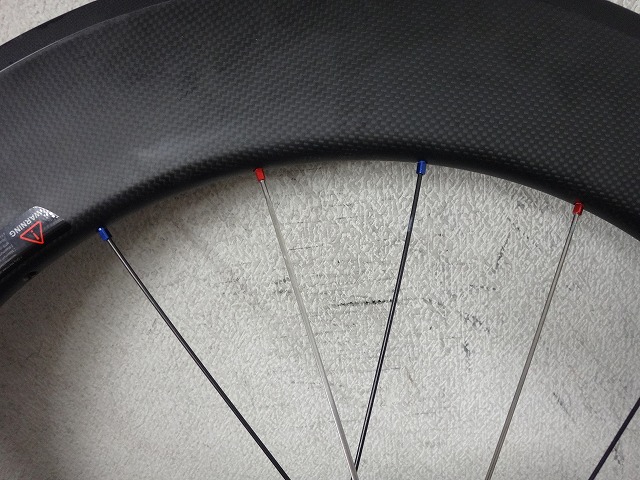
A non-freewheel side spoke of the proper length with the thread hidden just at the nipple end face

overlapping at the color change points on the spokes while bringing the spoke head to where the hub flange slot diameter is, and...
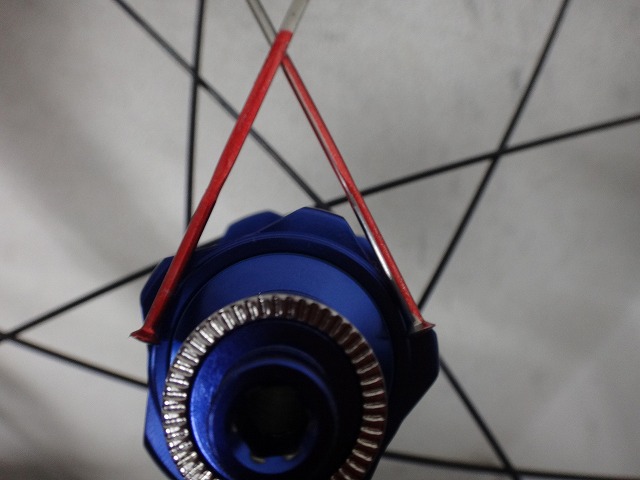
↑becomes this.
This is as seen from the non-freewheel side, and it shows that "it would be good if the non-freewheel side boss offset counter-clockwise from the exact middle relative to the freewheel side boss position."

And for example, with the earlier Shimano hub, that's actually what it is.
How to build a wheel with this hub—I humbly asked the distributor to inquire with Tange, and I was told I'd get some kind of response today, but the phone never rang.
Any customer who happened to call our shop today, especially regulars, must have thought something was odd.
Me making a point to call back politely? That's unusual.