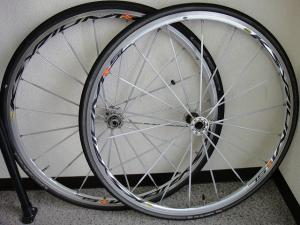
I took in a Mavic Ksyrium SL for service.
The customer wants truing (if needed), centering (if needed),
and bearing replacement.
Here's the state with the axle and bearings removed.
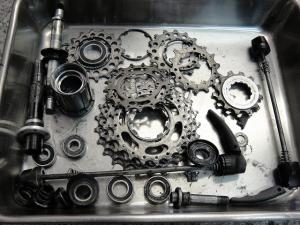
I wash everything, including the sprockets.
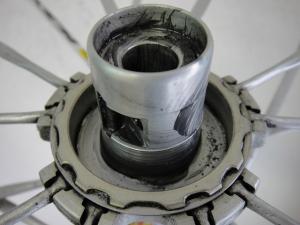
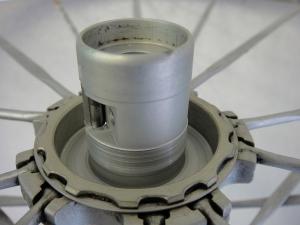
I washed the hub body side too.

These are cartridge bearings, but in the case of Mavic,
they don't use special-sized bearings outside standard specs.
Off-the-shelf ones work fine.
When I say "special," take Campagnolo's Ultegra Torque bearings for example.
The outer diameter, inner diameter, and width are 37, 25, and 6mm respectively,
but 37mm outer/25mm inner bearings normally come in 7mm width.
The 6mm width ones are a bit unusual.
Shimano's Hollowtech II BB bearings before BB-9000
are 37, 25, and 7mm. These are readily available sizes.
Shimano BBs have "DO NOT DISASSEMBLE" written on them,
so they can't be serviced. I can't say more than that, so use your imagination.
Anyway, Mavic's bearings are all in the category I mentioned above—
"readily available" sizes.
Mavic wheels are often said to have heavy hub rotation,
but that's because the original bearings use contact-type seals.
If you switch to non-contact seal types, waterproofing and dust protection suffer a bit,
but rotation gets noticeably lighter.
Personally, I think this is sufficient without going all the way to ceramic bearings.
About the waterproofing—many hubs I normally use for wheel builds, like Tnni, use non-contact seals,
so there's no real problem.
Considering usage conditions and durability, Mavic's answer is simply
"we'll accept heavier rotation for the sake of contact seals,"
but if that bothers you, you can just swap the bearings.
I consider the Ksyrium "one of the conclusions for aluminum-rim wheels,"
and it pains me to see it get unfairly criticized for having heavy bearing rotation.
This time I'm switching to non-contact bearings,
though the previous ones were already non-OEM Japanese non-contact bearings.
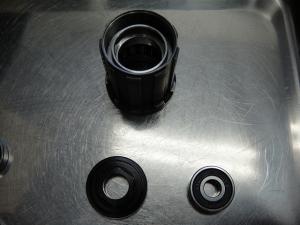

I'm also replacing the freewheel body bearings.
As a Mavic OEM part, this bearing isn't available individually.
Their approach is "just replace the whole freewheel body."
If you remove the cap, the bearing comes out toward the outside.
In cases like CeramicSpeed bearing sets that come with five pieces,
one of them is for this position.
With Mavic, the ratchet knurling on the freewheel mechanism is
on the inside of the freewheel body, not the hub shell.
Given the material, the bearing's lifespan will be reached
before the knurling wears out and needs replacing.
Since a single bearing costs less than 1000 yen,
replacing the whole freewheel body is... abababababababa (censored).
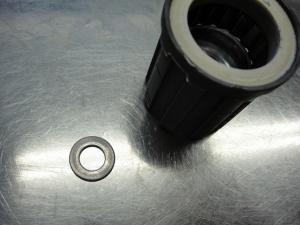
Between the freewheel body and hub shell sits this small spacer—it's essential.
Depending on the freewheel body grease condition,
this spacer can stick to the hub shell or end up inside the freewheel body,
and if you're not paying attention, you can easily lose it.

You install it here before mounting the wheel.
If you're the type to replace the freewheel body yourself, be careful.
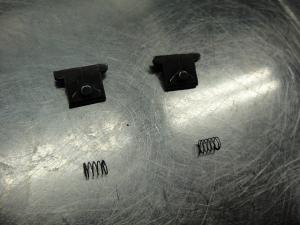
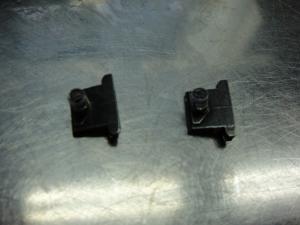
One more thing.
The two pawls in the freewheel have small springs attached.
They're designed so the springs seat properly on the pawls,
and normally the springs don't come off, but if something causes them to ping out,
you have no idea where they've gone.
You probably shouldn't disassemble a Mavic wheel in a room with thick carpet.
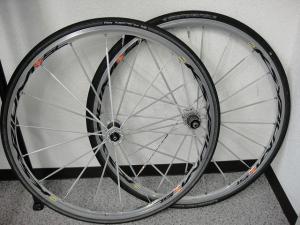
The overhaul is complete.
Both wheels have virtually no runout; the front wheel had only a slight center offset.
The Ksyrium (aluminum spoke model) and R-SYS models
have coarse nipple threads, so if you do simple truing adjustments while the tire is mounted
multiple times, the center can shift easily.
It seemed like that's probably what happened.
The customer wants truing (if needed), centering (if needed),
and bearing replacement.
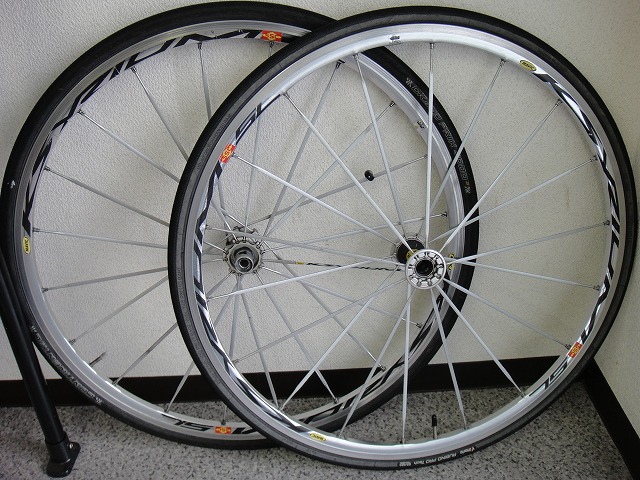
Here's the state with the axle and bearings removed.
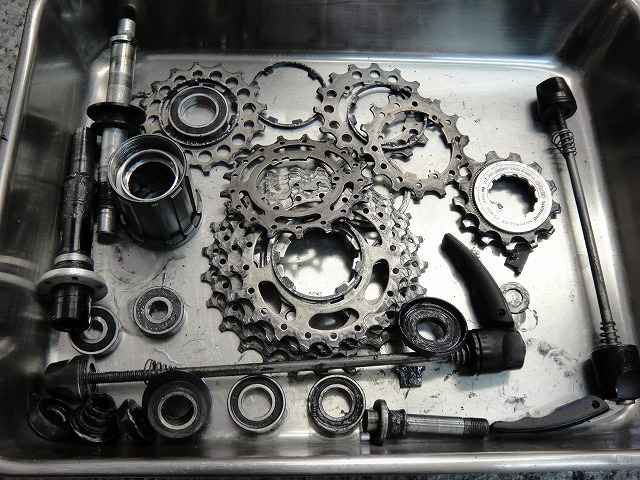
I wash everything, including the sprockets.
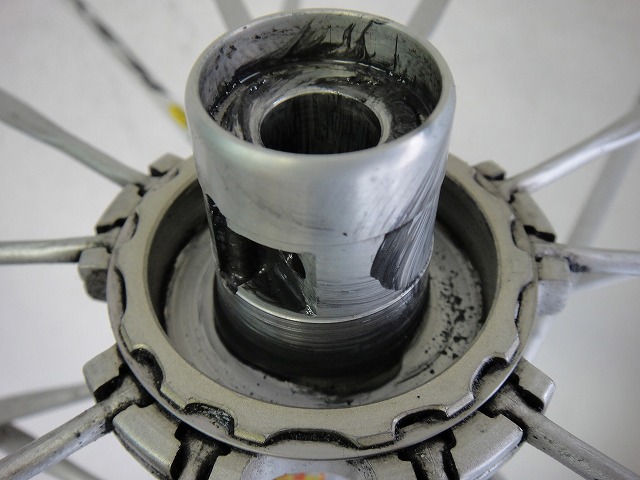
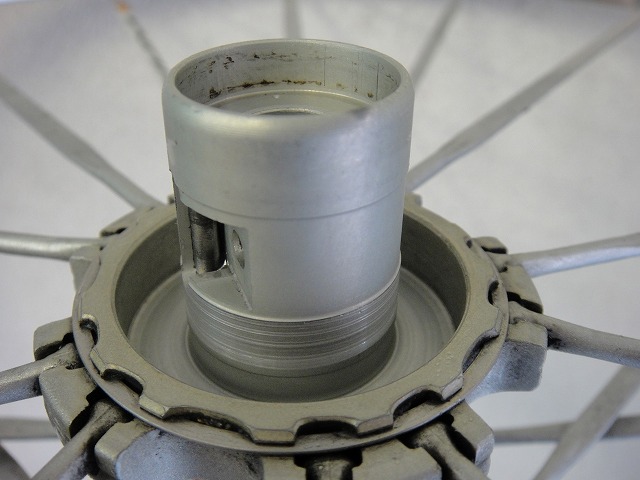
I washed the hub body side too.
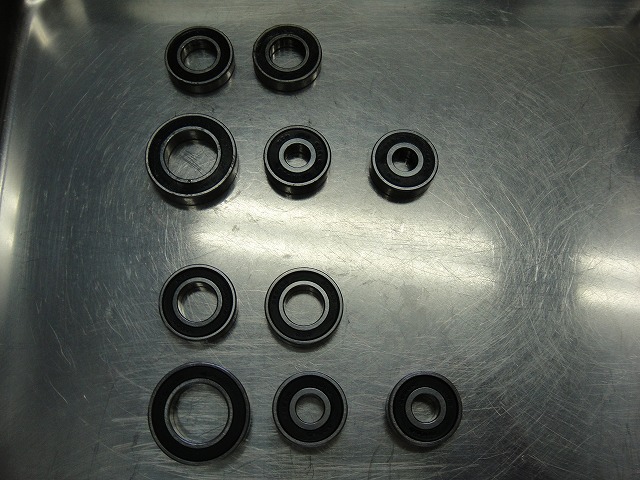
These are cartridge bearings, but in the case of Mavic,
they don't use special-sized bearings outside standard specs.
Off-the-shelf ones work fine.
When I say "special," take Campagnolo's Ultegra Torque bearings for example.
The outer diameter, inner diameter, and width are 37, 25, and 6mm respectively,
but 37mm outer/25mm inner bearings normally come in 7mm width.
The 6mm width ones are a bit unusual.
Shimano's Hollowtech II BB bearings before BB-9000
are 37, 25, and 7mm. These are readily available sizes.
Shimano BBs have "DO NOT DISASSEMBLE" written on them,
so they can't be serviced. I can't say more than that, so use your imagination.
Anyway, Mavic's bearings are all in the category I mentioned above—
"readily available" sizes.
Mavic wheels are often said to have heavy hub rotation,
but that's because the original bearings use contact-type seals.
If you switch to non-contact seal types, waterproofing and dust protection suffer a bit,
but rotation gets noticeably lighter.
Personally, I think this is sufficient without going all the way to ceramic bearings.
About the waterproofing—many hubs I normally use for wheel builds, like Tnni, use non-contact seals,
so there's no real problem.
Considering usage conditions and durability, Mavic's answer is simply
"we'll accept heavier rotation for the sake of contact seals,"
but if that bothers you, you can just swap the bearings.
I consider the Ksyrium "one of the conclusions for aluminum-rim wheels,"
and it pains me to see it get unfairly criticized for having heavy bearing rotation.
This time I'm switching to non-contact bearings,
though the previous ones were already non-OEM Japanese non-contact bearings.
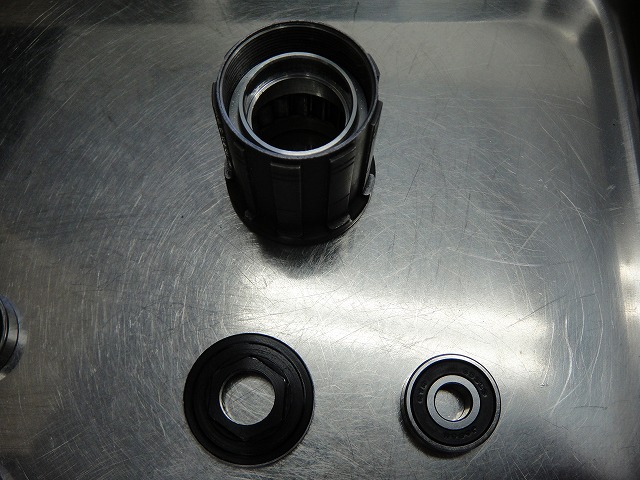
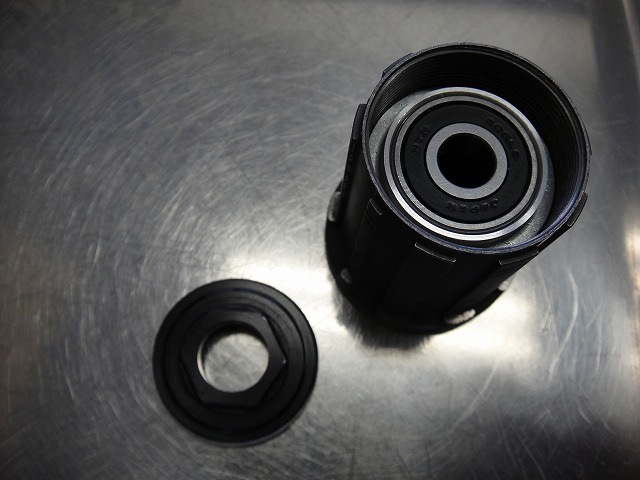
I'm also replacing the freewheel body bearings.
As a Mavic OEM part, this bearing isn't available individually.
Their approach is "just replace the whole freewheel body."
If you remove the cap, the bearing comes out toward the outside.
In cases like CeramicSpeed bearing sets that come with five pieces,
one of them is for this position.
With Mavic, the ratchet knurling on the freewheel mechanism is
on the inside of the freewheel body, not the hub shell.
Given the material, the bearing's lifespan will be reached
before the knurling wears out and needs replacing.
Since a single bearing costs less than 1000 yen,
replacing the whole freewheel body is... abababababababa (censored).

Between the freewheel body and hub shell sits this small spacer—it's essential.
Depending on the freewheel body grease condition,
this spacer can stick to the hub shell or end up inside the freewheel body,
and if you're not paying attention, you can easily lose it.
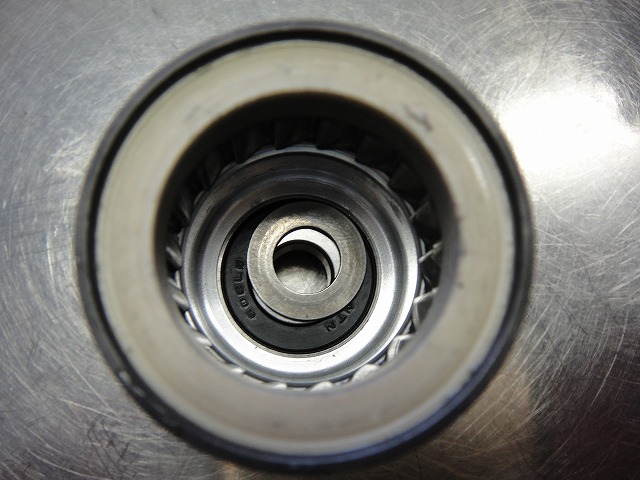
You install it here before mounting the wheel.
If you're the type to replace the freewheel body yourself, be careful.
One more thing.
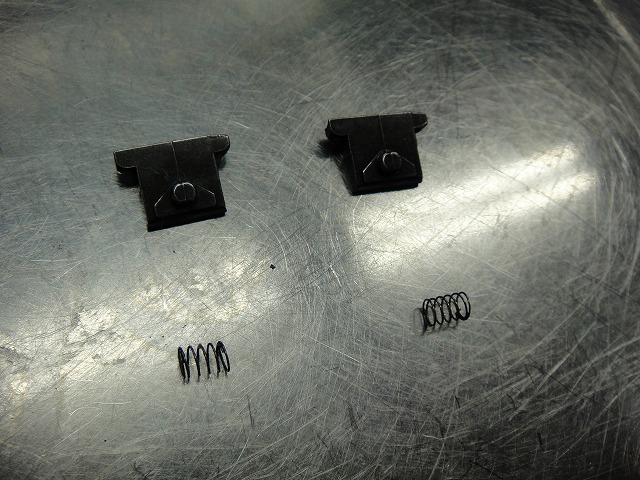
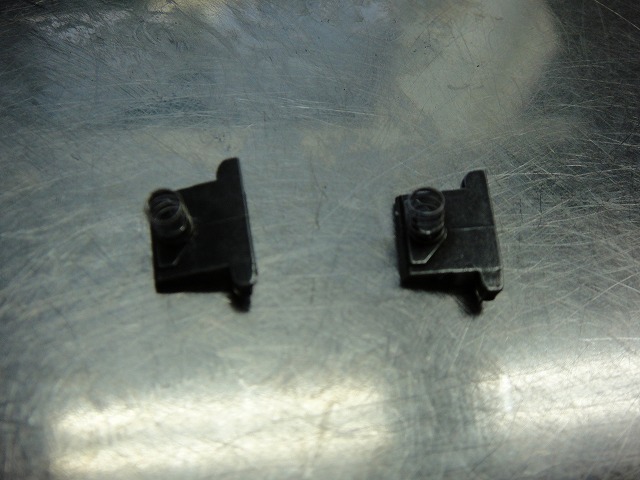
The two pawls in the freewheel have small springs attached.
They're designed so the springs seat properly on the pawls,
and normally the springs don't come off, but if something causes them to ping out,
you have no idea where they've gone.
You probably shouldn't disassemble a Mavic wheel in a room with thick carpet.

The overhaul is complete.
Both wheels have virtually no runout; the front wheel had only a slight center offset.
The Ksyrium (aluminum spoke model) and R-SYS models
have coarse nipple threads, so if you do simple truing adjustments while the tire is mounted
multiple times, the center can shift easily.
It seemed like that's probably what happened.