Wheels again today (and so on).
Continuing from yesterday.
Building a disc brake rear wheel with HED Belgium rim.
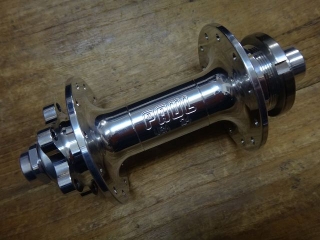
The hub is Paul's single-speed fixed gear rear hub, and
I thought it might be reverse offset, so I checked
but while that turned out to be true,
actual measurement showed only about 0.2mm left-right difference,
so it's not severe enough to force asymmetrical lacing.
In fact, you shouldn't do that.
I can treat it as an offset-free hub.
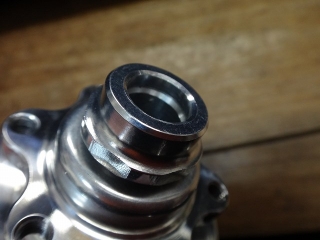
Paul's hubs of this type are normally
spec'd with bolts (male threads) for frames, unlike standard nut (female thread) mount hubs,
which I don't like because what sits directly under the frame dropout is
the bolt's threaded portion, not the hub axle itself.
But this hub is through-axle spec, so no problem there.
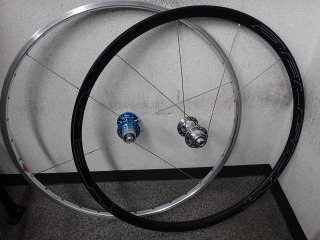
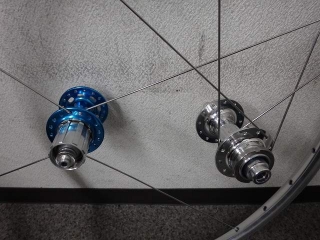
From that rear wheel, I was able to transplant 2 inpokes and
2 outpokes from the 6-spoke side.
Out of 32 spokes, I put 28 to good use.
The rear wheel I'm building now is 24H, so
the remaining 20 are new spokes, but
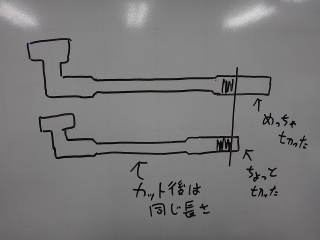
when you cut spokes,
the length of the plain section at the rim end varies.
For example, CX-RAY comes in even millimeter lengths (2mm increments)
from Japanese distributors,
and cutting up to about 8mm seems possible,
but I limit it to 6mm.
It's a combination that would never happen in my wheelbuilding,
but if you pair an 8mm-cut CX-RAY with
a 16mm-long nipple,
the inner rim end of the nipple will interfere with
the start of the butted section of the spoke before you finish lacing the wheel.
When building a wheel with CX-RAY 280mm,
you can use the 280mm straight as-is,
but there are times when I use pieces cut from
282mm, 284mm, or 286mm lengths.
However, I never mix different original lengths in a single wheel.
This time the spokes are DT Competition, which
can be ordered in 1mm increments,
and since Competition can be cut up to 30mm,
the possible range would be, for example, 270mm as-is through to
300mm cut down by 30mm if using 270mm as the target length.
(I didn't use 290mm as my example because
there's no original 320mm Competition length.)
The shop stocks 4 types of silver Competition year-round,
and they cover roughly 303mm down to 240mm.
I said 30mm can be cut,
but in practice, even at the widest gap,
it's only about 20mm.
When I checked, the 4 Competition spokes transplanted from the Turquoise rear hub
turned out to be from one of those four lengths,
so I've cut the remaining 20 spokes from that same length.
Therefore all 24 have matching plain section lengths at the rim end.
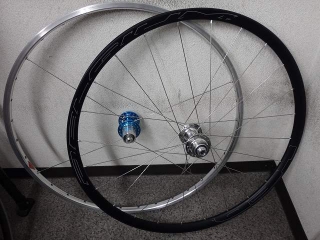
Done.
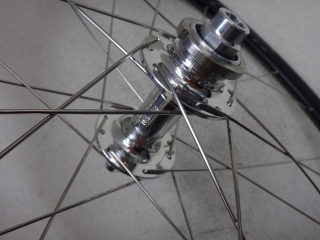
24H, all Competition, crossed 6-for-6 JIS lace, no relief holes.

Continuing from yesterday.
Building a disc brake rear wheel with HED Belgium rim.
The hub is Paul's single-speed fixed gear rear hub, and
I thought it might be reverse offset, so I checked
but while that turned out to be true,
actual measurement showed only about 0.2mm left-right difference,
so it's not severe enough to force asymmetrical lacing.
In fact, you shouldn't do that.
I can treat it as an offset-free hub.

Paul's hubs of this type are normally
spec'd with bolts (male threads) for frames, unlike standard nut (female thread) mount hubs,
which I don't like because what sits directly under the frame dropout is
the bolt's threaded portion, not the hub axle itself.
But this hub is through-axle spec, so no problem there.


From that rear wheel, I was able to transplant 2 inpokes and
2 outpokes from the 6-spoke side.
Out of 32 spokes, I put 28 to good use.
The rear wheel I'm building now is 24H, so
the remaining 20 are new spokes, but

when you cut spokes,
the length of the plain section at the rim end varies.
For example, CX-RAY comes in even millimeter lengths (2mm increments)
from Japanese distributors,
and cutting up to about 8mm seems possible,
but I limit it to 6mm.
It's a combination that would never happen in my wheelbuilding,
but if you pair an 8mm-cut CX-RAY with
a 16mm-long nipple,
the inner rim end of the nipple will interfere with
the start of the butted section of the spoke before you finish lacing the wheel.
When building a wheel with CX-RAY 280mm,
you can use the 280mm straight as-is,
but there are times when I use pieces cut from
282mm, 284mm, or 286mm lengths.
However, I never mix different original lengths in a single wheel.
This time the spokes are DT Competition, which
can be ordered in 1mm increments,
and since Competition can be cut up to 30mm,
the possible range would be, for example, 270mm as-is through to
300mm cut down by 30mm if using 270mm as the target length.
(I didn't use 290mm as my example because
there's no original 320mm Competition length.)
The shop stocks 4 types of silver Competition year-round,
and they cover roughly 303mm down to 240mm.
I said 30mm can be cut,
but in practice, even at the widest gap,
it's only about 20mm.
When I checked, the 4 Competition spokes transplanted from the Turquoise rear hub
turned out to be from one of those four lengths,
so I've cut the remaining 20 spokes from that same length.
Therefore all 24 have matching plain section lengths at the rim end.

Done.

24H, all Competition, crossed 6-for-6 JIS lace, no relief holes.