Another day, another wheel (and so on).
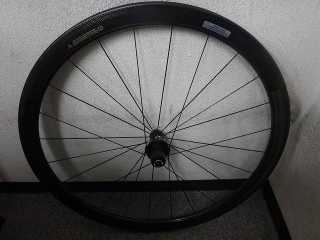
I took in a Reynolds Assault rear wheel from a customer.
The rim is tubeless ready.
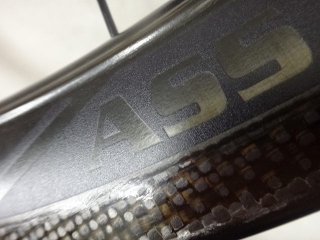
I got too close and ended up photographing only the ASS part
but there's no deep meaning to it.
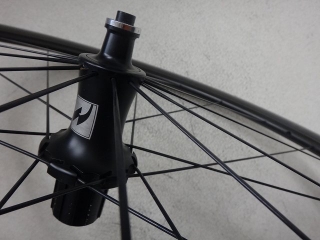
The customer wants a rebuild,
but the freewheel body is Shimano 11-speed spec, so
the motivation isn't "convert a 10-speed hub to 11-speed."
Because of how this straight-gauge spoke hub is designed,
the non-freewheel side is forced into radial lacing,
and the customer says the wheel doesn't feel like it rolls very well because of that.
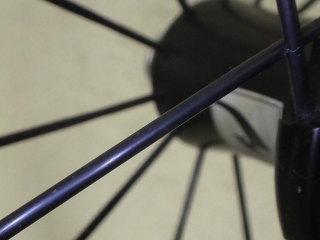
The freewheel side uses black Campagnolo spokes,
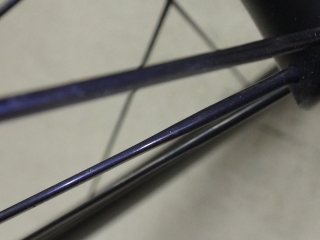
and the non-freewheel side uses black Aero Comp spokes—
so it's laced asymmetrically with about a 10% difference between sides,
which is smart in that regard... but.
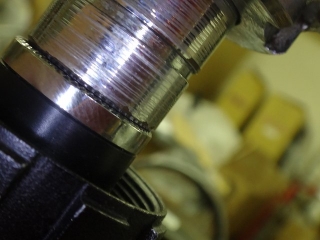
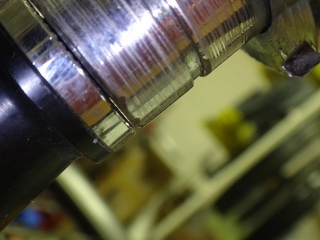
Before disassembling, the rim was slightly offset toward the non-freewheel side.
This isn't the direction it would drift with age, so either
it was offset that way from the factory,
or there's a history of someone not using a center gauge
and doing a rough truing job.
But this is the kind of center offset that passes manufacturer QC,
so it's not really a problem.
I just needed to know what the original center was
so I checked it.
I'm rebuilding this rear wheel with
a Chris King hub that the customer provided,

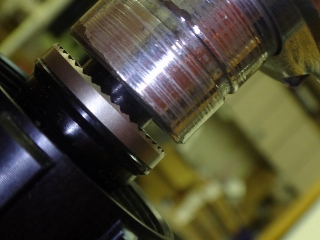
and with virtually no radial or lateral runout,
even the minimum spoke tension value in the new freewheel side
across all 12 spokes surpasses the maximum value
in the original freewheel side across all 12 spokes.
In other words, the spoke tension variation range is so clearly higher now
that there's virtually no overlap with the original,
and yet the rim is significantly offset toward the freewheel side.
This means the non-freewheel side can still be tightened one-sidedly.
When we do that, the non-freewheel side tension obviously increases,
but the freewheel side increases slightly too.
The freewheel side spokes are all black Campagnolo—
though there's a difference between straight and bent-elbow types—
and while the final crossing angles vary slightly even though
they're 2-cross lacing on both sides, matching the hub's right flange diameter and width,
if the specific weight of the spokes is the same,
spoke tension difference is the largest factor affecting deformation
(for example, say the Reynolds hub has right Campagnolo at 1000N
and the Chris King hub has right Campagnolo at 1100N,
but if the Reynolds hub's right flange dimensions are exceptional,
you wouldn't end up with the lower-tension Reynolds actually being stiffer).
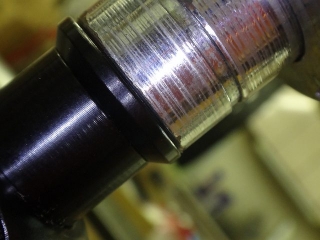
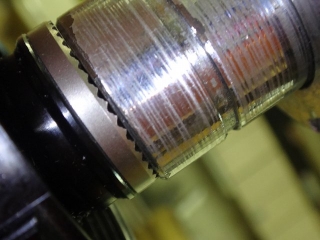
I got the center dialed in by tightening up the non-freewheel side.
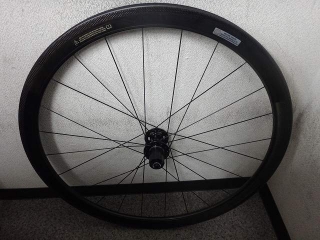
Built.
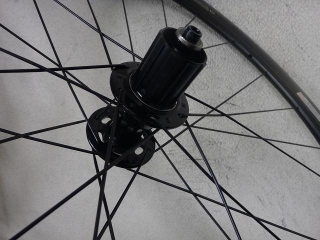
R45 hub, 24 holes, black half-Campagnolo, 4-cross lacing.
I'll do the nipple welding later.
The customer asked me, "Is half-Campagnolo stiffer?"
Well, full Campagnolo or CX-RAY will have the non-freewheel side
stretched to the limit, and I've done it before, but I don't recommend it.
Considering the customer's weight and all, half-Campagnolo is plenty.
Also, it won't be as stiff as a Racing Zero.
There's no spoke wheel adjustable with nipples that's stiffer than those.
If you could build an aluminum-spoke wheel stiffer than a Racing Zero with steel spokes,
Fulcrum wouldn't be putting out complete aluminum-spoke wheels in the first place—
that's the logic of it.
Also, unrelated, but
there were people in the past who went around saying stuff like
"my wheels are stiffer than a Racing Zero" or
"aluminum spokes have no material significance,"
and both of those camps have since disappeared.
Was it my fault...? I have no idea what you're talking about.
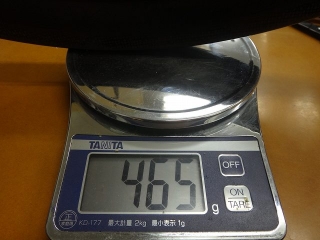
I've also weighed the rim on this Assault,
but Kani Kosen (the shop's mascot/character) is away on summer break, so there's no one to publicize it.
Besides, I have zero intention of telling anyone anyway.
↑Wow, what a jerk this guy is

I came from Nagano Prefecture to stand in for Kani Kosen!
And please be sure to pick me up at "Echo Norikura"!(totally not an ad)
Take a look at this image!
↑Stop it right now!

I took in a Reynolds Assault rear wheel from a customer.
The rim is tubeless ready.

I got too close and ended up photographing only the ASS part
but there's no deep meaning to it.

The customer wants a rebuild,
but the freewheel body is Shimano 11-speed spec, so
the motivation isn't "convert a 10-speed hub to 11-speed."
Because of how this straight-gauge spoke hub is designed,
the non-freewheel side is forced into radial lacing,
and the customer says the wheel doesn't feel like it rolls very well because of that.

The freewheel side uses black Campagnolo spokes,

and the non-freewheel side uses black Aero Comp spokes—
so it's laced asymmetrically with about a 10% difference between sides,
which is smart in that regard... but.


Before disassembling, the rim was slightly offset toward the non-freewheel side.
This isn't the direction it would drift with age, so either
it was offset that way from the factory,
or there's a history of someone not using a center gauge
and doing a rough truing job.
But this is the kind of center offset that passes manufacturer QC,
so it's not really a problem.
I just needed to know what the original center was
so I checked it.
I'm rebuilding this rear wheel with
a Chris King hub that the customer provided,


and with virtually no radial or lateral runout,
even the minimum spoke tension value in the new freewheel side
across all 12 spokes surpasses the maximum value
in the original freewheel side across all 12 spokes.
In other words, the spoke tension variation range is so clearly higher now
that there's virtually no overlap with the original,
and yet the rim is significantly offset toward the freewheel side.
This means the non-freewheel side can still be tightened one-sidedly.
When we do that, the non-freewheel side tension obviously increases,
but the freewheel side increases slightly too.
The freewheel side spokes are all black Campagnolo—
though there's a difference between straight and bent-elbow types—
and while the final crossing angles vary slightly even though
they're 2-cross lacing on both sides, matching the hub's right flange diameter and width,
if the specific weight of the spokes is the same,
spoke tension difference is the largest factor affecting deformation
(for example, say the Reynolds hub has right Campagnolo at 1000N
and the Chris King hub has right Campagnolo at 1100N,
but if the Reynolds hub's right flange dimensions are exceptional,
you wouldn't end up with the lower-tension Reynolds actually being stiffer).


I got the center dialed in by tightening up the non-freewheel side.

Built.

R45 hub, 24 holes, black half-Campagnolo, 4-cross lacing.
I'll do the nipple welding later.
The customer asked me, "Is half-Campagnolo stiffer?"
Well, full Campagnolo or CX-RAY will have the non-freewheel side
stretched to the limit, and I've done it before, but I don't recommend it.
Considering the customer's weight and all, half-Campagnolo is plenty.
Also, it won't be as stiff as a Racing Zero.
There's no spoke wheel adjustable with nipples that's stiffer than those.
If you could build an aluminum-spoke wheel stiffer than a Racing Zero with steel spokes,
Fulcrum wouldn't be putting out complete aluminum-spoke wheels in the first place—
that's the logic of it.
Also, unrelated, but
there were people in the past who went around saying stuff like
"my wheels are stiffer than a Racing Zero" or
"aluminum spokes have no material significance,"
and both of those camps have since disappeared.
I've also weighed the rim on this Assault,
but Kani Kosen (the shop's mascot/character) is away on summer break, so there's no one to publicize it.
Besides, I have zero intention of telling anyone anyway.
↑Wow, what a jerk this guy is

I came from Nagano Prefecture to stand in for Kani Kosen!
And please be sure to pick me up at "Echo Norikura"!

Take a look at this image!
↑Stop it right now!