I recently built up a LOOK 795 BLADE RS.
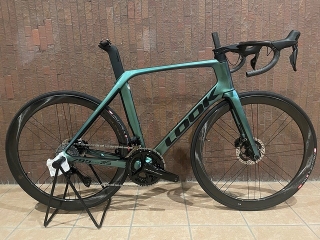
It's a disc brake spec.
This one is already finished and delivered to the customer,
but this is a photo I took to report on the progress at that point.
On through-axle spec frames,
some have protrusions on the threaded section on the right side of the frame
—presumably to allow them to be held in place by a kickstand that pinches
the quick-release cone and lever protrusion.
On the left side of the frame, even if the through-axle isn't lever-type
but rather the hex key fixing type,
the through-axle head sticks out slightly and doesn't sit flush with the frame,
and as a result, the frame design seems to be such that
using a quick-release style kickstand to just prop it up
on both sides shouldn't be a problem.
This frame is the same way, so I used a quick-release kickstand.
When doing derailleur adjustment or lubrication, you should avoid spinning the crank.
If the kickstand got caught in the spinning rear wheel
and the bike got sent to Nomu Lab for repairs, it would be pretty bad.
Oh, I wrote "Nomu Lab" because we keep spare spokes on hand for
Bora WTO45 and Ultra WTO45
(the wheel in the image above is an Ultra WTO45),
and I honestly can't think of another shop
that can fix them to at least OEM precision or better.
If you know of one, you don't need to tell me,
but if you have a shop like that within commuting distance from home,
I'd say you're pretty lucky.
The paper between the kickstand and frame is
to prevent any accidental scratches.
When you open current Shimano component parts from the box,
they use this paper instead of vinyl for internal packaging
—the kind that's very much "doing SDGs" but could probably contain fried chicken without leaking oil,
and seems to be bad enough for your stomach that a goat would get sick eating it.
Lucky for us it had one more job before hitting the trash!
When doing derailleur adjustments and such, I use a different stand
that hoists the bike in the air, just to be safe.
As for the bike in the opening image,
aside from the pedals the customer brought with them to keep using,
everything from the frameset—the separate LOOK handlebars,
components, wheels, tires, tubes, saddle,
bar tape—everything was purchased at our shop.
Well, I don't mind even if the proportion of customer-supplied parts is quite high,
but I'd be lying if I said I wasn't grateful when it's basically zero.

The rear triangle is very clean, with no seatstay bridge or chainstay bridge.
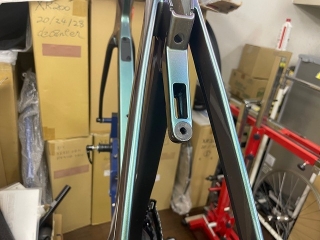
This is another customer's (technically speaking) frame,
which I'm building up with infinite lead time and "reverse" queue-jumping totally fine—
same frame, same size, same color as the one at the top,
the only difference being it's rim brake spec.
In fact, I received this frame much earlier
than the disc brake one.
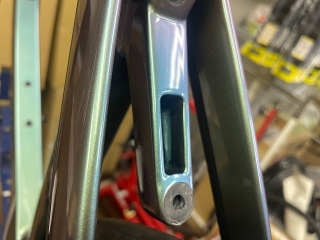
There's a sort of mounting bracket extending out
just for mounting the rear brake caliper.
If this were converted to a bridge connecting left and right stays laterally,
I think they wanted to avoid throwing off the rear triangle stiffness
(probably making it overly stiff)
that they're deliberately pursuing.
Since the frame is designed with disc specs in mind,
if they want to share molds and manufacturing processes as much as possible,
it's more convenient than a bridge design.
Also, as a way to announce it to the general public,
saying "this is what we got when we pursued aerodynamics" might work too.
Old Trek seatless tube frames like the "Y-Foil"
and Kestrel's "500 EMS" had front derailleur mounting tabs sticking out,
and I thought "if this is set up for front single-speed,
you could snap it off and the look would be cleaner,"
but even I, who never uses rear brakes, would still mount them in a functional way,
so if this were my own bike, I'd install the brake too.
The fork and head tube area use
the flagship model's typical all-proprietary spec,
but with disc brakes,
the fork steerer becomes flat and sword-shaped on both sides,
and the brake hose runs along the left side.
So when setting up with a right front brake—the minority setup in Europe—
the hose routing becomes a bit complicated.
This customer's bike at the top just happened to have a left front brake though.
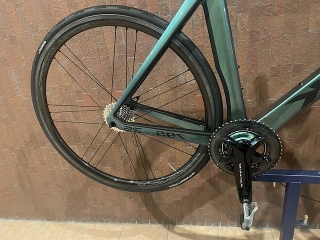
Now to address the title.
This frame was bought from an overseas online shop,
and the Bora WTO (※not Ultra)
is also from overseas online shopping. The components are parts removed from a previous bike.
No, I'm not bothered at all?
What? I said I'm not mad!
※Similar phrasing to "non-GMO"
So when I started to assemble the parts,
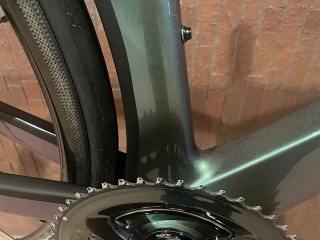
I noticed that the front derailleur mounting bracket wasn't installed.
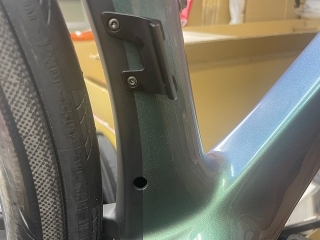
↑It should normally look like this.
What should I do, it's defective, should I contact the overseas seller?
I tried to scare the customer (technically speaking),
but as you can tell if you look closely at the image from two pictures back,
it's a left-right flipped image
of the right crank and sprocketed rear wheel
photographed upside down—and they figured that out pretty quickly.
Damn, that wasn't funny.
Well, I spent time on this gag,
so there's no particular progress on this frame today.
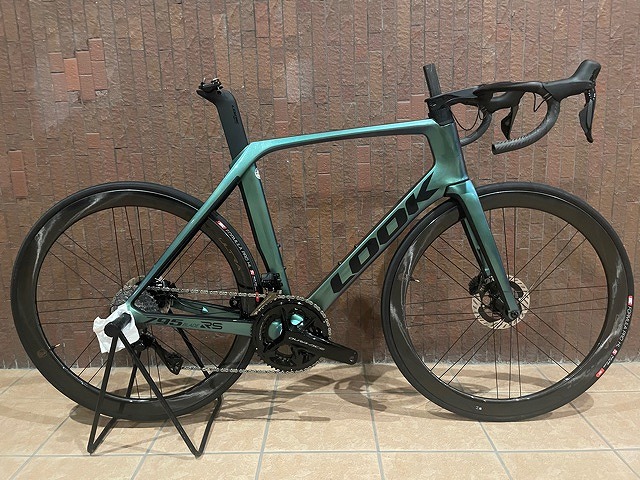
It's a disc brake spec.
This one is already finished and delivered to the customer,
but this is a photo I took to report on the progress at that point.
On through-axle spec frames,
some have protrusions on the threaded section on the right side of the frame
—presumably to allow them to be held in place by a kickstand that pinches
the quick-release cone and lever protrusion.
On the left side of the frame, even if the through-axle isn't lever-type
but rather the hex key fixing type,
the through-axle head sticks out slightly and doesn't sit flush with the frame,
and as a result, the frame design seems to be such that
using a quick-release style kickstand to just prop it up
on both sides shouldn't be a problem.
This frame is the same way, so I used a quick-release kickstand.
When doing derailleur adjustment or lubrication, you should avoid spinning the crank.
If the kickstand got caught in the spinning rear wheel
and the bike got sent to Nomu Lab for repairs, it would be pretty bad.
Oh, I wrote "Nomu Lab" because we keep spare spokes on hand for
Bora WTO45 and Ultra WTO45
(the wheel in the image above is an Ultra WTO45),
and I honestly can't think of another shop
that can fix them to at least OEM precision or better.
If you know of one, you don't need to tell me,
but if you have a shop like that within commuting distance from home,
I'd say you're pretty lucky.
The paper between the kickstand and frame is
to prevent any accidental scratches.
When you open current Shimano component parts from the box,
they use this paper instead of vinyl for internal packaging
—the kind that's very much "doing SDGs" but could probably contain fried chicken without leaking oil,
and seems to be bad enough for your stomach that a goat would get sick eating it.
Lucky for us it had one more job before hitting the trash!
When doing derailleur adjustments and such, I use a different stand
that hoists the bike in the air, just to be safe.
As for the bike in the opening image,
aside from the pedals the customer brought with them to keep using,
everything from the frameset—the separate LOOK handlebars,
components, wheels, tires, tubes, saddle,
bar tape—everything was purchased at our shop.
Well, I don't mind even if the proportion of customer-supplied parts is quite high,
but I'd be lying if I said I wasn't grateful when it's basically zero.
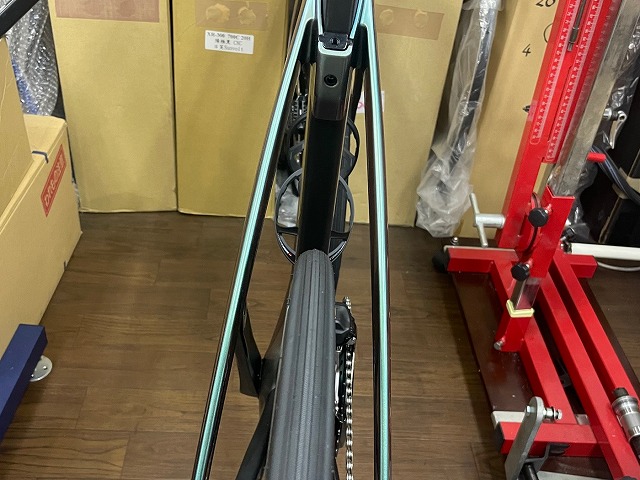
The rear triangle is very clean, with no seatstay bridge or chainstay bridge.
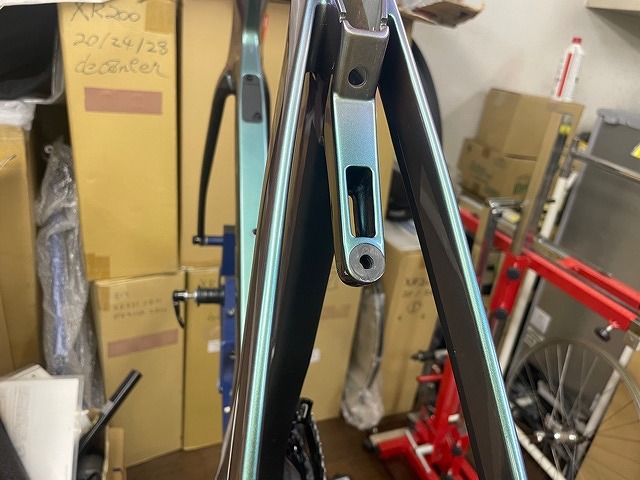
This is another customer's (technically speaking) frame,
which I'm building up with infinite lead time and "reverse" queue-jumping totally fine—
same frame, same size, same color as the one at the top,
the only difference being it's rim brake spec.
In fact, I received this frame much earlier
than the disc brake one.
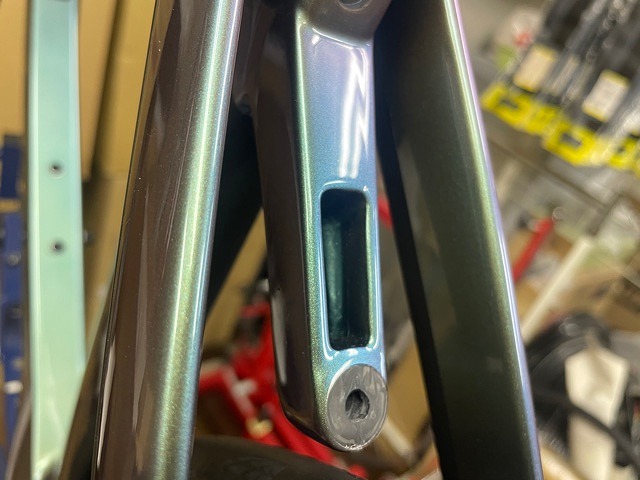
There's a sort of mounting bracket extending out
just for mounting the rear brake caliper.
If this were converted to a bridge connecting left and right stays laterally,
I think they wanted to avoid throwing off the rear triangle stiffness
(probably making it overly stiff)
that they're deliberately pursuing.
Since the frame is designed with disc specs in mind,
if they want to share molds and manufacturing processes as much as possible,
it's more convenient than a bridge design.
Also, as a way to announce it to the general public,
saying "this is what we got when we pursued aerodynamics" might work too.
Old Trek seatless tube frames like the "Y-Foil"
and Kestrel's "500 EMS" had front derailleur mounting tabs sticking out,
and I thought "if this is set up for front single-speed,
you could snap it off and the look would be cleaner,"
but even I, who never uses rear brakes, would still mount them in a functional way,
so if this were my own bike, I'd install the brake too.
The fork and head tube area use
the flagship model's typical all-proprietary spec,
but with disc brakes,
the fork steerer becomes flat and sword-shaped on both sides,
and the brake hose runs along the left side.
So when setting up with a right front brake—the minority setup in Europe—
the hose routing becomes a bit complicated.
This customer's bike at the top just happened to have a left front brake though.

Now to address the title.
This frame was bought from an overseas online shop,
and the Bora WTO (※not Ultra)
is also from overseas online shopping. The components are parts removed from a previous bike.
No, I'm not bothered at all?
What? I said I'm not mad!
※Similar phrasing to "non-GMO"
So when I started to assemble the parts,
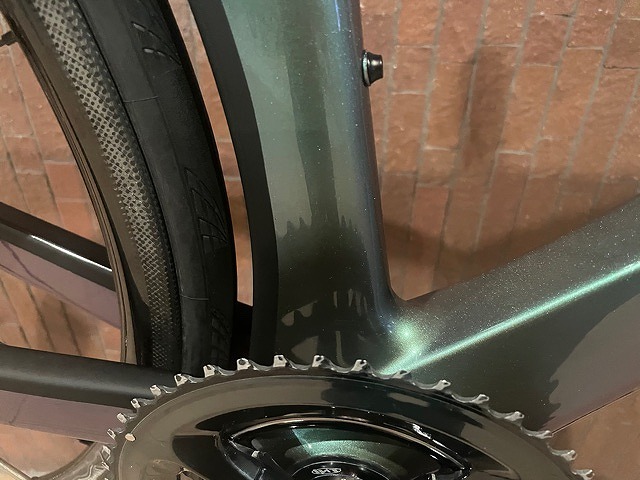
I noticed that the front derailleur mounting bracket wasn't installed.
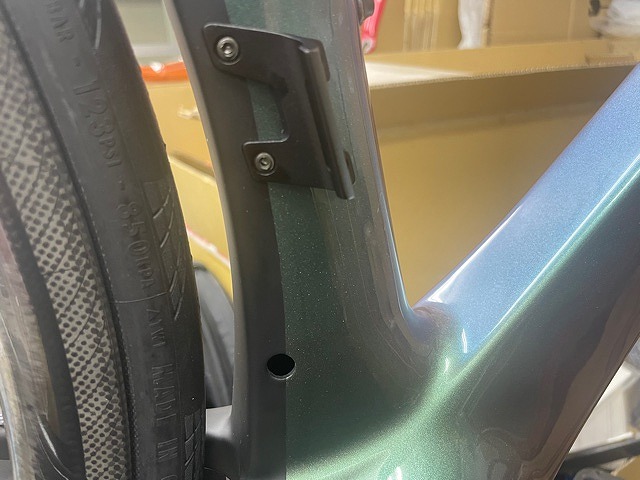
↑It should normally look like this.
What should I do, it's defective, should I contact the overseas seller?
I tried to scare the customer (technically speaking),
but as you can tell if you look closely at the image from two pictures back,
it's a left-right flipped image
of the right crank and sprocketed rear wheel
photographed upside down—and they figured that out pretty quickly.
Damn, that wasn't funny.
Well, I spent time on this gag,
so there's no particular progress on this frame today.