I received Nomu Lab Wheel #1's rear wheel from a customer.
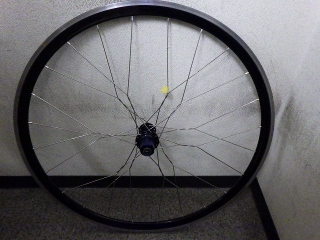
It's a rear wheel built in the Molanbon lacing pattern.
Originally it was built in a standard way,
but the customer requested it be rebuilt.
The current lacing pattern dates back to August 2017 (→here),
so it's been over five years.
This is the customer's most-used wheel for practice and training.
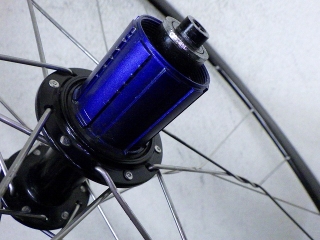
It's a Rolf hub, 24H, Champion/Competé, Molanbon lacing.
The spoke pattern uses asymmetric lacing on both sides with different spoke gauges.
The main reason for the drop-off was to replace the freewheel body bearings, but

separately from that,
the spoke twist-off point was gradually slipping,
and even after truing, the wheel would come out of true again quickly.
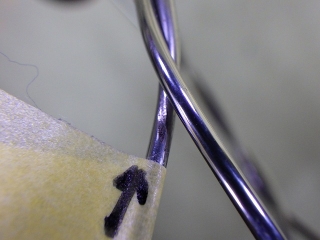
↑At this location
In the butted thin-diameter section,
unyon (stress-induced deformation) is occurring.
Normally, with 1.8mm diameter (15G) spokes, unyon almost never happens,
but with Molanbon lacing, the radial load concentrates beyond the twist-off point on the rim side,
and unyon can occur even with Competé spokes.
With Revolution spokes where the butted section is 1.5mm diameter (17G),
unyon can occur probabilistically from around 100 kgf of force even on normal wheels,
but with Molanbon lacing, nearly all spokes develop unyon at or after the twist-off before the wheel is even finished building—
making wheel building itself difficult, or frankly impossible
(I've actually tested this).
With Competé spokes, the wheel building process itself produces almost no unyon,
but seeing such pronounced unyon develop from long-term use is something I encountered for the first time.
The customer marked one spot with tape, but
with varying degrees of severity, I found similar traces at the twist-off points on all non-freewheel side spokes.
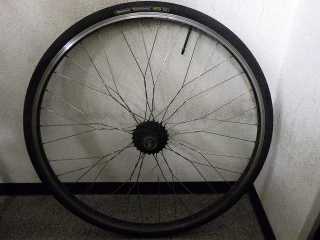
This is a separate case showing a spoke break from Molanbon lacing.
It was built on November 10, 2018 (→here),
and was repaired on November 18 of this year—exactly four years later.

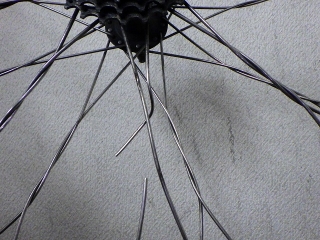
The break occurred at the twist-off point.
On this wheel, the freewheel side is Strong and the non-freewheel side is Champion,
and the Strong on the freewheel side is 13G (2.3mm diameter) at the spoke head,
then 14G (2.0mm diameter) after that—single-butted—so
the diameter doesn't change beyond the twist-off point.
Also, there were no spokes with unyon on either side.
What this wheel shows is that the stress at the twist-off point is indeed substantial.
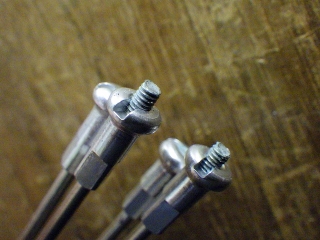
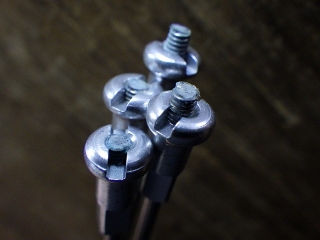
↑These are the rim-end sections of spokes I cut and pulled out without loosening the nipples at all
when disassembling the non-freewheel side spokes.
Once spokes that have undergone unyon are tightened further,
the additional tension converts not to spoke tension but to spoke elongation.
So there are spokes where the thread has advanced several pitches beyond where the spoke length was flush with the nipple end face.
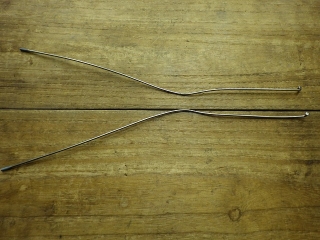
↑These are two spokes from the final crossing pair,
extracted after fully loosening the nipples.
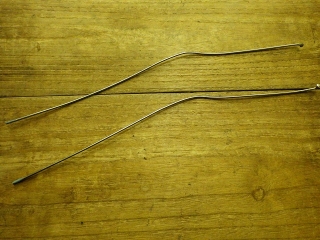
When I flip one over, it looks like this
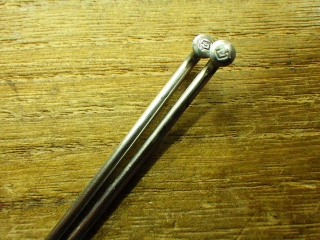
I aligned the ends at the spoke head.
The appearance that the head of the spoke on the right is floating is
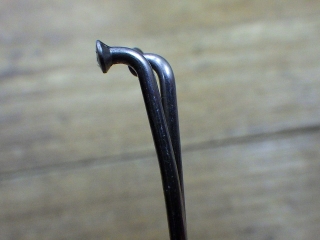
due to the difference between inpoke and outpoke.
The angle difference from the hub flange to the beginning of the twist is larger than on normal wheels,
so the difference in neck deformation also becomes more pronounced.
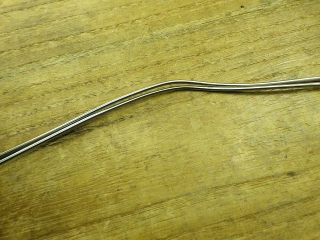
When I align the orientation, they fit together quite well.
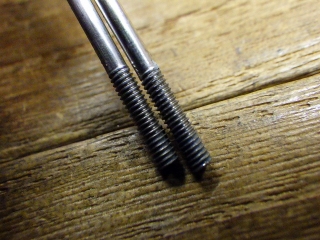
The length difference was about this much.
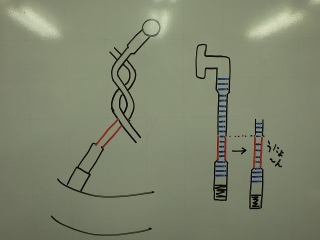
↑This is a diagram of a butted spoke, with the section from the twist-off point to where it widens to the nipple diameter shown in red.
To its right is a spoke with evenly spaced horizontal lines drawn across it,
and I've colored in red on the right the section corresponding to the red on the left diagram.
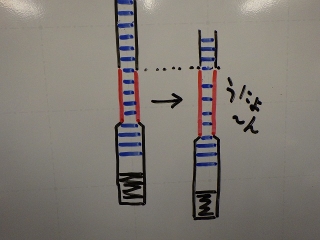
↑Butted spoke unyon occurs
like this, apparently.
Whether it's "the short length of the 1.8mm diameter section concentrates stress, causing unyon within normal spoke tension ranges"
or "simply that 1.8mm diameter can't withstand it" remains unclear.
If the former is true, there should be a range where 2.0–1.8–2.0mm butted develops unyon while 1.8mm plain doesn't.
If the latter, then any 1.8mm diameter Molanbon lacing
would inherently develop unyon within normal wheel-building parameters.
Also, "spoke count" seems like it might be quite a significant factor in unyon generation.
It's plausible that 24H develops it while 32H doesn't.
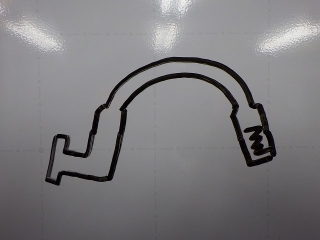
This is an extreme diagram, but
when a butted spoke is bent with force insufficient to cause plastic deformation,
the bowing curvature differs between the thick and thin diameter sections.
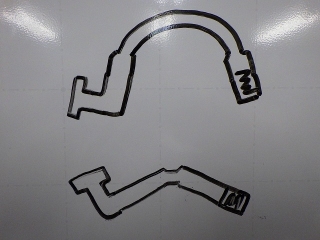
Now, if the butted section were extremely short—
ampule or toothpick-groove length—
the deformation shape would become angular like a folded line rather than a smooth bow.
Assuming both spokes had identical thick and thin diameter dimensions,
if pulled in tension rather than bent sideways,
while the upper spoke would at worst undergo unyon,
the lower spoke would snap and break—
a different outcome entirely. If that's the case,
then the Molanbon lacing beyond the twist-off point is
straddling the line toward the lower spoke's state.
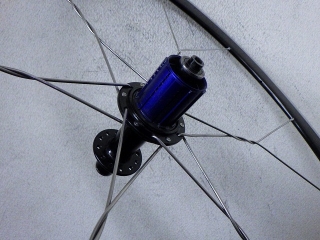
With 15G plain, the bowing curvature in the bending direction becomes uniform,
so it's possible that regarding resistance to unyon specifically during Molanbon building,
butted spokes with a 15G section might actually be stronger than those with a 14G section.
Since testing that would be gambling, I decided to rebuild the non-freewheel side spokes
with 14G plain—spokes that are reliably resistant to unyon
within normal wheel-building parameters and through years of use.
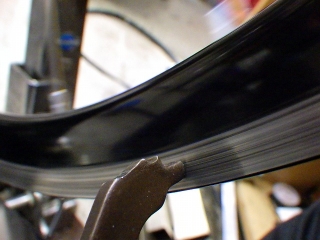
I replaced the spokes and did a rough radial and lateral true.
The wheel in the image above is spinning.
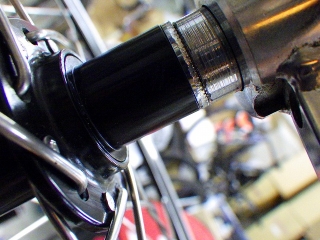
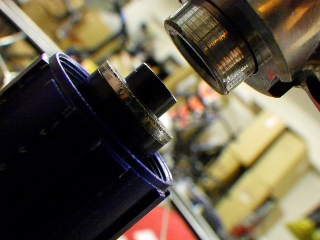
The wheel centering at that point.
The rim is badly offset toward the freewheel side,
but from there I can tighten the non-freewheel side
and center the wheel. Well, not quite that simple—
I needed to fine-tune the radial true one more time toward the end.
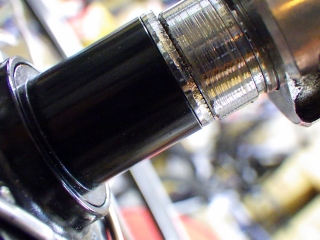
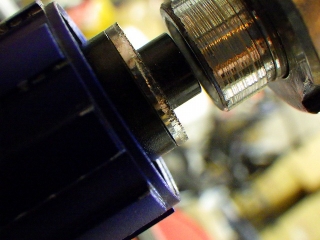
Still working on it.
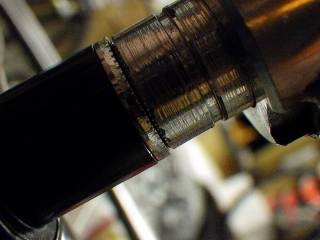
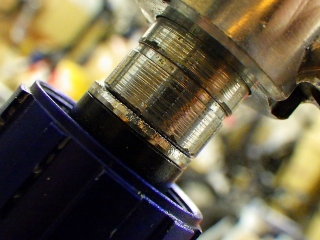
Got it centered.
I had attempted some light truing on the wheel before disassembly too,
but there was a pronounced vertical hop, and the spokes at those positions were undergoing unyon—
no matter how much I tightened, the spokes just kept stretching and the wobble wouldn't disappear.
Once I swapped in the new spokes, everything locked in cleanly and sharply.
I've confirmed that all the Champion spokes I reused from the freewheel side
are perfectly aligned at the nipple end face with no unyon.
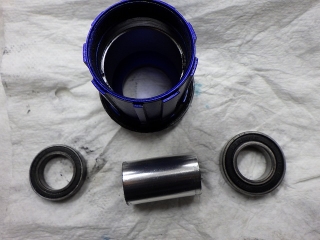
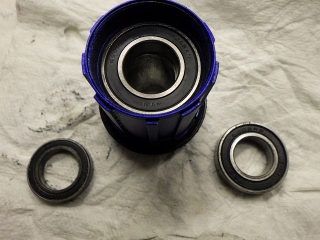
Oh right, I also replaced the freewheel body bearings as originally intended.
Since I did that after the wheel building,
I checked with the centering gauge just to be safe at the end,
and the bearing replacement didn't shift the centering at all.
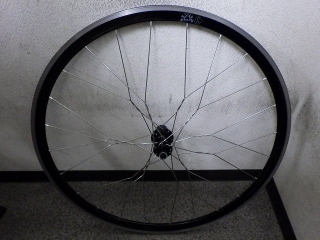
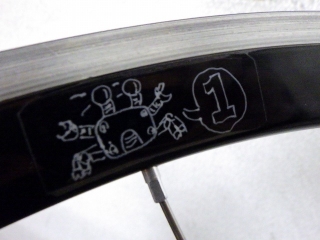
Done. It's now all-Champion instead of Champion/Competé,
but it's still 4-cross Italian lacing.

It's a rear wheel built in the Molanbon lacing pattern.
Originally it was built in a standard way,
but the customer requested it be rebuilt.
The current lacing pattern dates back to August 2017 (→here),
so it's been over five years.
This is the customer's most-used wheel for practice and training.

It's a Rolf hub, 24H, Champion/Competé, Molanbon lacing.
The spoke pattern uses asymmetric lacing on both sides with different spoke gauges.
The main reason for the drop-off was to replace the freewheel body bearings, but

separately from that,
the spoke twist-off point was gradually slipping,
and even after truing, the wheel would come out of true again quickly.

↑At this location
In the butted thin-diameter section,
unyon (stress-induced deformation) is occurring.
Normally, with 1.8mm diameter (15G) spokes, unyon almost never happens,
but with Molanbon lacing, the radial load concentrates beyond the twist-off point on the rim side,
and unyon can occur even with Competé spokes.
With Revolution spokes where the butted section is 1.5mm diameter (17G),
unyon can occur probabilistically from around 100 kgf of force even on normal wheels,
but with Molanbon lacing, nearly all spokes develop unyon at or after the twist-off before the wheel is even finished building—
making wheel building itself difficult, or frankly impossible
(I've actually tested this).
With Competé spokes, the wheel building process itself produces almost no unyon,
but seeing such pronounced unyon develop from long-term use is something I encountered for the first time.
The customer marked one spot with tape, but
with varying degrees of severity, I found similar traces at the twist-off points on all non-freewheel side spokes.

This is a separate case showing a spoke break from Molanbon lacing.
It was built on November 10, 2018 (→here),
and was repaired on November 18 of this year—exactly four years later.


The break occurred at the twist-off point.
On this wheel, the freewheel side is Strong and the non-freewheel side is Champion,
and the Strong on the freewheel side is 13G (2.3mm diameter) at the spoke head,
then 14G (2.0mm diameter) after that—single-butted—so
the diameter doesn't change beyond the twist-off point.
Also, there were no spokes with unyon on either side.
What this wheel shows is that the stress at the twist-off point is indeed substantial.


↑These are the rim-end sections of spokes I cut and pulled out without loosening the nipples at all
when disassembling the non-freewheel side spokes.
Once spokes that have undergone unyon are tightened further,
the additional tension converts not to spoke tension but to spoke elongation.
So there are spokes where the thread has advanced several pitches beyond where the spoke length was flush with the nipple end face.

↑These are two spokes from the final crossing pair,
extracted after fully loosening the nipples.

When I flip one over, it looks like this

I aligned the ends at the spoke head.
The appearance that the head of the spoke on the right is floating is

due to the difference between inpoke and outpoke.
The angle difference from the hub flange to the beginning of the twist is larger than on normal wheels,
so the difference in neck deformation also becomes more pronounced.

When I align the orientation, they fit together quite well.

The length difference was about this much.

↑This is a diagram of a butted spoke, with the section from the twist-off point to where it widens to the nipple diameter shown in red.
To its right is a spoke with evenly spaced horizontal lines drawn across it,
and I've colored in red on the right the section corresponding to the red on the left diagram.

↑Butted spoke unyon occurs
like this, apparently.
Whether it's "the short length of the 1.8mm diameter section concentrates stress, causing unyon within normal spoke tension ranges"
or "simply that 1.8mm diameter can't withstand it" remains unclear.
If the former is true, there should be a range where 2.0–1.8–2.0mm butted develops unyon while 1.8mm plain doesn't.
If the latter, then any 1.8mm diameter Molanbon lacing
would inherently develop unyon within normal wheel-building parameters.
Also, "spoke count" seems like it might be quite a significant factor in unyon generation.
It's plausible that 24H develops it while 32H doesn't.

This is an extreme diagram, but
when a butted spoke is bent with force insufficient to cause plastic deformation,
the bowing curvature differs between the thick and thin diameter sections.

Now, if the butted section were extremely short—
ampule or toothpick-groove length—
the deformation shape would become angular like a folded line rather than a smooth bow.
Assuming both spokes had identical thick and thin diameter dimensions,
if pulled in tension rather than bent sideways,
while the upper spoke would at worst undergo unyon,
the lower spoke would snap and break—
a different outcome entirely. If that's the case,
then the Molanbon lacing beyond the twist-off point is
straddling the line toward the lower spoke's state.

With 15G plain, the bowing curvature in the bending direction becomes uniform,
so it's possible that regarding resistance to unyon specifically during Molanbon building,
butted spokes with a 15G section might actually be stronger than those with a 14G section.
Since testing that would be gambling, I decided to rebuild the non-freewheel side spokes
with 14G plain—spokes that are reliably resistant to unyon
within normal wheel-building parameters and through years of use.

I replaced the spokes and did a rough radial and lateral true.
The wheel in the image above is spinning.


The wheel centering at that point.
The rim is badly offset toward the freewheel side,
but from there I can tighten the non-freewheel side
and center the wheel. Well, not quite that simple—
I needed to fine-tune the radial true one more time toward the end.


Still working on it.


Got it centered.
I had attempted some light truing on the wheel before disassembly too,
but there was a pronounced vertical hop, and the spokes at those positions were undergoing unyon—
no matter how much I tightened, the spokes just kept stretching and the wobble wouldn't disappear.
Once I swapped in the new spokes, everything locked in cleanly and sharply.
I've confirmed that all the Champion spokes I reused from the freewheel side
are perfectly aligned at the nipple end face with no unyon.


Oh right, I also replaced the freewheel body bearings as originally intended.
Since I did that after the wheel building,
I checked with the centering gauge just to be safe at the end,
and the bearing replacement didn't shift the centering at all.


Done. It's now all-Champion instead of Champion/Competé,
but it's still 4-cross Italian lacing.