Another wheel day (and so on).
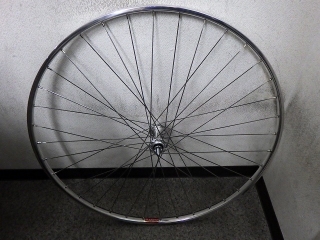
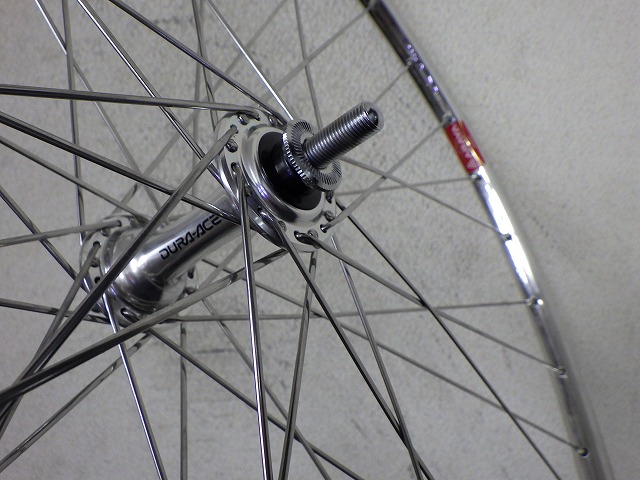
Built a Keirin front wheel with an HB-7710 hub.
With just that information, the specs are basically locked in.
The HB-7710 has a rear hub too,
but since it's explicitly stated as a front wheel
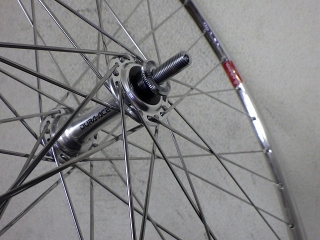
and since it's explicitly Keirin,
the rim is definitely an Araya 16B Gold 36H,
the spokes are NJS spokes based on Hoshi #15,
and it's definitely an 88-style lacing pattern.
For the spokes alone, based on Hoshi #15, there's Starbright
in both round-butted and aero options,
but this time it's the aero version.
Either way, NJS spokes come in only 305mm length.
With the large-flange HB-7600 hub,
whether it's a front wheel, single-sided rear, or double-sided rear,
the length generally works out,
but with the small-flange HB-7710,
the spokes are quite short—which by my standards would be NG—
but there's no other option, so it can't be helped.
From measurements of the actual rim I'm using, the calculated
spoke length comes to 305.41mm for the HB-7600 front hub
and 306.49mm for the HB-7710 front hub.
When using different rim samples or measuring different rim holes,
the measured rim inner diameter often varies by about 0.1–0.3mm.
With old ZIPP rims, even the same rim model (like two rims bought for front and rear)
had quite inconsistent rim inner diameters,
and it was common for the rounded integer mm length to differ by 1mm.
With this rim, the calculated 8-spoke length for the HB-7710 front hub
comes to 306.49mm, but if it were just 1/100mm longer,
the rounded integer mm length would be judged as 307mm.
When spoke lengths can be custom cut,
if the decimal is close to 0.5mm, I sometimes cut right between
two integer mm lengths.
For example, if this weren't a Keirin wheel,
I'd cut at 306.5mm instead of 307mm.
But the only available length is 305mm,
and since the calculated length is longer, there's nothing to be done.
If hypothetically the NJS spokes came only in 307mm
and the calculated length was 305mm,
if asked whether I'd cut 2mm off, well,
technically that might violate the rules, and
since "it's supplied that way, can't be helped,"
I'd just use it as-is anyway.

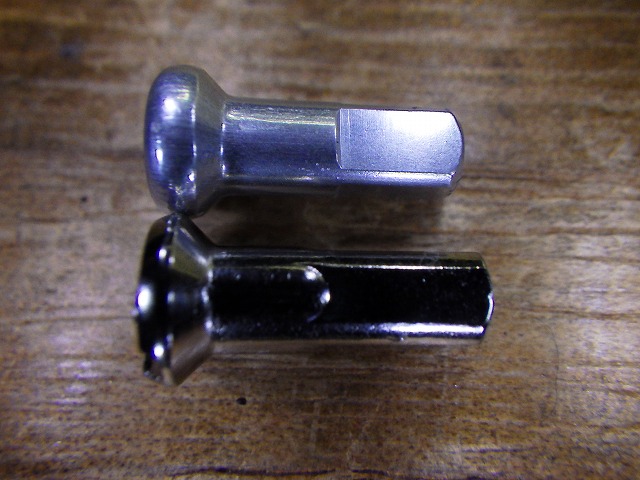
↑The top is a DT 12mm length aluminum nipple,
the bottom is the brass nipple included with Hoshi NJS spokes.
The DT 12mm nominal length nipple measures 12.0mm actual,
while the Hoshi brass nipple measures 12.4mm actual.
Because it's brass, the outer circumference side beyond where it sits in the rim hole
is thinner than the aluminum nipple,
so in terms of protrusion from the rim hole toward the center,
it looks like a 13mm nipple.
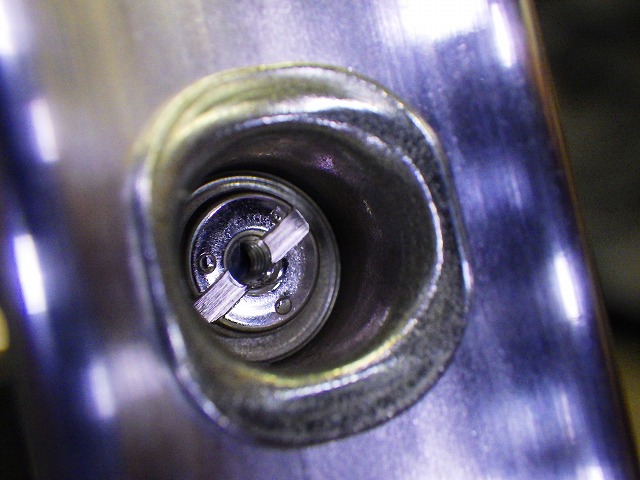
I evened out the tightening amount across all 36 places
so the inner end of the nipple just covers the spoke threads,
but the tension was already pretty good
and there was hardly any more turning left to do.
If I'd used DT 12mm nipples instead,
one thread of the spoke might still be visible even after wheel completion.
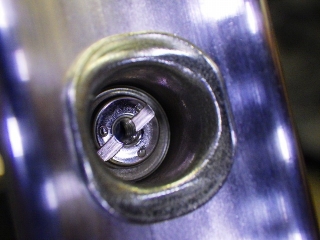
↑The appearance from the outer side
when the inner end face of the nipple just covers
the spoke threads
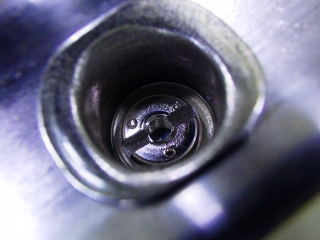
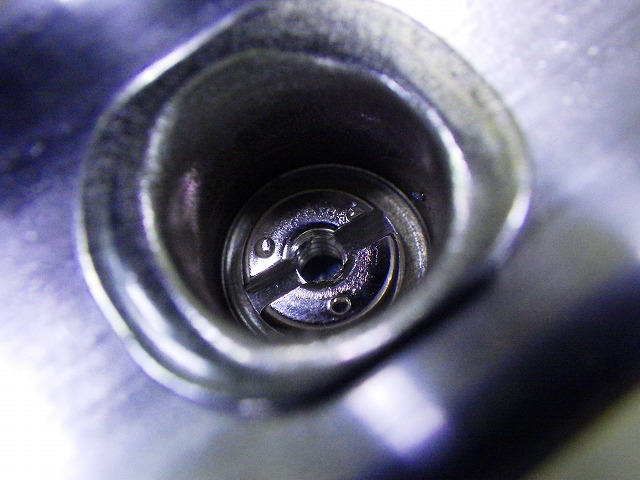
↑The appearance once wheel building is complete.
The spoke end face doesn't even reach the nipple slot,
but I tensioned it as much as the rim allows.
Once tension is applied to the hub flanges,
some lateral play appeared that wasn't there on the bare hub,
so I adjusted the bearing play too.
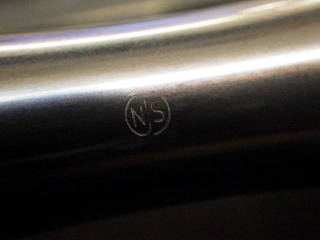
Like the HB-7600, the hub shell has an NJS stamped mark,
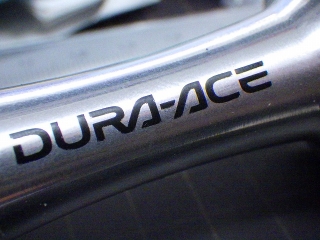
but with the model number HB-7710, which is nominally 7700-series,
the Dura-Ace logo from the 7700-series Dura-Ace era
is stamped on the opposite side from the mark.
Incidentally, the seatpost model number from the 7700-series Dura-Ace era
is SP-7410, but the logo is the 7700-series Dura-Ace one, not the 7400-series.
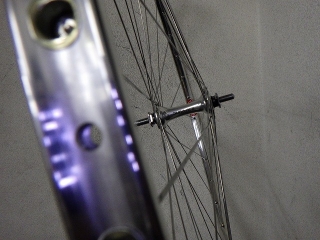
This time I aligned the phase of the hub shell visible through the valve hole
with the Dura-Ace logo.
By the way, this HB-7710 front hub
also comes in 32H and 28H for non-NJS-approved hole counts,
but if you swap in a hub axle for a 100mm-width quick-release,
the water sealing is slightly looser and rotation becomes extremely smooth and light,
turning it into a god hub for road use.
In that case, you should avoid radial lacing.
Oh right, I'll do the lacing later.
Full lacing on both sides, so it'll take even longer
than the wheel building itself.
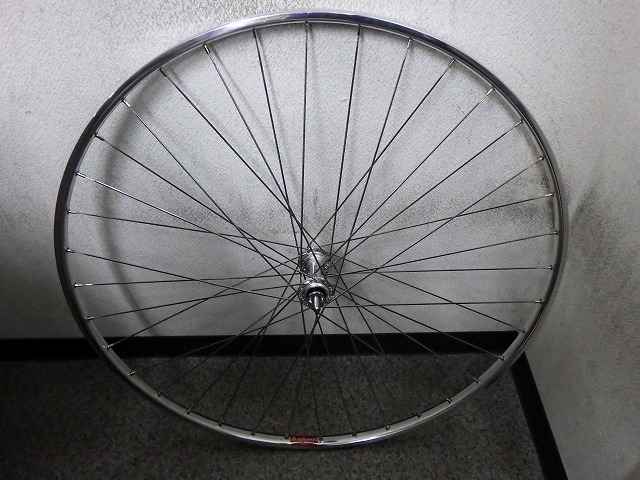
Built a Keirin front wheel with an HB-7710 hub.
With just that information, the specs are basically locked in.
The HB-7710 has a rear hub too,
but since it's explicitly stated as a front wheel
and since it's explicitly Keirin,
the rim is definitely an Araya 16B Gold 36H,
the spokes are NJS spokes based on Hoshi #15,
and it's definitely an 88-style lacing pattern.
For the spokes alone, based on Hoshi #15, there's Starbright
in both round-butted and aero options,
but this time it's the aero version.
Either way, NJS spokes come in only 305mm length.
With the large-flange HB-7600 hub,
whether it's a front wheel, single-sided rear, or double-sided rear,
the length generally works out,
but with the small-flange HB-7710,
the spokes are quite short—which by my standards would be NG—
but there's no other option, so it can't be helped.
From measurements of the actual rim I'm using, the calculated
spoke length comes to 305.41mm for the HB-7600 front hub
and 306.49mm for the HB-7710 front hub.
When using different rim samples or measuring different rim holes,
the measured rim inner diameter often varies by about 0.1–0.3mm.
With old ZIPP rims, even the same rim model (like two rims bought for front and rear)
had quite inconsistent rim inner diameters,
and it was common for the rounded integer mm length to differ by 1mm.
With this rim, the calculated 8-spoke length for the HB-7710 front hub
comes to 306.49mm, but if it were just 1/100mm longer,
the rounded integer mm length would be judged as 307mm.
When spoke lengths can be custom cut,
if the decimal is close to 0.5mm, I sometimes cut right between
two integer mm lengths.
For example, if this weren't a Keirin wheel,
I'd cut at 306.5mm instead of 307mm.
But the only available length is 305mm,
and since the calculated length is longer, there's nothing to be done.
If hypothetically the NJS spokes came only in 307mm
and the calculated length was 305mm,
if asked whether I'd cut 2mm off, well,
technically that might violate the rules, and
since "it's supplied that way, can't be helped,"
I'd just use it as-is anyway.
↑The top is a DT 12mm length aluminum nipple,
the bottom is the brass nipple included with Hoshi NJS spokes.
The DT 12mm nominal length nipple measures 12.0mm actual,
while the Hoshi brass nipple measures 12.4mm actual.
Because it's brass, the outer circumference side beyond where it sits in the rim hole
is thinner than the aluminum nipple,
so in terms of protrusion from the rim hole toward the center,
it looks like a 13mm nipple.
I evened out the tightening amount across all 36 places
so the inner end of the nipple just covers the spoke threads,
but the tension was already pretty good
and there was hardly any more turning left to do.
If I'd used DT 12mm nipples instead,
one thread of the spoke might still be visible even after wheel completion.
↑The appearance from the outer side
when the inner end face of the nipple just covers
the spoke threads
↑The appearance once wheel building is complete.
The spoke end face doesn't even reach the nipple slot,
but I tensioned it as much as the rim allows.
Once tension is applied to the hub flanges,
some lateral play appeared that wasn't there on the bare hub,
so I adjusted the bearing play too.
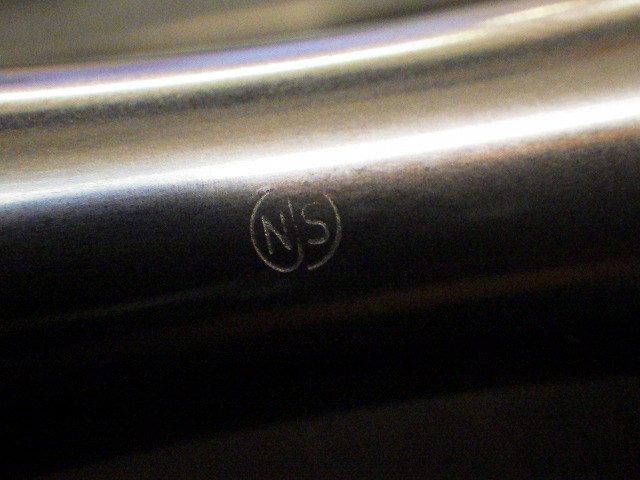
Like the HB-7600, the hub shell has an NJS stamped mark,

but with the model number HB-7710, which is nominally 7700-series,
the Dura-Ace logo from the 7700-series Dura-Ace era
is stamped on the opposite side from the mark.
Incidentally, the seatpost model number from the 7700-series Dura-Ace era
is SP-7410, but the logo is the 7700-series Dura-Ace one, not the 7400-series.
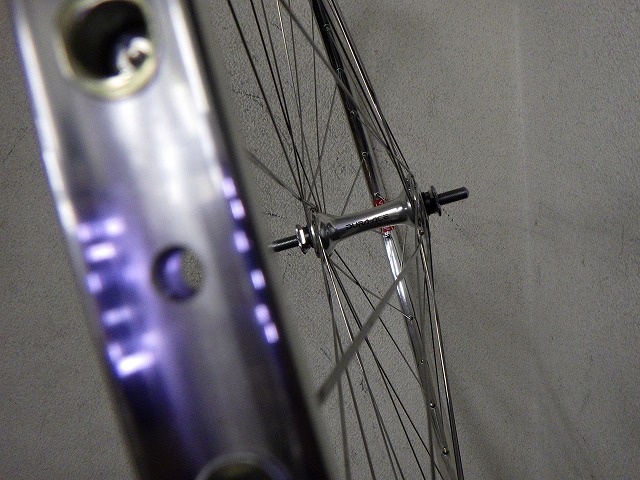
This time I aligned the phase of the hub shell visible through the valve hole
with the Dura-Ace logo.
By the way, this HB-7710 front hub
also comes in 32H and 28H for non-NJS-approved hole counts,
but if you swap in a hub axle for a 100mm-width quick-release,
the water sealing is slightly looser and rotation becomes extremely smooth and light,
turning it into a god hub for road use.
In that case, you should avoid radial lacing.
Oh right, I'll do the lacing later.
Full lacing on both sides, so it'll take even longer
than the wheel building itself.