Today it's wheels again (and so on).

Continuing from the other day.
I built a rear wheel with the Mavic all-road rim, A1022.
The "22" at the end of A1022
refers to the rim's internal width of 22mm,
and while it's only available in 650B size,
there's also an A1025 rim which is the 25mm internal width version.
The rim internal width differs by 3mm, but the usable tire sizes for both rims
are 28–64C.
It's supposed to work with tube tires,
but the rim bead looks almost hookless.

ZUTTO R2 hub, 24H, black champion/CX sprint.
Built with forced left-right 2-cross lacing.
Unlike the front hub, the rear hub is a reasonably high-low flange.
I'll do the lacing later.

The freebody is for Campagnolo,
but since Campagnolo disc hubs are pretty rare,
maybe that's why I chose this hub.
The right dropout is sized to pair with
a Campagnolo freebody,
so perhaps "CP" is marked there to denote Campagnolo.

Sometimes when you become a pioneer in some advanced innovation,
you end up stuck with it even as time progresses.
Pinarello was the pioneer of carbon seatstays on full aluminum frames—
the carbon-back concept—but getting locked into that,
they lagged behind other makers until
they made full carbon frames their flagship.
The first carbon-back model appeared as a prototype at the 1997 Tour de France,
converting the full aluminum Paris frame to carbon-back,
and later the Prince model came out with an aluminum front triangle and carbon seatstays,
then in 2001 the first Dogma with a magnesium front triangle and carbon seatstays was announced.
The Dogma FP came in 2004 and the Dogma FPX in 2007,
but until the final year of the FPX in 2009, the flagship model was still
the magnesium—that is, metal—front triangle frame.
Starting with the 2010 model Dogma 60.1,
it became a full carbon frame.
However, even before 2000, full carbon frames from Trek and Colnago
were already being used in pro racing.
Though it's hard to say that those carbon frames back then were
completely superior to aluminum frames of that era
in every respect—weight, stiffness, and so on.
About the eyelet—the spoke hole reinforcement ring—
it originally came about because aluminum forming technology was low,
creating variance in the thickness of the rim hole's inner wall,
leading to inconsistency in spoke tension resistance,
and because forging technology for aluminum was underdeveloped,
making it hard to achieve hardness.
In other words, with modern aluminum rims,
there's no real need to include them.
An eyelet on just the rim's inner hole is called a single eyelet,
while one that's crimped to the outer hole as well
is called a double eyelet.
A double eyelet distributes the load of spoke tension
to the outer rim wall as well.
Since Mavic was a pioneer of double eyelets,
even as aluminum rim forming and forging technology advanced,
they basically never made eyelet-free rims.
Rims like the GEL280, Montréal series, and early GP4
would require double eyelets,
but back around when the Open Pro came out,
eyelets weren't necessarily essential work.
As a rare example,
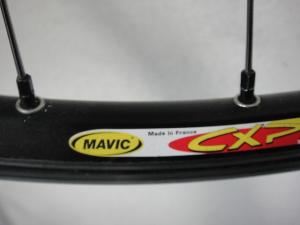
from this blog—
the CXP22 rim in the image has eyelets, but
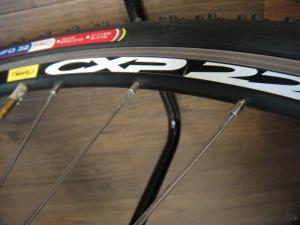
this CXP22 has no eyelets.
This isn't because of a different era—
the eyelet-free CXP22
was made for hand-built wheels on budget complete bikes
from manufacturers. For example,
it was used on Specialized's Allez complete bikes.
The story got long, so I'm posting the same image again.
Double eyelets don't play well with tubeless-ready rim specs,
which require a center depression,
and since this rim is an offset rim,
the outer hole positions are also drilled offset.
But as a Mavic quirk,
they apparently still wanted eyelets even with just a single,
so the inner rim hole has a crimped eyelet,
but this eyelet has a different color and finish than the rim's black anodizing—
it's painted, so with the rim's interior being silver
and the eyelet area being black, that means
it was a black eyelet before being crimped to the rim.
In the image above, the dull black circle around
the glossy black aluminum nipple
is the painted single eyelet.
Quite meticulous craftsmanship.


The rim seam at the opposite end from the valve hole
has been welded and machined,
and black tape with no relation to the internal shape
is applied on the outer rim to hide the marks,
while on other visible areas—even after the tire is mounted—
yellow logo tape is applied as minimal cosmetics.

I peeled it off.
For rims with a slight gap at the seam,
the outer perimeter is sealed with tubeless tape
and the rim's side is sealed with the tire bead,
so you'd think there's no problem, but when running tubeless-ready,
sealant can sometimes balloon out ("honking") from the rim side seam.
For such rims, injecting instant adhesive into the seam
and spraying primer to cure it usually seals the gap.
This rim doesn't require such concerns, but
applying tubeless tape over this black tape would look bulky,
so I'd peel off the black tape, start taping from slightly offset
from the valve hole, toward the seam,
then cut the tape after crossing the seam again—
meaning most positions are single-wrapped
but around the seam area it becomes double-wrapped.
That might work well.

Zoomed in as much as possible to photograph the rim bead.
No matter how you look at it, it only looks like a hookless rim.

The ZUTTO hub with 12S microspline marking says
"12S MS" on the right dropout,
so indeed the "CP" from before seems to mean Campagnolo.

This rear hub has a marking on the hub shell
"32T ratchet system,"
and I've always thought that 32 pawls isn't
such a fine number to brag about.
The image above is the BOOST rear hub with microspline
I mentioned earlier, and it has
54 pawls.
As for this A1022 rim,
before building the wheel I took both out of the bag
because they have the same hole count and
I wanted to use the lighter one for the rear.
The A1022 rim is only available in 700C size
with a stated weight of 460g,
while the A1025 is only available in 650B size
also with a stated weight of 460g.
"Wider rim width makes up for smaller diameter,
so about the same weight in the end"—
this is the same relationship as the Ksyrium SL and Crossmax SL (26-inch rim brake)
from around 2006, which both had Zicral aluminum spokes.
But the actual measured weight—unusually for Mavic—
both came in under the stated weight.
I'm not going to tell you the specific numbers though.
↑ wow this guy's got bad vibes

Sorry for the wait! Please check this image!


I used the lighter one for the rear wheel!
↑ Stop iiiiit!

Continuing from the other day.
I built a rear wheel with the Mavic all-road rim, A1022.
The "22" at the end of A1022
refers to the rim's internal width of 22mm,
and while it's only available in 650B size,
there's also an A1025 rim which is the 25mm internal width version.
The rim internal width differs by 3mm, but the usable tire sizes for both rims
are 28–64C.
It's supposed to work with tube tires,
but the rim bead looks almost hookless.

ZUTTO R2 hub, 24H, black champion/CX sprint.
Built with forced left-right 2-cross lacing.
Unlike the front hub, the rear hub is a reasonably high-low flange.
I'll do the lacing later.

The freebody is for Campagnolo,
but since Campagnolo disc hubs are pretty rare,
maybe that's why I chose this hub.
The right dropout is sized to pair with
a Campagnolo freebody,
so perhaps "CP" is marked there to denote Campagnolo.

Sometimes when you become a pioneer in some advanced innovation,
you end up stuck with it even as time progresses.
Pinarello was the pioneer of carbon seatstays on full aluminum frames—
the carbon-back concept—but getting locked into that,
they lagged behind other makers until
they made full carbon frames their flagship.
The first carbon-back model appeared as a prototype at the 1997 Tour de France,
converting the full aluminum Paris frame to carbon-back,
and later the Prince model came out with an aluminum front triangle and carbon seatstays,
then in 2001 the first Dogma with a magnesium front triangle and carbon seatstays was announced.
The Dogma FP came in 2004 and the Dogma FPX in 2007,
but until the final year of the FPX in 2009, the flagship model was still
the magnesium—that is, metal—front triangle frame.
Starting with the 2010 model Dogma 60.1,
it became a full carbon frame.
However, even before 2000, full carbon frames from Trek and Colnago
were already being used in pro racing.
Though it's hard to say that those carbon frames back then were
completely superior to aluminum frames of that era
in every respect—weight, stiffness, and so on.
About the eyelet—the spoke hole reinforcement ring—
it originally came about because aluminum forming technology was low,
creating variance in the thickness of the rim hole's inner wall,
leading to inconsistency in spoke tension resistance,
and because forging technology for aluminum was underdeveloped,
making it hard to achieve hardness.
In other words, with modern aluminum rims,
there's no real need to include them.
An eyelet on just the rim's inner hole is called a single eyelet,
while one that's crimped to the outer hole as well
is called a double eyelet.
A double eyelet distributes the load of spoke tension
to the outer rim wall as well.
Since Mavic was a pioneer of double eyelets,
even as aluminum rim forming and forging technology advanced,
they basically never made eyelet-free rims.
Rims like the GEL280, Montréal series, and early GP4
would require double eyelets,
but back around when the Open Pro came out,
eyelets weren't necessarily essential work.
As a rare example,
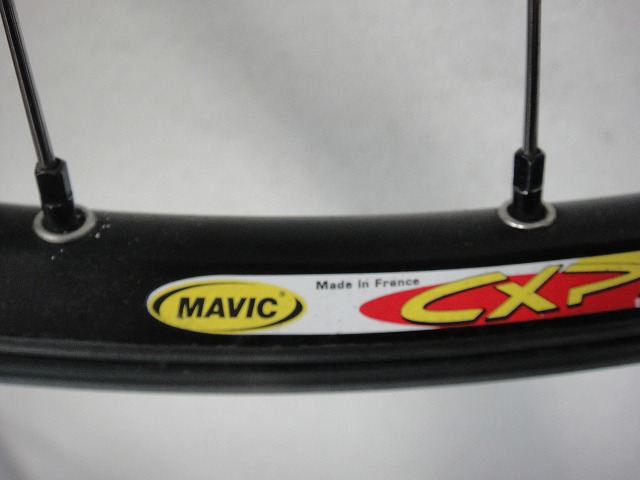
from this blog—
the CXP22 rim in the image has eyelets, but
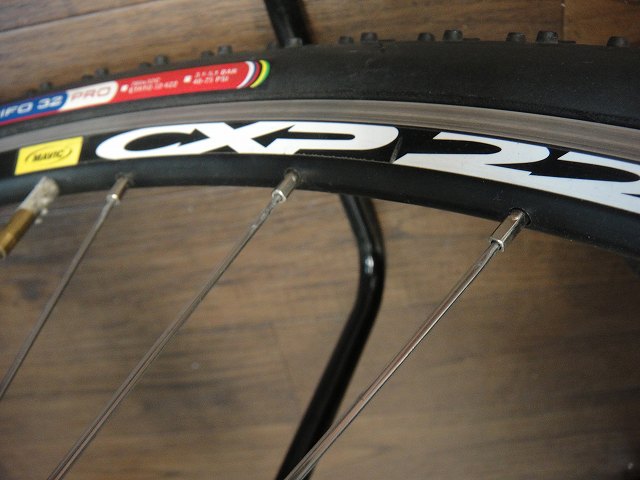
this CXP22 has no eyelets.
This isn't because of a different era—
the eyelet-free CXP22
was made for hand-built wheels on budget complete bikes
from manufacturers. For example,
it was used on Specialized's Allez complete bikes.
The story got long, so I'm posting the same image again.
Double eyelets don't play well with tubeless-ready rim specs,
which require a center depression,
and since this rim is an offset rim,
the outer hole positions are also drilled offset.
But as a Mavic quirk,
they apparently still wanted eyelets even with just a single,
so the inner rim hole has a crimped eyelet,
but this eyelet has a different color and finish than the rim's black anodizing—
it's painted, so with the rim's interior being silver
and the eyelet area being black, that means
it was a black eyelet before being crimped to the rim.
In the image above, the dull black circle around
the glossy black aluminum nipple
is the painted single eyelet.
Quite meticulous craftsmanship.


The rim seam at the opposite end from the valve hole
has been welded and machined,
and black tape with no relation to the internal shape
is applied on the outer rim to hide the marks,
while on other visible areas—even after the tire is mounted—
yellow logo tape is applied as minimal cosmetics.

I peeled it off.
For rims with a slight gap at the seam,
the outer perimeter is sealed with tubeless tape
and the rim's side is sealed with the tire bead,
so you'd think there's no problem, but when running tubeless-ready,
sealant can sometimes balloon out ("honking") from the rim side seam.
For such rims, injecting instant adhesive into the seam
and spraying primer to cure it usually seals the gap.
This rim doesn't require such concerns, but
applying tubeless tape over this black tape would look bulky,
so I'd peel off the black tape, start taping from slightly offset
from the valve hole, toward the seam,
then cut the tape after crossing the seam again—
meaning most positions are single-wrapped
but around the seam area it becomes double-wrapped.
That might work well.

Zoomed in as much as possible to photograph the rim bead.
No matter how you look at it, it only looks like a hookless rim.

The ZUTTO hub with 12S microspline marking says
"12S MS" on the right dropout,
so indeed the "CP" from before seems to mean Campagnolo.

This rear hub has a marking on the hub shell
"32T ratchet system,"
and I've always thought that 32 pawls isn't
such a fine number to brag about.
The image above is the BOOST rear hub with microspline
I mentioned earlier, and it has
54 pawls.
As for this A1022 rim,
before building the wheel I took both out of the bag
because they have the same hole count and
I wanted to use the lighter one for the rear.
The A1022 rim is only available in 700C size
with a stated weight of 460g,
while the A1025 is only available in 650B size
also with a stated weight of 460g.
"Wider rim width makes up for smaller diameter,
so about the same weight in the end"—
this is the same relationship as the Ksyrium SL and Crossmax SL (26-inch rim brake)
from around 2006, which both had Zicral aluminum spokes.
But the actual measured weight—unusually for Mavic—
both came in under the stated weight.
I'm not going to tell you the specific numbers though.
↑ wow this guy's got bad vibes

Sorry for the wait! Please check this image!


I used the lighter one for the rear wheel!
↑ Stop iiiiit!