The other day, I installed a Zonda DB
(which I converted from thru-axle to
quick-release specs — see here)
onto my Trek FX 3 crossbike.
When I mount Continental Grand Prix 5000 tires
onto a rim, I position them so that
the "Grand Prix 5000" label (model name)
aligns with the valve hole phase.
On the opposite side of that phase is the "Continental" (manufacturer name) marking.
However, with a Campagnolo wheel, when I do the same thing,
the Campagnolo marking appears at the valve hole phase,
and the Zonda marking at the opposite phase.
So at the valve hole phase I get wheel manufacturer name / tire model name,
and at the opposite phase I get wheel model name / tire manufacturer name,
which means the manufacturer and model name markings don't align.
I still prefer to orient the Grand Prix 5000 marking
toward the valve hole, but if a customer's wheel
has Continental facing the valve hole,
I respect their or the shop's intention
and restore it to its original orientation when I remove the tire for service.

The Bontrager tire has, I believe,
a unique design where the label text orientation
has its "center of gravity" pointing "outward."
Since the Campagnolo wheel text has a "single direction" orientation,
when the wheel sits flat, Zonda points straight up and Campagnolo points straight down,
both readable in the correct direction.
This H2 Comp has only one label location on the tire,
and when I brought the label to the valve hole phase,
it aligned with the rim marking and text orientation,
so I positioned the label at the valve hole phase.
If the text orientation pointed "inward"
and the tire had only one side marking,
I might have aligned the label to the opposite side of the valve hole phase,
toward the Zonda side instead.

The front wheel of my personal 63H Nomu-Lab Wheel No. 1
is the Nomu-Lab Wheel No. 1, 3-3-7,
with brass nipples,
and the actual measured weight is 1160g.

The version with a gold rim and gold aluminum nipples
that we sold in the past
weighs 1118g.
Both use Gran Compe large flange front hubs,
which aren't particularly light hubs.
As for the measured weight difference between
the FX 3's stock wheels and the Zonda DB,
the FX 3 wheel has a 6-bolt rotor mount with bolts only,
includes rim tape, and is weighed without rotor and sprocket.
The Zonda DB doesn't need rim tape to begin with,
and is weighed without rotor, rotor lockring, and sprocket.


↑Front wheel before/after


↑Rear wheel before/after
The original front wheel at 1071g
is deliberately built quite heavy—
comparable in weight to a rim brake front wheel.
The Zonda DB's stated weight is
in the same condition as my measured weight,
and according to the manufacturer's site,
both wheels combined are 1675g—
just a rough figure—but since the specs haven't changed
since its 2019 debut, I checked the original catalog
and found front wheel 786g and rear wheel 889g.
Adding those gives 1675g,
so the stated weight hasn't changed.
The Sirocco DB, which came out after the Zonda DB,
has a list price of 99,000 yen (before tax)
compared to the Zonda DB's 109,000 yen—just a 10,000 yen difference.
Instead of the Zonda DB's C17 WO rim,
it uses a C19 2WAY-FIT rim, which is more on-trend,
but the big difference is that the hub is not cup-and-cone.
What's confusing is that in the old days,
cup-and-cone hubs used the higher-spec freebody,
while cartridge bearing hubs used the lower-spec freebody—
a clear distinction.
But the Sirocco DB uses a higher-tier freebody,
so in Shimano spec it comes with a white aluminum freebody.

The front fork dropouts have a slot oriented forward
for removing the front wheel forward.
That's fine, but

the right fork end is a round hole with no slot,

and the left fork end has a threaded part with an anti-rotation cutout
bolted in place.

The quick-release part is only this section,
using a specification called TrhuSkew (Through Skew).
Compared to a normal quick-release setup,
this mimics a 5mm thru-axle-like clamping method to reduce
variances in how the disc brake sits,
probably for that reason, but

when I lever the quick-release closed fairly firmly,
the phase ends up around 2 o'clock when viewed from the right,
pointing forward—which isn't safe.
I haven't disassembled the left fork end part,
but it seems the thread-start phase can't be adjusted,
so since having the lever pointing that direction is risky,
I position it to close around 10 o'clock,
between the fork blade and the mudguard stay.
Given that the lever cam feel is fairly stiff in the image above,
I couldn't advance it a full 8 hours of thread rotation—
instead I backed it off 4 hours to reach the 10 o'clock position.
The disc rotor is a 6-bolt style for Shimano resin pads,
so it can't be mounted directly onto the Zonda DB's center-lock hub.
I could use a 6-bolt to center-lock adapter, but
sometimes the adapter costs more than the rotor itself, and
if I switch to a center-lock rotor next time,
the adapter becomes unnecessary.
So I considered getting a new rotor, but
for various reasons I went with the adapter this time.
By the way, the rotor's 6-bolt hole area shape
interferes with the Campagnolo wheel's
external lockring—which has a male thread on the hub side—
at the thread section, so
even with a rotor adapter,
it can't be mounted as-is.
How I dealt with it is a story for another meal-time chat.
(which I converted from thru-axle to
quick-release specs — see here)
onto my Trek FX 3 crossbike.
When I mount Continental Grand Prix 5000 tires
onto a rim, I position them so that
the "Grand Prix 5000" label (model name)
aligns with the valve hole phase.
On the opposite side of that phase is the "Continental" (manufacturer name) marking.
However, with a Campagnolo wheel, when I do the same thing,
the Campagnolo marking appears at the valve hole phase,
and the Zonda marking at the opposite phase.
So at the valve hole phase I get wheel manufacturer name / tire model name,
and at the opposite phase I get wheel model name / tire manufacturer name,
which means the manufacturer and model name markings don't align.
I still prefer to orient the Grand Prix 5000 marking
toward the valve hole, but if a customer's wheel
has Continental facing the valve hole,
I respect their or the shop's intention
and restore it to its original orientation when I remove the tire for service.

The Bontrager tire has, I believe,
a unique design where the label text orientation
has its "center of gravity" pointing "outward."
Since the Campagnolo wheel text has a "single direction" orientation,
when the wheel sits flat, Zonda points straight up and Campagnolo points straight down,
both readable in the correct direction.
This H2 Comp has only one label location on the tire,
and when I brought the label to the valve hole phase,
it aligned with the rim marking and text orientation,
so I positioned the label at the valve hole phase.
If the text orientation pointed "inward"
and the tire had only one side marking,
I might have aligned the label to the opposite side of the valve hole phase,
toward the Zonda side instead.

The front wheel of my personal 63H Nomu-Lab Wheel No. 1
is the Nomu-Lab Wheel No. 1, 3-3-7,
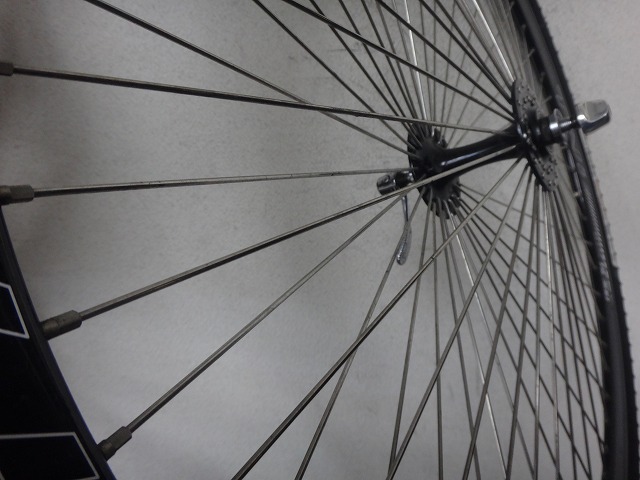
with brass nipples,
and the actual measured weight is 1160g.
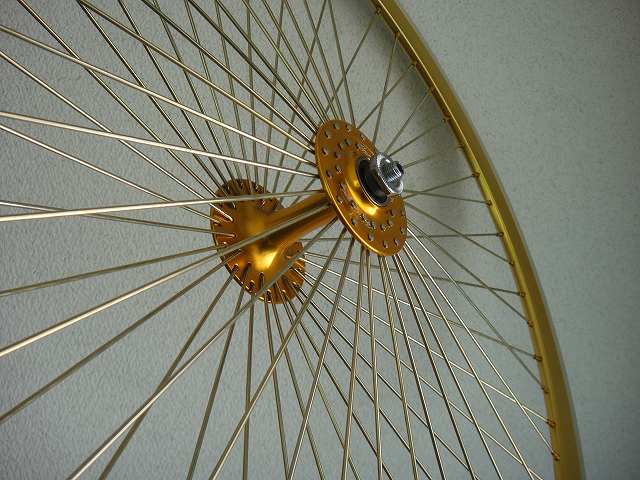
The version with a gold rim and gold aluminum nipples
that we sold in the past
weighs 1118g.
Both use Gran Compe large flange front hubs,
which aren't particularly light hubs.
As for the measured weight difference between
the FX 3's stock wheels and the Zonda DB,
the FX 3 wheel has a 6-bolt rotor mount with bolts only,
includes rim tape, and is weighed without rotor and sprocket.
The Zonda DB doesn't need rim tape to begin with,
and is weighed without rotor, rotor lockring, and sprocket.


↑Front wheel before/after


↑Rear wheel before/after
The original front wheel at 1071g
is deliberately built quite heavy—
comparable in weight to a rim brake front wheel.
The Zonda DB's stated weight is
in the same condition as my measured weight,
and according to the manufacturer's site,
both wheels combined are 1675g—
just a rough figure—but since the specs haven't changed
since its 2019 debut, I checked the original catalog
and found front wheel 786g and rear wheel 889g.
Adding those gives 1675g,
so the stated weight hasn't changed.
The Sirocco DB, which came out after the Zonda DB,
has a list price of 99,000 yen (before tax)
compared to the Zonda DB's 109,000 yen—just a 10,000 yen difference.
Instead of the Zonda DB's C17 WO rim,
it uses a C19 2WAY-FIT rim, which is more on-trend,
but the big difference is that the hub is not cup-and-cone.
What's confusing is that in the old days,
cup-and-cone hubs used the higher-spec freebody,
while cartridge bearing hubs used the lower-spec freebody—
a clear distinction.
But the Sirocco DB uses a higher-tier freebody,
so in Shimano spec it comes with a white aluminum freebody.

The front fork dropouts have a slot oriented forward
for removing the front wheel forward.
That's fine, but

the right fork end is a round hole with no slot,

and the left fork end has a threaded part with an anti-rotation cutout
bolted in place.

The quick-release part is only this section,
using a specification called TrhuSkew (Through Skew).
Compared to a normal quick-release setup,
this mimics a 5mm thru-axle-like clamping method to reduce
variances in how the disc brake sits,
probably for that reason, but

when I lever the quick-release closed fairly firmly,
the phase ends up around 2 o'clock when viewed from the right,
pointing forward—which isn't safe.
I haven't disassembled the left fork end part,
but it seems the thread-start phase can't be adjusted,
so since having the lever pointing that direction is risky,
I position it to close around 10 o'clock,
between the fork blade and the mudguard stay.
Given that the lever cam feel is fairly stiff in the image above,
I couldn't advance it a full 8 hours of thread rotation—
instead I backed it off 4 hours to reach the 10 o'clock position.
The disc rotor is a 6-bolt style for Shimano resin pads,
so it can't be mounted directly onto the Zonda DB's center-lock hub.
I could use a 6-bolt to center-lock adapter, but
sometimes the adapter costs more than the rotor itself, and
if I switch to a center-lock rotor next time,
the adapter becomes unnecessary.
So I considered getting a new rotor, but
for various reasons I went with the adapter this time.
By the way, the rotor's 6-bolt hole area shape
interferes with the Campagnolo wheel's
external lockring—which has a male thread on the hub side—
at the thread section, so
even with a rotor adapter,
it can't be mounted as-is.
How I dealt with it is a story for another meal-time chat.
Products Mentioned in This Article
- 🛒 Continental Grand Prix 5000 tire
- 🛒 Campagnolo Zonda DB wheel
- 🛒 Bontrager H2 Comp tire
- 🛒 Gran Compe large flange front hub
* Amazon affiliate links — prices may vary
Original Japanese post: のむラボ日記 #7039