Another day of wheel building (et cetera)... but first.

↑This is the rear wheel I rebuilt yesterday.
In the article, I initially called this Cosmic Pro Carbon SL "UST,"
but it turned out these front and rear wheels
were not tubeless Road UST wheels.

The cosmetics on the rim have "Cosmic" written in huge letters
at three locations spaced 120° apart.


↑A while back, there was a case where I reused the hub and spokes from UST wheels
with a different rim of the same height and iridescent nipples.
The cosmetics on this rim are extremely simple.
The tire also has a yellow triangle in one location that's meant to align
with a yellow line on the rim.
Regarding why things turned out this way—
the manufacturer hasn't admitted it, but
I have a reason I'm pretty sure about.
When Road UST tubeless first came out,
the initial tubeless tires that fit it
had a very loose fit to the rim,
so loose that the manufacturer emphasized
even weak-handed people wouldn't need tire levers—
they made a point of how easy it was to handle.
That was definitely intentional,
but something must have gone wrong because
the tires from the second generation onward
became extremely difficult to remove.
I wondered at the time if the wheel dimensions had changed,
but that wouldn't make sense,
and since second-gen tires fit poorly on wheels that had first-gen tires,
it's certain the tires changed, not the wheels.
So when you tried to mount second-gen tires to the rim,
the tire bead wouldn't seat properly,
and you'd frequently get a phenomenon where the tire lever
would slide across and scratch the rim sidewall.

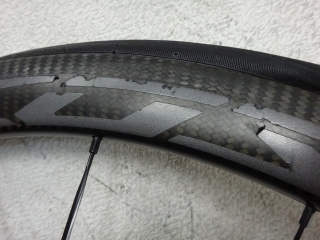
↑These are photos of a different wheel, but
you could see rim sidewall stickers peeling and falling apart all around
becoming a widespread problem.
This is what I think caused the rim sidewall cosmetics
to become so simplified.
By the way, the current tire is third-generation.
The third gen isn't quite as loose as the first,
but it's been made easy enough to mount and dismount
that an amateur can handle a puncture out on the road.
With the second gen, there were stories—I've heard several—
about people getting stranded when a puncture happened in the mountains
because they couldn't get the tire off, so they had to call a tow truck.
(They used the free roadside assistance that comes with car insurance,
available a few times a year.)
Anyway, back to building wheels.

Rebuilding the front wheel.


The spokes are rusted heavily—
when you rub your finger on them, rust powder comes off.
Actually, spokes this rusty are considered to be at lower risk
for spoke neck breakage,
but that doesn't mean most people would accept this condition.
A while back, I rebuilt a wheel reusing the hub and spokes
with a Mavic-equivalent rim of the same height
and iridescent nipples,
and those spokes had slight rust on them too.
I still reused the spokes because
the hub and spokes of this wheel are
inseparably linked.
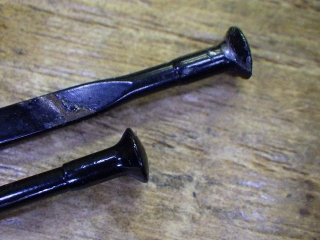
This is an image from the article about
the rear wheel with simple cosmetics
(looking at it now, yeah, it's pretty rusty).
Even with Mavic, on Cosmic-series wheels,
the final section below the spoke neck on straight spokes
is butted to #13 (2.3mm),
and this reduces spoke neck breakage risk.
But the fit at the hub flange catch
doesn't seem to match #14 (2.0mm),
so wheels with #13 butted spoke necks
possibly can't be serviced with standard straight spokes.
The parts I wrote in red are things
I haven't been able to confirm definitively, but

I tested it this time.

...It didn't work.
The custom spoke doesn't give that satisfying "click" fit
with a #14 neck straight spoke.
While it's not impossible to build a wheel,
I can't build a wheel good enough to hand to a customer.
We have a fixed-gear hub on deposit for the rear,
and the plan was to either reuse the front hub if possible,
or have our shop source some kind of 18H hub.

Oh, unrelated to today's work,
but here's an image of the front hub's bearing area.
We currently have a Ksyrium Pro on deposit with various issues,
and I'll reference this image when working on that.

↑This is an image of the rear rim by itself.
I mentioned before that the two dots next to the valve hole
indicate a rear rim, but
they also contain information about rim orientation.
Aluminum Ksyrium and R-SYS rims are offset rims,
so you can't get the sides mixed up,
but on this rear rim, the upper side of the image is the freewheel side.
There's a straight ridge running down the center of the rim—
like a burr—and
subtly, the holes on the non-freewheel side,
where the spoke angle is more reclined,
are positioned further from the ridge.
This isn't just on one side; it's true for all the holes.
If this were an aluminum rim with Zicral spoke holes,
and one side was tangential and one side radial,
there'd be such strong directionality
you couldn't possibly mix up the sides.
(Since tangential-radial sides are opposite on Ksyrium vs. R-SYS,
it might technically be possible to build a wheel intentionally wrong—
say, a Ksyrium hub with an R-SYS rim with reversed offset.)
But with hole spacing differences this small on the Cosmic rim,
it is possible to build the wheel with the rim sides reversed.

So here's the front rim for today.
Since it's a front wheel with no ochos,
the hole spacing is symmetrical left and right, but


both hole sets are offset such that the rim's ridge
becomes tangential, and they're offset even further outboard
than the non-freewheel side of the rear rim.
This kind of fine work in custom design
for each hub's flange width is hard to appreciate
unless you know what to look for.
This rim is 18H, but hypothetically if it were 20H or 24H,
and you tried to build a rear wheel using a rear hub with the same hole count,
you could do it.
The broad tolerance range from the spherical-joint-like shape
at the base of generic nipples makes that possible.

Built it.

They'll supply 18H front hubs
but skip 28H rear hubs and only offer 24H and 32H—
660 hub, 18H, black CX Sprint outpoke radial,
with black aluminum nipples.
This time I happened to get the chance to weigh
the front and rear rims of the same Cosmic Pro Carbon,
both UST versions,
but with only a small sample size
and possible weight loss on the UST front rim,
I can't say for certain, but
it's possible that the tubeless conversion
didn't actually make the rim heavier.
Of course I'm not going to tell you the specific weights though.
↑man this guy's kind of annoying

Thanks for waiting! please view this image!

the non-UST front rim!

the non-UST rear rim!


so you don't have to dig through past articles
i've added these references!
the front and rear rims of the new Cosmic Road UST!
↑stop pls!

↑This is the rear wheel I rebuilt yesterday.
In the article, I initially called this Cosmic Pro Carbon SL "UST,"
but it turned out these front and rear wheels
were not tubeless Road UST wheels.

The cosmetics on the rim have "Cosmic" written in huge letters
at three locations spaced 120° apart.
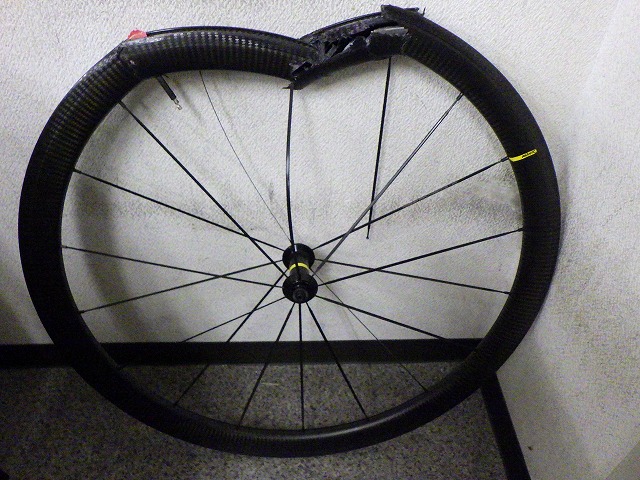

↑A while back, there was a case where I reused the hub and spokes from UST wheels
with a different rim of the same height and iridescent nipples.
The cosmetics on this rim are extremely simple.
The tire also has a yellow triangle in one location that's meant to align
with a yellow line on the rim.
Regarding why things turned out this way—
the manufacturer hasn't admitted it, but
I have a reason I'm pretty sure about.
When Road UST tubeless first came out,
the initial tubeless tires that fit it
had a very loose fit to the rim,
so loose that the manufacturer emphasized
even weak-handed people wouldn't need tire levers—
they made a point of how easy it was to handle.
That was definitely intentional,
but something must have gone wrong because
the tires from the second generation onward
became extremely difficult to remove.
I wondered at the time if the wheel dimensions had changed,
but that wouldn't make sense,
and since second-gen tires fit poorly on wheels that had first-gen tires,
it's certain the tires changed, not the wheels.
So when you tried to mount second-gen tires to the rim,
the tire bead wouldn't seat properly,
and you'd frequently get a phenomenon where the tire lever
would slide across and scratch the rim sidewall.
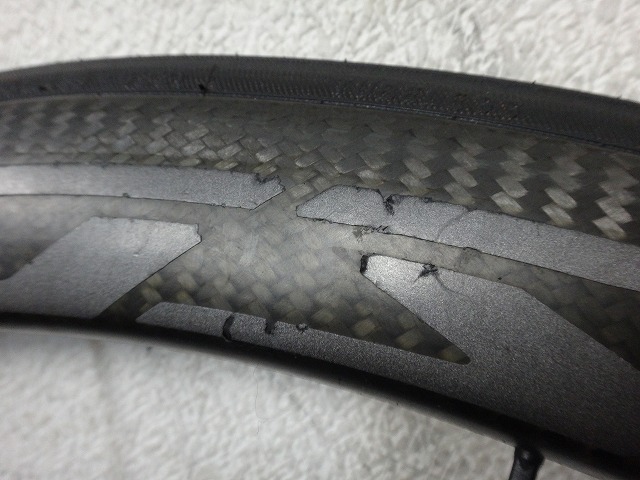
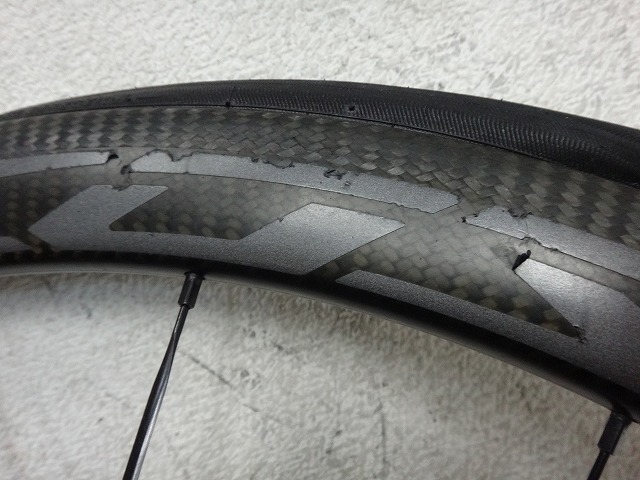
↑These are photos of a different wheel, but
you could see rim sidewall stickers peeling and falling apart all around
becoming a widespread problem.
This is what I think caused the rim sidewall cosmetics
to become so simplified.
By the way, the current tire is third-generation.
The third gen isn't quite as loose as the first,
but it's been made easy enough to mount and dismount
that an amateur can handle a puncture out on the road.
With the second gen, there were stories—I've heard several—
about people getting stranded when a puncture happened in the mountains
because they couldn't get the tire off, so they had to call a tow truck.
(They used the free roadside assistance that comes with car insurance,
available a few times a year.)
Anyway, back to building wheels.

Rebuilding the front wheel.


The spokes are rusted heavily—
when you rub your finger on them, rust powder comes off.
Actually, spokes this rusty are considered to be at lower risk
for spoke neck breakage,
but that doesn't mean most people would accept this condition.
A while back, I rebuilt a wheel reusing the hub and spokes
with a Mavic-equivalent rim of the same height
and iridescent nipples,
and those spokes had slight rust on them too.
I still reused the spokes because
the hub and spokes of this wheel are
inseparably linked.
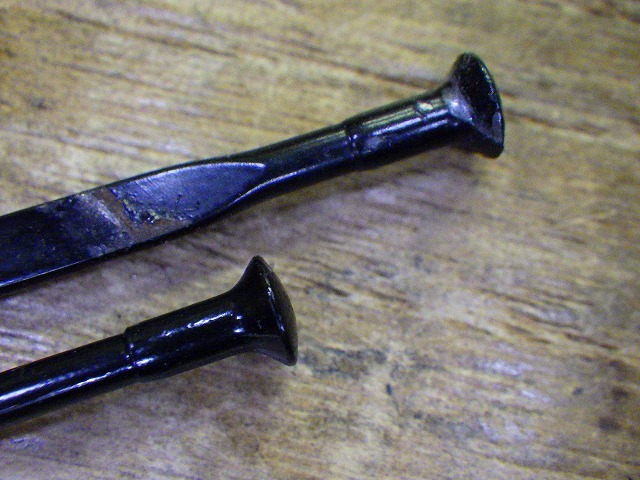
This is an image from the article about
the rear wheel with simple cosmetics
Even with Mavic, on Cosmic-series wheels,
the final section below the spoke neck on straight spokes
is butted to #13 (2.3mm),
and this reduces spoke neck breakage risk.
But the fit at the hub flange catch
doesn't seem to match #14 (2.0mm),
so wheels with #13 butted spoke necks
possibly can't be serviced with standard straight spokes.
The parts I wrote in red are things
I haven't been able to confirm definitively, but

I tested it this time.

...It didn't work.
The custom spoke doesn't give that satisfying "click" fit
with a #14 neck straight spoke.
While it's not impossible to build a wheel,
I can't build a wheel good enough to hand to a customer.
We have a fixed-gear hub on deposit for the rear,
and the plan was to either reuse the front hub if possible,
or have our shop source some kind of 18H hub.

Oh, unrelated to today's work,
but here's an image of the front hub's bearing area.
We currently have a Ksyrium Pro on deposit with various issues,
and I'll reference this image when working on that.

↑This is an image of the rear rim by itself.
I mentioned before that the two dots next to the valve hole
indicate a rear rim, but
they also contain information about rim orientation.
Aluminum Ksyrium and R-SYS rims are offset rims,
so you can't get the sides mixed up,
but on this rear rim, the upper side of the image is the freewheel side.
There's a straight ridge running down the center of the rim—
subtly, the holes on the non-freewheel side,
where the spoke angle is more reclined,
are positioned further from the ridge.
This isn't just on one side; it's true for all the holes.
If this were an aluminum rim with Zicral spoke holes,
and one side was tangential and one side radial,
there'd be such strong directionality
you couldn't possibly mix up the sides.
(Since tangential-radial sides are opposite on Ksyrium vs. R-SYS,
it might technically be possible to build a wheel intentionally wrong—
say, a Ksyrium hub with an R-SYS rim with reversed offset.)
But with hole spacing differences this small on the Cosmic rim,
it is possible to build the wheel with the rim sides reversed.

So here's the front rim for today.
Since it's a front wheel with no ochos,
the hole spacing is symmetrical left and right, but


both hole sets are offset such that the rim's ridge
becomes tangential, and they're offset even further outboard
than the non-freewheel side of the rear rim.
This kind of fine work in custom design
for each hub's flange width is hard to appreciate
unless you know what to look for.
This rim is 18H, but hypothetically if it were 20H or 24H,
and you tried to build a rear wheel using a rear hub with the same hole count,
you could do it.
The broad tolerance range from the spherical-joint-like shape
at the base of generic nipples makes that possible.

Built it.

They'll supply 18H front hubs
but skip 28H rear hubs and only offer 24H and 32H—
660 hub, 18H, black CX Sprint outpoke radial,
with black aluminum nipples.
This time I happened to get the chance to weigh
the front and rear rims of the same Cosmic Pro Carbon,
both UST versions,
but with only a small sample size
and possible weight loss on the UST front rim,
I can't say for certain, but
it's possible that the tubeless conversion
didn't actually make the rim heavier.
Of course I'm not going to tell you the specific weights though.
↑man this guy's kind of annoying

Thanks for waiting! please view this image!

the non-UST front rim!

the non-UST rear rim!


so you don't have to dig through past articles
i've added these references!
the front and rear rims of the new Cosmic Road UST!
↑stop pls!