Another day with wheels (and so on).
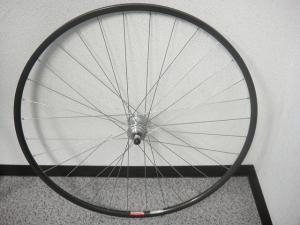
Built a wheel with a Campagnolo boss freewheel hub.
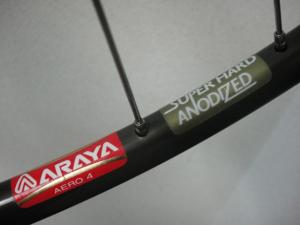
This is a 32-hole Aero 4, and it's in excellent condition despite being new.
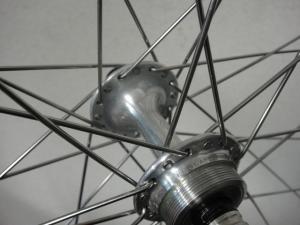
Since it's a radial 4-cross lacing throughout, I'd like to say there's minimal left-right tension difference in the spokes—but that's not actually the biggest factor creating this feel.
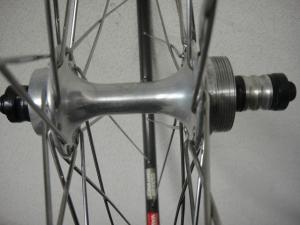
It's an older hub, so there's minimal dish (offset). From the right flange edge to the center of the overall hub is about 22mm.
With a 9-speed Dura-Ace 7700 freewheel hub it's 20.8mm, and with a 105 5500 from the same era it's 21.1mm, but that 1-2mm difference is huge.
With 11-speed hubs, you see many under 19mm—like 18.7mm or 18.9mm—but from my personal experience, when you drop below 20mm the balance gets really tricky to nail.
Even if I built this boss hub wheel with 6-cross lacing on both sides, it would still have better left-right balance than the 4-cross or 4-8 lacing patterns I typically use with 11-speed compatible hubs.
This is actually headwind for hand-built wheels, and I have to admit that pre-designed factory-built wheels with specially engineered hubs are currently superior in this regard. My desperate efforts at hand-building, even when successful, only manage to approach the left-right balance of wheels from over 20 years ago.
Unlike factory wheels, hand-built wheels do have the advantage of being able to "push the limits" by selecting rims and spokes according to individual preference—but that's about it.
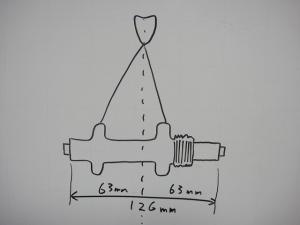
This hub has an over-locknut dimension of 126mm. What I'm about to write has nothing to do with this particular wheel.
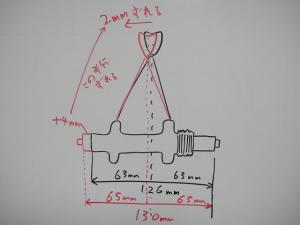
To fit a 126mm hub into a 130mm frame, you swap the axle and add 4mm of spacers. Since adjusting the right side affects shifting trim, you add the 4mm to the left instead, and the rim shifts left by exactly half that amount.
When you build a wheel with a hub like this, the left-right balance is incredibly good. In the sense of "the flange width hasn't changed at all, but the dish is different," it has the same effect as an offset rim. The correction you get is way beyond what high-low flange differences can achieve.
Changing flange diameter by 1-2mm won't show a noticeable difference when you feel the wheel, but change the dish amount by 2mm and it's totally different.
It's the downside of multi-speed, so to speak—a tradeoff. Of course, when weighing increased dish against adding one or two more cogs, the extra gears are what matters for winning and losing races.
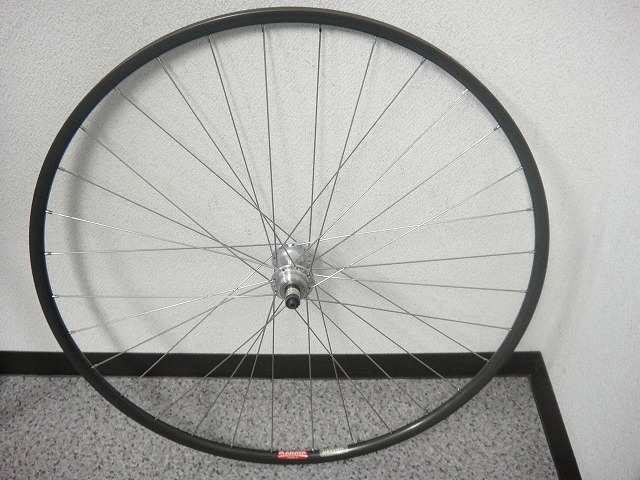
Built a wheel with a Campagnolo boss freewheel hub.
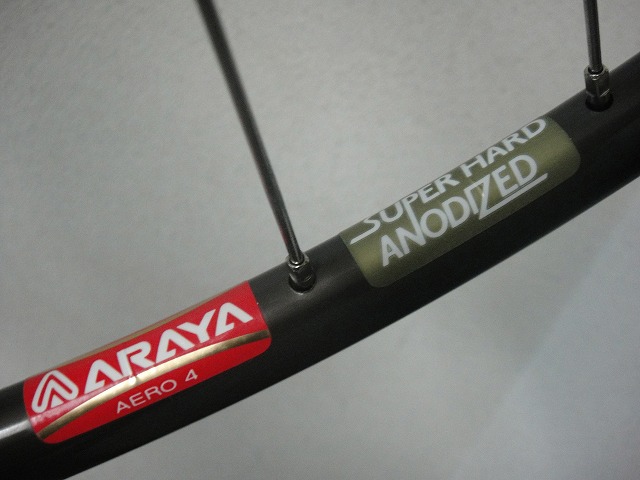
This is a 32-hole Aero 4, and it's in excellent condition despite being new.
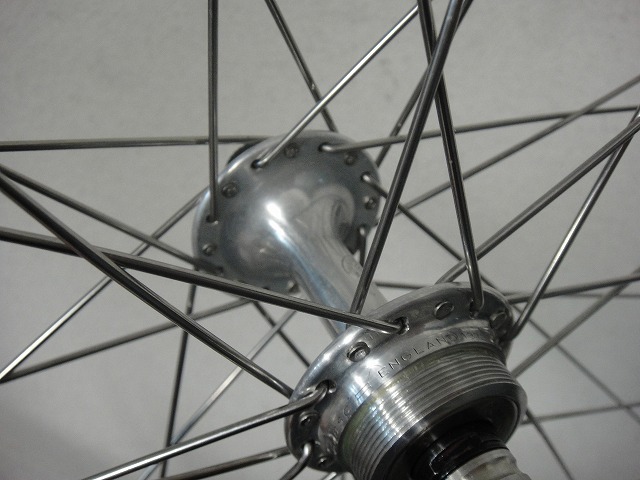
Since it's a radial 4-cross lacing throughout, I'd like to say there's minimal left-right tension difference in the spokes—but that's not actually the biggest factor creating this feel.
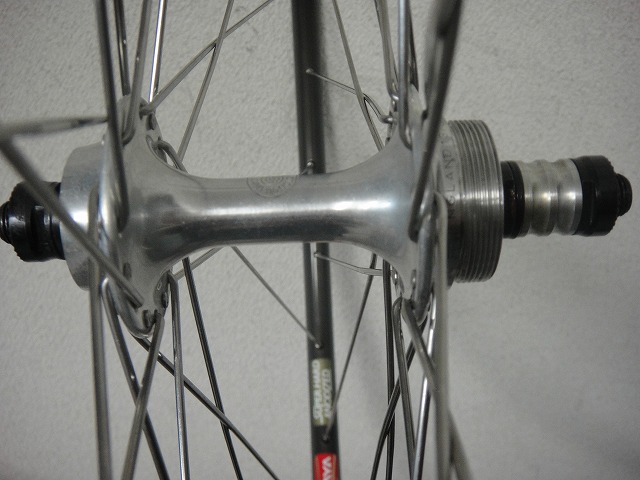
It's an older hub, so there's minimal dish (offset). From the right flange edge to the center of the overall hub is about 22mm.
With a 9-speed Dura-Ace 7700 freewheel hub it's 20.8mm, and with a 105 5500 from the same era it's 21.1mm, but that 1-2mm difference is huge.
With 11-speed hubs, you see many under 19mm—like 18.7mm or 18.9mm—but from my personal experience, when you drop below 20mm the balance gets really tricky to nail.
Even if I built this boss hub wheel with 6-cross lacing on both sides, it would still have better left-right balance than the 4-cross or 4-8 lacing patterns I typically use with 11-speed compatible hubs.
This is actually headwind for hand-built wheels, and I have to admit that pre-designed factory-built wheels with specially engineered hubs are currently superior in this regard. My desperate efforts at hand-building, even when successful, only manage to approach the left-right balance of wheels from over 20 years ago.
Unlike factory wheels, hand-built wheels do have the advantage of being able to "push the limits" by selecting rims and spokes according to individual preference—but that's about it.

This hub has an over-locknut dimension of 126mm. What I'm about to write has nothing to do with this particular wheel.
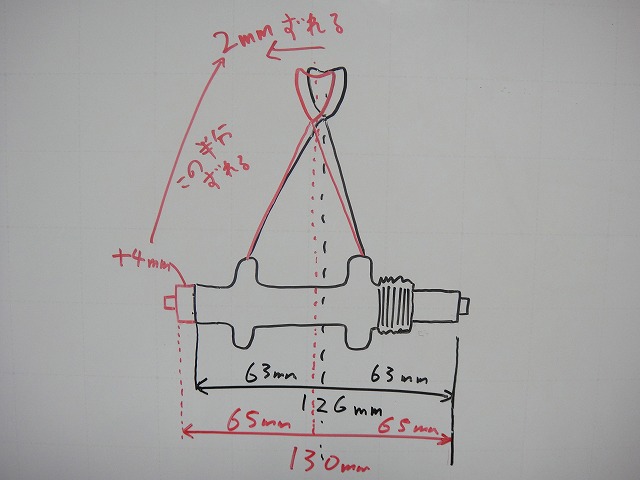
To fit a 126mm hub into a 130mm frame, you swap the axle and add 4mm of spacers. Since adjusting the right side affects shifting trim, you add the 4mm to the left instead, and the rim shifts left by exactly half that amount.
When you build a wheel with a hub like this, the left-right balance is incredibly good. In the sense of "the flange width hasn't changed at all, but the dish is different," it has the same effect as an offset rim. The correction you get is way beyond what high-low flange differences can achieve.
Changing flange diameter by 1-2mm won't show a noticeable difference when you feel the wheel, but change the dish amount by 2mm and it's totally different.
It's the downside of multi-speed, so to speak—a tradeoff. Of course, when weighing increased dish against adding one or two more cogs, the extra gears are what matters for winning and losing races.