I received a Mavic Ksyrium Elite S on consignment.
Brand new.

As usual, I checked for runout and centering.
Since this is a model with tires installed, I had to remove the tire before I could use the centering gauge.
(Our shop has three centering gauges, and while some can measure with tires on,
their accuracy is questionable so I don't use them much)
The front wheel was basically done after just removing the tire and applying the centering gauge.
Hardly any runout correction was needed. This one was spot-on.
The rear wheel had some centering issues—the rim was pulled quite far toward the non-drive side.
In situations like this, you deal with it by either tightening the drive side or loosening the non-drive side,
and I mainly handled it by tightening the drive side a bit more.
It would actually be preferable if the rim pull were in the opposite direction.
The Ksyrium Elite is unusual for a complete wheel in that the spokes are woven at their crossing points.
With black spokes, if they're round or even aero-profiled like the CX-RAY with a rugby-ball cross-section,
the crossing points make point contact and can create squeaking noises when you manipulate the spokes,
but the spokes on this wheel are quite flat and have surface contact,
so you don't get any squeaking even when you grab the spokes.

While I had the tire off, I cleaned out the machining debris.

While reinstalling the tire, I wrapped tape around the valve area.
The valve hole is larger than the outer diameter of the tube valve
(to the point where it's "greater than" rather than "approximately equal"),
so if you grab the valve and shake it back and forth it rattles.
This can cause a "click" or "shush" sound once per wheel rotation during actual riding,
so I wrap it with tape to prevent the noise.
Campagnolo and Fulcrum carbon wheels have plastic parts installed to suppress this,
but most wheels don't, so I use this method.
You could also use a locknut, but that can sometimes leave marks or scratches on the rim,
and in this valve's case the threads aren't cut anyway so you can't use a locknut.
This tape is "3M Transpore Surgical Tape."
Vinyl tape is too thick and the adhesive gets weird and shifts,
masking tape is still slightly too thick, and I've tried various other options,
but this turned out to be the best solution.
This used to be a Meshinotane cord tip, but not anymore.
If you're having trouble with noise at this point, please give it a try.
The trick is to wrap it "as thickly as possible while keeping the tape unpeeled and the valve fitting straight through the hole,"
and it just so happens that exactly one wrap of this tape is usually perfect—
any thicker tape won't work as well.
Brand new.
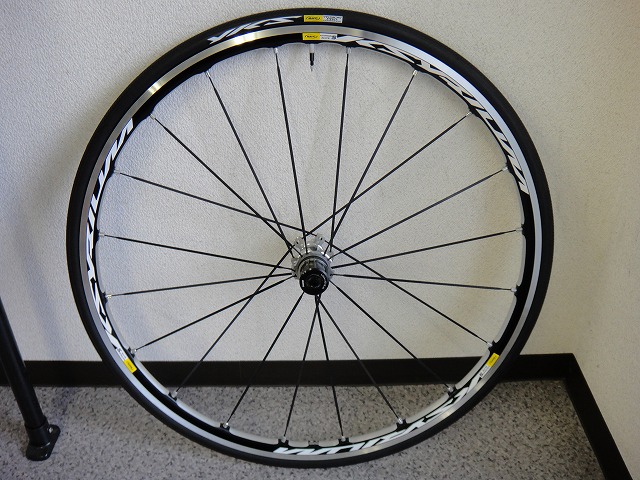
As usual, I checked for runout and centering.
Since this is a model with tires installed, I had to remove the tire before I could use the centering gauge.
(Our shop has three centering gauges, and while some can measure with tires on,
their accuracy is questionable so I don't use them much)
The front wheel was basically done after just removing the tire and applying the centering gauge.
Hardly any runout correction was needed. This one was spot-on.
The rear wheel had some centering issues—the rim was pulled quite far toward the non-drive side.
In situations like this, you deal with it by either tightening the drive side or loosening the non-drive side,
and I mainly handled it by tightening the drive side a bit more.
It would actually be preferable if the rim pull were in the opposite direction.
The Ksyrium Elite is unusual for a complete wheel in that the spokes are woven at their crossing points.
With black spokes, if they're round or even aero-profiled like the CX-RAY with a rugby-ball cross-section,
the crossing points make point contact and can create squeaking noises when you manipulate the spokes,
but the spokes on this wheel are quite flat and have surface contact,
so you don't get any squeaking even when you grab the spokes.
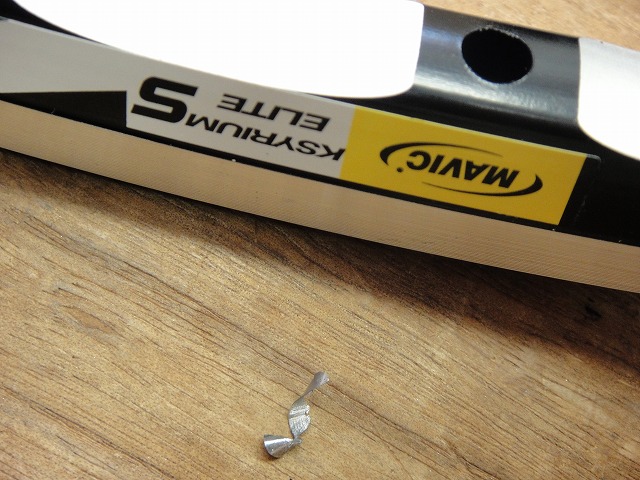
While I had the tire off, I cleaned out the machining debris.
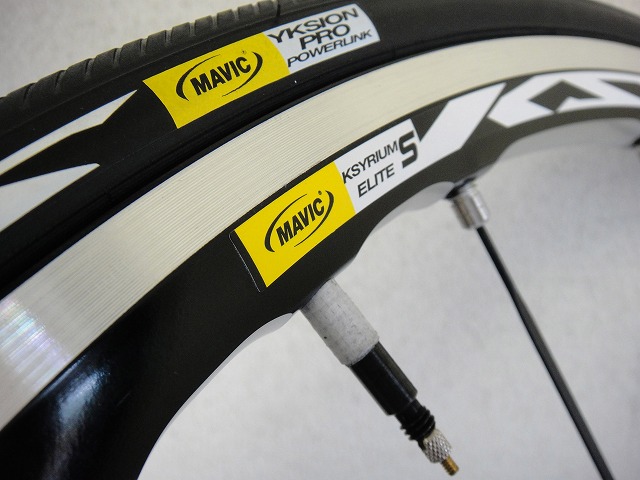
While reinstalling the tire, I wrapped tape around the valve area.
The valve hole is larger than the outer diameter of the tube valve
(to the point where it's "greater than" rather than "approximately equal"),
so if you grab the valve and shake it back and forth it rattles.
This can cause a "click" or "shush" sound once per wheel rotation during actual riding,
so I wrap it with tape to prevent the noise.
Campagnolo and Fulcrum carbon wheels have plastic parts installed to suppress this,
but most wheels don't, so I use this method.
You could also use a locknut, but that can sometimes leave marks or scratches on the rim,
and in this valve's case the threads aren't cut anyway so you can't use a locknut.
This tape is "3M Transpore Surgical Tape."
Vinyl tape is too thick and the adhesive gets weird and shifts,
masking tape is still slightly too thick, and I've tried various other options,
but this turned out to be the best solution.
This used to be a Meshinotane cord tip, but not anymore.
If you're having trouble with noise at this point, please give it a try.
The trick is to wrap it "as thickly as possible while keeping the tape unpeeled and the valve fitting straight through the hole,"
and it just so happens that exactly one wrap of this tape is usually perfect—
any thicker tape won't work as well.