Looking at a Dura-Ace 12-speed sprocket, I started wondering:
if you kept increasing sprocket size in 1-tooth increments without limit,
what would happen to the ridge line formed by the sprocket teeth tips?

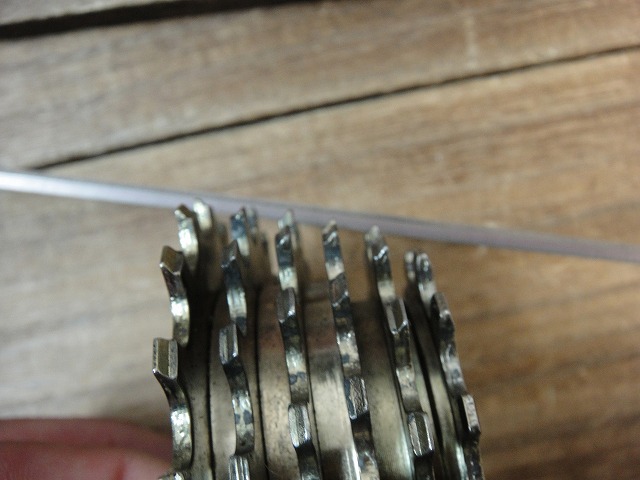
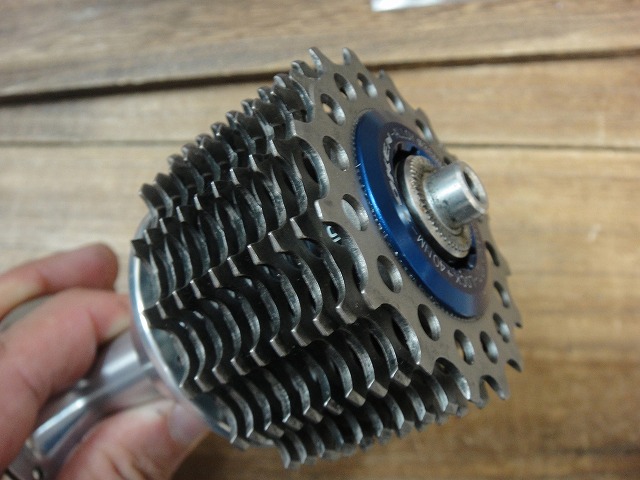
↑12-speed sprocket (when using front double)
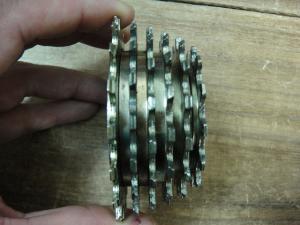
The tooth counts are 13-15-16-17-18-19T.
It's unusual to skip a cog on the smallest side,
but there is a reason for it. I won't write about it though.
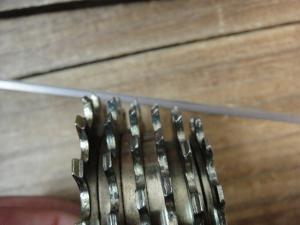
Anyway, from 15T to 19T it's a 1-tooth skip pattern,
and the point I want to explore is that connecting the tooth tips
forms a straight line (or so I thought).
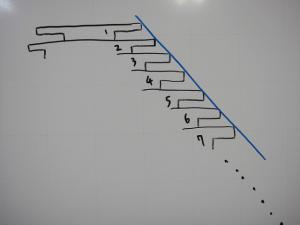
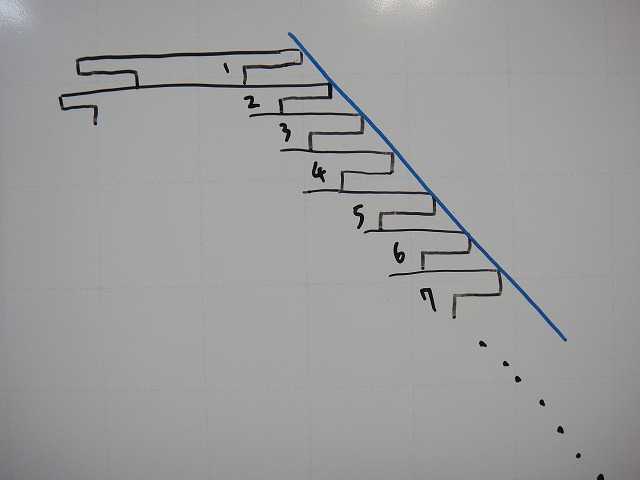
The diagram above only goes up to the 7th stage, but the line connecting the tooth tips
(the blue line) should remain straight no matter how large the sprocket grows.
Let's say a gear has a thickness of 1.65mm and a spacer has a thickness of 2.35mm.
Combined, that's 4mm. At 250000T, you'd hit exactly 1000000mm,
which is 1000m tall. If you don't like ending with a spacer,
250001T would give you 1000001.65mm instead.
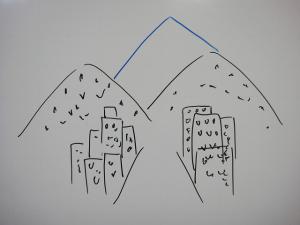
If such a 1000-meter-tall sprocket suddenly appeared in the city,
what would it look like?
I think it would look like a pyramid as shown in the drawing above,
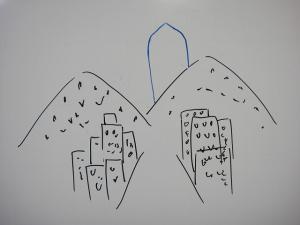
but some people insist it would look like a tower instead.
Whether it would actually take that shape at 1000m is debatable,
but apparently it will eventually adopt some tower-like form. Is that really true?
First, about sprocket tooth tips.
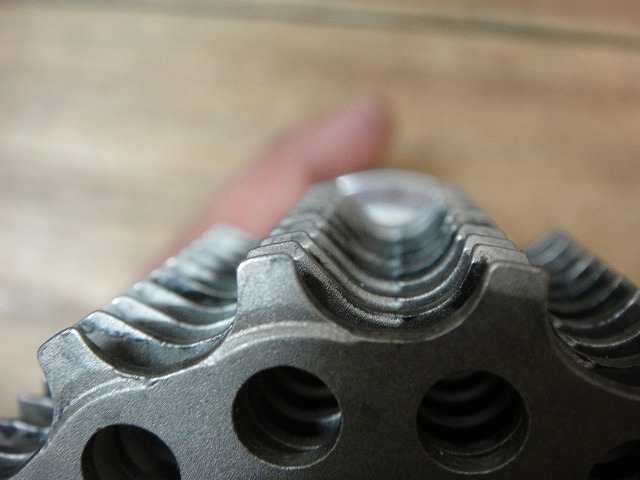
Sprocket teeth are machined for smooth shifting,
so the distance to the tooth tip isn't constant.
In the case of SRAM, the tooth design itself has a gap equivalent to 1 tooth.
This makes it impossible to define the tooth tip position consistently.
So let me define what I mean by "tooth tip" here.
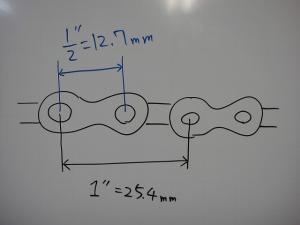
Whether it's a chain for a cruiser bike or an 11-speed chain,
the center-to-center distance of chain rollers is fixed.
Two links = 1 inch (25.4mm), one link = 1/2 inch (12.7mm).
~Tangent~

Long ago, there was a Dura-Ace 10 fixed-gear component set,

and this is its sprocket removal tool. The "10" comes from the fact that
the chain pitch is 10mm.

Compared to 12.7mm pitch, it's completely different.
These exceptions do exist.
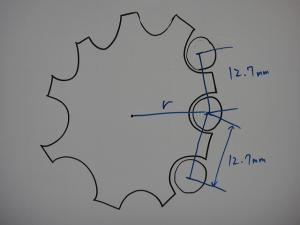
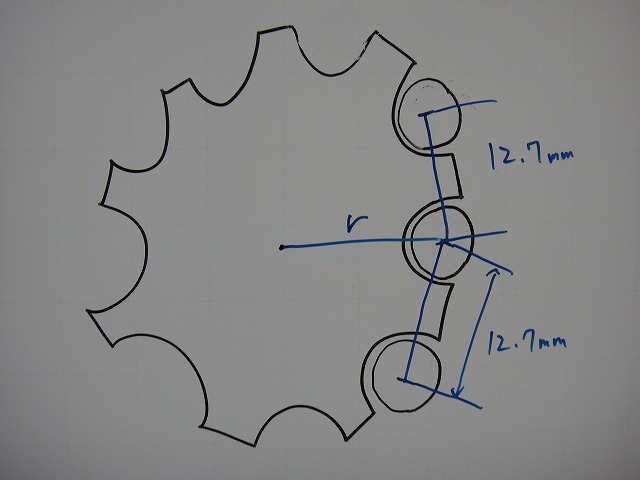
↑Please ignore how roughly the diagram is drawn (laugh).
The diagram above shows a 9-tooth sprocket, but when the chain rollers
fall cleanly between sprocket teeth, if you connect the roller centers with a line,
you get a regular n-gon for an n-tooth sprocket.
Here I define the vertices of this regular n-gon as the "tooth tips."
The distance r from the sprocket center to a vertex
is what I call the "distance to tooth tip."

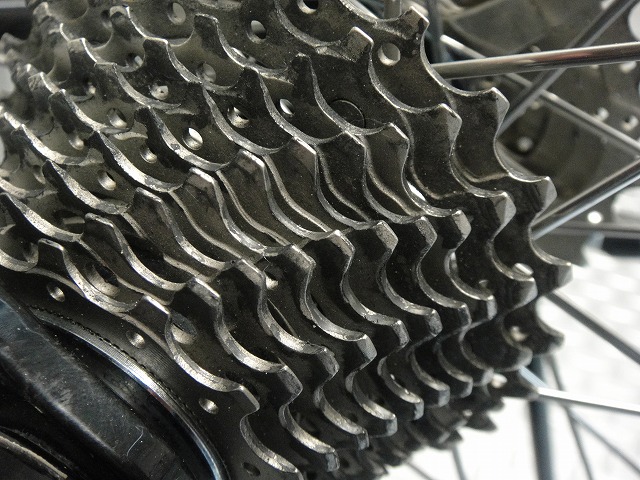
Multi-cog sprockets shift the tooth tip phase slightly as they progress
to improve shifting performance.

For this analysis, I'll assume that as sprockets multiply,
the phase is aligned at one location.
~Another tangent~
If someone asks you: "What's the most cross-ratio tooth count
for a Shimano 10-speed?"
How would you answer? 12-21T?
That might be the correct answer, but consider

16-16-16-16-16-16-16-16-16-16T
This combination also exists.

It's earned the nicknames "Corn of Death" and "Facial Device of Death."
(I just made those up)

While studying it for a different reason than it was built for,
I discovered something.

When tooth tip phases are aligned, shifting becomes terribly bad.
I think part of this is because the adjacent cog is the same size, but
the rear derailleur's slant angle is surprisingly extreme with this setup.
Now, before moving to verification, let me present the argument from
the "it becomes tower-shaped" camp:
The front gear can be any tooth count, but
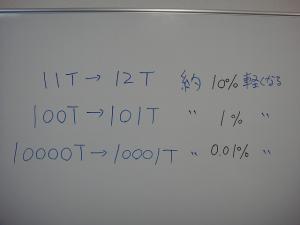
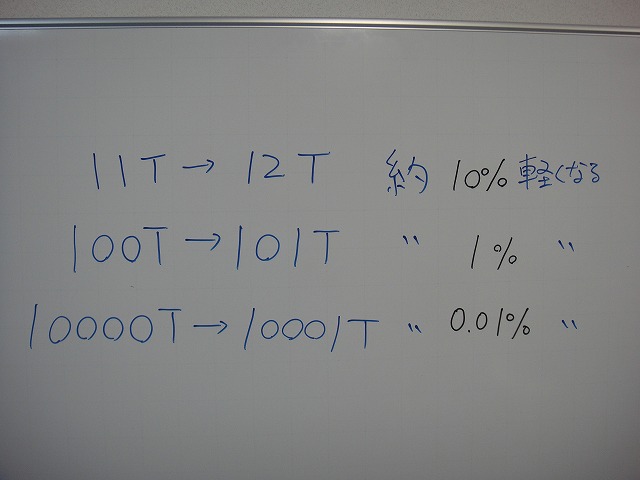
when shifting the rear from 11T to 12T, it gets about 10% easier.
Even with a 1-tooth shift, if it were 100T to 101T,
it only gets about 1% easier.
Further, with 10000T to 10001T,
it only gets about 0.01% easier.
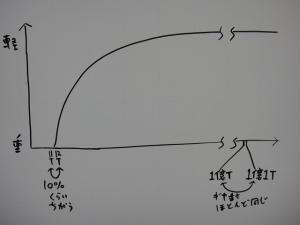
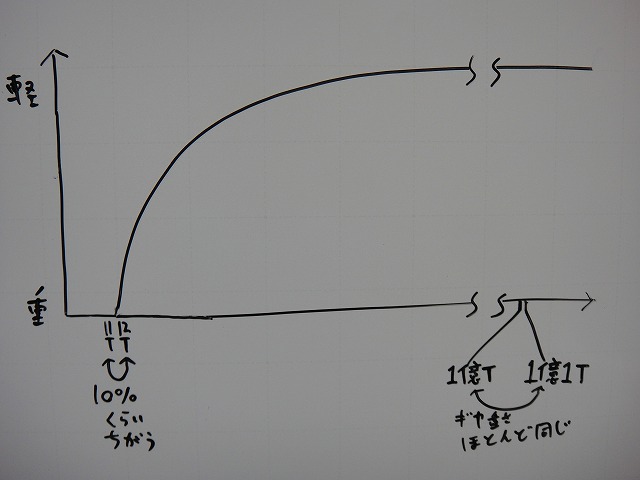
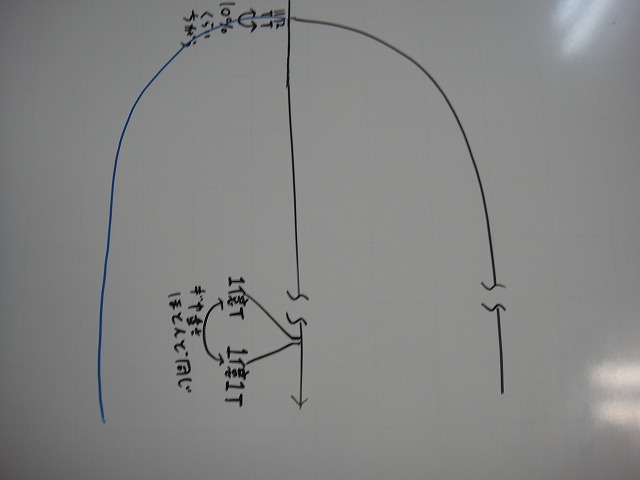
If you graph gear ease like this,
even shifting from 100 million teeth to 100 million and 1 tooth
barely changes the gear ratio.
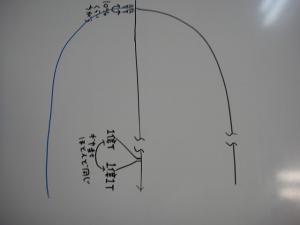
Draw a line mirror-symmetric to that curve and stand it up—
this shape, they claim, is what a sprocket looks like when it has
a sufficiently large number of teeth.
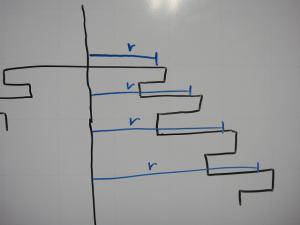
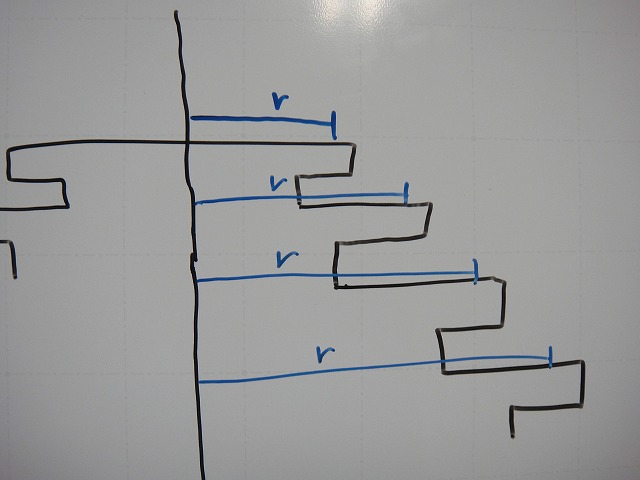
Now I've plotted the newly defined "distance to tooth tip r."
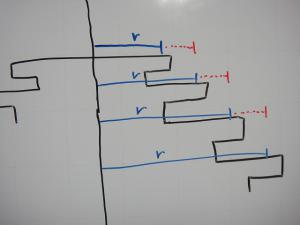
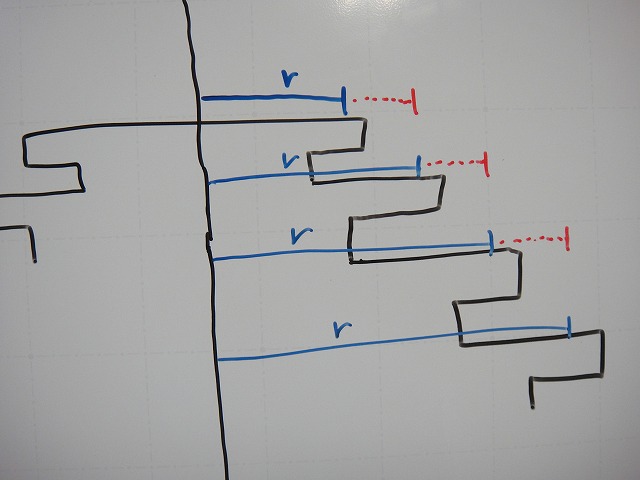
So I just need to compare the difference between r for n-tooth
and r for (n+1)-tooth (the red dashed line in the diagram above).
If the shape becomes tower-like, then for sufficiently large n,
the difference (r for (n+1)T) – (r for nT) should approach zero.
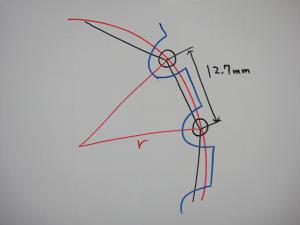
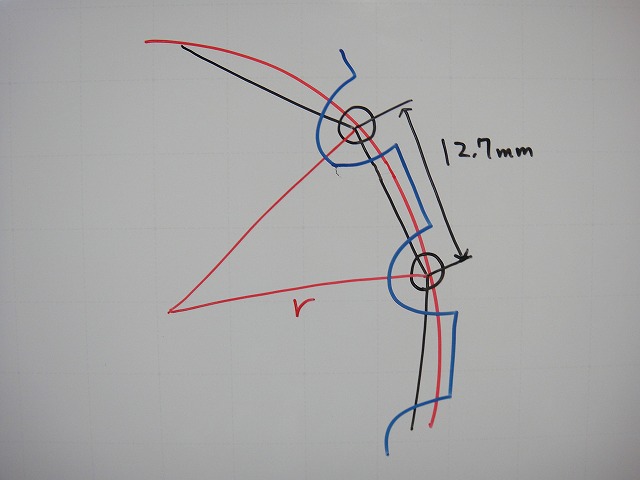
The tooth tips—defined as the centers of chain rollers—
form a regular polygon when connected.
If the circumradius of this regular polygon is r
and the side length is 12.7mm (let's call it a), then
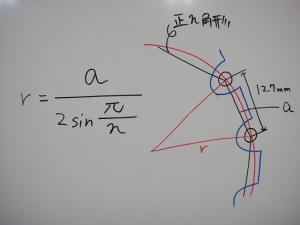
↑You can calculate r using this formula.
Below, I'll calculate the difference in r between n and n+1 teeth (in mm).
When n = 11:
11T r: 22.539106113
12T r: 24.534515199
Difference: 1.995409986
When n = 12:
12T r: 24.534515199
13T r: 26.533992233
Difference: 1.999476334
When n = 13:
13T r: 26.533992233
14T r: 28.536640497
Difference: 2.002648464
Hmm? The numbers aren't the same... which means
at least the ridge line isn't straight.
Next, let me plug in much larger numbers for n.
When n = 10,000:
10,000T r: 20212.678105115
10,001T r: 20214.699372289
Difference: 2.021267774
When n = 1 trillion:
1 trillion T r: 202121267777267.070764626
1 trillion 1 T r: 202121267777269.092032004
Difference: 2.021267778
...Now I'm getting somewhere.
The r growth between 10,000T and 10,001T is nearly identical
to the r growth between 1 trillion and 1 trillion+1.
What converges to zero isn't r itself—it's the difference in r
between n-tooth and (n+1)-tooth as n gets very large.
And since there's one difference value for each tooth count (each slightly different),
the ridge line isn't perfectly straight, but it looks nearly straight.
When tooth counts are small, the n to n+1 difference is large,
but this difference gets larger the further the regular polygon is from being a circle.
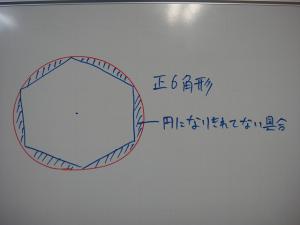
↑A 6-tooth count doesn't exist, but between a regular hexagon and its
circumscribed circle there's "surplus area not yet a circle."
The larger this surplus area, the larger the difference becomes
between r for n-tooth and r for (n+1)-tooth.
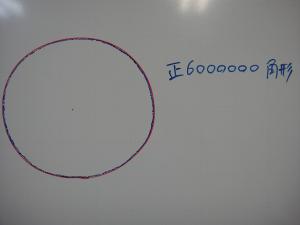
↑This is labeled as a regular 6-million-gon, but at this point it's practically a circle.
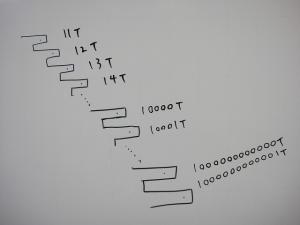
Since the r growth around 10,000T is nearly the same as around 1 trillion T,
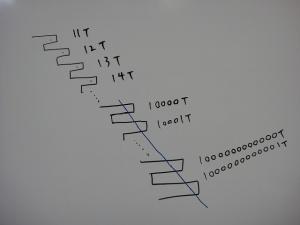
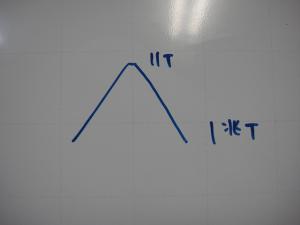
I'll draw a straight line from the 10,000T tooth tip to the 1 trillion+1 tooth tip.
This isn't the true ridge line, but it approximates it well.
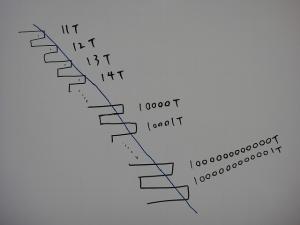
If you extend that line all the way to the top gear,
exaggerated as it is, it looks something like this.
Still, if someone tells me
"1 trillion T isn't large enough,"
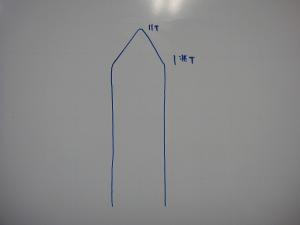
"Eventually, far beyond 1 trillion T, it will tower-ify,"
then...
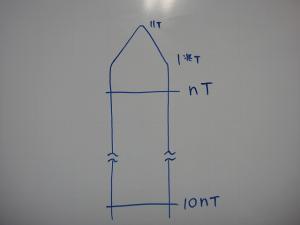
Assuming the r growth per tooth eventually converges to zero,
imagine a sufficiently large tooth count n where the growth is nearly zero.
The position of 10n-tooth is about 10 times the height from 11T to n-tooth,
but think about it: "The chain pitch is fixed at 12.7mm,
and even though the tooth count differs by a factor of 10,
the outer diameter of the gear is nearly the same? That doesn't make sense."
Once you think about it that way, it becomes clear the shape won't become tower-like.
You could have just said that from the start, I know,
but calculating r wasn't wasted effort for me—I initially thought
the tooth tip ridge was a straight line.
if you kept increasing sprocket size in 1-tooth increments without limit,
what would happen to the ridge line formed by the sprocket teeth tips?

↑12-speed sprocket (when using front double)
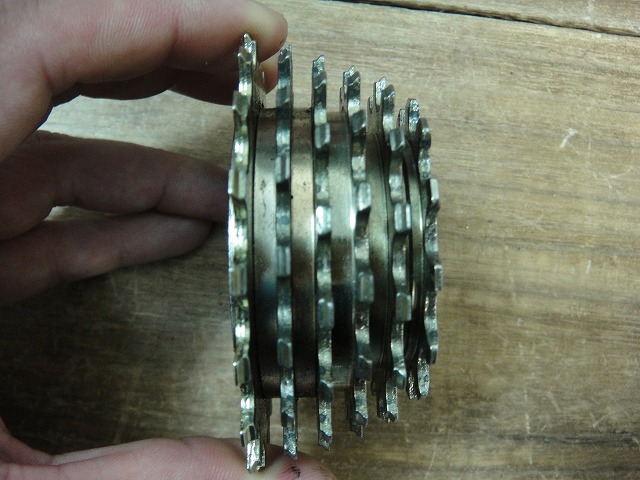
The tooth counts are 13-15-16-17-18-19T.
It's unusual to skip a cog on the smallest side,
but there is a reason for it. I won't write about it though.
Anyway, from 15T to 19T it's a 1-tooth skip pattern,
and the point I want to explore is that connecting the tooth tips
forms a straight line (or so I thought).
The diagram above only goes up to the 7th stage, but the line connecting the tooth tips
(the blue line) should remain straight no matter how large the sprocket grows.
Let's say a gear has a thickness of 1.65mm and a spacer has a thickness of 2.35mm.
Combined, that's 4mm. At 250000T, you'd hit exactly 1000000mm,
which is 1000m tall. If you don't like ending with a spacer,
250001T would give you 1000001.65mm instead.

If such a 1000-meter-tall sprocket suddenly appeared in the city,
what would it look like?
I think it would look like a pyramid as shown in the drawing above,

but some people insist it would look like a tower instead.
Whether it would actually take that shape at 1000m is debatable,
but apparently it will eventually adopt some tower-like form. Is that really true?

First, about sprocket tooth tips.
Sprocket teeth are machined for smooth shifting,
so the distance to the tooth tip isn't constant.
In the case of SRAM, the tooth design itself has a gap equivalent to 1 tooth.
This makes it impossible to define the tooth tip position consistently.
So let me define what I mean by "tooth tip" here.

Whether it's a chain for a cruiser bike or an 11-speed chain,
the center-to-center distance of chain rollers is fixed.
Two links = 1 inch (25.4mm), one link = 1/2 inch (12.7mm).
~Tangent~

Long ago, there was a Dura-Ace 10 fixed-gear component set,

and this is its sprocket removal tool. The "10" comes from the fact that
the chain pitch is 10mm.

Compared to 12.7mm pitch, it's completely different.
These exceptions do exist.
↑Please ignore how roughly the diagram is drawn (laugh).
The diagram above shows a 9-tooth sprocket, but when the chain rollers
fall cleanly between sprocket teeth, if you connect the roller centers with a line,
you get a regular n-gon for an n-tooth sprocket.
Here I define the vertices of this regular n-gon as the "tooth tips."
The distance r from the sprocket center to a vertex
is what I call the "distance to tooth tip."
Multi-cog sprockets shift the tooth tip phase slightly as they progress
to improve shifting performance.

For this analysis, I'll assume that as sprockets multiply,
the phase is aligned at one location.
~Another tangent~
If someone asks you: "What's the most cross-ratio tooth count
for a Shimano 10-speed?"
How would you answer? 12-21T?
That might be the correct answer, but consider

16-16-16-16-16-16-16-16-16-16T
This combination also exists.
It's earned the nicknames "Corn of Death" and "Facial Device of Death."
(I just made those up)

While studying it for a different reason than it was built for,
I discovered something.
When tooth tip phases are aligned, shifting becomes terribly bad.
I think part of this is because the adjacent cog is the same size, but
the rear derailleur's slant angle is surprisingly extreme with this setup.
Now, before moving to verification, let me present the argument from
the "it becomes tower-shaped" camp:
The front gear can be any tooth count, but
when shifting the rear from 11T to 12T, it gets about 10% easier.
Even with a 1-tooth shift, if it were 100T to 101T,
it only gets about 1% easier.
Further, with 10000T to 10001T,
it only gets about 0.01% easier.
If you graph gear ease like this,
even shifting from 100 million teeth to 100 million and 1 tooth
barely changes the gear ratio.
Draw a line mirror-symmetric to that curve and stand it up—
this shape, they claim, is what a sprocket looks like when it has
a sufficiently large number of teeth.
Now I've plotted the newly defined "distance to tooth tip r."
So I just need to compare the difference between r for n-tooth
and r for (n+1)-tooth (the red dashed line in the diagram above).
If the shape becomes tower-like, then for sufficiently large n,
the difference (r for (n+1)T) – (r for nT) should approach zero.
The tooth tips—defined as the centers of chain rollers—
form a regular polygon when connected.
If the circumradius of this regular polygon is r
and the side length is 12.7mm (let's call it a), then
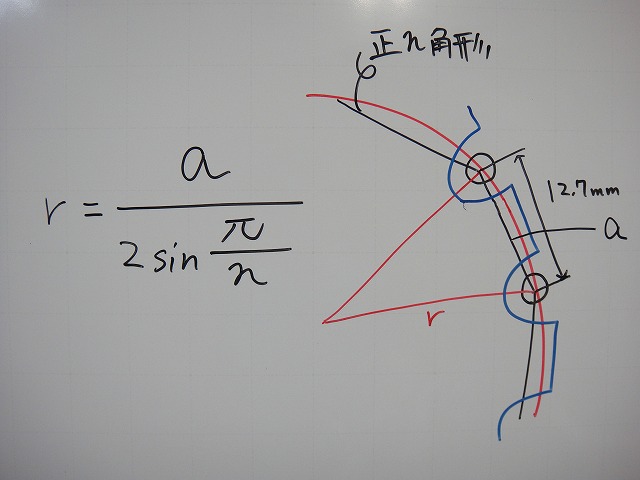
↑You can calculate r using this formula.
Below, I'll calculate the difference in r between n and n+1 teeth (in mm).
When n = 11:
11T r: 22.539106113
12T r: 24.534515199
Difference: 1.995409986
When n = 12:
12T r: 24.534515199
13T r: 26.533992233
Difference: 1.999476334
When n = 13:
13T r: 26.533992233
14T r: 28.536640497
Difference: 2.002648464
Hmm? The numbers aren't the same... which means
at least the ridge line isn't straight.
Next, let me plug in much larger numbers for n.
When n = 10,000:
10,000T r: 20212.678105115
10,001T r: 20214.699372289
Difference: 2.021267774
When n = 1 trillion:
1 trillion T r: 202121267777267.070764626
1 trillion 1 T r: 202121267777269.092032004
Difference: 2.021267778
...Now I'm getting somewhere.
The r growth between 10,000T and 10,001T is nearly identical
to the r growth between 1 trillion and 1 trillion+1.
What converges to zero isn't r itself—it's the difference in r
between n-tooth and (n+1)-tooth as n gets very large.
And since there's one difference value for each tooth count (each slightly different),
the ridge line isn't perfectly straight, but it looks nearly straight.
When tooth counts are small, the n to n+1 difference is large,
but this difference gets larger the further the regular polygon is from being a circle.
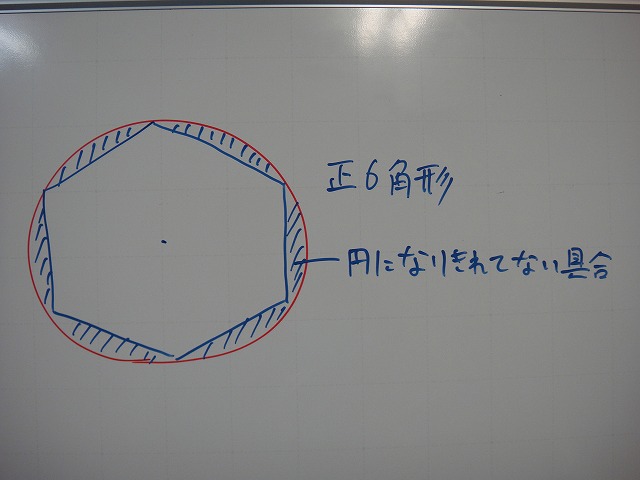
↑A 6-tooth count doesn't exist, but between a regular hexagon and its
circumscribed circle there's "surplus area not yet a circle."
The larger this surplus area, the larger the difference becomes
between r for n-tooth and r for (n+1)-tooth.
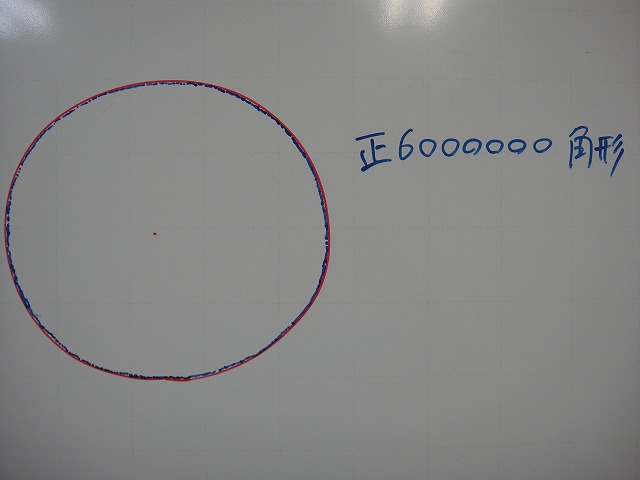
↑This is labeled as a regular 6-million-gon, but at this point it's practically a circle.

Since the r growth around 10,000T is nearly the same as around 1 trillion T,
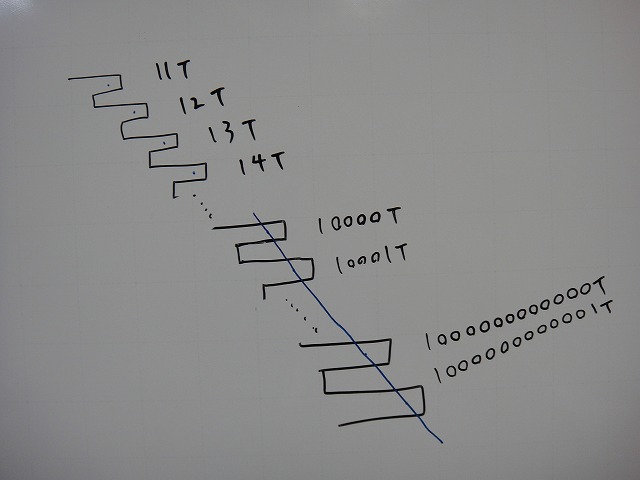
I'll draw a straight line from the 10,000T tooth tip to the 1 trillion+1 tooth tip.
This isn't the true ridge line, but it approximates it well.

If you extend that line all the way to the top gear,
exaggerated as it is, it looks something like this.
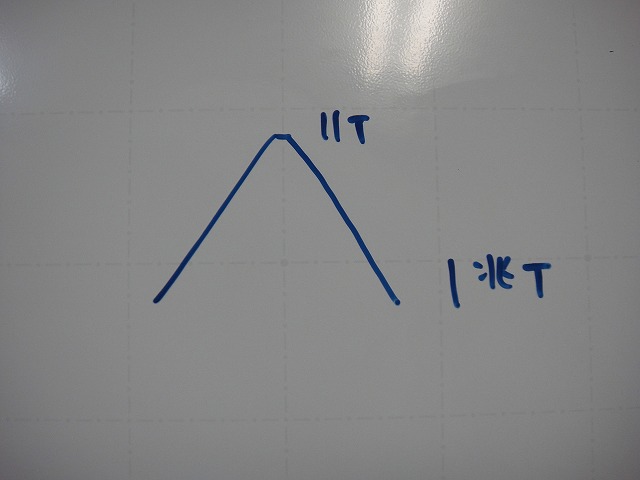
Still, if someone tells me
"1 trillion T isn't large enough,"
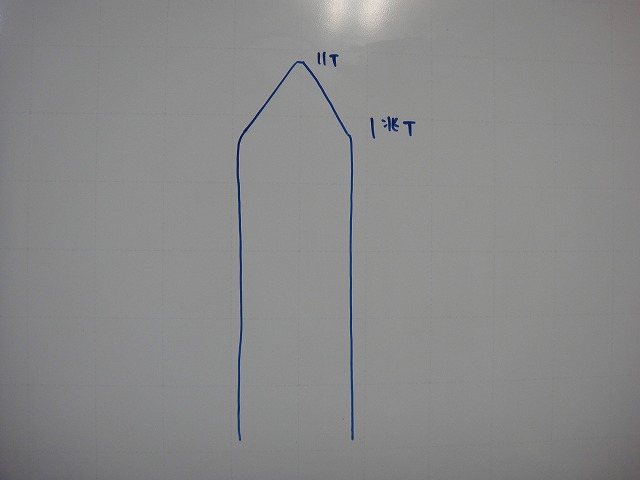
"Eventually, far beyond 1 trillion T, it will tower-ify,"
then...
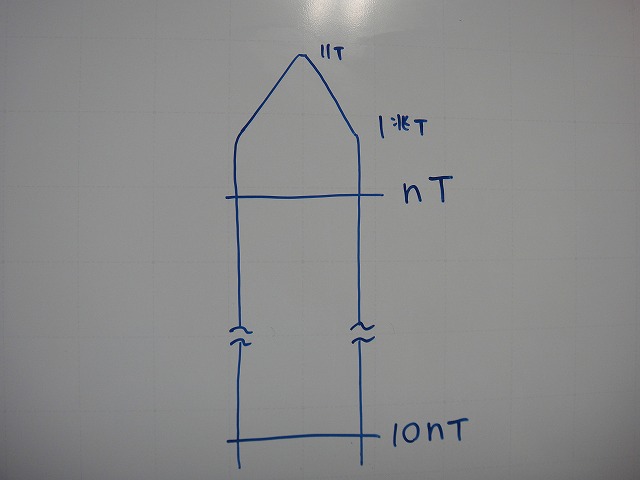
Assuming the r growth per tooth eventually converges to zero,
imagine a sufficiently large tooth count n where the growth is nearly zero.
The position of 10n-tooth is about 10 times the height from 11T to n-tooth,
but think about it: "The chain pitch is fixed at 12.7mm,
and even though the tooth count differs by a factor of 10,
the outer diameter of the gear is nearly the same? That doesn't make sense."
Once you think about it that way, it becomes clear the shape won't become tower-like.
You could have just said that from the start, I know,
but calculating r wasn't wasted effort for me—I initially thought
the tooth tip ridge was a straight line.
Products Mentioned in This Article
* Amazon affiliate links — prices may vary
Original Japanese post: のむラボ日記 #11