A customer recently mentioned that when they searched for "tooth engagement correction" (歯離れ修正), my blog came up in the results.
But I should clarify—"tooth engagement" (歯離れ) is actually a term I coined myself.
I'm not using a made-up word because I want to claim "I thought of this first!"
Rather, I couldn't find an existing word that properly describes this concept.
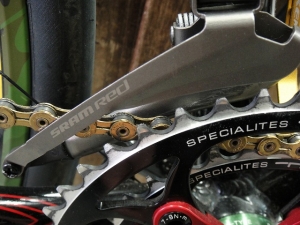
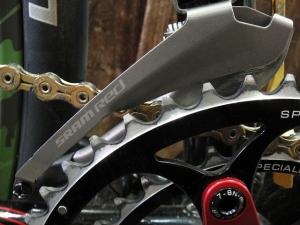
This time I adjusted the gap quite significantly.
The front derailleur mounting method isn't a direct-mount bracket, but rather
a "direct-mount derailleur + band clamp" setup.
I did a type of modification that wouldn't be possible with either "direct-mount derailleur + direct-mount bracket" or "band-type derailleur."
I made some minor adjustments to the derailleur cage itself,
but the main work was on the band clamp.
The chainring is 46T, and since I didn't modify the front derailleur itself that much,
if I were to use this same derailleur on a bike with a 53T outer ring later, there wouldn't be any issues.
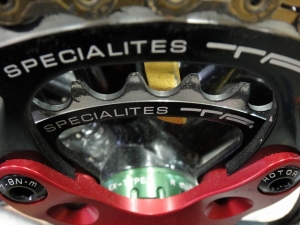
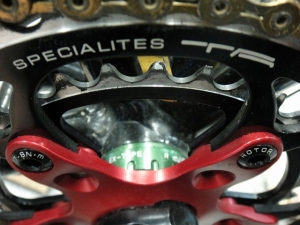
↑And another one.
I changed the phase of the inner chainring mounting position.
With chainrings other than those that come stock on component manufacturer cranksets,
the mounting position isn't necessarily set at the optimal phase.
The outer ring pin position was set up with a striking angle that makes it rise during the pedal stroke around top dead center on both sides, so I left that as-is.
But the phase of the five-hole inner ring
wasn't optimal relative to shifting to the outer ring,
so I repositioned it to a better location.
The method for determining this is the Meshinota code.
The modifications to the "track" where the chain runs on the back of the outer chainring,
the pin positions on the outer ring, and the phase difference between outer and inner rings—
I don't match these exactly to what component manufacturers do,
not for technical reasons, but rather due to patent-related issues.
But I should clarify—"tooth engagement" (歯離れ) is actually a term I coined myself.
I'm not using a made-up word because I want to claim "I thought of this first!"
Rather, I couldn't find an existing word that properly describes this concept.
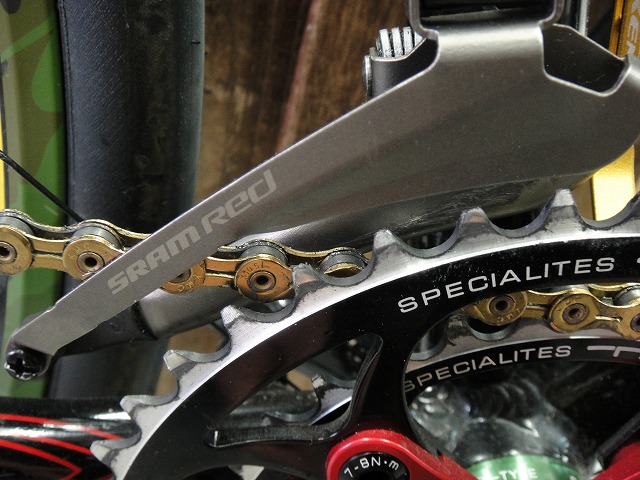
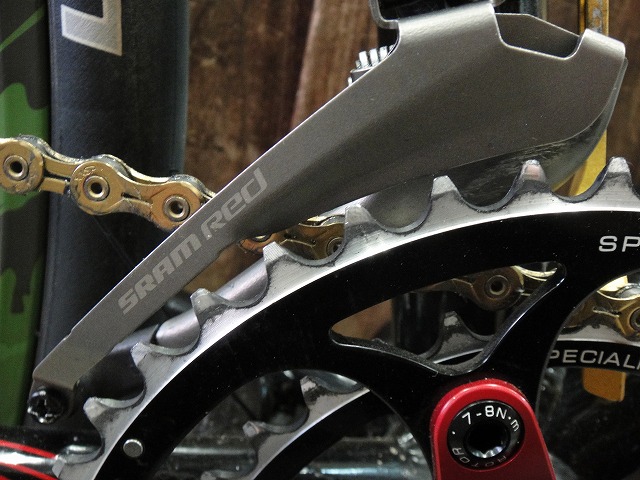
This time I adjusted the gap quite significantly.
The front derailleur mounting method isn't a direct-mount bracket, but rather
a "direct-mount derailleur + band clamp" setup.
I did a type of modification that wouldn't be possible with either "direct-mount derailleur + direct-mount bracket" or "band-type derailleur."
I made some minor adjustments to the derailleur cage itself,
but the main work was on the band clamp.
The chainring is 46T, and since I didn't modify the front derailleur itself that much,
if I were to use this same derailleur on a bike with a 53T outer ring later, there wouldn't be any issues.
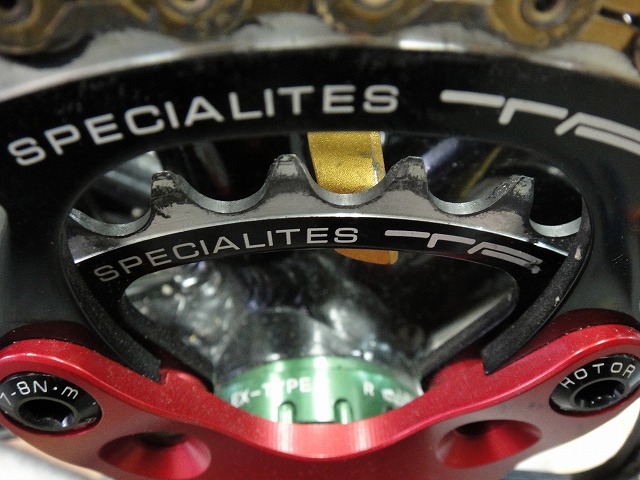
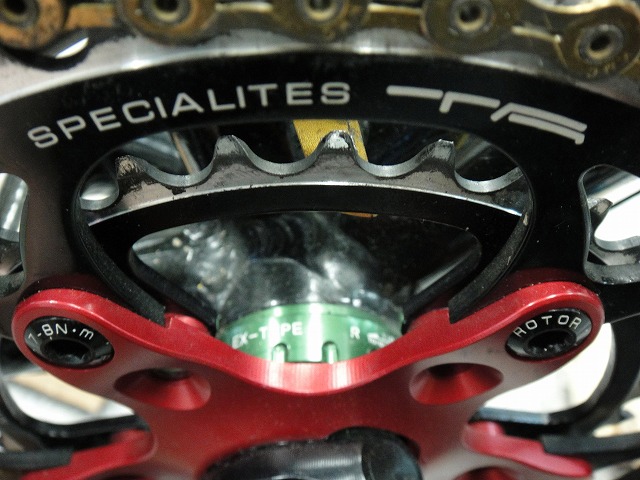
↑And another one.
I changed the phase of the inner chainring mounting position.
With chainrings other than those that come stock on component manufacturer cranksets,
the mounting position isn't necessarily set at the optimal phase.
The outer ring pin position was set up with a striking angle that makes it rise during the pedal stroke around top dead center on both sides, so I left that as-is.
But the phase of the five-hole inner ring
wasn't optimal relative to shifting to the outer ring,
so I repositioned it to a better location.
The method for determining this is the Meshinota code.
The modifications to the "track" where the chain runs on the back of the outer chainring,
the pin positions on the outer ring, and the phase difference between outer and inner rings—
I don't match these exactly to what component manufacturers do,
not for technical reasons, but rather due to patent-related issues.