I bought a Cat Eye high-brightness LED light called the "VOLT300".

VOLT300 is a pet name, with the model number HL-EL460RC, but
not many people call it that, so I'll refer to it as VOLT300 going forward.
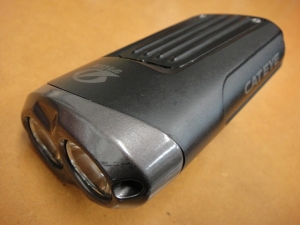
Originally I already own a Nanoshot Plus (HL-EL625RC),
but there were several reasons why I bought the VOLT300 anyway.
Before the Nanoshot Plus, I was using a battery-powered Econom Force model (HL-EL540)
and found it really useful for night training rides.
The battery lasted 2 hours on High / 9 hours on Low,
but with four AA batteries, if you had rechargeables on hand you could double the usage time,
or even without them you could just buy alkaline batteries at a convenience store.
The weakness of the Nanoshot Plus is its built-in battery with USB charging,
meaning "you can't charge it while out".
I did try all sorts of workarounds.
When I connected the Nanoshot Plus to my smartphone's fast charger,
the lamp that should normally glow red while charging would flash yellow instead.
According to the manual, this means "an appropriate charger is not connected".
My guess is that the charging voltage isn't sufficient.
Both the Nanoshot Plus and VOLT300 maintain constant brightness right up until the battery dies,
with no dimming beforehand.
The Econom Force manual mentions "constant voltage circuit included",
and Cat Eye's high-brightness LED lights from a certain era onward have this spec.
(You don't get that situation where "the filament just glows dimly as the battery runs out".)
This constant voltage design actually creates a problem: "it's hard to tell when it's about to die".
Because of the constant voltage circuit, when it goes, it cuts out suddenly like you flipped the switch off.
If this happens while descending a pitch-black mountain road, it's seriously dangerous.

↑ These are the Nanoshot Plus specs.
The battery barely lasted 2.5 hours on Low from a full charge anymore, so
I started thinking about replacing it.
The "Hyper Constant" mode mentioned in the features above is a type of flashing,
but rather than alternating between off and on,
it's a mode where brightness pulses while remaining constantly lit.
Regular flashing has a moment of darkness, and there's an interpretation question about whether
that counts as "headlight operation" under Japanese traffic law since it's not constantly on.
I think Cat Eye's intention with Hyper Constant is to say "this flashing is actually constant illumination",
to satisfy that legal requirement.
In city streets the light is too bright and looks like you're flashing cars,
and on pitch-black mountain roads the visibility actually gets worse,
so I don't use Hyper Constant.
Long press to ON/OFF, short press to toggle High/Low, double-click for Hyper Constant,
so it's convenient that there's no accidental mode-switching during normal use.
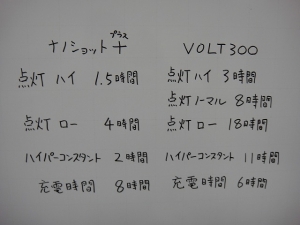
↑ Now the VOLT300 specs.
I don't use it so I left it off the chart, but there's also a "flashing 60 hours" mode.
Long press to ON/OFF is the same as Nanoshot Plus,
but short press cycles through High→Normal→Low→Hyper Constant→High,
and it's a bit annoying that Hyper Constant is stuck in that cycle.
Double-click from any mode switches to flashing.
As for actual brightness compared to the Nanoshot Plus...
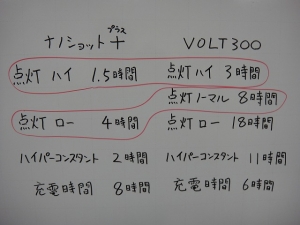
From my subjective observation, per light unit the brightness is roughly:
Nanoshot Plus High ≈ VOLT300 High,
Nanoshot Plus Low ≈ VOLT300 Normal.
The rated brightness on High is 600 lumens for Nanoshot Plus
and 300 lumens for VOLT300 (as the name suggests),
so it seems the Nanoshot Plus is like two VOLT300s placed side by side.
That tracks with the runtime specs too.
Though the Nanoshot Plus does take longer to charge.
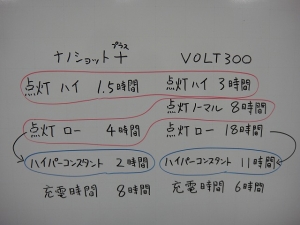
In Hyper Constant mode, the brightness during the dim part of the pulse
(the baseline constant brightness) on the Nanoshot Plus matches its Low setting,
while on VOLT300 it also matches its Low setting.
It's confusing that they both call it "Low" but the brightness is totally different.
Looking at the Hyper Constant runtime, this seems to be accurate.
Going back to what I said earlier, the VOLT300 manual includes this line:
"For nighttime riding, please use in constant light mode.
Under traffic law, flashing is limited to supplementary light use only."
But the Nanoshot Plus manual doesn't say this.
So it seems Cat Eye's interpretation is indeed that "Hyper Constant = constant illumination".
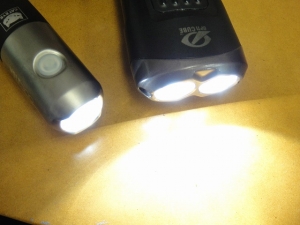
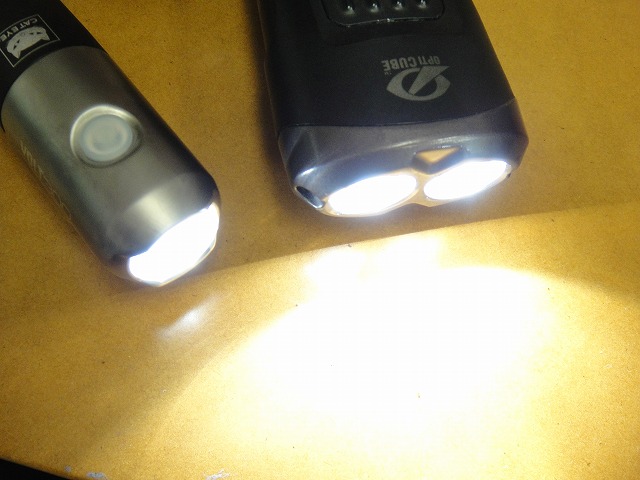
↑ Both lit on High. The brightness is about the same, but
the Nanoshot Plus light color is ever so slightly more yellow.
Cat Eye has made lights that tout "yellowish light color for better visibility than the actual candlepower",
but the Nanoshot Plus yellow isn't that pronounced.
Since I've been using it for about two years, that might have something to do with it,
so comparing new units they might be the same color.
One of my shop customers owns a Cat Eye Triple Shot (HL-EL700),
and recently got a VOLT300 too, but they said
on the dark Minoh mountain roads with no street lights,
the beam angle is too narrow to be useful when riding at night or early morning.
However, since the per-light brightness is about the same,
and the Triple Shot is the type where the battery hangs from the frame,
they acknowledge that the Nanoshot and VOLT systems have superior convenience
with no wiring and just sitting on the handlebar.
Hearing that, I'd been holding off on buying the VOLT300,
but the Nanoshot Plus battery capacity declined and I had to buy something,
so in the end I went with the VOLT300.
The Nanoshot Plus doesn't allow user battery replacement for reliability and safety reasons.
You have to send it to the manufacturer for replacement.
I considered swapping the battery, but
the main body has cracks in it so I gave up on that.
This was another reason to go with VOLT300.
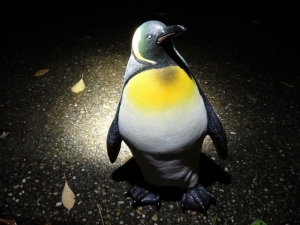
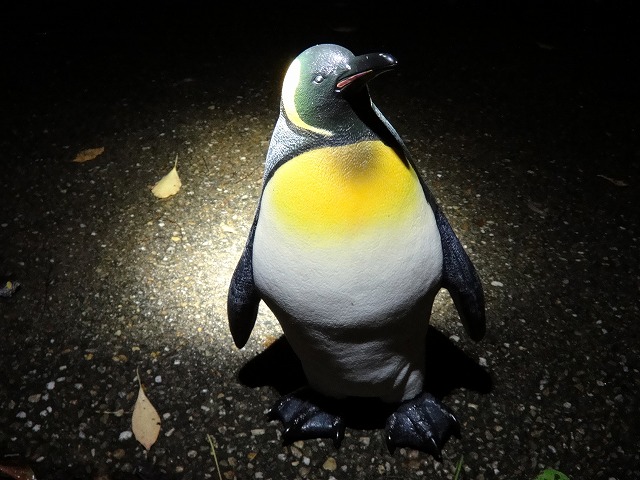
Sorry for the wait!

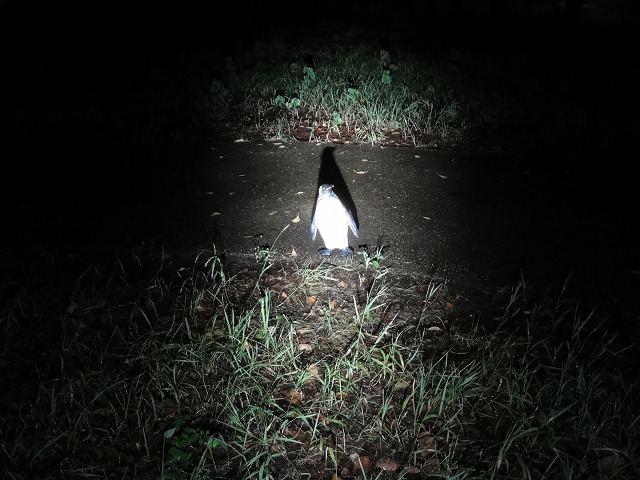
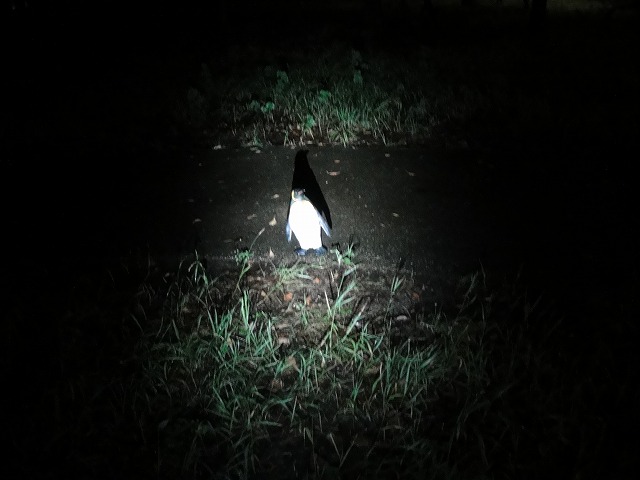
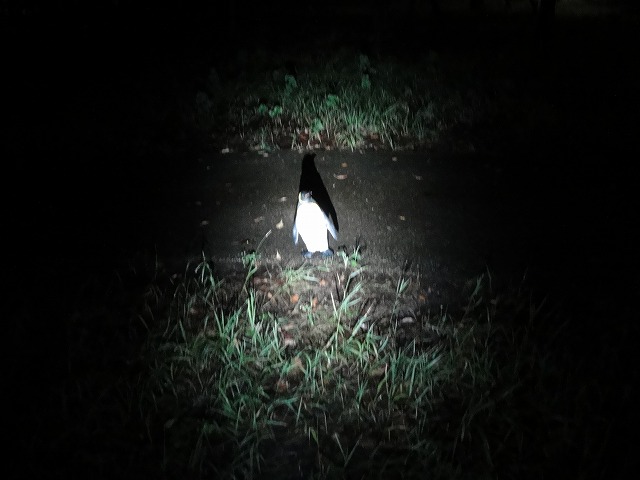
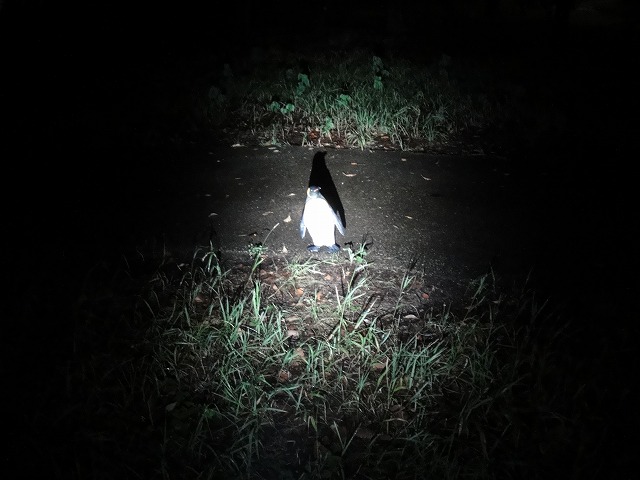
The white spot in the center is my friend.
Finding a completely dark place was a hassle.
I didn't use the camera flash; the bracket on the handlebar is
mounted at the same position and angle to compare lights fairly.
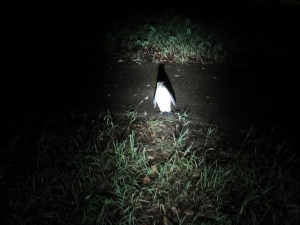
Nanoshot Plus — Low
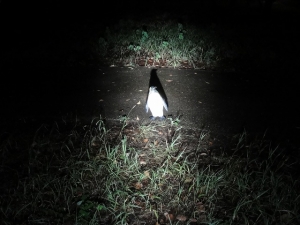
Nanoshot Plus — High

VOLT300 — Low
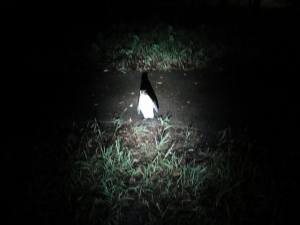
VOLT300 — Normal
(hard to tell from the images, but
VOLT300's Low is quite dim, totally different from Normal)

VOLT300 — High
Comparing the High modes side by side, you can see that
while the per-light brightness is about the same, the beam angle is completely different.
(The Econom Force beam angle is square rather than round. Details → here)
I hate cluttering up the handlebar with stuff,
so I don't even use those front hub quick-release light mount adapters.
Having the light on the handlebar lets me fiddle with it while riding
and adjust the beam angle up and down as needed.
In the image, the Nanoshot Plus's wide part is angled toward me,
but I use it like that on climbs, and angle it up a bit for descents.
Actually, the other day I did a night training ride
that went from Kiyotaki Pass into Nara Prefecture, south on Route 168,
and from the Moto-Yamakamiguchi Station area over Juso Pass back to Osaka,
and when descending Juso on the Osaka side I was too scared to trust the VOLT300
so I used the Nanoshot Plus on High as a backup.
(The Nara side of Kiyotaki Pass was fine with just the VOLT300)
I've descended the Osaka side of Juso Pass hundreds of times,
but descending it at the witching hour was a first, and
even going slowly down that rough road, I realized beam angle matters.
I finally understood what that customer meant about needing a Triple Shot
to ride deep Minoh at night.
Still, as a compact light that just mounts on the handlebar,
the VOLT300 is definitely in the very bright category.

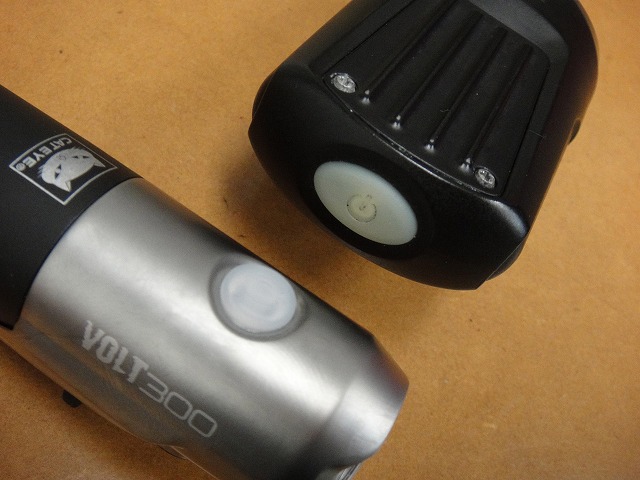
Both the Nanoshot Plus and VOLT300
have their switch light up when battery capacity drops,
though the behavior is slightly different.
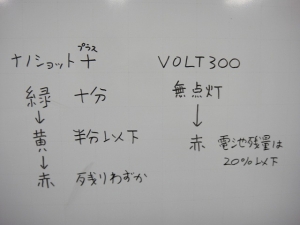
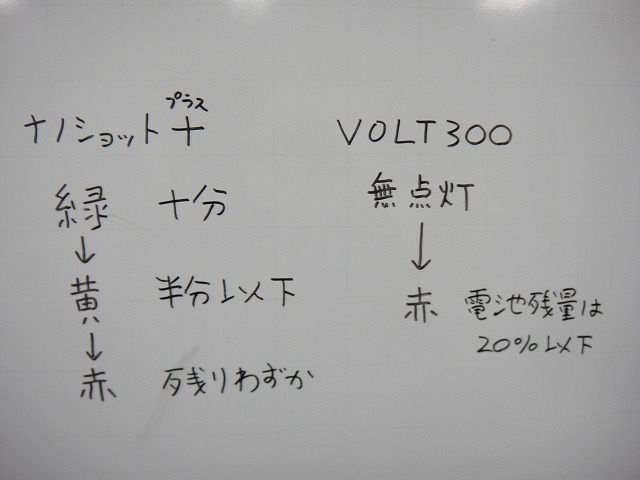
The Nanoshot Plus switch light changes color based on remaining battery.
The note next to it is quoted directly from the Cat Eye manual.
From practical experience, the Nanoshot Plus
when first turns yellow from full charge, if you turn it off then back on immediately,
the green light will stay for about 30 minutes.
I call this the "good yellow".
Then eventually it turns yellow again, but turning off and back on
will briefly show green before switching to yellow.
This is the "bad yellow".
Probably the unit checks voltage repeatedly during operation,
so that brief green flash happens.
When it turns red, turning back on shows green initially
but quickly jumps to red.
When it dies it just cuts out suddenly, so red is scary time.
If you wait a while (about 30 minutes) after it cuts out
and try to power on by long-pressing, you get green → quick red → quick off,
but it is possible to restart.
The VOLT300 handles this a bit differently.
Unlike the Nanoshot Plus, it normally doesn't light the switch,
but once red appears and you turn off then back on,
it starts red immediately. No dark period.
It seems to have a built-in function: "once red appears and the unit isn't charged, always start red".
And when the battery dies and it cuts out, pressing the switch doesn't
respond at all, not even briefly.
I waited over 30 minutes and tried turning it on again,
but it didn't light even for an instant.
I suspected it was mechanically saving power, so I charged it for just 1 second via USB,
and then it went no-light startup → quick red, and
ran on High for about 20 minutes.
Seems like without the stimulus of "USB charging detected",
it pretends the battery is completely empty.
Of course this is bad for the battery so you shouldn't do it.
Untested, but removing the battery once might let you "trick" it into thinking
the battery was replaced and squeeze out the last power.
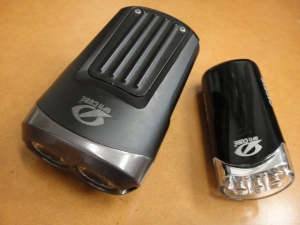
I mentioned earlier that sudden battery death on mountain roads is dangerous,
and both the Nanoshot Plus and VOLT300 manuals
recommend carrying a backup light just in case.
I didn't originally carry a backup, but
once the battery started failing I started carrying one.
I use the backup light on the town streets to the base of the mountain,
then switch to the Nanoshot Plus on the dark trails,
which extends the Nanoshot Plus runtime.
Cat Eye's strength is that
the mounting bracket is shared across most models.

With the VOLT300, full charge to continuous High output time
matches perfectly with my typical maximum night training ride of about 3 hours.
But just to be safe, I still carry that backup light.
So really I just downgraded to a less capable light through this whole process.
However, since the battery is removable,
if you have a spare battery you can swap it with the "cockroach egg method".
That awful name is not official, just so you know.
If you buy a rapid-charge cradle and spare battery,
even if you use both on a night ride, you can pop one in the light and
charge the other on the cradle for convenience.
(The light takes 6 hours, the cradle takes 3 hours,
but running both concurrently means you never forget to charge.)
I bought the VOLT300 as a standalone package this time,
but there's also a kit with a spare battery and rapid-charge cradle
that's a bit cheaper than buying them separately.
The VOLT300 has a higher-end model called the VOLT1200,
and the reason I didn't buy the VOLT1200 is "the body is chunky".
The Nanoshot Plus also sticks out horizontally from the bracket
and interferes with your hands when holding the drop bars from the inside.
The VOLT300 has no horizontal protrusion, so using the drop bar position,
you don't think "man, this thing is annoying".
But on dark mountain roads, the VOLT300 is a bit harsh.
Though I think most people don't need that level of brightness anyway...
For brevity events (brevets) where VOLT development seems aimed,
the battery swap feature would be really handy.
The Nanoshot Plus has what I believe is a unique feature among bicycle lights,
whether intentional or not (probably not):
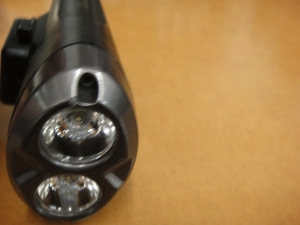
On a hard desk or similar surface, orient the light so the top faces down
and let go.
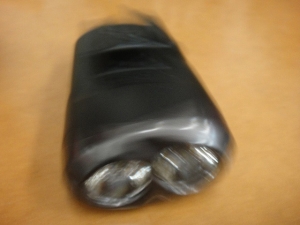
It vibrates left and right with a clatter,
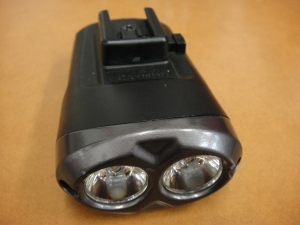
and comes to rest, but that clatter sound is

the intro to "Pipeline" by The Ventures — that "dun-dun-dun-dun..." sound!
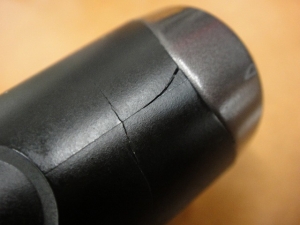
The body has cracks, but that's not from overdoing Pipeline — it's just from
dropping it a few times by accident.
Since I'm used to the Nanoshot Plus brightness,
I run the VOLT300 on High constantly.
(In town I use the backup light instead of Low)
If instead of going up Juso from Kiyotaki, I take Heiguri → Sango → Yamato River path home,
the VOLT300 alone is fine.
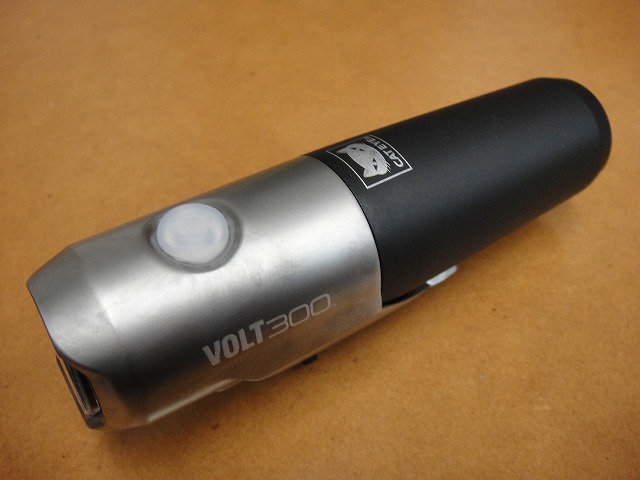
VOLT300 is a pet name, with the model number HL-EL460RC, but
not many people call it that, so I'll refer to it as VOLT300 going forward.
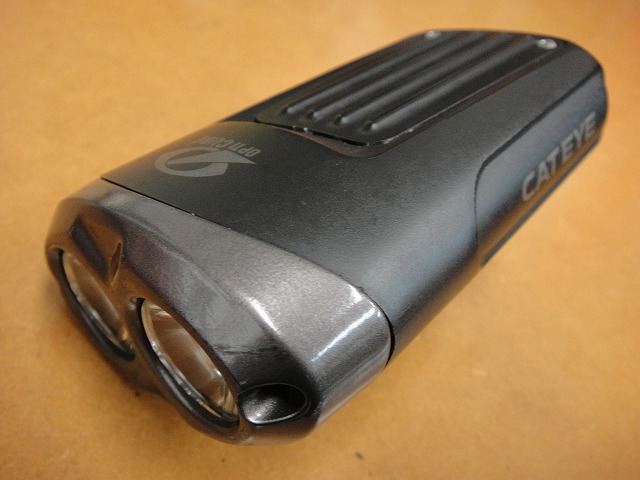
Originally I already own a Nanoshot Plus (HL-EL625RC),
but there were several reasons why I bought the VOLT300 anyway.
Before the Nanoshot Plus, I was using a battery-powered Econom Force model (HL-EL540)
and found it really useful for night training rides.
The battery lasted 2 hours on High / 9 hours on Low,
but with four AA batteries, if you had rechargeables on hand you could double the usage time,
or even without them you could just buy alkaline batteries at a convenience store.
The weakness of the Nanoshot Plus is its built-in battery with USB charging,
meaning "you can't charge it while out".
I did try all sorts of workarounds.
When I connected the Nanoshot Plus to my smartphone's fast charger,
the lamp that should normally glow red while charging would flash yellow instead.
According to the manual, this means "an appropriate charger is not connected".
My guess is that the charging voltage isn't sufficient.
Both the Nanoshot Plus and VOLT300 maintain constant brightness right up until the battery dies,
with no dimming beforehand.
The Econom Force manual mentions "constant voltage circuit included",
and Cat Eye's high-brightness LED lights from a certain era onward have this spec.
(You don't get that situation where "the filament just glows dimly as the battery runs out".)
This constant voltage design actually creates a problem: "it's hard to tell when it's about to die".
Because of the constant voltage circuit, when it goes, it cuts out suddenly like you flipped the switch off.
If this happens while descending a pitch-black mountain road, it's seriously dangerous.

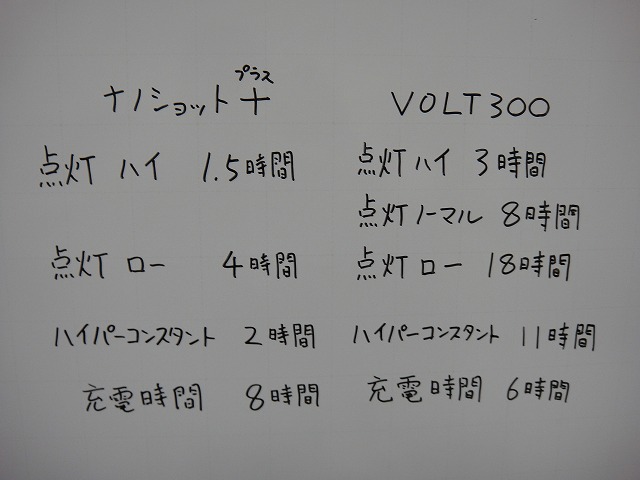
↑ These are the Nanoshot Plus specs.
The battery barely lasted 2.5 hours on Low from a full charge anymore, so
I started thinking about replacing it.
The "Hyper Constant" mode mentioned in the features above is a type of flashing,
but rather than alternating between off and on,
it's a mode where brightness pulses while remaining constantly lit.
Regular flashing has a moment of darkness, and there's an interpretation question about whether
that counts as "headlight operation" under Japanese traffic law since it's not constantly on.
I think Cat Eye's intention with Hyper Constant is to say "this flashing is actually constant illumination",
to satisfy that legal requirement.
In city streets the light is too bright and looks like you're flashing cars,
and on pitch-black mountain roads the visibility actually gets worse,
so I don't use Hyper Constant.
Long press to ON/OFF, short press to toggle High/Low, double-click for Hyper Constant,
so it's convenient that there's no accidental mode-switching during normal use.
↑ Now the VOLT300 specs.
I don't use it so I left it off the chart, but there's also a "flashing 60 hours" mode.
Long press to ON/OFF is the same as Nanoshot Plus,
but short press cycles through High→Normal→Low→Hyper Constant→High,
and it's a bit annoying that Hyper Constant is stuck in that cycle.
Double-click from any mode switches to flashing.
As for actual brightness compared to the Nanoshot Plus...
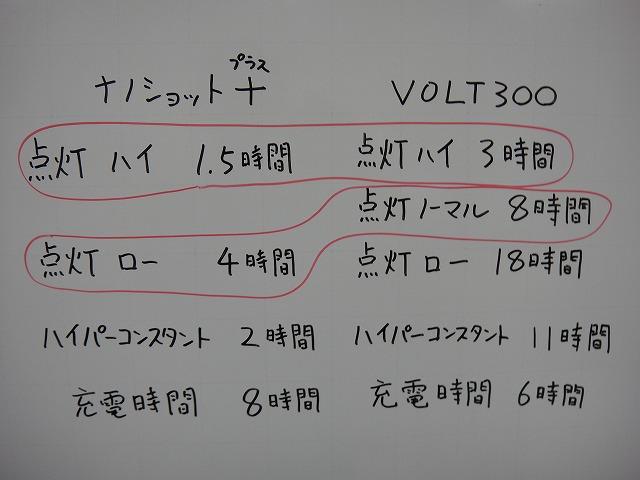
From my subjective observation, per light unit the brightness is roughly:
Nanoshot Plus High ≈ VOLT300 High,
Nanoshot Plus Low ≈ VOLT300 Normal.
The rated brightness on High is 600 lumens for Nanoshot Plus
and 300 lumens for VOLT300 (as the name suggests),
so it seems the Nanoshot Plus is like two VOLT300s placed side by side.
That tracks with the runtime specs too.
Though the Nanoshot Plus does take longer to charge.
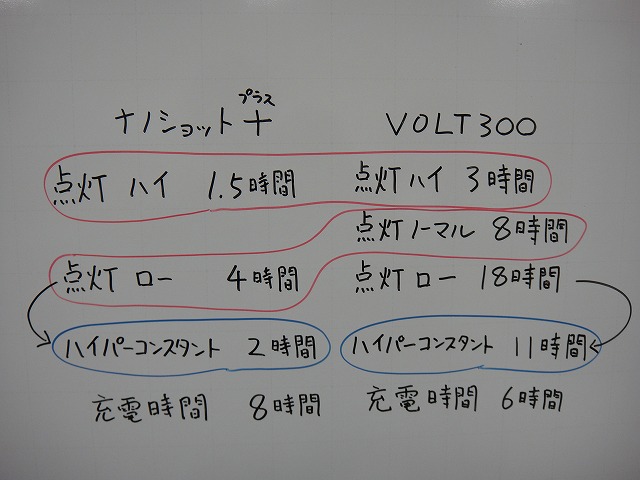
In Hyper Constant mode, the brightness during the dim part of the pulse
(the baseline constant brightness) on the Nanoshot Plus matches its Low setting,
while on VOLT300 it also matches its Low setting.
It's confusing that they both call it "Low" but the brightness is totally different.
Looking at the Hyper Constant runtime, this seems to be accurate.
Going back to what I said earlier, the VOLT300 manual includes this line:
"For nighttime riding, please use in constant light mode.
Under traffic law, flashing is limited to supplementary light use only."
But the Nanoshot Plus manual doesn't say this.
So it seems Cat Eye's interpretation is indeed that "Hyper Constant = constant illumination".
↑ Both lit on High. The brightness is about the same, but
the Nanoshot Plus light color is ever so slightly more yellow.
Cat Eye has made lights that tout "yellowish light color for better visibility than the actual candlepower",
but the Nanoshot Plus yellow isn't that pronounced.
Since I've been using it for about two years, that might have something to do with it,
so comparing new units they might be the same color.
One of my shop customers owns a Cat Eye Triple Shot (HL-EL700),
and recently got a VOLT300 too, but they said
on the dark Minoh mountain roads with no street lights,
the beam angle is too narrow to be useful when riding at night or early morning.
However, since the per-light brightness is about the same,
and the Triple Shot is the type where the battery hangs from the frame,
they acknowledge that the Nanoshot and VOLT systems have superior convenience
with no wiring and just sitting on the handlebar.
Hearing that, I'd been holding off on buying the VOLT300,
but the Nanoshot Plus battery capacity declined and I had to buy something,
so in the end I went with the VOLT300.
The Nanoshot Plus doesn't allow user battery replacement for reliability and safety reasons.
You have to send it to the manufacturer for replacement.
I considered swapping the battery, but
the main body has cracks in it so I gave up on that.
This was another reason to go with VOLT300.
Sorry for the wait!

The white spot in the center is my friend.
Finding a completely dark place was a hassle.
I didn't use the camera flash; the bracket on the handlebar is
mounted at the same position and angle to compare lights fairly.

Nanoshot Plus — Low
Nanoshot Plus — High
VOLT300 — Low
VOLT300 — Normal
(hard to tell from the images, but
VOLT300's Low is quite dim, totally different from Normal)
VOLT300 — High
Comparing the High modes side by side, you can see that
while the per-light brightness is about the same, the beam angle is completely different.
(The Econom Force beam angle is square rather than round. Details → here)
I hate cluttering up the handlebar with stuff,
so I don't even use those front hub quick-release light mount adapters.
Having the light on the handlebar lets me fiddle with it while riding
and adjust the beam angle up and down as needed.
In the image, the Nanoshot Plus's wide part is angled toward me,
but I use it like that on climbs, and angle it up a bit for descents.
Actually, the other day I did a night training ride
that went from Kiyotaki Pass into Nara Prefecture, south on Route 168,
and from the Moto-Yamakamiguchi Station area over Juso Pass back to Osaka,
and when descending Juso on the Osaka side I was too scared to trust the VOLT300
so I used the Nanoshot Plus on High as a backup.
(The Nara side of Kiyotaki Pass was fine with just the VOLT300)
I've descended the Osaka side of Juso Pass hundreds of times,
but descending it at the witching hour was a first, and
even going slowly down that rough road, I realized beam angle matters.
I finally understood what that customer meant about needing a Triple Shot
to ride deep Minoh at night.
Still, as a compact light that just mounts on the handlebar,
the VOLT300 is definitely in the very bright category.
Both the Nanoshot Plus and VOLT300
have their switch light up when battery capacity drops,
though the behavior is slightly different.
The Nanoshot Plus switch light changes color based on remaining battery.
The note next to it is quoted directly from the Cat Eye manual.
From practical experience, the Nanoshot Plus
when first turns yellow from full charge, if you turn it off then back on immediately,
the green light will stay for about 30 minutes.
I call this the "good yellow".
Then eventually it turns yellow again, but turning off and back on
will briefly show green before switching to yellow.
This is the "bad yellow".
Probably the unit checks voltage repeatedly during operation,
so that brief green flash happens.
When it turns red, turning back on shows green initially
but quickly jumps to red.
When it dies it just cuts out suddenly, so red is scary time.
If you wait a while (about 30 minutes) after it cuts out
and try to power on by long-pressing, you get green → quick red → quick off,
but it is possible to restart.
The VOLT300 handles this a bit differently.
Unlike the Nanoshot Plus, it normally doesn't light the switch,
but once red appears and you turn off then back on,
it starts red immediately. No dark period.
It seems to have a built-in function: "once red appears and the unit isn't charged, always start red".
And when the battery dies and it cuts out, pressing the switch doesn't
respond at all, not even briefly.
I waited over 30 minutes and tried turning it on again,
but it didn't light even for an instant.
I suspected it was mechanically saving power, so I charged it for just 1 second via USB,
and then it went no-light startup → quick red, and
ran on High for about 20 minutes.
Seems like without the stimulus of "USB charging detected",
it pretends the battery is completely empty.
Of course this is bad for the battery so you shouldn't do it.
Untested, but removing the battery once might let you "trick" it into thinking
the battery was replaced and squeeze out the last power.
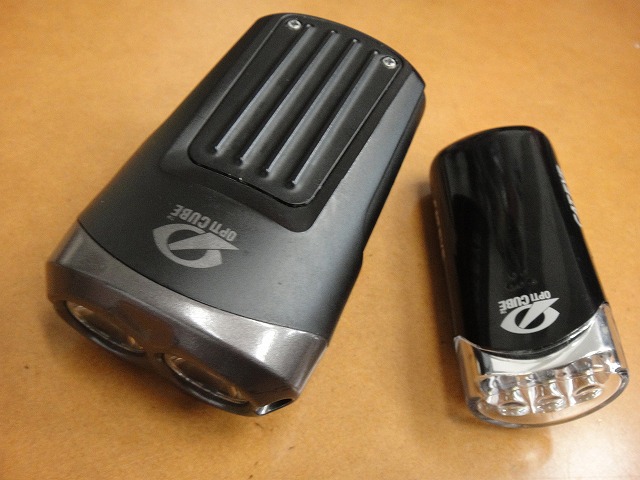
I mentioned earlier that sudden battery death on mountain roads is dangerous,
and both the Nanoshot Plus and VOLT300 manuals
recommend carrying a backup light just in case.
I didn't originally carry a backup, but
once the battery started failing I started carrying one.
I use the backup light on the town streets to the base of the mountain,
then switch to the Nanoshot Plus on the dark trails,
which extends the Nanoshot Plus runtime.
Cat Eye's strength is that
the mounting bracket is shared across most models.

With the VOLT300, full charge to continuous High output time
matches perfectly with my typical maximum night training ride of about 3 hours.
But just to be safe, I still carry that backup light.
So really I just downgraded to a less capable light through this whole process.
However, since the battery is removable,
if you have a spare battery you can swap it with the "cockroach egg method".
That awful name is not official, just so you know.
If you buy a rapid-charge cradle and spare battery,
even if you use both on a night ride, you can pop one in the light and
charge the other on the cradle for convenience.
(The light takes 6 hours, the cradle takes 3 hours,
but running both concurrently means you never forget to charge.)
I bought the VOLT300 as a standalone package this time,
but there's also a kit with a spare battery and rapid-charge cradle
that's a bit cheaper than buying them separately.
The VOLT300 has a higher-end model called the VOLT1200,
and the reason I didn't buy the VOLT1200 is "the body is chunky".
The Nanoshot Plus also sticks out horizontally from the bracket
and interferes with your hands when holding the drop bars from the inside.
The VOLT300 has no horizontal protrusion, so using the drop bar position,
you don't think "man, this thing is annoying".
But on dark mountain roads, the VOLT300 is a bit harsh.
Though I think most people don't need that level of brightness anyway...
For brevity events (brevets) where VOLT development seems aimed,
the battery swap feature would be really handy.
The Nanoshot Plus has what I believe is a unique feature among bicycle lights,
whether intentional or not (probably not):
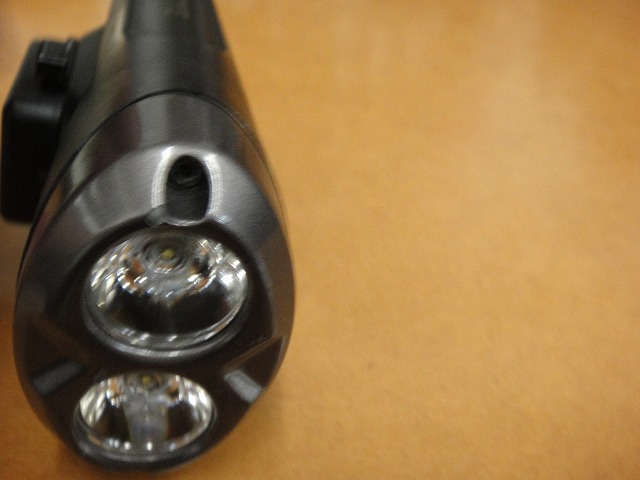
On a hard desk or similar surface, orient the light so the top faces down
and let go.
It vibrates left and right with a clatter,
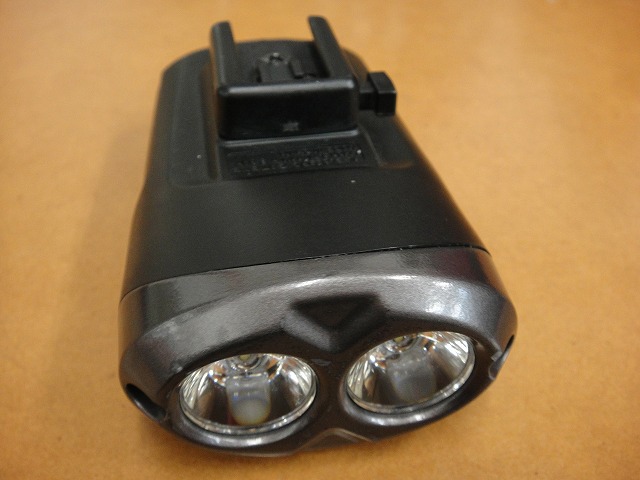
and comes to rest, but that clatter sound is
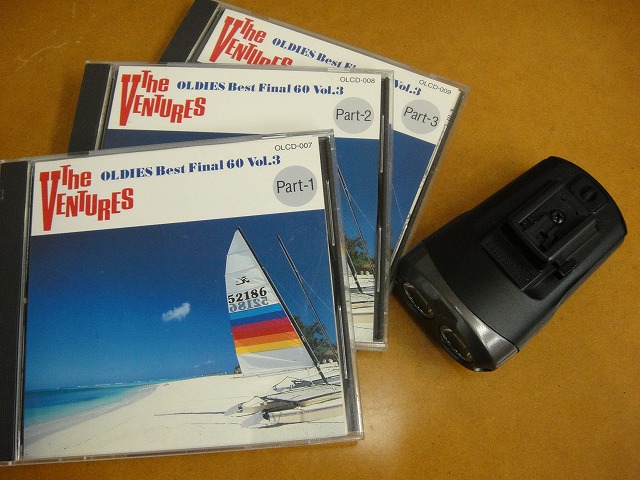
the intro to "Pipeline" by The Ventures — that "dun-dun-dun-dun..." sound!
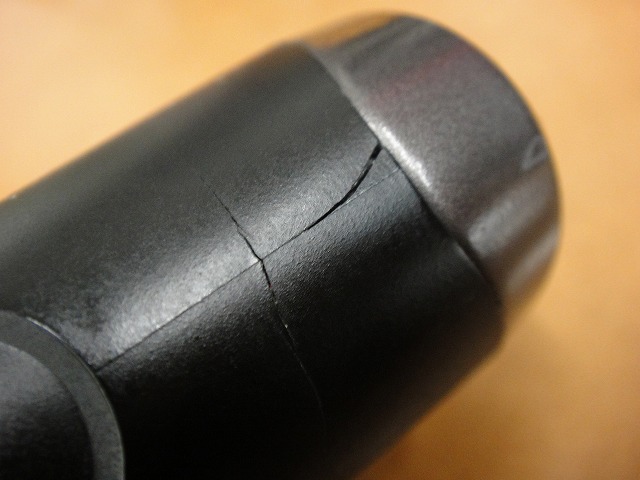
The body has cracks, but that's not from overdoing Pipeline — it's just from
dropping it a few times by accident.
Since I'm used to the Nanoshot Plus brightness,
I run the VOLT300 on High constantly.
(In town I use the backup light instead of Low)
If instead of going up Juso from Kiyotaki, I take Heiguri → Sango → Yamato River path home,
the VOLT300 alone is fine.