A customer dropped off a Racing Speed bike for service.
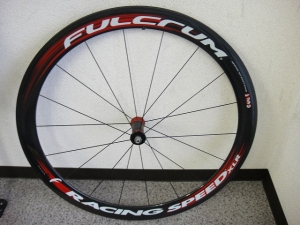
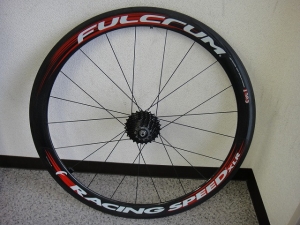
To be precise, it's an XLR with carbon hubs and CULT bearing specification.
Normally I'd true the wheels, of course, but since this has internal nipples and tubular tires,
I was thinking if the runout was just a tiny bit, I'd suggest "let's do that when we replace the tires next time."
But the runout turned out to be more than just a tiny bit, so I removed the tires and did a full truing job.
There was also some centering offset that I wouldn't call factory-acceptable,
so I corrected that too.
The tires are the same model and width front and rear,
and they seemed to be wearing evenly from their simultaneous new installation (estimated),
so I suggested to the customer, "This would be a perfect opportunity for tire rotation."
Since they wanted rotation, I swapped the front and rear wheels.
This might not be entirely beside the point, and I can't deny the possibility, but
between Nōmu Lab wheel #1 and #5, wheel #1 has a noticeably stiffer ride feel.
My goal isn't necessarily to unify spoke tension above a certain threshold, but rather
to control spoke deflection. Since wheel #1, with its higher rim, makes it easier to achieve
stiffness (spoke resistance to deformation), I actually build wheel #5 with marginally higher spoke tension.
Even so, wheel #1 still feels stiffer to ride.
This is because the spokes are shorter.
In a simple radial-laced front wheel, as hub flange diameter increases or rim height increases,
the spokes become shorter. (With tangential lacing, it's a different story—the closer to tangential,
the larger the flange diameter, the longer the spokes become.)
Limiting this to radial lacing: whether the hub flange diameter or rim height increases,
shorter spokes result in a stiffer wheel at the same spoke tension.
The degree of stiffness increase per 1mm of flange radius versus per 1mm of rim height isn't equivalent,
but if making the wheel stiffer is the primary goal, increasing flange diameter helps too.
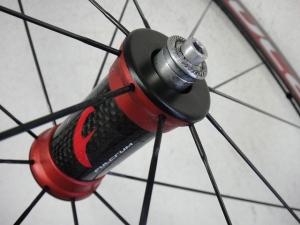
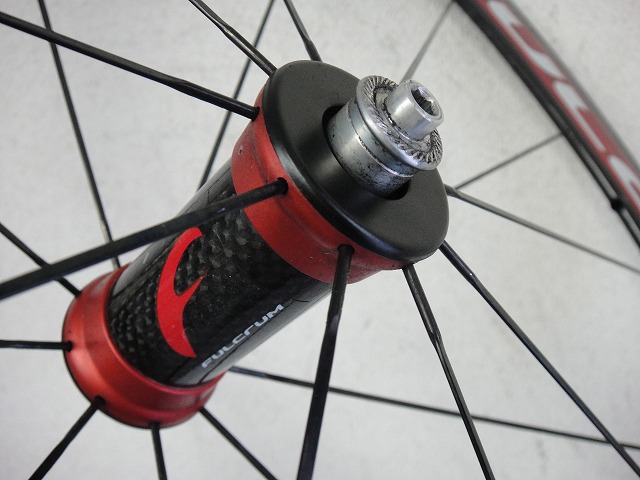
Now, the Racing Speed hub has relatively small flanges when measured from the spoke neck.
But if we went with large flanges, the cataloged weight would become extremely heavy
due to the added hub mass, so they likely avoided this considering overall wheel performance
and marketability.
This isn't to say the ride feel of this wheel is dull.
It's rather a question of whether, if large flanges made it slightly stiffer but added 50g on the scale,
that would be a net gain when considering all factors comprehensively.
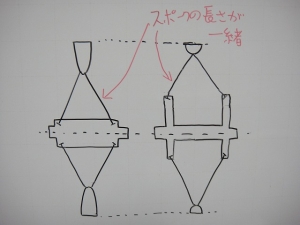
Now, imagine a wheel with the same spoke length as this front wheel but with a low-profile rim and ultra-large flanges.
In the diagram above, the spoke length is the same, and let's say spoke tension is also the same.
Clearly, rim height is the dominant factor in determining wheel stiffness.
Looking at simplicity, weight, and aerodynamics, the Racing Speed front hub seems right as it is.
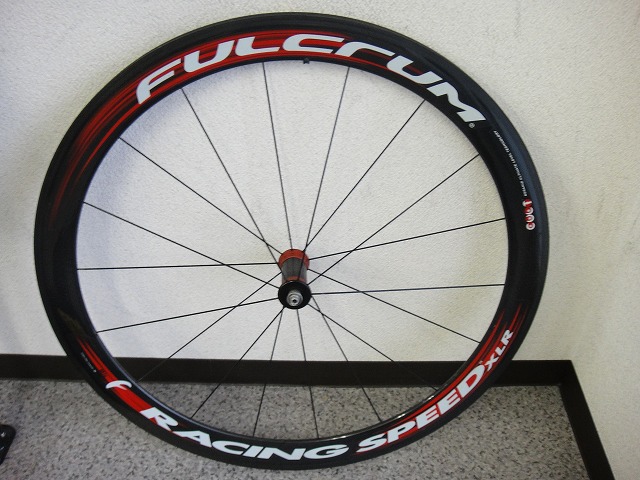

To be precise, it's an XLR with carbon hubs and CULT bearing specification.
Normally I'd true the wheels, of course, but since this has internal nipples and tubular tires,
I was thinking if the runout was just a tiny bit, I'd suggest "let's do that when we replace the tires next time."
But the runout turned out to be more than just a tiny bit, so I removed the tires and did a full truing job.
There was also some centering offset that I wouldn't call factory-acceptable,
so I corrected that too.
The tires are the same model and width front and rear,
and they seemed to be wearing evenly from their simultaneous new installation (estimated),
so I suggested to the customer, "This would be a perfect opportunity for tire rotation."
Since they wanted rotation, I swapped the front and rear wheels.
This might not be entirely beside the point, and I can't deny the possibility, but
between Nōmu Lab wheel #1 and #5, wheel #1 has a noticeably stiffer ride feel.
My goal isn't necessarily to unify spoke tension above a certain threshold, but rather
to control spoke deflection. Since wheel #1, with its higher rim, makes it easier to achieve
stiffness (spoke resistance to deformation), I actually build wheel #5 with marginally higher spoke tension.
Even so, wheel #1 still feels stiffer to ride.
This is because the spokes are shorter.
In a simple radial-laced front wheel, as hub flange diameter increases or rim height increases,
the spokes become shorter. (With tangential lacing, it's a different story—the closer to tangential,
the larger the flange diameter, the longer the spokes become.)
Limiting this to radial lacing: whether the hub flange diameter or rim height increases,
shorter spokes result in a stiffer wheel at the same spoke tension.
The degree of stiffness increase per 1mm of flange radius versus per 1mm of rim height isn't equivalent,
but if making the wheel stiffer is the primary goal, increasing flange diameter helps too.
Now, the Racing Speed hub has relatively small flanges when measured from the spoke neck.
But if we went with large flanges, the cataloged weight would become extremely heavy
due to the added hub mass, so they likely avoided this considering overall wheel performance
and marketability.
This isn't to say the ride feel of this wheel is dull.
It's rather a question of whether, if large flanges made it slightly stiffer but added 50g on the scale,
that would be a net gain when considering all factors comprehensively.

Now, imagine a wheel with the same spoke length as this front wheel but with a low-profile rim and ultra-large flanges.
In the diagram above, the spoke length is the same, and let's say spoke tension is also the same.
Clearly, rim height is the dominant factor in determining wheel stiffness.
Looking at simplicity, weight, and aerodynamics, the Racing Speed front hub seems right as it is.