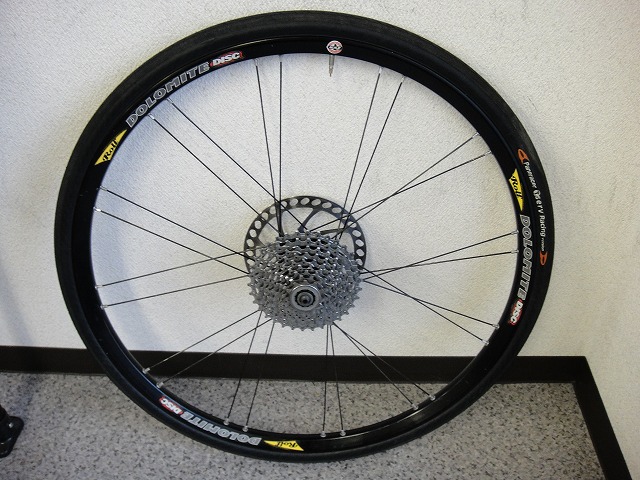
I received the rear wheel of a Rolf Dolomite Disc from a customer.
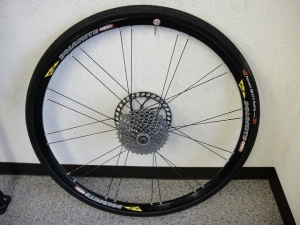
The issue was that the freewheel body had some play in it,
so I want to remove the freewheel body first, but...
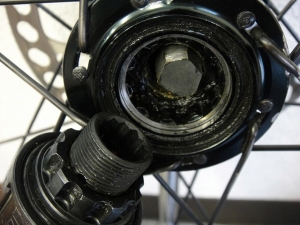
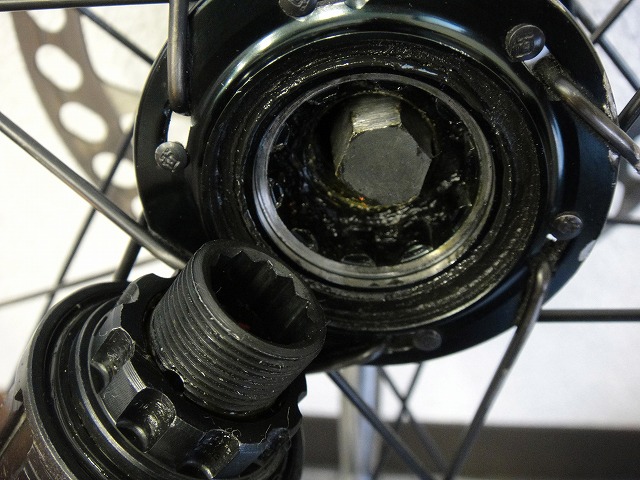
To do that, I first need to remove the cartridge bearing on the left,
then insert an 11mm Allen key from the left side of the hub body
to loosen the freewheel body fixing hollow bolt.
The hexagon on the Allen key is distorted because
I improvised it by filing down a 12mm Allen key.
Even the short end of an L-shaped Allen key is pretty long,
so it could work as a dual-purpose Allen key (11mm on the near end / 12mm on the far end),
but I really hate that kind of corner-cutting and multi-tools or all-in-one tools—
except for portable versions—
so I should just buy a proper 11mm Allen key.
(I have other 12mm keys anyway)
Once I took it apart, I found out that
the play was caused by wear on the balls inside the freewheel body,
so even tightening it firmly against the hub body won't eliminate the play.
The freewheel body needs to be replaced.
Rolf's signature pair-spoked design is special, but
with an equal number of pair spokes on each side, when you go with fewer spokes overall,
the tension each spoke places on the rim increases,
and by bringing the rim hole positions closer together,
they're trying to mitigate the rim distorting in an alternating left-right pattern
(though there's a trade-off in increased radial runout).
In other words, it's probably not that they thought "let's design a pair-spoked wheel,"
but rather that reducing the spoke count as much as possible led them to
the pair-spoke design.
As a way to market this unique wheel design,
Rolf once entered the Trek Group, but
Trek's parts brand Bontrager came out with a blatant knockoff wheel,
so Rolf got furious and left the Trek Group.
By the way, Bontrager itself is a parts and frame brand founded by Keith Bontrager
and has nothing to do with Trek originally.
Trek's original parts brand is icon.
Recently Rolf has been releasing pair-spoked wheels under a new brand called "Rolf Prima,"
but they clearly weren't happy about being dealt the "let them borrow the porch and they took the house" treatment by Trek,
so on Rolf Prima's website about supplying repair parts for older Rolf wheels, it said
Rolf Prima cannot provide parts or service for "Rolf Wheels"-branded wheels.
For more information, please contact Trek Bicycle Corporation.
basically saying "go ask Trek about old Rolf stuff,"
and they had the word "cannot" in bold.
(Though when I checked their homepage recently, it's changed)
So if I need to get this freewheel body replaced,
I'll have to contact Trek.
Anyway, about what I wrote earlier—"pair spokes because of fewer spokes"—
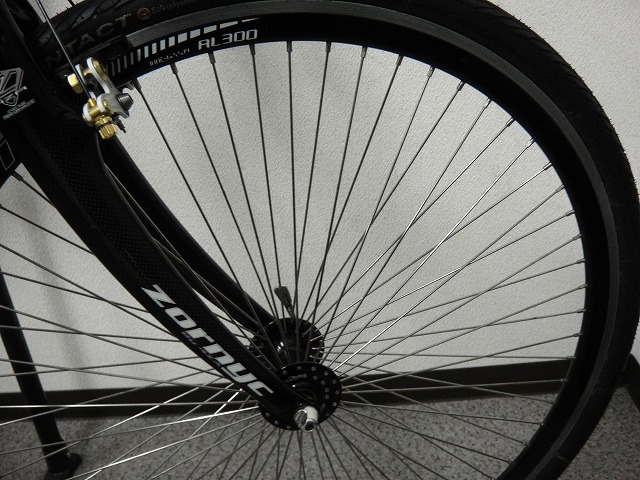
there's no benefit to pair-spoked wheels when you have a lot of spokes.
In fact, with more spokes, the rim hole spacing
becomes similar to pair-spoke spacing anyway.
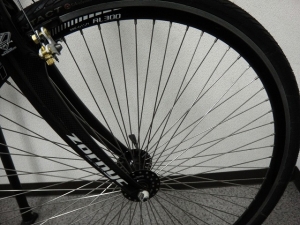
↑This is my 63H wheel,
and even if I made it pair-spoked, the wheel's characteristics would barely change.
Not that it matters, but if someone did that,
the non-wrench type Park Tool-style nipple wrenches wouldn't be able to turn the nipples.
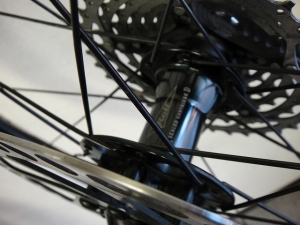
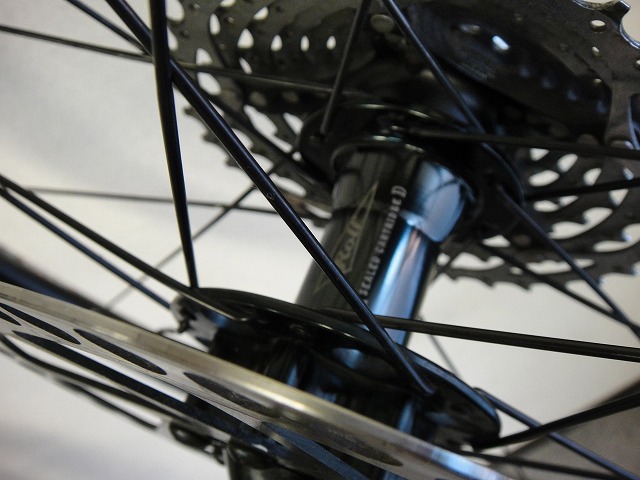
I think I wrote somewhere before that "Rolf's low-to-high flange design has merit,"
but I don't think I've ever explained it in detail.
Whether you look at a wheel dynamically (pedaling torque and such),
statically (spoke tension balance and such),
or aesthetically (the way this hub tapers is just irresistible),
the evaluation of low-to-high flanges changes a bit.
And I'm not going to explain it in detail today either.
The issue was that the freewheel body had some play in it,
so I want to remove the freewheel body first, but...
To do that, I first need to remove the cartridge bearing on the left,
then insert an 11mm Allen key from the left side of the hub body
to loosen the freewheel body fixing hollow bolt.
The hexagon on the Allen key is distorted because
I improvised it by filing down a 12mm Allen key.
Even the short end of an L-shaped Allen key is pretty long,
so it could work as a dual-purpose Allen key (11mm on the near end / 12mm on the far end),
but I really hate that kind of corner-cutting and multi-tools or all-in-one tools—
except for portable versions—
so I should just buy a proper 11mm Allen key.
(I have other 12mm keys anyway)
Once I took it apart, I found out that
the play was caused by wear on the balls inside the freewheel body,
so even tightening it firmly against the hub body won't eliminate the play.
The freewheel body needs to be replaced.
Rolf's signature pair-spoked design is special, but
with an equal number of pair spokes on each side, when you go with fewer spokes overall,
the tension each spoke places on the rim increases,
and by bringing the rim hole positions closer together,
they're trying to mitigate the rim distorting in an alternating left-right pattern
(though there's a trade-off in increased radial runout).
In other words, it's probably not that they thought "let's design a pair-spoked wheel,"
but rather that reducing the spoke count as much as possible led them to
the pair-spoke design.
As a way to market this unique wheel design,
Rolf once entered the Trek Group, but
Trek's parts brand Bontrager came out with a blatant knockoff wheel,
so Rolf got furious and left the Trek Group.
By the way, Bontrager itself is a parts and frame brand founded by Keith Bontrager
and has nothing to do with Trek originally.
Trek's original parts brand is icon.
Recently Rolf has been releasing pair-spoked wheels under a new brand called "Rolf Prima,"
but they clearly weren't happy about being dealt the "let them borrow the porch and they took the house" treatment by Trek,
so on Rolf Prima's website about supplying repair parts for older Rolf wheels, it said
Rolf Prima cannot provide parts or service for "Rolf Wheels"-branded wheels.
For more information, please contact Trek Bicycle Corporation.
basically saying "go ask Trek about old Rolf stuff,"
and they had the word "cannot" in bold.
(Though when I checked their homepage recently, it's changed)
So if I need to get this freewheel body replaced,
I'll have to contact Trek.
Anyway, about what I wrote earlier—"pair spokes because of fewer spokes"—
there's no benefit to pair-spoked wheels when you have a lot of spokes.
In fact, with more spokes, the rim hole spacing
becomes similar to pair-spoke spacing anyway.
↑This is my 63H wheel,
and even if I made it pair-spoked, the wheel's characteristics would barely change.
Not that it matters, but if someone did that,
the non-wrench type Park Tool-style nipple wrenches wouldn't be able to turn the nipples.
I think I wrote somewhere before that "Rolf's low-to-high flange design has merit,"
but I don't think I've ever explained it in detail.
Whether you look at a wheel dynamically (pedaling torque and such),
statically (spoke tension balance and such),
or aesthetically (the way this hub tapers is just irresistible),
the evaluation of low-to-high flanges changes a bit.
And I'm not going to explain it in detail today either.