I'm finally writing something worthwhile (laughs).
Back in the Dura-Ace 7400 era, there were all kinds of suspicious (but full of promise) third-party component tuning parts floating around,
but from Dura-Ace 7700 onwards, since Dura-Ace itself became lighter,
parts that tout weight reduction have become rare.
These days, manufacturers are focusing their efforts
mostly on bearing-related components.
Parts that claim low-friction BB and hub performance are examples of this.
This is the area where, even when replacing OEM parts,
you can clearly say "it got better."
Regarding the shifting system, currently it's hard to imagine
third-party parts being able to achieve better shifting performance
than the OEM component combinations.
However, people who install all sorts of third-party parts
almost always end up messing with the rear derailleur pulley.
The rear derailleur pulley actually has quite a major impact on shifting performance.
That's what I want to talk about today.
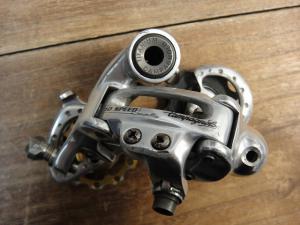
↑This is the rear derailleur of a Campagnolo Chorus 10-speed.
It's been fitted with non-OEM pulleys.
There seem to be various other things wrong before we even get to the pulleys, but never mind that.
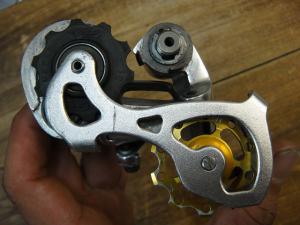
The upper pulley is a BBB, and the lower pulley is a KCNC.
These pulleys achieve low-friction rotation by adopting sealed bearings,
but in terms of actually doing the job of a pulley,
they fall short.
The upper pulley is also called an upper pulley, but
during shifting it pushes the chain to shift,
so it's also called a guide pulley.
However, saying it "pushes the chain" is partly a lie.
I'll explain that later.
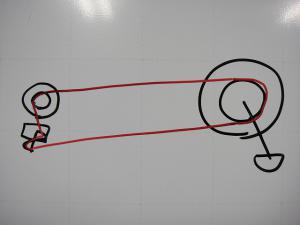
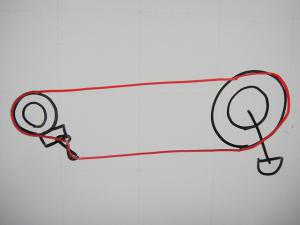
The lower pulley is also called a lower pulley.
Or it's called a tension pulley.
For example, in the case of 20-speed, from outer×low (large gear×large gear) to
inner×top (small gear×small gear), there are 20 different possible chain lengths,
and it's called this because it maintains the state where the lower side of the chain
doesn't sag and is kept at proper tension (maintaining chain tension).
Since I want to focus on the roles here, from now on I'll call
the upper pulley the guide pulley and the lower pulley the tension pulley.

↑This is the rear derailleur of an RD-7402, an 8-speed Dura-Ace.
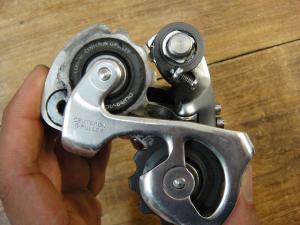
Looking at the back, there's marking on the pulley cage that says "Centalon Guide Pulley,"
and the guide pulley itself has similar markings.
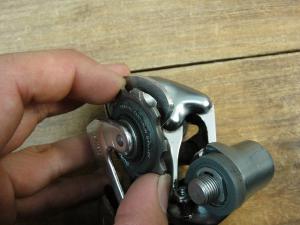
This is a Shimano patent that refers to the structure of a guide pulley
that slides left and right and moves back and forth.
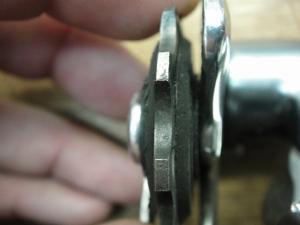
↑At the rightmost position
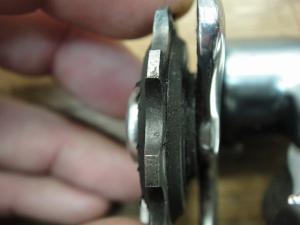
↑At the leftmost position
The reason for this kind of structure is that when shifting up from the top gear
and when shifting down from the low gear, the ideal position for the pulley differs,
so we want it to fit in the proper position in either case.
Currently, both Shimano and Campagnolo use sliding guide pulleys.
This "sliding guide pulley" structurally requires the pulley rotation shaft to be bushing-type,
so in terms of simple rotational smoothness it's inferior to bearing-type.
Almost all third-party pulleys tout light rotation and are bearing-type,
so they don't have a sliding mechanism.
Here I'm writing about bushings and bearings as if they're opposites,
but a bushing is actually a type of bearing too.
Bushing → Bushing bearing
Bearing → Sealed bearing
That's what I mean.
Since many people call them bushing pulleys and bearing pulleys respectively.
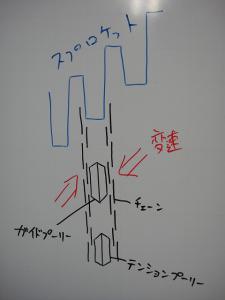
Most of the shifting stress (the red arrows in the diagram above) is borne by the guide pulley.
Furthermore, when shifting toward the low side, compared to shifting toward the top side,
there's greater friction between the pulley and the chain's inner plate.
I'll explain this later too.
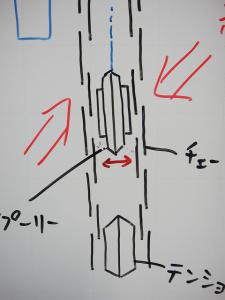
I've changed the diagram of the guide pulley section and added left-right arrows below.
This is the slide range of the guide pulley.
In the case of Shimano 10-speed, this slide range is 0.7mm,
but when you replace it with a sealed bearing pulley,
this 0.7mm becomes essentially 0.
↓This is an RD-7800, but
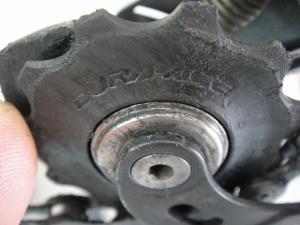
↑At the rightmost position
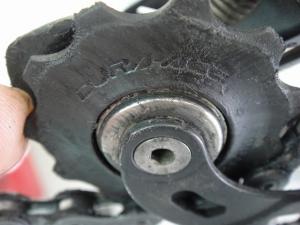
↑At the leftmost position
This is the 0.7mm range of motion.
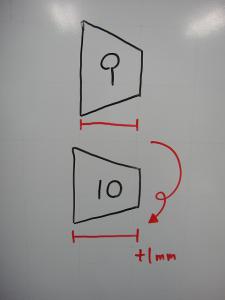
0.7mm is definitely not a small number.
When Shimano upgraded from 9-speed to 10-speed, they made the sprocket width 1mm wider,
but
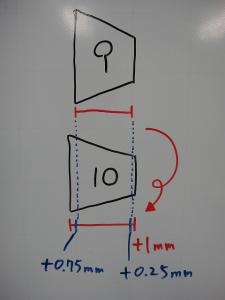
the breakdown is 0.25mm on the top side and 0.75mm on the low side.
0.7mm is a pretty significant number for shifting performance.
What I'm trying to say is,
replacing the guide pulley with a third-party one means
in exchange for slight reduction in friction, you're clearly
reducing shifting performance.
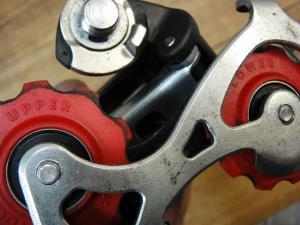
Third-party pulleys have more problems.
The pulley in the image above is from Tacx, but it's essentially the same as BBB.
Although this pulley has markings for upper and lower,
there's no sign that they're actually made differently.
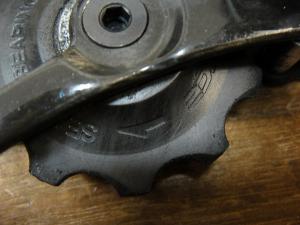
This is the tension pulley of an RD-7900,
and there's marking showing the direction of rotation.
Since a road bike won't move forward even if you crank backwards,
the direction of chain travel is uniform.
The tension pulley has the tooth tip shaped to be more ideal
in relation to the chain, so there's a specified rotation direction.
Nearly all third-party tension pulleys lack
any such rotation direction specification.
KCNC pulleys are sold one piece at a time, so
they can't possibly be made with consciousness of up/down or front/back orientation.
That said, even if it's just cosmetic customization, I understand the desire
to try changing various parts. I'm the same way.
So my personal recommendation is "only replace the tension pulley."
If you truly demand critical shifting performance,
OEM parts are definitely still the best. That's clear.
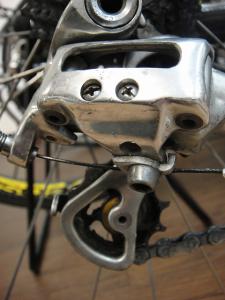
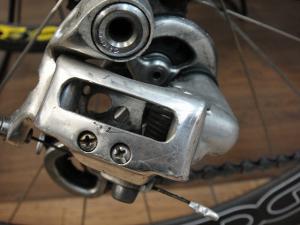
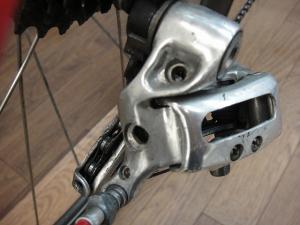
↑The Chorus 10-speed at the beginning has sealed bearing pulleys both top and bottom,
but this Athena 11-speed has only the tension pulley changed to KCNC.
There seem to be various other things wrong before we even get to the pulleys, but never mind that.
About the suspicion that only the guide pulley isn't doing the pushing during low-side shifting
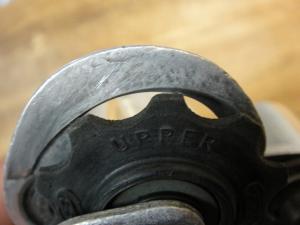
↑This is the Chorus 10-speed from the beginning,
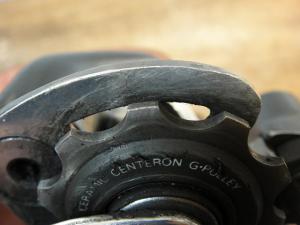
↑and this is an RD-7402,
but apart from wear on the guide pulley, you can also see that the inside
of the right pulley cage is worn from contact with the chain.
Which means,
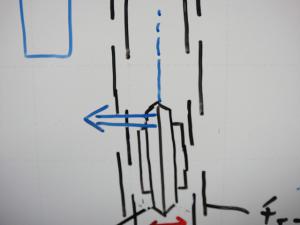
Low-side shifting isn't just being pushed by the guide pulley,
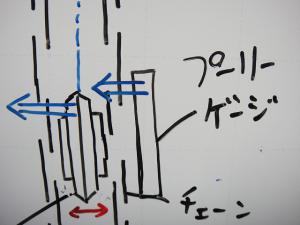
it seems like the inside of the right pulley cage is also pushing.
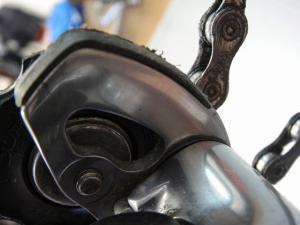
↑This is an RD-7800, and on the inside edge of the right pulley cage,
there's something like a plastic guard attached.
This has been the spec since RD-7700,
and it's something that appears on Dura-Ace only — not on Ultegra or 105,
making it a Dura-Ace exclusive secret?
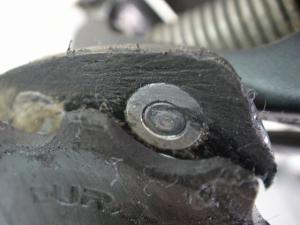
And looking at this from the inside, it seems to be working pretty hard.
The metal parts are worn too. There's no individual repair part for just this plastic section,
but by replacing the entire right pulley cage,
you can replace the plastic section with a new one.
Shimano clearly understands that the guide pulley alone isn't doing the pushing,
which is why they did this.
Since it's adopted only on the 7700 and 7800 Dura-Ace,
it's a differentiation point that says "Dura-Ace really is different."
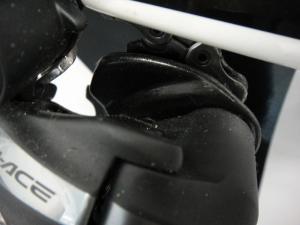
So, what about the RD-7900?
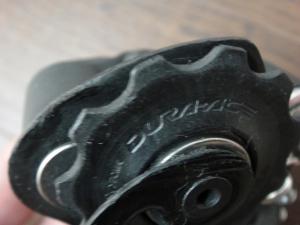
It seems something is missing. The "pushing part."
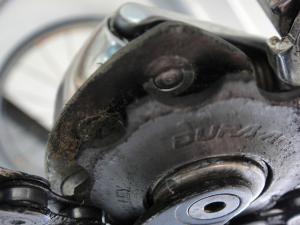
↑I took the same angle shot with the RD-7800.
If pushing the entire pulley cage is advantageous for shifting,
theoretically wouldn't the 7800 be better? Am I the only one thinking that?
I wish the 7900 had something to address this issue.
About pulley wear

↑This is a titanium pulley.
From when it was first installed until it was removed, I never changed its orientation at all.
It's worn heavily and I'm not using it anymore.
With both pulleys, I'm orienting whichever side shows more wear facing up.
The left one has worn teeth, you know. Almost connecting with the weight-reduction holes.
You can't tell from the photo, but the tooth tip thickness is also thinner on the left.
Right — the left one was originally the guide pulley.
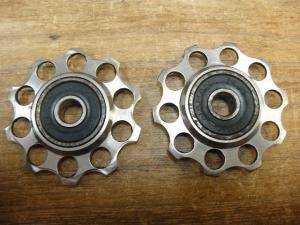
↑I just flipped it over.
Especially the right pulley, you can see
it's not worn much. The previous photo showed the side that was facing inward,
and this photo shows the side that was facing outward,
so you can understand that pulley wear isn't uniform.
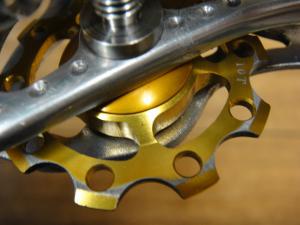
↑The outside of the tension pulley from the Chorus at the beginning
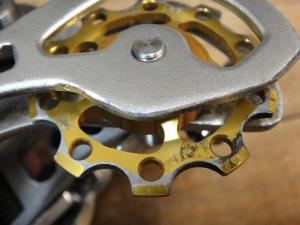
↑Same, the inside
You can tell from the anodize color that
more wear is happening on the inside.
Which means,
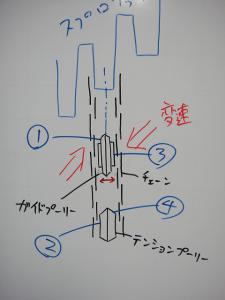
pulley wear patterns work out like this.
If you've got bearing pulleys both top and bottom, it might be good to
rotate your pulleys the next time you change your chain.
Back in the Dura-Ace 7400 era, there were all kinds of suspicious (but full of promise) third-party component tuning parts floating around,
but from Dura-Ace 7700 onwards, since Dura-Ace itself became lighter,
parts that tout weight reduction have become rare.
These days, manufacturers are focusing their efforts
mostly on bearing-related components.
Parts that claim low-friction BB and hub performance are examples of this.
This is the area where, even when replacing OEM parts,
you can clearly say "it got better."
Regarding the shifting system, currently it's hard to imagine
third-party parts being able to achieve better shifting performance
than the OEM component combinations.
However, people who install all sorts of third-party parts
almost always end up messing with the rear derailleur pulley.
The rear derailleur pulley actually has quite a major impact on shifting performance.
That's what I want to talk about today.
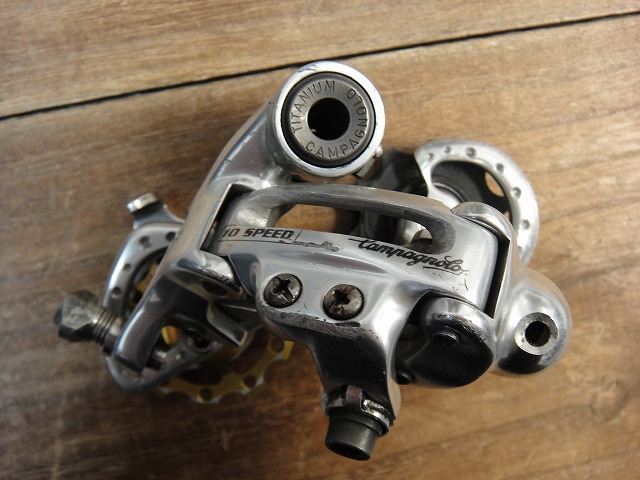
↑This is the rear derailleur of a Campagnolo Chorus 10-speed.
It's been fitted with non-OEM pulleys.
There seem to be various other things wrong before we even get to the pulleys, but never mind that.
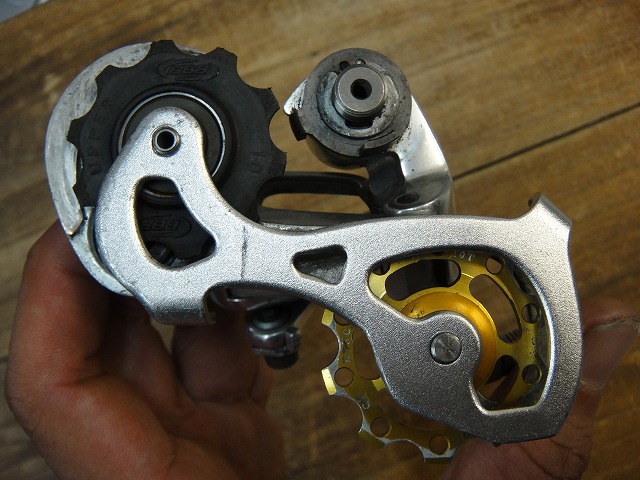
The upper pulley is a BBB, and the lower pulley is a KCNC.
These pulleys achieve low-friction rotation by adopting sealed bearings,
but in terms of actually doing the job of a pulley,
they fall short.
The upper pulley is also called an upper pulley, but
during shifting it pushes the chain to shift,
so it's also called a guide pulley.
However, saying it "pushes the chain" is partly a lie.
I'll explain that later.
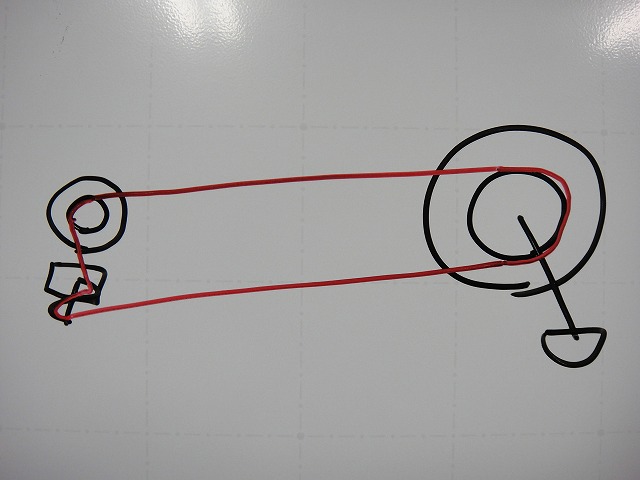

The lower pulley is also called a lower pulley.
Or it's called a tension pulley.
For example, in the case of 20-speed, from outer×low (large gear×large gear) to
inner×top (small gear×small gear), there are 20 different possible chain lengths,
and it's called this because it maintains the state where the lower side of the chain
doesn't sag and is kept at proper tension (maintaining chain tension).
Since I want to focus on the roles here, from now on I'll call
the upper pulley the guide pulley and the lower pulley the tension pulley.
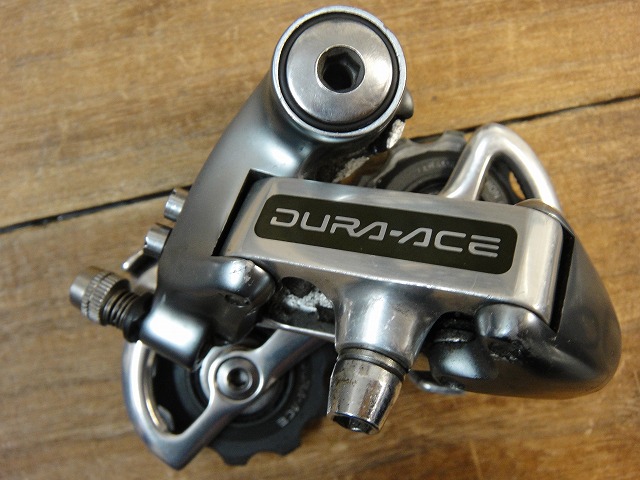
↑This is the rear derailleur of an RD-7402, an 8-speed Dura-Ace.
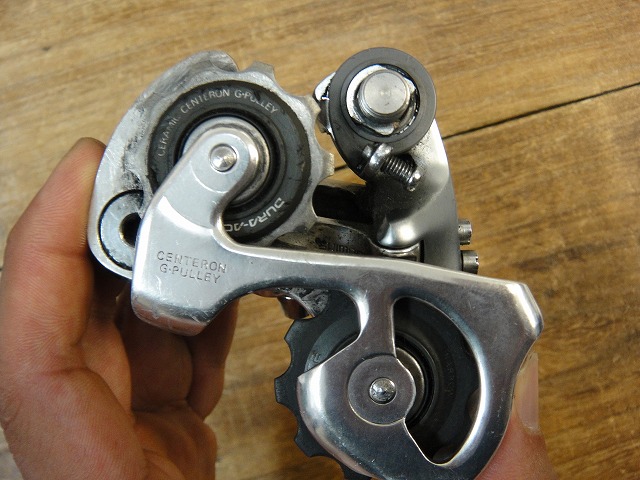
Looking at the back, there's marking on the pulley cage that says "Centalon Guide Pulley,"
and the guide pulley itself has similar markings.
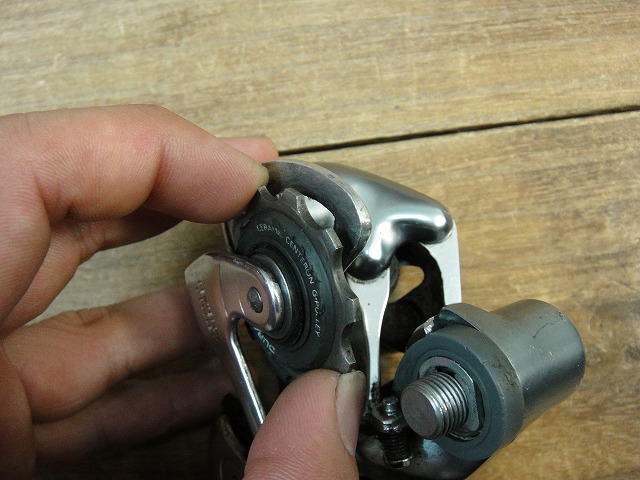
This is a Shimano patent that refers to the structure of a guide pulley
that slides left and right and moves back and forth.
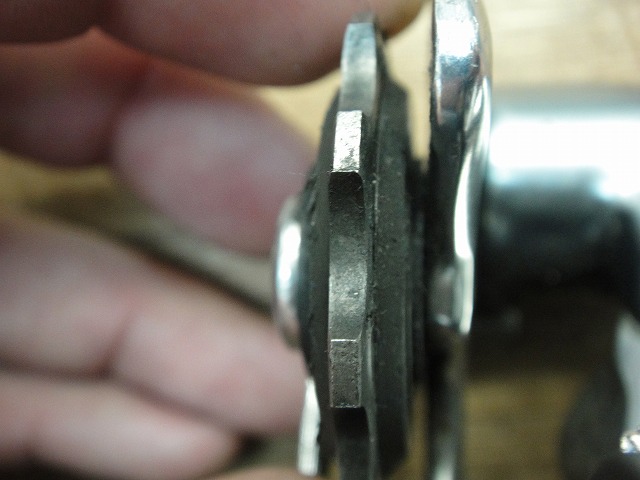
↑At the rightmost position
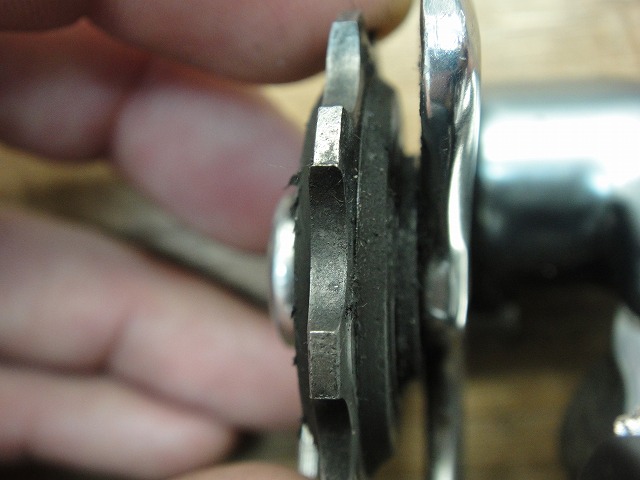
↑At the leftmost position
The reason for this kind of structure is that when shifting up from the top gear
and when shifting down from the low gear, the ideal position for the pulley differs,
so we want it to fit in the proper position in either case.
Currently, both Shimano and Campagnolo use sliding guide pulleys.
This "sliding guide pulley" structurally requires the pulley rotation shaft to be bushing-type,
so in terms of simple rotational smoothness it's inferior to bearing-type.
Almost all third-party pulleys tout light rotation and are bearing-type,
so they don't have a sliding mechanism.
Here I'm writing about bushings and bearings as if they're opposites,
but a bushing is actually a type of bearing too.
Bushing → Bushing bearing
Bearing → Sealed bearing
That's what I mean.
Since many people call them bushing pulleys and bearing pulleys respectively.

Most of the shifting stress (the red arrows in the diagram above) is borne by the guide pulley.
Furthermore, when shifting toward the low side, compared to shifting toward the top side,
there's greater friction between the pulley and the chain's inner plate.
I'll explain this later too.
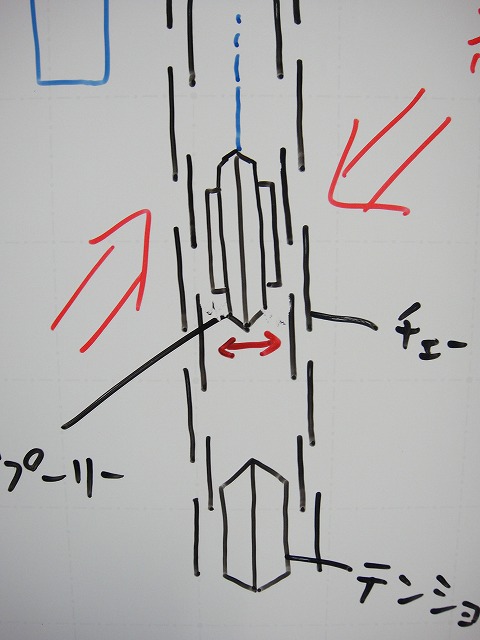
I've changed the diagram of the guide pulley section and added left-right arrows below.
This is the slide range of the guide pulley.
In the case of Shimano 10-speed, this slide range is 0.7mm,
but when you replace it with a sealed bearing pulley,
this 0.7mm becomes essentially 0.
↓This is an RD-7800, but

↑At the rightmost position
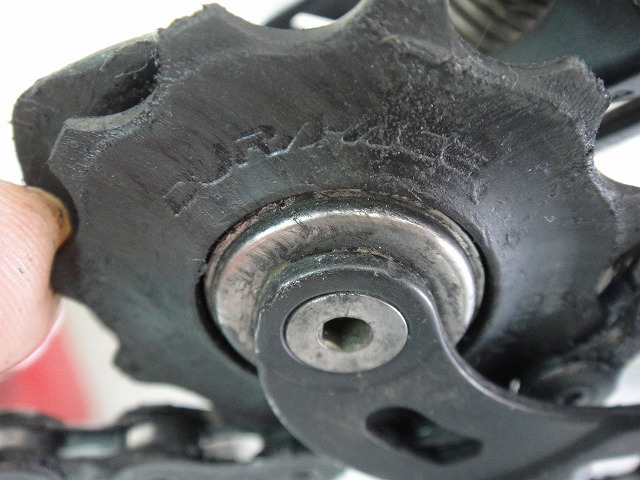
↑At the leftmost position
This is the 0.7mm range of motion.
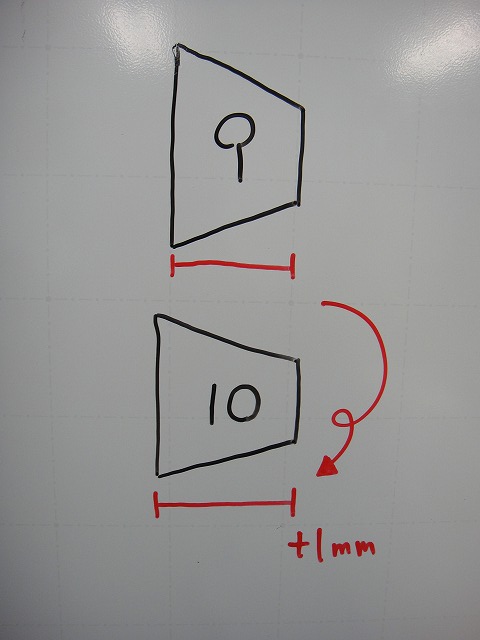
0.7mm is definitely not a small number.
When Shimano upgraded from 9-speed to 10-speed, they made the sprocket width 1mm wider,
but
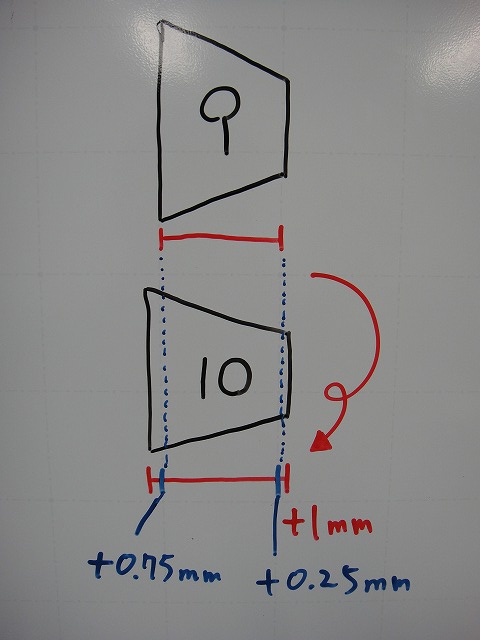
the breakdown is 0.25mm on the top side and 0.75mm on the low side.
0.7mm is a pretty significant number for shifting performance.
What I'm trying to say is,
replacing the guide pulley with a third-party one means
in exchange for slight reduction in friction, you're clearly
reducing shifting performance.
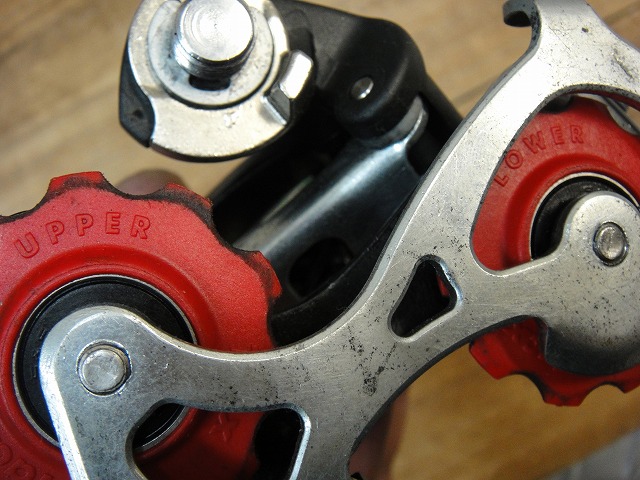
Third-party pulleys have more problems.
The pulley in the image above is from Tacx, but it's essentially the same as BBB.
Although this pulley has markings for upper and lower,
there's no sign that they're actually made differently.
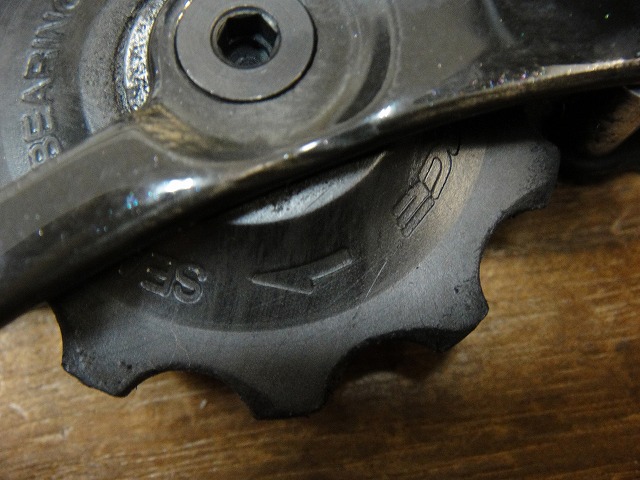
This is the tension pulley of an RD-7900,
and there's marking showing the direction of rotation.
Since a road bike won't move forward even if you crank backwards,
the direction of chain travel is uniform.
The tension pulley has the tooth tip shaped to be more ideal
in relation to the chain, so there's a specified rotation direction.
Nearly all third-party tension pulleys lack
any such rotation direction specification.
KCNC pulleys are sold one piece at a time, so
they can't possibly be made with consciousness of up/down or front/back orientation.
That said, even if it's just cosmetic customization, I understand the desire
to try changing various parts. I'm the same way.
So my personal recommendation is "only replace the tension pulley."
If you truly demand critical shifting performance,
OEM parts are definitely still the best. That's clear.
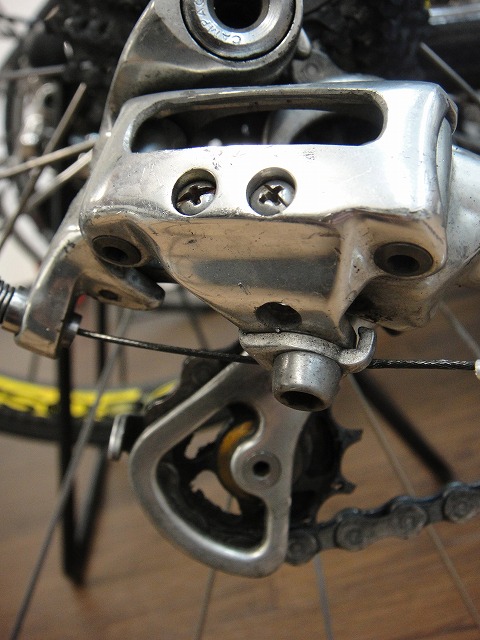

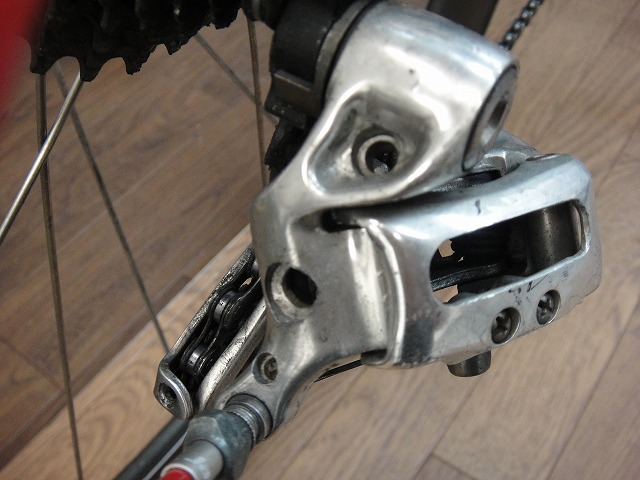
↑The Chorus 10-speed at the beginning has sealed bearing pulleys both top and bottom,
but this Athena 11-speed has only the tension pulley changed to KCNC.
There seem to be various other things wrong before we even get to the pulleys, but never mind that.
About the suspicion that only the guide pulley isn't doing the pushing during low-side shifting
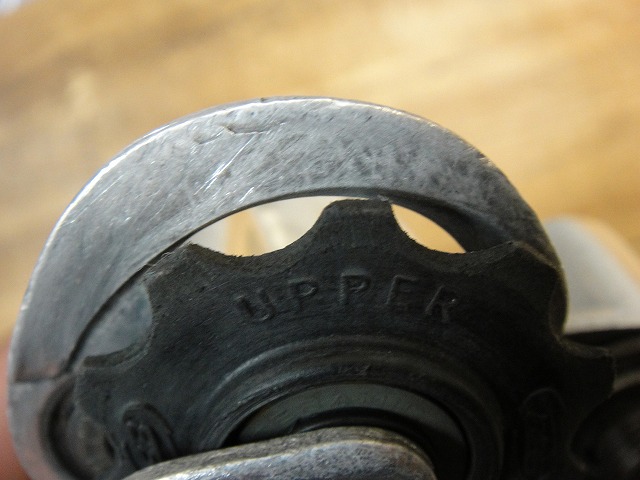
↑This is the Chorus 10-speed from the beginning,

↑and this is an RD-7402,
but apart from wear on the guide pulley, you can also see that the inside
of the right pulley cage is worn from contact with the chain.
Which means,
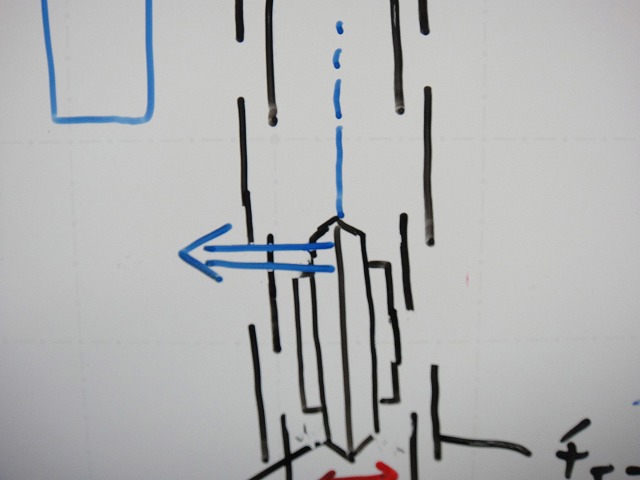
Low-side shifting isn't just being pushed by the guide pulley,
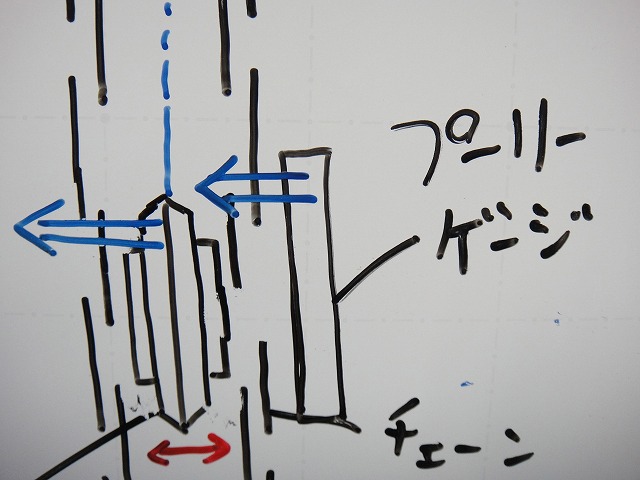
it seems like the inside of the right pulley cage is also pushing.
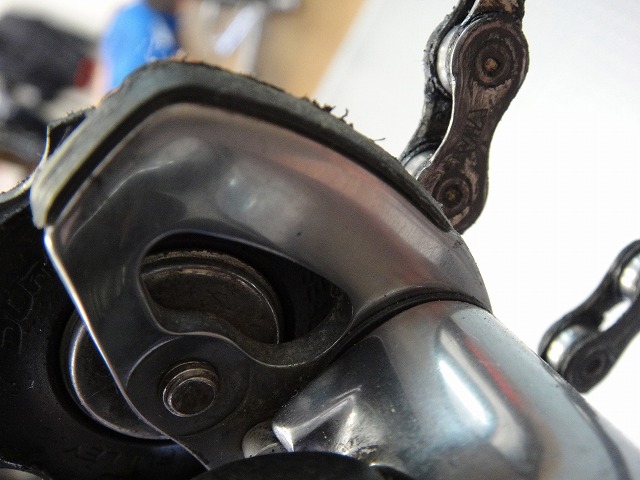
↑This is an RD-7800, and on the inside edge of the right pulley cage,
there's something like a plastic guard attached.
This has been the spec since RD-7700,
and it's something that appears on Dura-Ace only — not on Ultegra or 105,
making it a Dura-Ace exclusive secret?
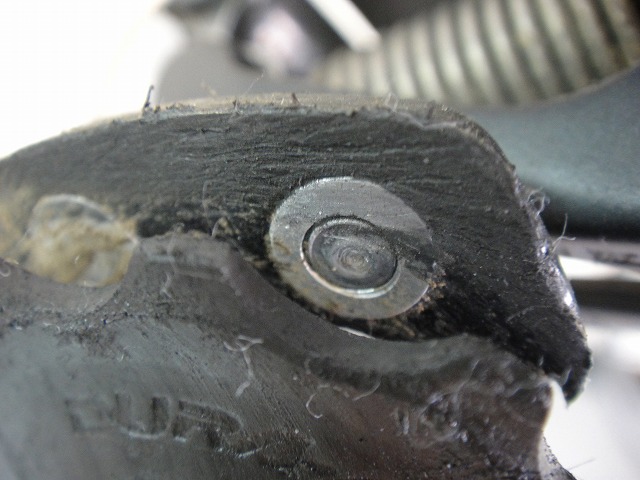
And looking at this from the inside, it seems to be working pretty hard.
The metal parts are worn too. There's no individual repair part for just this plastic section,
but by replacing the entire right pulley cage,
you can replace the plastic section with a new one.
Shimano clearly understands that the guide pulley alone isn't doing the pushing,
which is why they did this.
Since it's adopted only on the 7700 and 7800 Dura-Ace,
it's a differentiation point that says "Dura-Ace really is different."
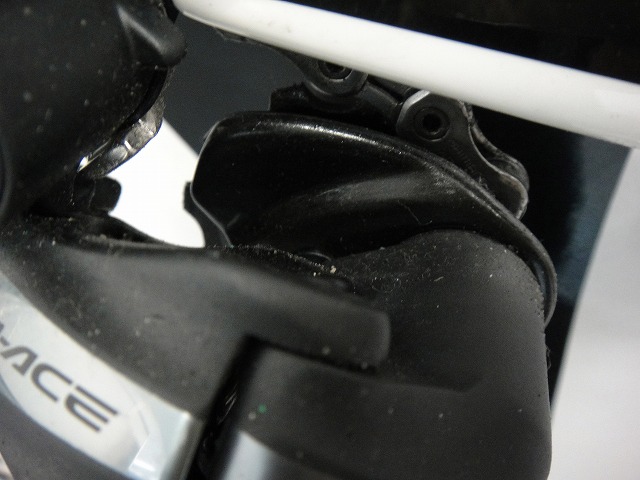
So, what about the RD-7900?
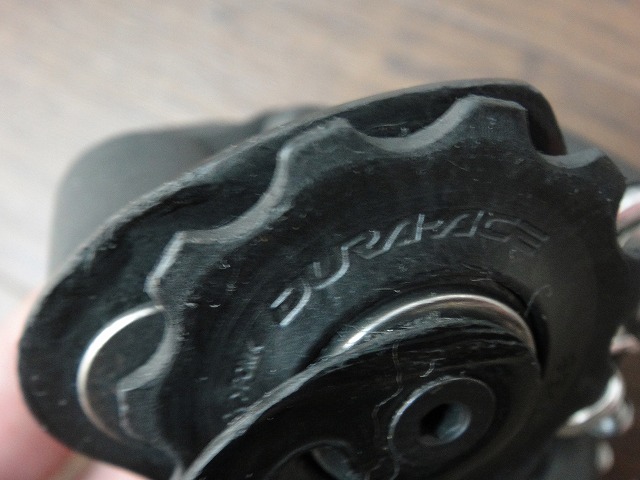
It seems something is missing. The "pushing part."
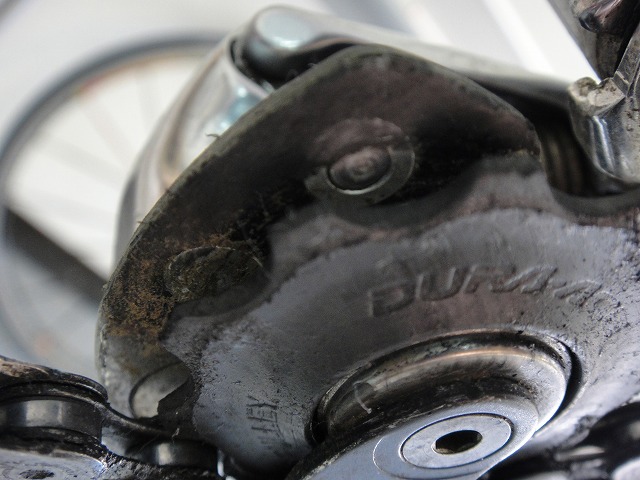
↑I took the same angle shot with the RD-7800.
If pushing the entire pulley cage is advantageous for shifting,
theoretically wouldn't the 7800 be better? Am I the only one thinking that?
I wish the 7900 had something to address this issue.
About pulley wear
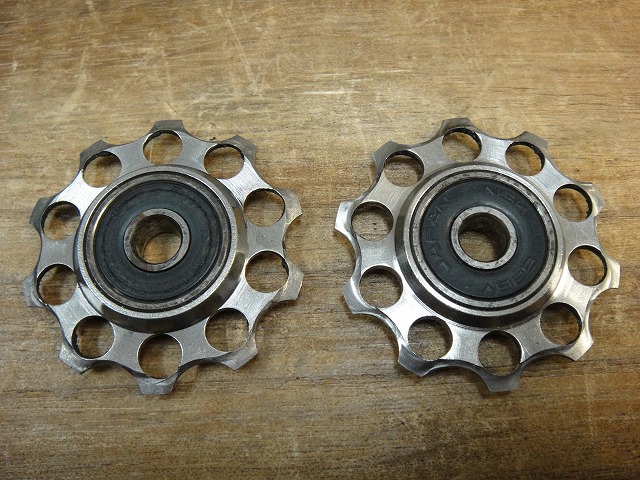
↑This is a titanium pulley.
From when it was first installed until it was removed, I never changed its orientation at all.
It's worn heavily and I'm not using it anymore.
With both pulleys, I'm orienting whichever side shows more wear facing up.
The left one has worn teeth, you know. Almost connecting with the weight-reduction holes.
You can't tell from the photo, but the tooth tip thickness is also thinner on the left.
Right — the left one was originally the guide pulley.
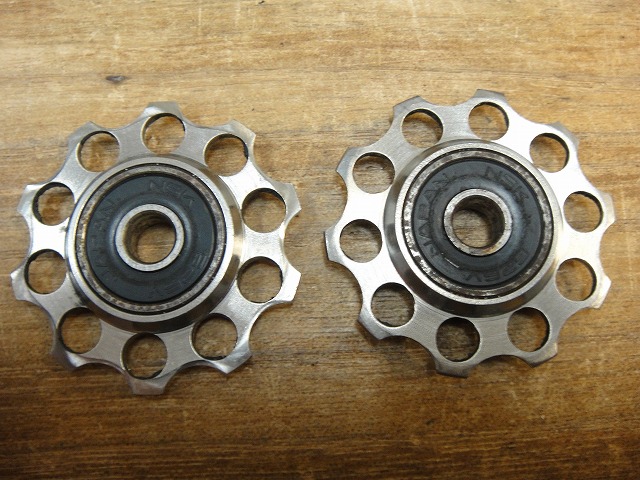
↑I just flipped it over.
Especially the right pulley, you can see
it's not worn much. The previous photo showed the side that was facing inward,
and this photo shows the side that was facing outward,
so you can understand that pulley wear isn't uniform.

↑The outside of the tension pulley from the Chorus at the beginning
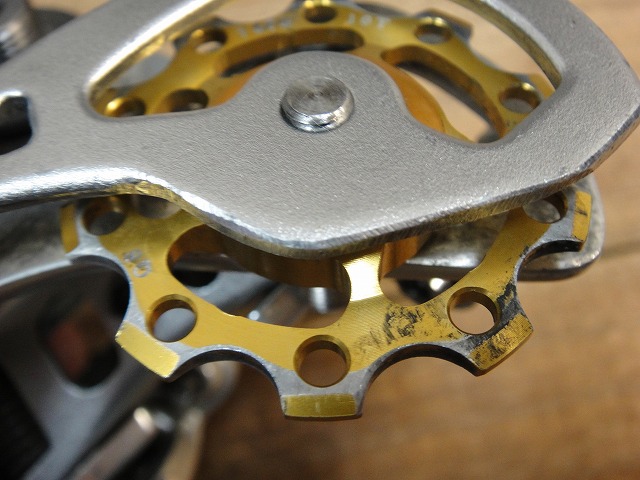
↑Same, the inside
You can tell from the anodize color that
more wear is happening on the inside.
Which means,
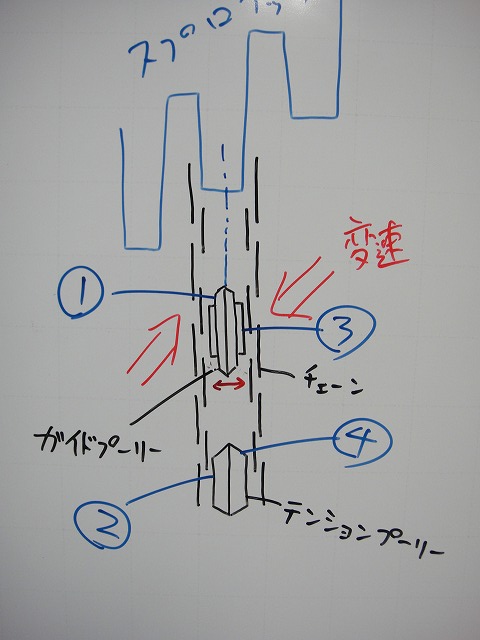
pulley wear patterns work out like this.
If you've got bearing pulleys both top and bottom, it might be good to
rotate your pulleys the next time you change your chain.