I get asked fairly often by customers,
「Which is better for tubular tire adhesion—rim cement or rim tape?」
I'm personally firmly in the rim cement camp, but each has its merits and drawbacks so
I'll try to write about them.
Going forward, I'll use these abbreviations:
Rim cement = cement
Rim tape = tape
Tubular tire = tire
First, regarding basic adhesive strength.
Cement wins here.
Peeling off a tire applied with tape doesn't take that much effort,
but properly cemented tires can be a real pain to remove.
Also, in cyclocross cement is essentially the only choice.
Tape seems weak against mud moisture—I see plenty of cases where tape-applied tires shift or
worst case, completely peel off.
Next, regarding brake heat resistance.
I think tape has the advantage here.
On steep descents when you're holding the brake lever continuously,
the rim gradually heats up from friction with the brake shoe.
Eventually the rim gets hot enough to cause a burn if you touch it,
and at that temperature the cement softens and the tire shifts forward relative to the rim.
Tape might do this too, but cement fails first.
Next, regarding punctures out on the road.
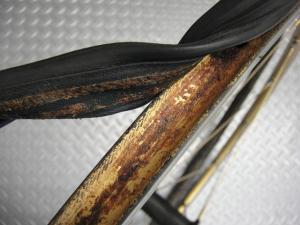
↑With cement, some cement remains on the rim surface after the tire is peeled off.
Also, if you carry a spare tire that's old or one where you've pre-applied cement to the
casing (called a "fundoshi"), you don't need to apply rim cement out on the road.
You can just mount it on the rim and inflate it to 7 bar, and as long as you're not being crazy like attacking descents,
it will be fine. It won't peel off easily.
As I'll mention later, if you've properly built up a "bed" on the rim side, it's even more secure.
With tape, mounting a spare tire requires tape.
Which means you need to carry tape with you.
That's a hassle, and honestly it's the biggest reason I'm a cement guy.
Though truth be told, when I started cycling tape didn't exist anyway.
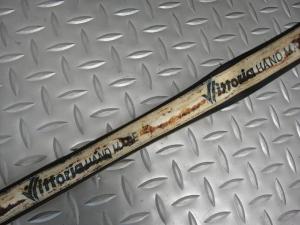
↑This Vittoria tire you see labeled here—that cement-coated surface
was originally called the "rim tape" section,
but in slang it's called the "fundoshi."
These days "rim tape" usually refers to the adhesive tape for tubular tires,
so I used the fundoshi term earlier to avoid confusion.
Tangent here: the term "Super Record" no longer typically refers to
「Campagnolo's flagship component group from around 1985」
but rather to the current 11-speed flagship model.
Similarly, San Marco made a "Concor Sprint" with that distinctive upswept rear shape,
but now they make a current model with the same name that's a completely different ordinary saddle shape,
which is really confusing.
When I talk, I'm usually referring to the older one which just adds to the confusion.
End tangent
Next, regarding how to mount the tire.
I think this is where a lot of prejudice against cement comes from.
For tape first: you lay tape all the way around the rim,
leaving just the edge slightly peeled back.
Then you mount the tire and inflate it gently.
Tubular tires require a "centering" operation.
The goal is to get the fundoshi visible from the rim edge to be equal on both sides,
and to look about the same around a full rotation on both sides—
then tire centering becomes a matter of the tire's own precision.
Once you've positioned the tire's center at the wheel's outer circumference apex,
you pull out that tape edge you peeled back earlier and the tire is mounted.
With cement, you first apply cement to the rim.
The drying time varies with temperature (summer vs. winter),
but you dry it until touching the cement with your finger doesn't produce adhesive strings
(the cement won't stick to your finger).
Then you quickly mount the tire and inflate gently, and do the centering.
You have to do this quickly or the tire bonds completely to the rim before you're done.
Also, if you touch the cement while mounting, it gets all over your finger
and takes forever to come off.
Particularly with some tires that have smaller inner diameters (like Continental premium models and TUFO),
struggling to fit the tire on the rim can result in getting the tire sidewall and your fingers covered in cement on the opposite side of the valve.
That's another reason people shy away from cement.
Also, with cement,
to increase adhesive strength, it's better to apply a thin coat of cement to the tire's fundoshi too when mounting.
When you inflate a tire before mounting it on a rim,
the fundoshi surface turns sideways (though TUFO and others have exceptions)
so laying it on the ground with the fundoshi facing up
makes this step easier.
With experience, some people omit this step intentionally—saying they prefer the tire to peel off easily at replacement—
but when I do work for customers I always apply cement to the tire 100% of the time.
Also, with a new rim, first apply a thin coat of cement to the rim side
and let it dry completely. Then apply cement again.
Repeat this several times to build a proper cement film on the rim side that doesn't peel off easily even when removing the tire.
This film is called a "bed."
Modern cements are high-performance enough that a single coat without a bed will still hold the tire,
but with a bed the adhesive strength is superior.
With cyclocross, a single coat of cement can actually result in tire peeling,
so building a proper bed is even more important than with road bikes.
Also, the bed serves to protect the rim's tire mounting surface—
with aluminum rims it doesn't matter much, but with carbon rims this can be important. I'll mention this more later.
Next, regarding which is better?
Based on the ease and low failure rate of the mounting procedure (keeping your fingers clean),
I first recommend tape to beginners.
There's another reason I recommend tape.
When using tape, the rim's tire mounting surface must be completely clean—no cement residue at all.
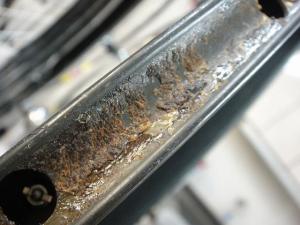
↑This is past "bed" and basically just cement debris,
but applying cement over it again or rebuilding the bed is easy.
However, cleaning this off properly to switch to tape is a nightmare.
You use a solvent called "rim cement cleaner" that contains toluene,
but it's not as simple as erasing pencil marks with an eraser.
In a scent that might make you loopy, you have to scrub with a metal brush
to remove the cement debris or bed.
So I think you should regard cement-to-tape migration as essentially impossible.
I'd like to see more cement users, but because
tape-to-cement is always possible to transition to while
cement-to-tape is essentially irreversible,
that's why I recommend tape first.
Next, regarding adhesive strength after mounting.
This is another merit of tape besides the ease of work.
A tire mounted with cement will shift forward if you brake hard right after mounting.
It takes at least several hours after work to achieve sufficient adhesive strength.
With tape this doesn't happen.
You can mount it and use it in a race immediately.
The final adhesive strength favors cement,
but right after mounting, tape is superior.
Next, regarding damage to carbon rims。
Tni rim instructions say「With cement, solvent effects can cause rim delamination」
and they recommend tape. But I have some doubts about that.
When peeling a tire off a carbon rim,
sometimes the surface layer of the carbon on the tire mounting face peels off,
but from experience tape results in more peeling cases than cement.
Regarding cement: to prevent this, carbon rims require
even more careful bed construction than aluminum rims.
There's a follow-up to the Bora One truing from the other day related to this,
so let me share it.

↑This is a Bora One, but incredibly
someone applied cement over the tape.
It wasn't the customer but apparently a shop.
When they said「When we peeled the tire off the surface delaminated HAHAHAHA」
(that can happen so it can't be helped),
with rim protection in mind we decided to switch completely to cement going forward.
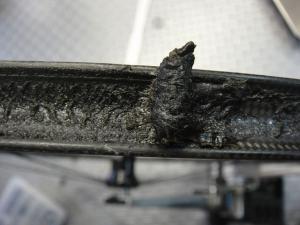
My fingernails were about to come off.
First, peeling the tape stuck to the rim was really difficult.
If I skipped this the bed wouldn't work properly.
Let's do this.
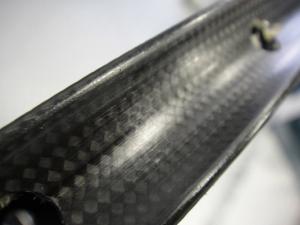
↑All clean now. You can see that clear coating texture.
This is the part where surface delamination didn't occur.
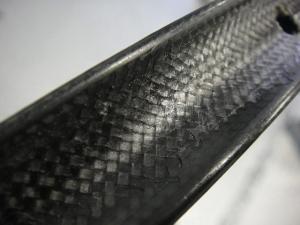
↑This part has surface delamination.
You can see it's lost its glossy finish.
If this section gets peeled again with tape in the future,
the delaminated area could expand further.
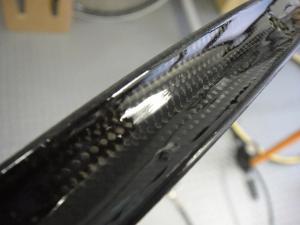
So instead of a single coat,
I built a thicker bed.
Ideally I could take over a week, but
to meet the Shirahama criterium deadline that wasn't possible.
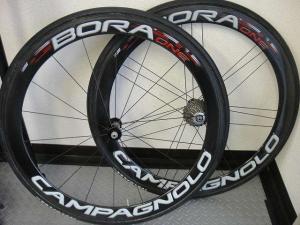
And it's mounted.
This is a personal note about work related to this Bora One.
Never mind this.
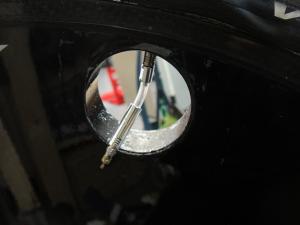
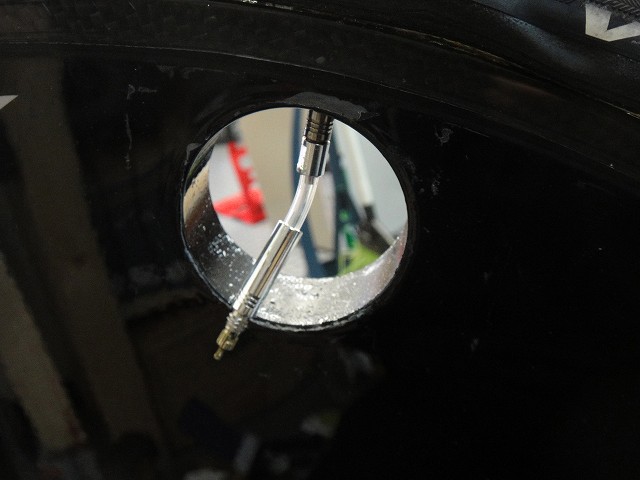
Using a Colima flexible valve extender on this disc wheel actually doesn't work well
(doesn't fit in the hole)so I left it without an extension.
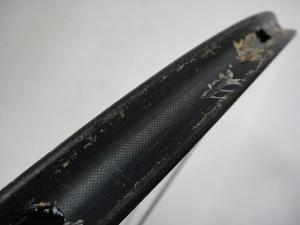
Got off track there.
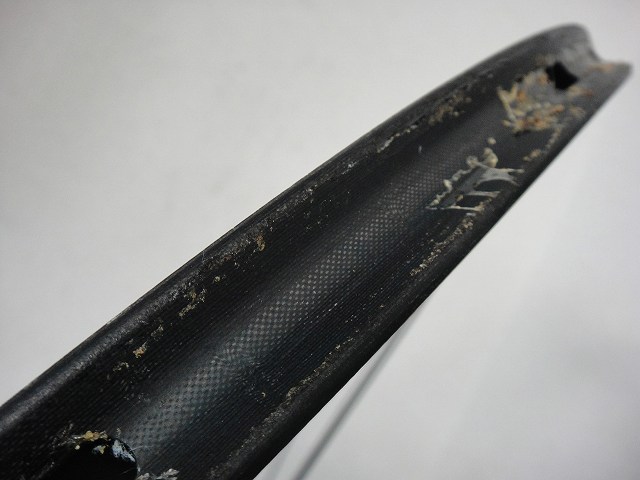
This rim in the image above was mounted with a single cement coat after,
so it has no bed. But to this extent I think you could actually clean it and transition to tape without too much trouble.
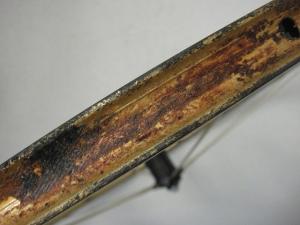
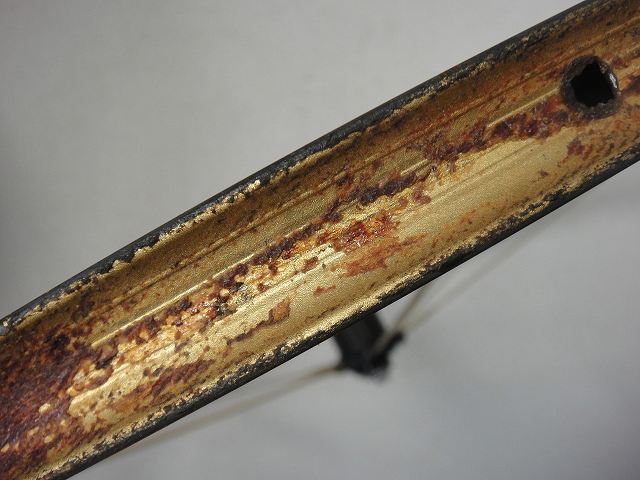
When peeling the tire, ideally cement stays on the rim side, but
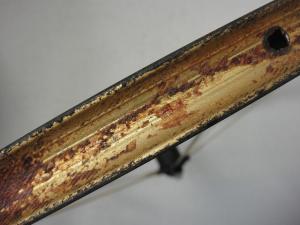
sometimes the cement film comes off with the tire.
Where the bed is gone or thinned out,
the next time you apply cement a bit thicker and let it dry.
I mentioned before that Veloflex tires have a wax-like coating on the fundoshi,
and I got a comment asking「Isn't there concern about adhesive strength?」
With both cement and tape there's absolutely no problem with that.
That coating is a tire-side trick to prevent the bed from peeling off when removing the tire.
Finally.
Between cement and tape, there's no inherent advantage or disadvantage.
Use whichever you find more convenient.
(Though I do push cement for cyclocross)
With tubular tire cement mounting,
if you get a puncture out on the road, the time from puncture to getting going again
is actually shorter than with clinchers or taped tubulars if you get good at it.
Tubular tires aren't as much of a hassle as you'd think.
Due to their construction tubulars generally ride better than clinchers and
have higher cornering limits, so
if you get the chance, definitely try them out.
「Which is better for tubular tire adhesion—rim cement or rim tape?」
I'm personally firmly in the rim cement camp, but each has its merits and drawbacks so
I'll try to write about them.
Going forward, I'll use these abbreviations:
Rim cement = cement
Rim tape = tape
Tubular tire = tire
First, regarding basic adhesive strength.
Cement wins here.
Peeling off a tire applied with tape doesn't take that much effort,
but properly cemented tires can be a real pain to remove.
Also, in cyclocross cement is essentially the only choice.
Tape seems weak against mud moisture—I see plenty of cases where tape-applied tires shift or
worst case, completely peel off.
Next, regarding brake heat resistance.
I think tape has the advantage here.
On steep descents when you're holding the brake lever continuously,
the rim gradually heats up from friction with the brake shoe.
Eventually the rim gets hot enough to cause a burn if you touch it,
and at that temperature the cement softens and the tire shifts forward relative to the rim.
Tape might do this too, but cement fails first.
Next, regarding punctures out on the road.
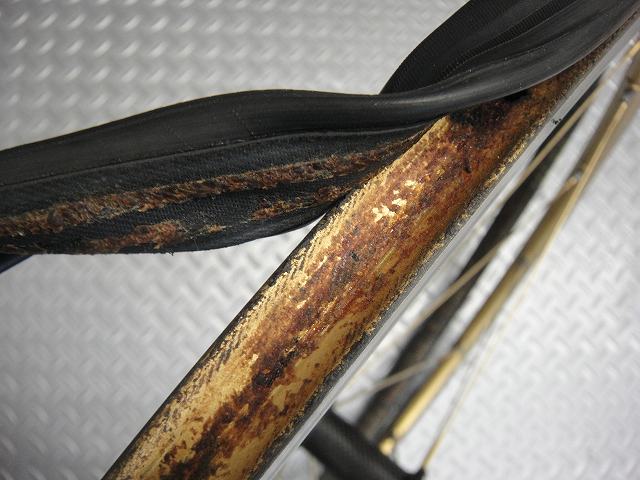
↑With cement, some cement remains on the rim surface after the tire is peeled off.
Also, if you carry a spare tire that's old or one where you've pre-applied cement to the
casing (called a "fundoshi"), you don't need to apply rim cement out on the road.
You can just mount it on the rim and inflate it to 7 bar, and as long as you're not being crazy like attacking descents,
it will be fine. It won't peel off easily.
As I'll mention later, if you've properly built up a "bed" on the rim side, it's even more secure.
With tape, mounting a spare tire requires tape.
Which means you need to carry tape with you.
That's a hassle, and honestly it's the biggest reason I'm a cement guy.
Though truth be told, when I started cycling tape didn't exist anyway.
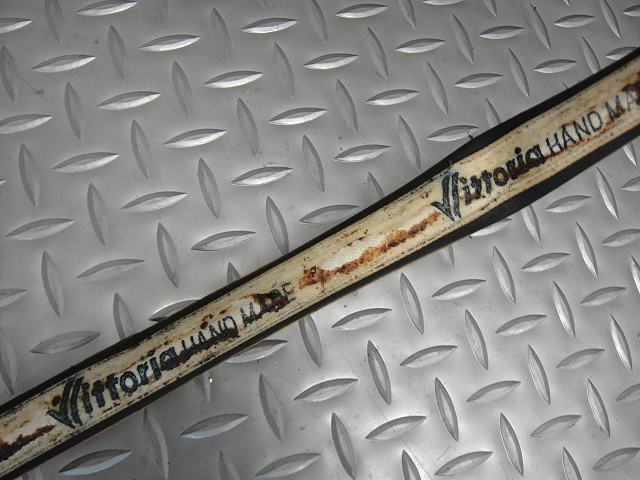
↑This Vittoria tire you see labeled here—that cement-coated surface
was originally called the "rim tape" section,
but in slang it's called the "fundoshi."
These days "rim tape" usually refers to the adhesive tape for tubular tires,
so I used the fundoshi term earlier to avoid confusion.
Tangent here: the term "Super Record" no longer typically refers to
「Campagnolo's flagship component group from around 1985」
but rather to the current 11-speed flagship model.
Similarly, San Marco made a "Concor Sprint" with that distinctive upswept rear shape,
but now they make a current model with the same name that's a completely different ordinary saddle shape,
which is really confusing.
When I talk, I'm usually referring to the older one which just adds to the confusion.
End tangent
Next, regarding how to mount the tire.
I think this is where a lot of prejudice against cement comes from.
For tape first: you lay tape all the way around the rim,
leaving just the edge slightly peeled back.
Then you mount the tire and inflate it gently.
Tubular tires require a "centering" operation.
The goal is to get the fundoshi visible from the rim edge to be equal on both sides,
and to look about the same around a full rotation on both sides—
then tire centering becomes a matter of the tire's own precision.
Once you've positioned the tire's center at the wheel's outer circumference apex,
you pull out that tape edge you peeled back earlier and the tire is mounted.
With cement, you first apply cement to the rim.
The drying time varies with temperature (summer vs. winter),
but you dry it until touching the cement with your finger doesn't produce adhesive strings
(the cement won't stick to your finger).
Then you quickly mount the tire and inflate gently, and do the centering.
You have to do this quickly or the tire bonds completely to the rim before you're done.
Also, if you touch the cement while mounting, it gets all over your finger
and takes forever to come off.
Particularly with some tires that have smaller inner diameters (like Continental premium models and TUFO),
struggling to fit the tire on the rim can result in getting the tire sidewall and your fingers covered in cement on the opposite side of the valve.
That's another reason people shy away from cement.
Also, with cement,
to increase adhesive strength, it's better to apply a thin coat of cement to the tire's fundoshi too when mounting.
When you inflate a tire before mounting it on a rim,
the fundoshi surface turns sideways (though TUFO and others have exceptions)
so laying it on the ground with the fundoshi facing up
makes this step easier.
With experience, some people omit this step intentionally—saying they prefer the tire to peel off easily at replacement—
but when I do work for customers I always apply cement to the tire 100% of the time.
Also, with a new rim, first apply a thin coat of cement to the rim side
and let it dry completely. Then apply cement again.
Repeat this several times to build a proper cement film on the rim side that doesn't peel off easily even when removing the tire.
This film is called a "bed."
Modern cements are high-performance enough that a single coat without a bed will still hold the tire,
but with a bed the adhesive strength is superior.
With cyclocross, a single coat of cement can actually result in tire peeling,
so building a proper bed is even more important than with road bikes.
Also, the bed serves to protect the rim's tire mounting surface—
with aluminum rims it doesn't matter much, but with carbon rims this can be important. I'll mention this more later.
Next, regarding which is better?
Based on the ease and low failure rate of the mounting procedure (keeping your fingers clean),
I first recommend tape to beginners.
There's another reason I recommend tape.
When using tape, the rim's tire mounting surface must be completely clean—no cement residue at all.
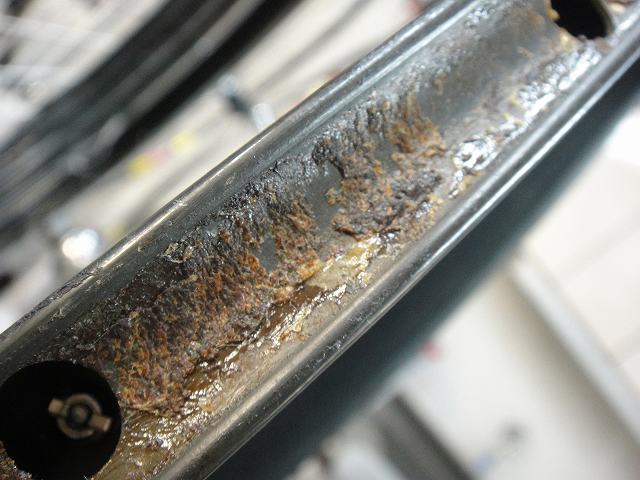
↑This is past "bed" and basically just cement debris,
but applying cement over it again or rebuilding the bed is easy.
However, cleaning this off properly to switch to tape is a nightmare.
You use a solvent called "rim cement cleaner" that contains toluene,
but it's not as simple as erasing pencil marks with an eraser.
In a scent that might make you loopy, you have to scrub with a metal brush
to remove the cement debris or bed.
So I think you should regard cement-to-tape migration as essentially impossible.
I'd like to see more cement users, but because
tape-to-cement is always possible to transition to while
cement-to-tape is essentially irreversible,
that's why I recommend tape first.
Next, regarding adhesive strength after mounting.
This is another merit of tape besides the ease of work.
A tire mounted with cement will shift forward if you brake hard right after mounting.
It takes at least several hours after work to achieve sufficient adhesive strength.
With tape this doesn't happen.
You can mount it and use it in a race immediately.
The final adhesive strength favors cement,
but right after mounting, tape is superior.
Next, regarding damage to carbon rims。
Tni rim instructions say「With cement, solvent effects can cause rim delamination」
and they recommend tape. But I have some doubts about that.
When peeling a tire off a carbon rim,
sometimes the surface layer of the carbon on the tire mounting face peels off,
but from experience tape results in more peeling cases than cement.
Regarding cement: to prevent this, carbon rims require
even more careful bed construction than aluminum rims.
There's a follow-up to the Bora One truing from the other day related to this,
so let me share it.

↑This is a Bora One, but incredibly
someone applied cement over the tape.
It wasn't the customer but apparently a shop.
When they said「When we peeled the tire off the surface delaminated HAHAHAHA」
(that can happen so it can't be helped),
with rim protection in mind we decided to switch completely to cement going forward.
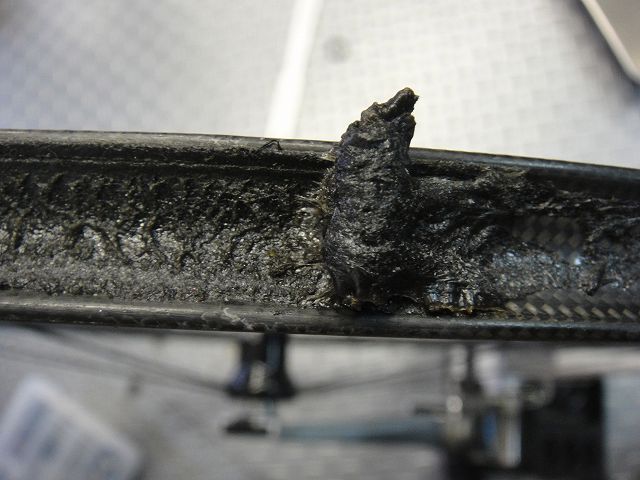
My fingernails were about to come off.
First, peeling the tape stuck to the rim was really difficult.
If I skipped this the bed wouldn't work properly.
Let's do this.
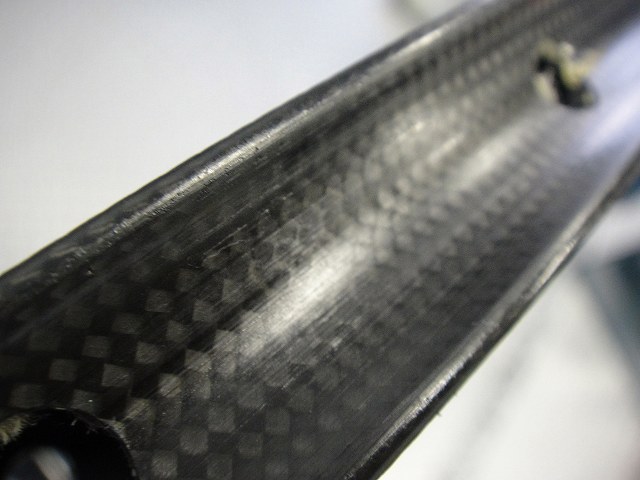
↑All clean now. You can see that clear coating texture.
This is the part where surface delamination didn't occur.
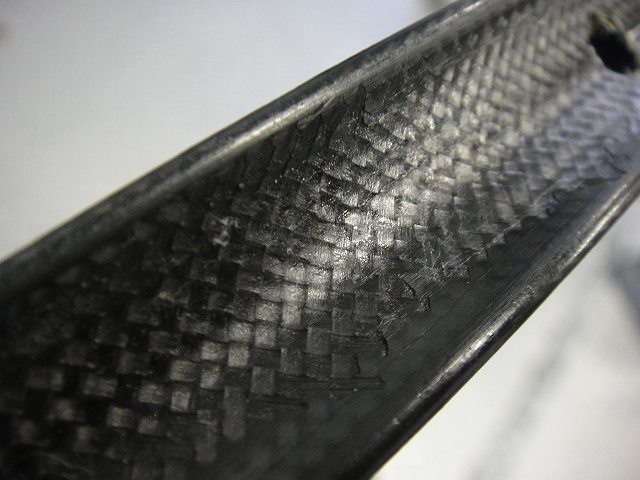
↑This part has surface delamination.
You can see it's lost its glossy finish.
If this section gets peeled again with tape in the future,
the delaminated area could expand further.
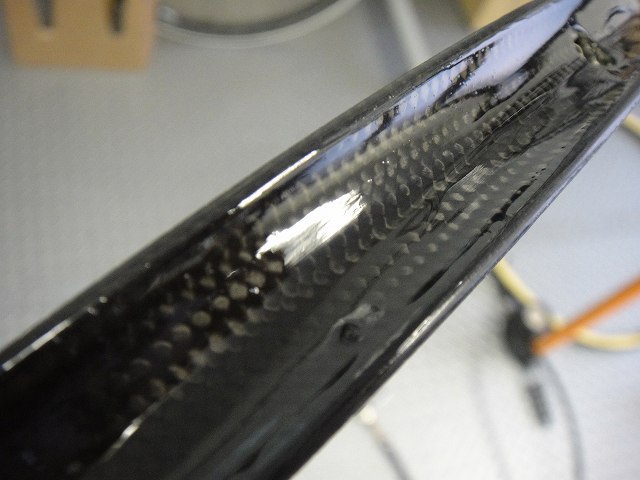
So instead of a single coat,
I built a thicker bed.
Ideally I could take over a week, but
to meet the Shirahama criterium deadline that wasn't possible.

And it's mounted.
This is a personal note about work related to this Bora One.
Never mind this.
Using a Colima flexible valve extender on this disc wheel actually doesn't work well
(doesn't fit in the hole)so I left it without an extension.
Got off track there.
This rim in the image above was mounted with a single cement coat after,
so it has no bed. But to this extent I think you could actually clean it and transition to tape without too much trouble.

When peeling the tire, ideally cement stays on the rim side, but
sometimes the cement film comes off with the tire.
Where the bed is gone or thinned out,
the next time you apply cement a bit thicker and let it dry.
I mentioned before that Veloflex tires have a wax-like coating on the fundoshi,
and I got a comment asking「Isn't there concern about adhesive strength?」
With both cement and tape there's absolutely no problem with that.
That coating is a tire-side trick to prevent the bed from peeling off when removing the tire.
Finally.
Between cement and tape, there's no inherent advantage or disadvantage.
Use whichever you find more convenient.
(Though I do push cement for cyclocross)
With tubular tire cement mounting,
if you get a puncture out on the road, the time from puncture to getting going again
is actually shorter than with clinchers or taped tubulars if you get good at it.
Tubular tires aren't as much of a hassle as you'd think.
Due to their construction tubulars generally ride better than clinchers and
have higher cornering limits, so
if you get the chance, definitely try them out.