Lately I've been getting a lot of comments, and I've been replying to them here in the blog.
But then some commenters reply to my replies too.
So here I'm responding to several of those follow-up comments all at once.
When I was talking about Colima hubs, I mentioned that Colima was pretty much the only one doing kinked-spoke inpoke radial lacing.
But someone sent me a comment saying there are other manufacturers doing this too, with concrete examples.
According to that person:
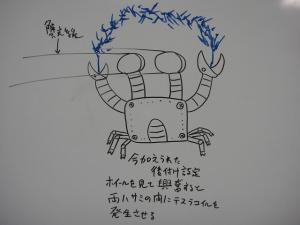
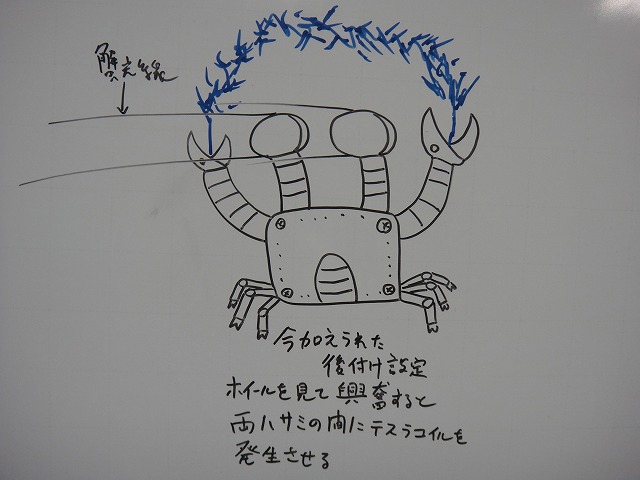
"If a wheel enthusiast saw it, they'd spontaneously discharge like a Tesla coil between crab pinchers,
with beams shooting out of their eyes."
I'm reproducing the comment exactly as written above, typos and all.
× used "用に" when it should be ○ "様に" — I didn't bother correcting that either. ←Well, that kind of stuff doesn't really matter anyway.
So I sketched what that would look like in the image above.
And I'm unofficially adopting it as canon now (laughs).
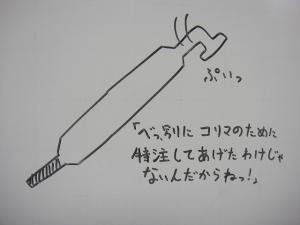
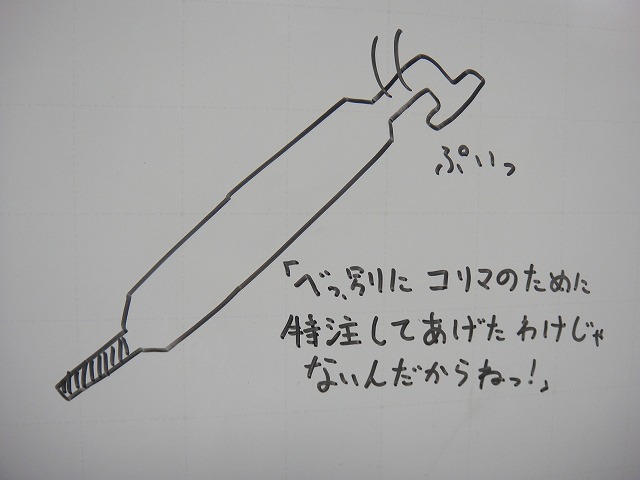
I wrote that the kinked spokes on the freewheel side of Colima hubs have a shape where a normal spoke is twisted 90 degrees,
making them essentially Colima-only parts.
But someone told me that at least one other manufacturer's hubs also require 90-degree-twisted aero spokes.
They also asked whether spokes like this are stably supplied,
and the answer is: no, not for anyone but Colima.
Colima aeros come in two different spoke lengths depending on the year
(same hub, different rim inner diameter). The importer, Trisports, really understands this difference perfectly.
And I've never had a situation where they said they were out of stock.
They're truly professional about it.
That other manufacturer I mentioned — they don't have an importer in Japan right now,
so even if you get the hub, it's difficult to build it up with aero spokes.
You'd be lucky if the spoke length worked out to use Colima spokes depending on which rim you're building,
but there's no guarantee of that.
To the person who commented that they own a wheel built as a "correct" rim
completely independent of rim spoke hole orientation:
There do exist things called "reverse" rims, though they're quite rare.
But bike shops seem to have a habit of building wheels as "correct" rims without even checking the rim's spoke hole orientation
(though I don't do that myself).
So sometimes you come across wheels where the rim's hole orientation and spoke direction don't match.
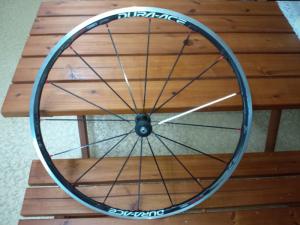
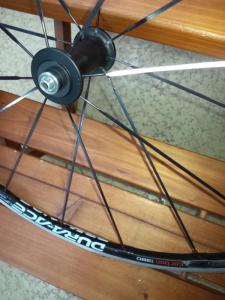
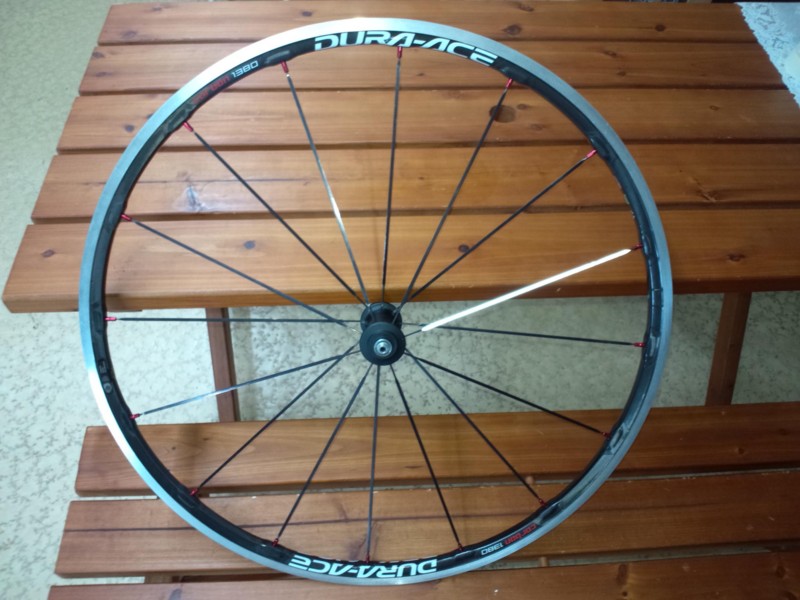
I once had a Zonda front wheel with a destroyed rim that I rebuilt using a Dura-Ace C24 WO
because the inner diameter was very close (see image above).
The Zonda is a reverse rim, and the C24 is a correct rim.
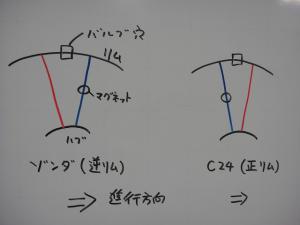
Naturally, I changed the spoke hole orientation when I rebuilt it.
In the image above, let me call the spokes coming out of the flange on my side blue,
and the spokes from the far flange red.
If we say a speedometer sensor is mounted on the right fork blade,
then the spoke where you'd attach the magnet is the spoke on the right side in the direction of travel.
If you want the magnet closest to the valve...
On the Zonda it ends up in front of the valve, but on the C24 it ends up behind the valve.
You might be able to build this wheel wrong and it would still go together,
but it's still not good for the wheel.
By the way, this front wheel is actually a pretty amazing wheel —
it can be made into a sub-300g CULT setup with a WO rim.
As for hub weight, I'm not too fixated on it if the rotation is smooth enough.
Even if a hub is heavier than a Dura-Ace hub, if the rotation is as smooth or smoother, I don't mind.
Actually, steel balls already spin smoother than Dura-Ace hubs anyway.
But there is a limit to how much you can overlook — if it gets heavy like Gokiso, I do hesitate a bit,
no matter how smooth the hub rotation is.
One thing I'm certain of is that I've just made a lot of enemies in the last few lines.
But then some commenters reply to my replies too.
So here I'm responding to several of those follow-up comments all at once.
When I was talking about Colima hubs, I mentioned that Colima was pretty much the only one doing kinked-spoke inpoke radial lacing.
But someone sent me a comment saying there are other manufacturers doing this too, with concrete examples.
According to that person:
"If a wheel enthusiast saw it, they'd spontaneously discharge like a Tesla coil between crab pinchers,
with beams shooting out of their eyes."
I'm reproducing the comment exactly as written above, typos and all.
× used "用に" when it should be ○ "様に" — I didn't bother correcting that either. ←Well, that kind of stuff doesn't really matter anyway.
So I sketched what that would look like in the image above.
And I'm unofficially adopting it as canon now (laughs).
I wrote that the kinked spokes on the freewheel side of Colima hubs have a shape where a normal spoke is twisted 90 degrees,
making them essentially Colima-only parts.
But someone told me that at least one other manufacturer's hubs also require 90-degree-twisted aero spokes.
They also asked whether spokes like this are stably supplied,
and the answer is: no, not for anyone but Colima.
Colima aeros come in two different spoke lengths depending on the year
(same hub, different rim inner diameter). The importer, Trisports, really understands this difference perfectly.
And I've never had a situation where they said they were out of stock.
They're truly professional about it.
That other manufacturer I mentioned — they don't have an importer in Japan right now,
so even if you get the hub, it's difficult to build it up with aero spokes.
You'd be lucky if the spoke length worked out to use Colima spokes depending on which rim you're building,
but there's no guarantee of that.
To the person who commented that they own a wheel built as a "correct" rim
completely independent of rim spoke hole orientation:
There do exist things called "reverse" rims, though they're quite rare.
But bike shops seem to have a habit of building wheels as "correct" rims without even checking the rim's spoke hole orientation
(though I don't do that myself).
So sometimes you come across wheels where the rim's hole orientation and spoke direction don't match.
I once had a Zonda front wheel with a destroyed rim that I rebuilt using a Dura-Ace C24 WO
because the inner diameter was very close (see image above).
The Zonda is a reverse rim, and the C24 is a correct rim.

Naturally, I changed the spoke hole orientation when I rebuilt it.
In the image above, let me call the spokes coming out of the flange on my side blue,
and the spokes from the far flange red.
If we say a speedometer sensor is mounted on the right fork blade,
then the spoke where you'd attach the magnet is the spoke on the right side in the direction of travel.
If you want the magnet closest to the valve...
On the Zonda it ends up in front of the valve, but on the C24 it ends up behind the valve.
You might be able to build this wheel wrong and it would still go together,
but it's still not good for the wheel.

By the way, this front wheel is actually a pretty amazing wheel —
it can be made into a sub-300g CULT setup with a WO rim.
As for hub weight, I'm not too fixated on it if the rotation is smooth enough.
Even if a hub is heavier than a Dura-Ace hub, if the rotation is as smooth or smoother, I don't mind.
Actually, steel balls already spin smoother than Dura-Ace hubs anyway.
But there is a limit to how much you can overlook — if it gets heavy like Gokiso, I do hesitate a bit,
no matter how smooth the hub rotation is.
One thing I'm certain of is that I've just made a lot of enemies in the last few lines.