I received a POWERWAY (Japanese high-performance wheel manufacturer) Scorpio 1 wheel for service.
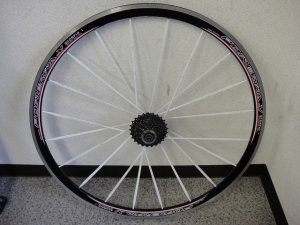
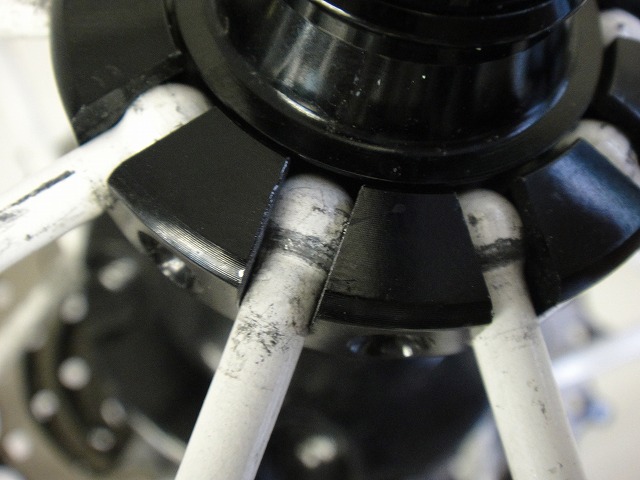
It's a rear wheel with white aluminum spokes laced in a 20-hole radial pattern on one side.
The nipples have standard holes on the outer rim side,
so while the shape and tools required are specialized, the basic structure is no different from a normal wheel.
Unlike Fulcrum's design with no holes besides the valve hole on the rim perimeter,
there's no need to worry about legal issues.
I shouldn't mention how Fulcrum as a brand was apparently created in anticipation of being sued by Mavic
for patent infringement on the Ksyrium design,
and how if they lost the lawsuit they probably intended to shut down immediately,
so it's laughable that Fulcrum would now claim patent infringement against other brands.
The customer apparently got obsessed with spoke truing and overdid it,
leaving the non-drive side extremely tight.
That alone wouldn't be so bad, but
the rim center was severely offset about two spoke widths to the left.
Even on a frame with thin seatstays,
the rim or tire would likely interfere if installed as-is.
So I loosened the non-drive side completely and then
re-tensioned it as if rebuilding the wheel from scratch.
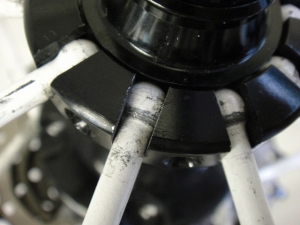
With low spoke tension, spoke heads can rotate at the hub flanges.
Fulcrum's spoke heads have a shape like sliced king trumpet mushroom
that itself acts as a anti-rotation feature, but
the lack of such a design on this wheel wasn't really a choice—
I suspect it was simply not possible to implement.
Since replacement spokes can't be obtained if one breaks,
I worked very carefully.
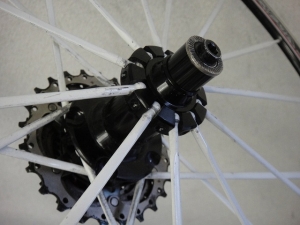
The non-drive side radial lacing might seem loose, but
due to the material properties of aluminum spokes—their resistance to deformation—
even the non-drive side spokes ended up quite rigid.
It feels slightly less stiff than Fulcrum, which is because
it's not a 2:1 lacing pattern,
but even so it reaches a level impossible to achieve with steel spoke wheels.
Come to think of it, I once re-laced a hand-built wheel for a customer
that claimed to "roll faster than Racing Zero"—changed it to asymmetric lacing with crossing on both sides,
and the customer said it transformed so dramatically they realized
what they'd previously thought was the frame being slow was actually the wheel.
But from my perspective, even after that re-lacing,
it doesn't come close to Racing Zero's "simple vertical stiffness."
Aluminum spokes are that powerful.
So I honestly can't figure out the basis for the original wheel being "faster than Racing Zero."
By the way, "simple vertical stiffness" is a term from the Nomu Lab universe tied to wheel performance metrics.
I'm in a difficult position if someone asks "is there such a thing as complex vertical stiffness?"
so I'll stop here. Sorry about that.
EDIT:
"If it was offset two spoke widths, wouldn't it go right up to the drive-side flange?
How much was it actually offset?"
A commenter asked—it really was about two spoke widths.
Around 40mm or so.
This happened through nipple adjustment, but
it shouldn't have been used in that state. Rather, it couldn't be used.
In certain wheel-building methods,
"only tension the drive side to nearly final tension during initial assembly"
creates moments where the rim is offset two spoke widths or more toward the drive side,
so that level of center offset is possible.
Because the non-drive side has greater lateral rim movement per full nipple turn and
less resistance when tensioning nipples,
it's far easier for an amateur to shift the center on the non-drive side than the drive side.
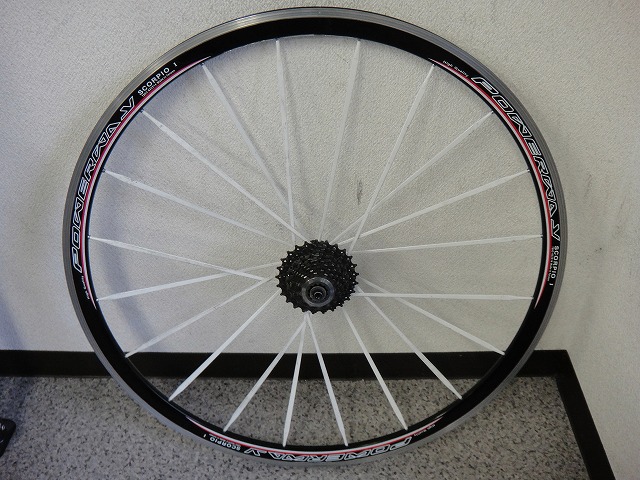
It's a rear wheel with white aluminum spokes laced in a 20-hole radial pattern on one side.
The nipples have standard holes on the outer rim side,
so while the shape and tools required are specialized, the basic structure is no different from a normal wheel.
Unlike Fulcrum's design with no holes besides the valve hole on the rim perimeter,
there's no need to worry about legal issues.
for patent infringement on the Ksyrium design,
and how if they lost the lawsuit they probably intended to shut down immediately,
so it's laughable that Fulcrum would now claim patent infringement against other brands.
The customer apparently got obsessed with spoke truing and overdid it,
leaving the non-drive side extremely tight.
That alone wouldn't be so bad, but
the rim center was severely offset about two spoke widths to the left.
Even on a frame with thin seatstays,
the rim or tire would likely interfere if installed as-is.
So I loosened the non-drive side completely and then
re-tensioned it as if rebuilding the wheel from scratch.
With low spoke tension, spoke heads can rotate at the hub flanges.
Fulcrum's spoke heads have a shape like sliced king trumpet mushroom
that itself acts as a anti-rotation feature, but
the lack of such a design on this wheel wasn't really a choice—
I suspect it was simply not possible to implement.
Since replacement spokes can't be obtained if one breaks,
I worked very carefully.

The non-drive side radial lacing might seem loose, but
due to the material properties of aluminum spokes—their resistance to deformation—
even the non-drive side spokes ended up quite rigid.
It feels slightly less stiff than Fulcrum, which is because
it's not a 2:1 lacing pattern,
but even so it reaches a level impossible to achieve with steel spoke wheels.
Come to think of it, I once re-laced a hand-built wheel for a customer
that claimed to "roll faster than Racing Zero"—changed it to asymmetric lacing with crossing on both sides,
and the customer said it transformed so dramatically they realized
what they'd previously thought was the frame being slow was actually the wheel.
But from my perspective, even after that re-lacing,
it doesn't come close to Racing Zero's "simple vertical stiffness."
Aluminum spokes are that powerful.
So I honestly can't figure out the basis for the original wheel being "faster than Racing Zero."
By the way, "simple vertical stiffness" is a term from the Nomu Lab universe tied to wheel performance metrics.
I'm in a difficult position if someone asks "is there such a thing as complex vertical stiffness?"
so I'll stop here. Sorry about that.
EDIT:
"If it was offset two spoke widths, wouldn't it go right up to the drive-side flange?
How much was it actually offset?"
A commenter asked—it really was about two spoke widths.
Around 40mm or so.
This happened through nipple adjustment, but
it shouldn't have been used in that state. Rather, it couldn't be used.
In certain wheel-building methods,
"only tension the drive side to nearly final tension during initial assembly"
creates moments where the rim is offset two spoke widths or more toward the drive side,
so that level of center offset is possible.
Because the non-drive side has greater lateral rim movement per full nipple turn and
less resistance when tensioning nipples,
it's far easier for an amateur to shift the center on the non-drive side than the drive side.