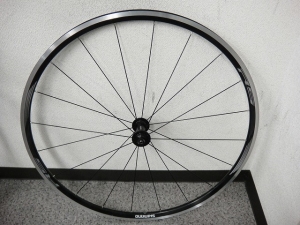
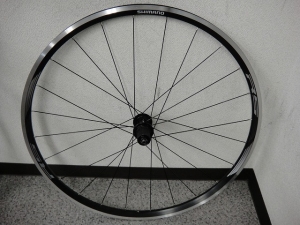
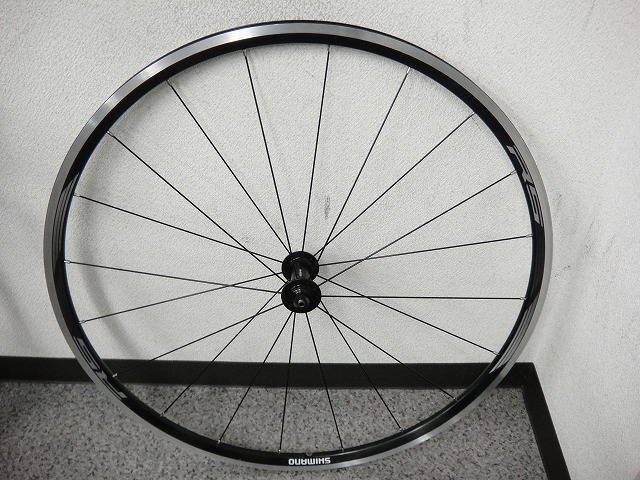
A customer brought in a WH-RS010 for me to check.
They bought it for use on a trainer, apparently,
but there's a strong suspicion from the shop that they just
handed it over straight from the box without checking it.
So they asked me to look it over.
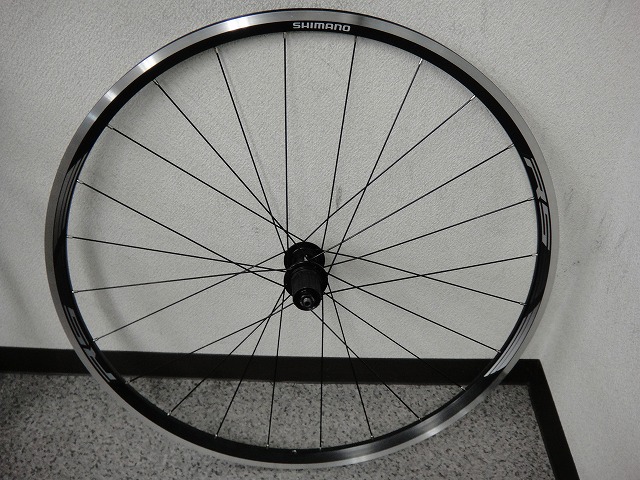
Looking at the rear wheel, the rim centering was spot-on with virtually no runout.
However, the front wheel's centering was so far off that
there's no way anyone could have missed it if they'd actually looked.
So unfortunately, I can confirm it was sold as-is.
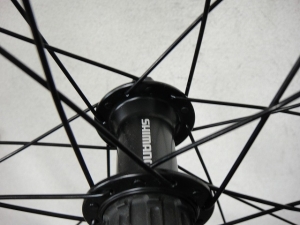
The rear wheel is a 24-spoke Italian-pattern build.
The spoke tension on the non-freewheel side is slightly looser compared to the freewheel side.
It's not particularly low though—pretty standard for a normal wheel.
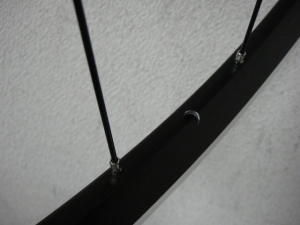
↑It's quite an offset rim, but if it weren't,
the non-freewheel side would be even looser, I'd imagine.
The rim has excellent precision, so you can really dial in the truing.
When Shimano wheels shift to straight-spoke specs,
they stubbornly stick to 16/20H front/rear regardless of rim height.
This is frankly a mistake.
The C24 carbon-laminate rim is light and low-profile, so
a 16H front wheel gets the rim pulled hard alternately left and right,
creating fine wavy runout in the rim holes (between nipples)
that there's simply no way to correct (it doesn't show up as brake drag variation though).
While I'm at it, I'll mention that from a 36H radial front wheel,
we removed spokes four at a time and ran wind tunnel tests,
graphing spoke air resistance for 36→32→28→24→20→16H.
From 36H down to about 24H, the line curves gently, not much different from straight,
but at 20H and 16H it drops sharply like a golf ball trajectory.
I think ZIPP published similar results, and looking at that graph,
I understand the obsession with thinking "16H is optimal for front wheel spokes."
But spoke air resistance is ultimately just one element of the wheel,
not important enough to sacrifice stiffness over.
With decent rim height, spoke counts under 20H aren't a problem,
but 16H on a C24 rim is just unreasonable.
Suppose we build both a 16H and 20H front wheel on a Nomulab wheel #5
with similar weight and rim height to the C24,
ignoring the risk of spoke nipple failure on bent-spoke designs.
The 16H would have an advantage in air resistance and weight with four fewer spokes,
but considering overall performance including stiffness, I think the 20H comes out ahead.
The C24 falls short by that very fact—being a straight-spoke spec.
If C24 came with a 20H front wheel,
I believe it would be a better-handling wheel than the 16H.
Between the C24 rim and the XR200 rim,
the C24 can handle higher tension, I think,
but the difference in spoke tension between these two
isn't as dramatic as "a 16H rim that can handle high tension makes a stiffer wheel than a 20H rim!"
The reason I'm saying "absolutely not" rather than "I don't think so" here
actually has some basis, but I can't quite write it out—my apologies.
This alone would make for a pretty useless article if I expanded it,
but making a separate post sounds like a pain, so I'll leave it as-is.
Anyway, the RS-010's rim
doesn't undulate in fine waves side-to-side in the brake zone despite being constrained by spoke tension
(which isn't that high to begin with),
so it actually edges out the C24 in how tight you can dial in the truing.
The rim is just that durable, but naturally it's quite heavy.
There's basically no such thing as a strong, light rim.
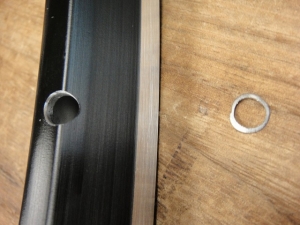
The rear wheel's assembly precision was acceptable,
but there were some pretty large metal shavings stuck in the rim.
They bought it for use on a trainer, apparently,
but there's a strong suspicion from the shop that they just
handed it over straight from the box without checking it.
So they asked me to look it over.
Looking at the rear wheel, the rim centering was spot-on with virtually no runout.
However, the front wheel's centering was so far off that
there's no way anyone could have missed it if they'd actually looked.
So unfortunately, I can confirm it was sold as-is.
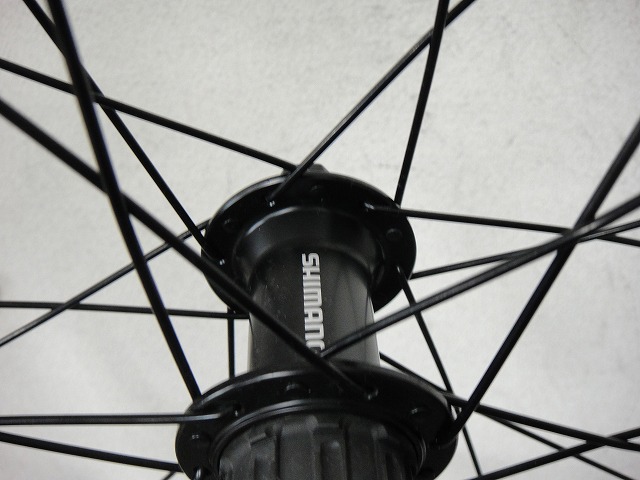
The rear wheel is a 24-spoke Italian-pattern build.
The spoke tension on the non-freewheel side is slightly looser compared to the freewheel side.
It's not particularly low though—pretty standard for a normal wheel.

↑It's quite an offset rim, but if it weren't,
the non-freewheel side would be even looser, I'd imagine.
The rim has excellent precision, so you can really dial in the truing.
When Shimano wheels shift to straight-spoke specs,
they stubbornly stick to 16/20H front/rear regardless of rim height.
This is frankly a mistake.
The C24 carbon-laminate rim is light and low-profile, so
a 16H front wheel gets the rim pulled hard alternately left and right,
creating fine wavy runout in the rim holes (between nipples)
that there's simply no way to correct (it doesn't show up as brake drag variation though).
While I'm at it, I'll mention that from a 36H radial front wheel,
we removed spokes four at a time and ran wind tunnel tests,
graphing spoke air resistance for 36→32→28→24→20→16H.
From 36H down to about 24H, the line curves gently, not much different from straight,
but at 20H and 16H it drops sharply like a golf ball trajectory.
I think ZIPP published similar results, and looking at that graph,
I understand the obsession with thinking "16H is optimal for front wheel spokes."
But spoke air resistance is ultimately just one element of the wheel,
not important enough to sacrifice stiffness over.
With decent rim height, spoke counts under 20H aren't a problem,
but 16H on a C24 rim is just unreasonable.
Suppose we build both a 16H and 20H front wheel on a Nomulab wheel #5
with similar weight and rim height to the C24,
ignoring the risk of spoke nipple failure on bent-spoke designs.
The 16H would have an advantage in air resistance and weight with four fewer spokes,
but considering overall performance including stiffness, I think the 20H comes out ahead.
The C24 falls short by that very fact—being a straight-spoke spec.
If C24 came with a 20H front wheel,
I believe it would be a better-handling wheel than the 16H.
Between the C24 rim and the XR200 rim,
the C24 can handle higher tension, I think,
but the difference in spoke tension between these two
isn't as dramatic as "a 16H rim that can handle high tension makes a stiffer wheel than a 20H rim!"
The reason I'm saying "absolutely not" rather than "I don't think so" here
actually has some basis, but I can't quite write it out—my apologies.
This alone would make for a pretty useless article if I expanded it,
but making a separate post sounds like a pain, so I'll leave it as-is.
Anyway, the RS-010's rim
doesn't undulate in fine waves side-to-side in the brake zone despite being constrained by spoke tension
(which isn't that high to begin with),
so it actually edges out the C24 in how tight you can dial in the truing.
The rim is just that durable, but naturally it's quite heavy.
There's basically no such thing as a strong, light rim.

The rear wheel's assembly precision was acceptable,
but there were some pretty large metal shavings stuck in the rim.