Today it's wheels again (and so on).
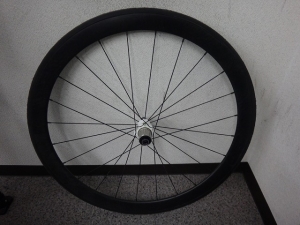
A customer dropped off a Vision carbon wheel with me.
The stickers were already peeled off by the customer.
They peel off stickers without hesitation even on Racing Speed and Cosmic Carbon Ultimate,
so they did the same here.
Vision is a sub-brand of FSA's time trial parts,
a brand that only carries aero bars, aero wheels, and time trial forward-positioned saddles...
but lately they seem to be expanding into road bike parts too.
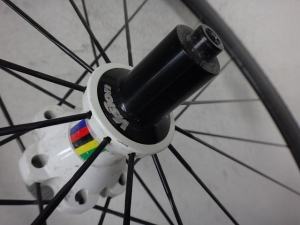
This wheel has a very narrow rear hub flange width,
minimizing the frontal projection area of the spokes.
There's an Easton EC90TT with a 12H front wheel,
and for probably the same reason, that one also has quite a narrow flange.
When spoke tension is maxed out as much as the rim allows,
lateral stiffness is essentially determined by flange width.
It's a law of nature—there are no exceptions.
This wheel doesn't have particularly high lateral stiffness either, and apparently it noticeably flexes on descents,
and even on flat ground the handling when attacking corners feels unreliable.
Oh, and the customer also said "you can't use it in road racing."
If you're the type who grips the aero bars and hardly ever stands up while pedaling—
a time trial-style rider—then spoke wind resistance is prioritized over stiffness, so
(I personally don't think so at all)
maybe the lack of lateral stiffness doesn't bother them.
The customer was using this for cyclocross
(apparently it works okay for cyclocross),
but they wanted to rebuild it for road racing.
Before the rebuild it had a Shimano 10-speed freebody,
and they want me to upgrade it to 11-speed in the process.
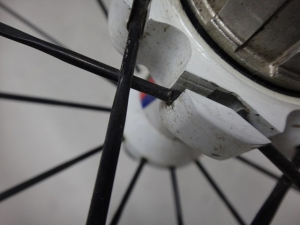
Looking closely, there's dirt in all sorts of places that shows the distinctive wear pattern of cyclocross.
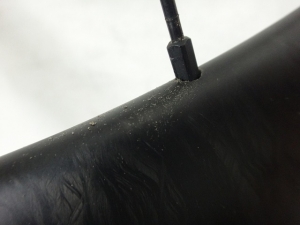
When I loosened the nipples to disassemble it,
sand came pouring out.
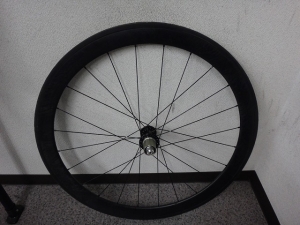
Built it up.
At the customer's request, I used black spokes.
(They have the front wheel too and wanted to match the colors)
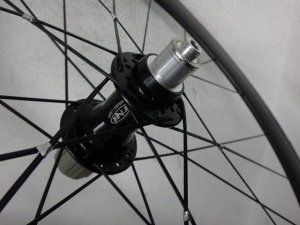
Evolite hub 24H semi-champ...
*wait*
I used Wheelsmith SS14 on the freewheel side and CX-RAY on the non-freewheel side,
so it's a semi-SS14 4/6 radial/tangential laced pattern with crossing.
Before the rebuild, the non-freewheel side was radially laced with low tension
(low even accounting for the fact that it's harder to tension),
so after the rebuild the stiffness has definitely increased.
There's no way I'd say "you can't use it in road racing" anymore.
But since it wasn't an "incredibly high-tension carbon rim," it didn't come out
in that "no crossing needed!" way.
So for me, crossing is essential.
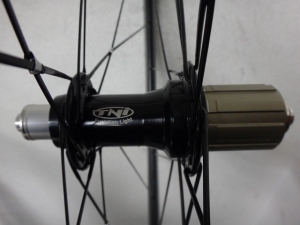
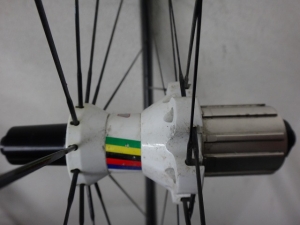
The flex resistance of the final spoke crossing when I squeeze it front-to-back
has improved,
and when I squeeze the spokes together from side to side,
the flex resistance has improved dramatically.
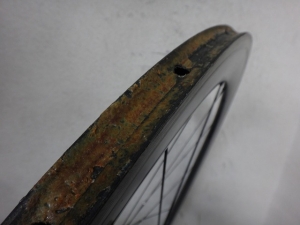
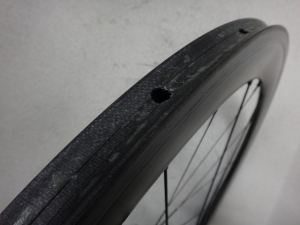
The customer uses tubeless tape on their road wheels,
but on the cyclocross wheels
they'd created a super-strong bed by mixingKonishi Bond G17 mystery adhesive into rim cement
(the image above is still the better part of it).
Before switching to road wheels, they asked me to clean up the rim
well enough to apply tape (※),
and this was extremely tedious.
The basic approach is using acetone,
but where it would normally come off easily, this stuff wouldn't budge.
Especially the bed that had gotten into the tire bead-seat groove was incredibly stubborn.
This rebuild took 30 minutes for wheel building and 12 minutes for crossing,
but removing the bed definitely took over 30 minutes.
※To be precise, initially it wasn't "clean up the rim for me"
but rather "teach me how to do it and I'll do it myself,"
but after watching me work, it changed to "I'll bring the front wheel too, so thanks."
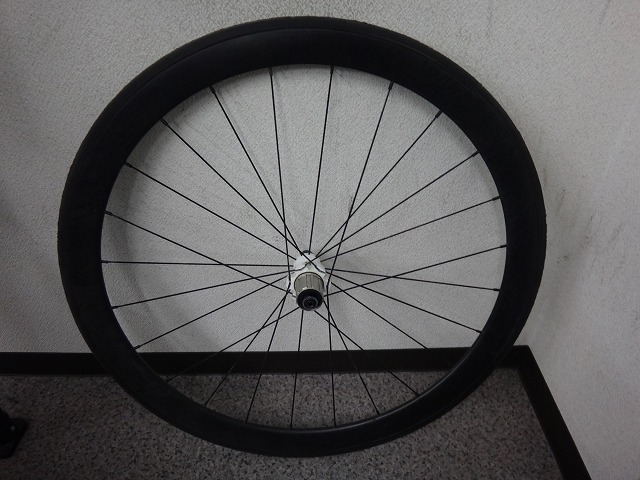
A customer dropped off a Vision carbon wheel with me.
The stickers were already peeled off by the customer.
They peel off stickers without hesitation even on Racing Speed and Cosmic Carbon Ultimate,
so they did the same here.
Vision is a sub-brand of FSA's time trial parts,
a brand that only carries aero bars, aero wheels, and time trial forward-positioned saddles...
but lately they seem to be expanding into road bike parts too.
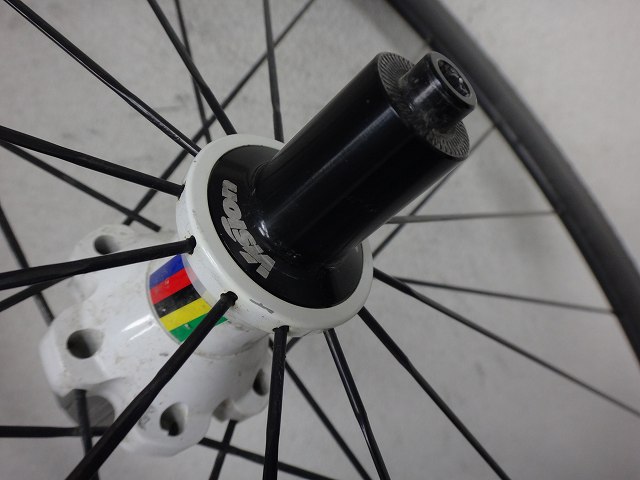
This wheel has a very narrow rear hub flange width,
minimizing the frontal projection area of the spokes.
There's an Easton EC90TT with a 12H front wheel,
and for probably the same reason, that one also has quite a narrow flange.
When spoke tension is maxed out as much as the rim allows,
lateral stiffness is essentially determined by flange width.
It's a law of nature—there are no exceptions.
This wheel doesn't have particularly high lateral stiffness either, and apparently it noticeably flexes on descents,
and even on flat ground the handling when attacking corners feels unreliable.
Oh, and the customer also said "you can't use it in road racing."
If you're the type who grips the aero bars and hardly ever stands up while pedaling—
a time trial-style rider—then spoke wind resistance is prioritized over stiffness, so
maybe the lack of lateral stiffness doesn't bother them.
The customer was using this for cyclocross
(apparently it works okay for cyclocross),
but they wanted to rebuild it for road racing.
Before the rebuild it had a Shimano 10-speed freebody,
and they want me to upgrade it to 11-speed in the process.
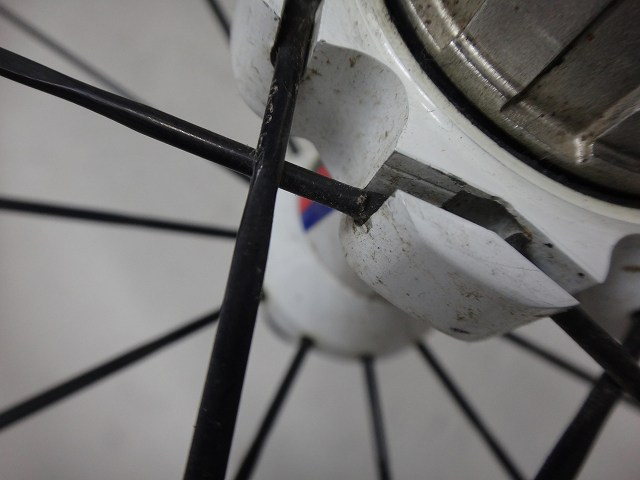
Looking closely, there's dirt in all sorts of places that shows the distinctive wear pattern of cyclocross.

When I loosened the nipples to disassemble it,
sand came pouring out.
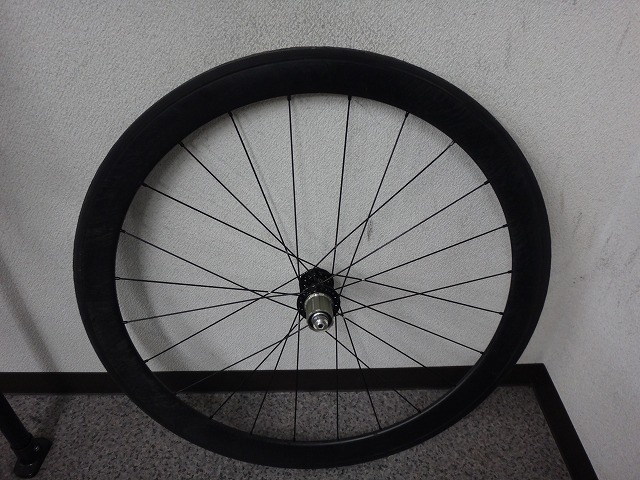
Built it up.
At the customer's request, I used black spokes.
(They have the front wheel too and wanted to match the colors)
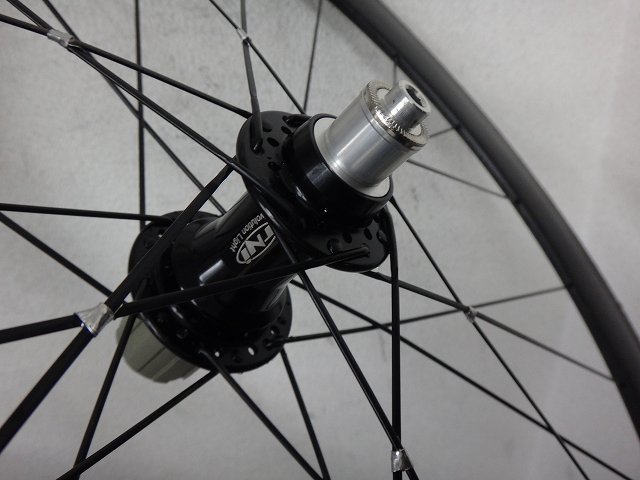
Evolite hub 24H semi-champ...
*wait*
I used Wheelsmith SS14 on the freewheel side and CX-RAY on the non-freewheel side,
so it's a semi-SS14 4/6 radial/tangential laced pattern with crossing.
Before the rebuild, the non-freewheel side was radially laced with low tension
(low even accounting for the fact that it's harder to tension),
so after the rebuild the stiffness has definitely increased.
There's no way I'd say "you can't use it in road racing" anymore.
But since it wasn't an "incredibly high-tension carbon rim," it didn't come out
in that "no crossing needed!" way.
So for me, crossing is essential.
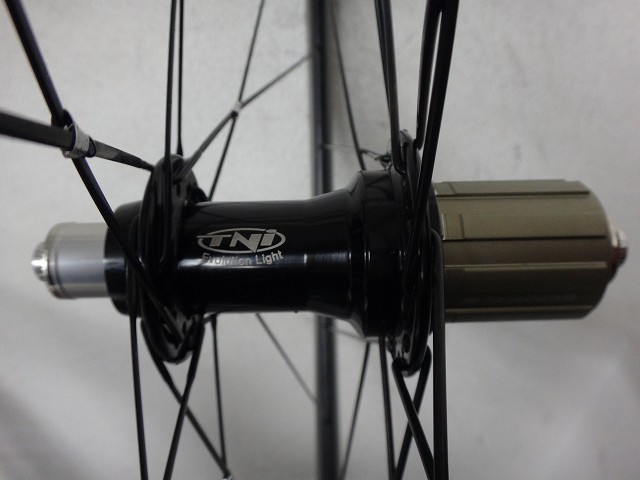
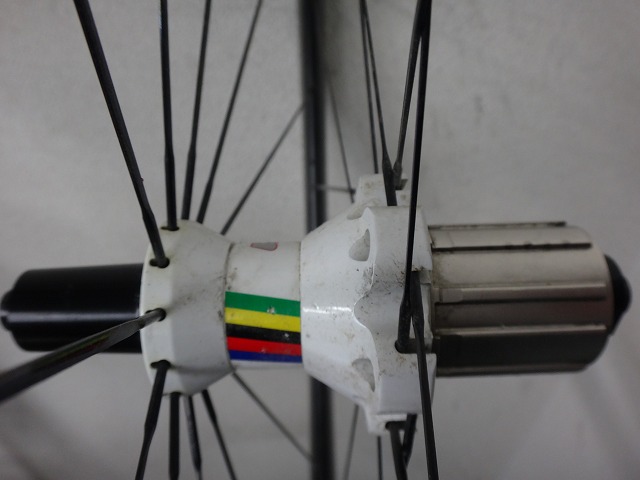
The flex resistance of the final spoke crossing when I squeeze it front-to-back
has improved,
and when I squeeze the spokes together from side to side,
the flex resistance has improved dramatically.


The customer uses tubeless tape on their road wheels,
but on the cyclocross wheels
they'd created a super-strong bed by mixing
(the image above is still the better part of it).
Before switching to road wheels, they asked me to clean up the rim
well enough to apply tape (※),
and this was extremely tedious.
The basic approach is using acetone,
but where it would normally come off easily, this stuff wouldn't budge.
Especially the bed that had gotten into the tire bead-seat groove was incredibly stubborn.
This rebuild took 30 minutes for wheel building and 12 minutes for crossing,
but removing the bed definitely took over 30 minutes.
※To be precise, initially it wasn't "clean up the rim for me"
but rather "teach me how to do it and I'll do it myself,"
but after watching me work, it changed to "I'll bring the front wheel too, so thanks."