Regarding yesterday's ENVE rebuild article, I received a comment saying
"I feel like American Classic's narrow flange width should be considered together with its large flange diameter."
American Classic (henceforth Amcla) rear hubs have such an indefensible specification even when taking flange diameter into account, so I'll write about that.

Before that.
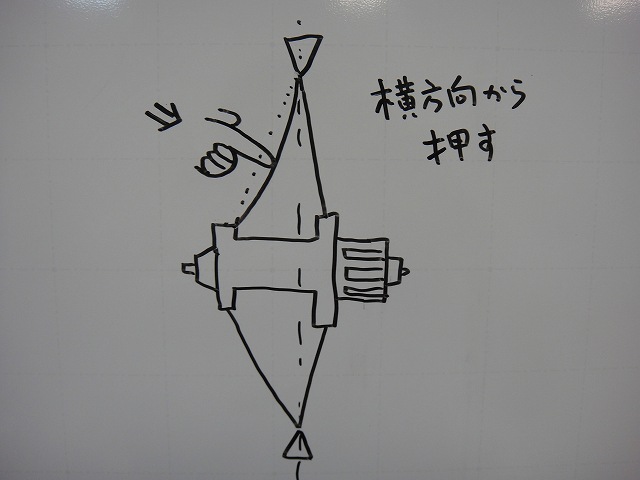
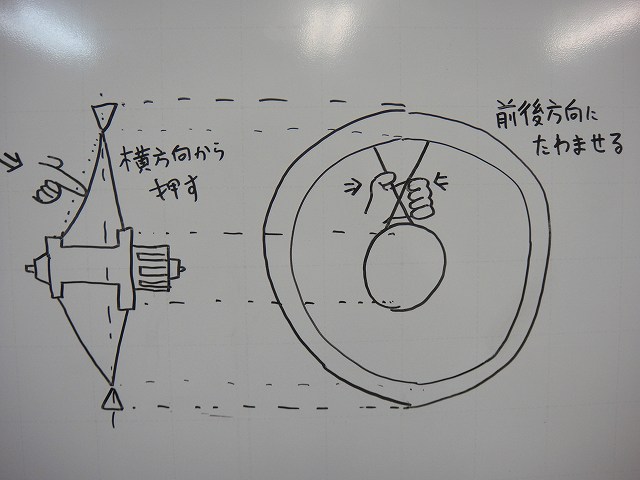
Let me think about spoke deflection in two different directions.
In a completed wheel state, if we deflect a spoke, one way is like in the diagram above—pushing the spoke from the side.

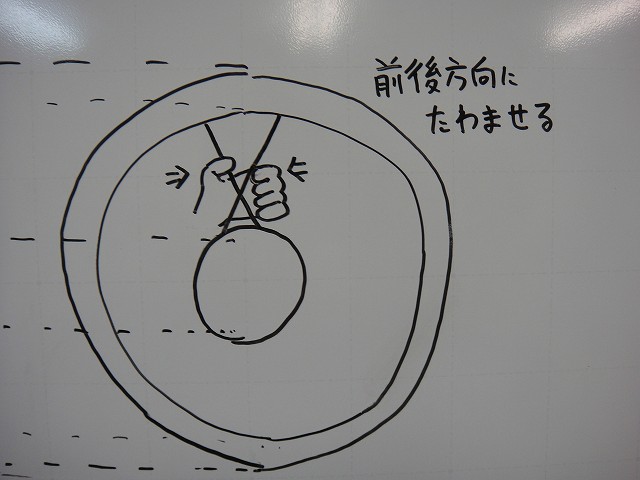
The other is grabbing two spokes on the same side together and deflecting them.
Deflection in the fore-aft direction.
With tangent lacing, we'd grab the two crossing spokes.

Either way, raising spoke tension reduces deflection, but we can also aim to mitigate deflection by enlarging the hub flange.
(The same applies if rim height increases)
If that were all, it'd be fine.
What makes Amcla rear hubs indefensible is that the left flange is positioned inward.
The loss from this is not recovered by having a large flange.

First, regarding fore-aft deflection.
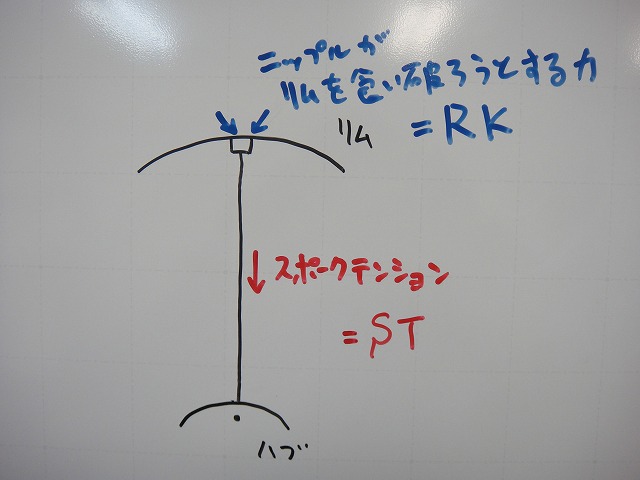
Let's call spoke tension ST,
and the force with which the nipple tries to bite through the rim RK (Rim Kuiyaburu—rim being eaten through).
As ST increases, RK also increases.

The previous diagram was radial lacing, but this is tangent lacing.

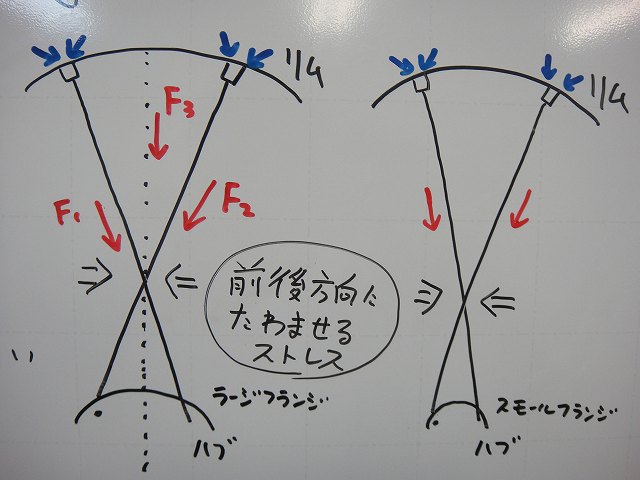
Let's call the pulling directions of the two crossing spokes in tangent lacing F1 and F2 respectively.
The combined pulling direction of F1 and F2 becomes F3 in the diagram above.
F3 aligns with the line connecting the spoke intersection point and the hub center.

Radial lacing, by definition, pulls spokes along the F3 line, so there's no angular loss in pulling direction.

With the same hub and same rim, if both radial and tangent lacing have the same ST, the radial lacing produces higher RK.
To achieve the same RK, radial lacing requires lower tension.
This is a bit of a tangent from Amcla, but my 4×6 and 4×8 lacing patterns aim to bring the freeheel side closer to radial (while still being tangent lacing) to relatively raise the tension on the non-freeheel side.

↑Taking the hub from before as a large flange, I've added a small flange hub next to it.
A small flange diameter doesn't mean you can't achieve sufficient ST.
Rather, the lacing method (radial or tangent) is a larger factor in the ST-RK relationship.

At the same ST, a large flange does deflect less when you squeeze the spoke intersection. That's true.
But reducing deflection during spoke-intersection squeezing is easy—just raise the ST.
Within realistic ranges (whether the hub is Tni, Dura-Ace, or Amcla), you can feel a meaningful change in fore-aft deflection with just one or half turn of the nipples near wheel completion.
What I'm saying is, large flanges provide little real benefit in reducing fore-aft deflection.

Next, lateral deflection.
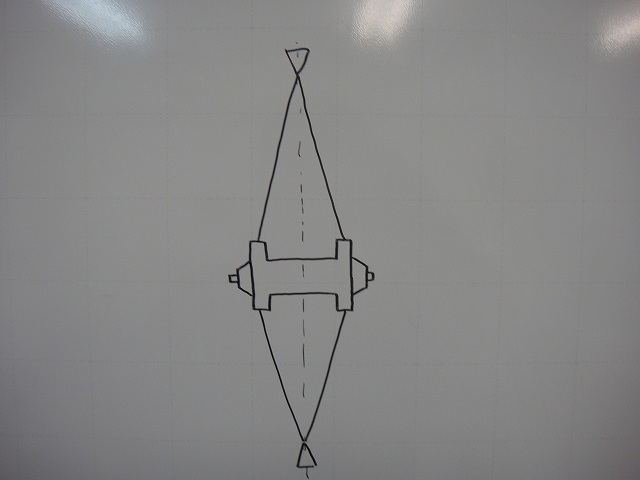
Let me consider a front wheel with radial lacing (←if both sides have the same lacing pattern, really any pattern works, but I think radial is easiest to visualize).
The spokes connect the hub flange to the rim, and there's some angle between the wheel's centerline and the spoke's slant line.
The more obtuse this angle, the less spoke deflection.

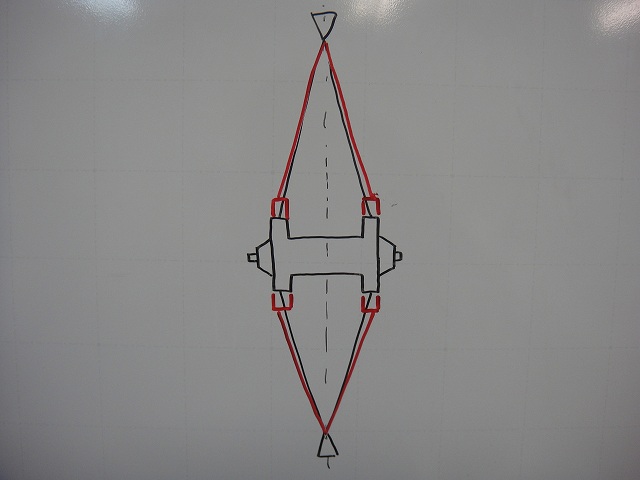
↑Here's a large flange version. The red lines I added show that.
The angle between the centerline and the spokes is now more obtuse.
Which means this wheel is (if ST is the same) definitely stiffer laterally—less lateral deflection—than the previous wheel.

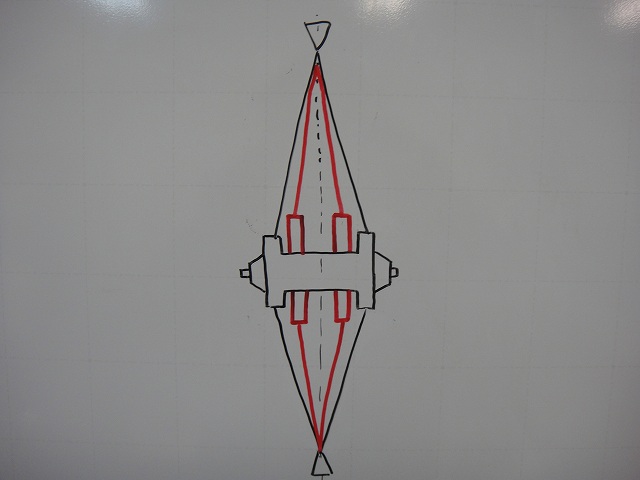
Now consider a hub with a large flange but the flange positioned inward.
In the diagram, you can see the acute angle between the centerline and spoke is sharper than on the original wheel.
Large flange will reduce fore-aft deflection, but as I said earlier, a small flange can recover that.
The lateral stiffness loss from moving the flange inward cannot be recovered by saying "I'll tighten the nipples!"
Let me try enlarging the flange diameter just enough, keeping this hub's flange width, to achieve the same spoke angle as the original wheel.

↑There we go.
The spokes become shorter, so even with the same acute angle between centerline and spoke, this wheel is much stiffer than the original.
My diagrams are quite exaggerated, so accuracy is questionable, but I'd like to now work through actual numbers with Tni Evolution's rear hub and Amcla's rear hub.

↑From this wheel diagram,

I'll zoom in on just the upper side of the non-freeheel side.

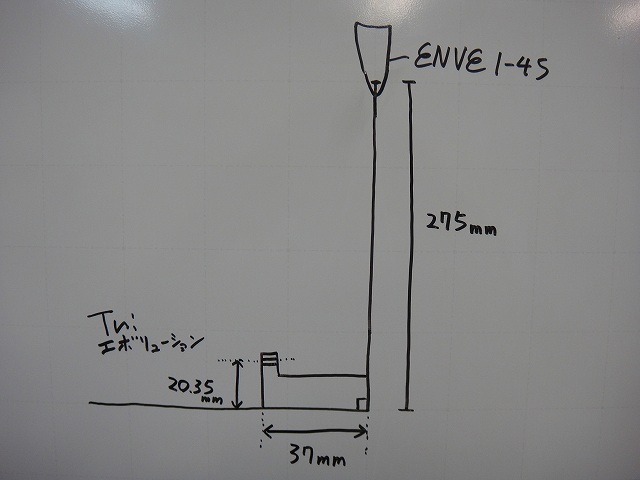
First, with the rim as ENVE 1-45 tubular and hub as Tni Evolution.

Let's say ENVE's rim inner diameter radius is 275mm.
It's not exactly 275.0mm, and I'd rather not go into Mesinota Neko Cord (thread pitch nomenclature), so please excuse the 275mm calculation.
Even so, it's close enough to measured values within rounding error.
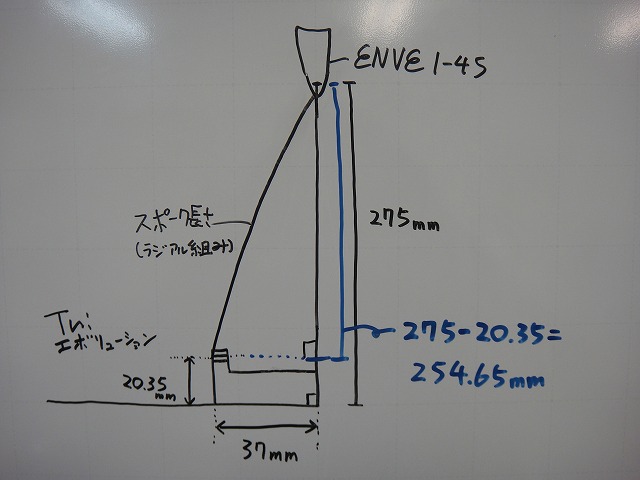
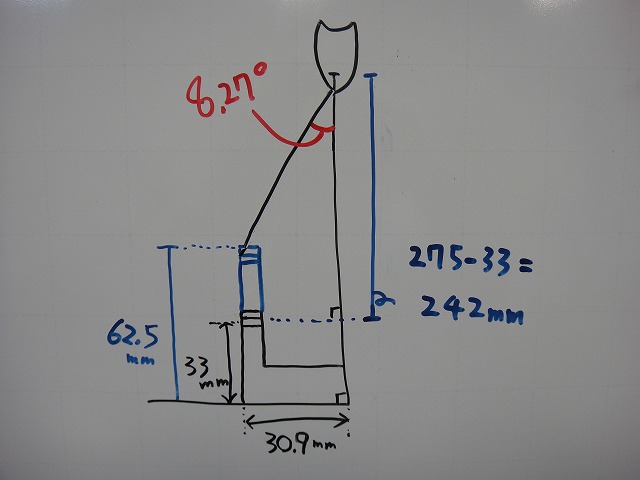
For the Tni Evo hub, let's say the distance from wheel center to flange outer edge is 37mm, and the distance from hub axle center to hub flange hole center is 20.35mm.

↑I can see a right triangle where the height is half the rim inner diameter minus the flange radius, and the base is the distance from wheel center to hub flange outer edge.
The hypotenuse length is the spoke length for radial lacing.
Since this is about the acute angle between wheel center and spoke, calculating this gives

8.27°.
When I held a protractor to the diagram it read 30° (laugh).
The diagram is rough, but the angle numbers are accurate.

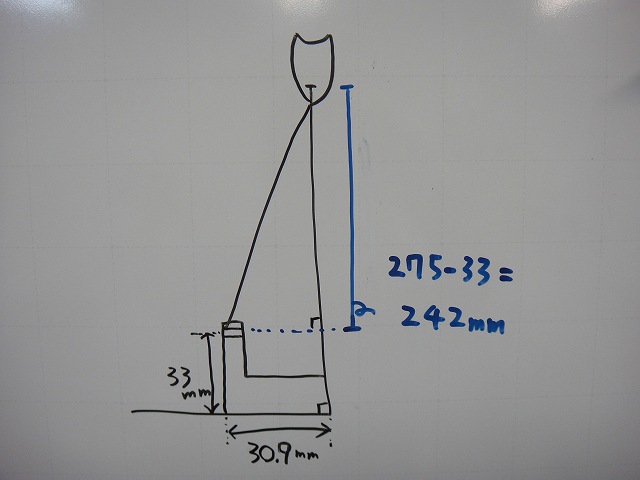
↑Let me do the same with Amcla's rear hub.

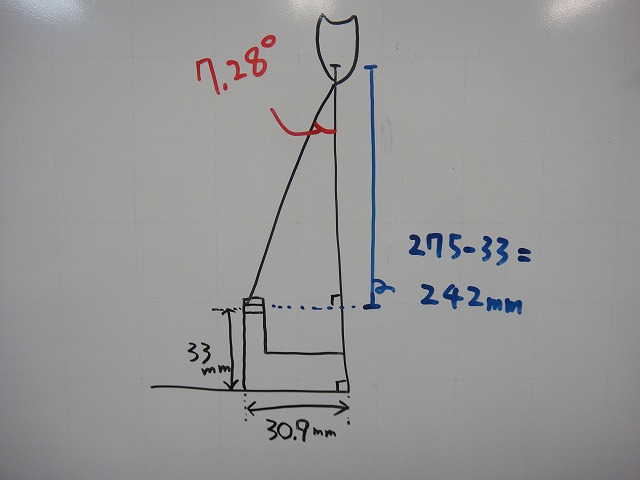
7.28°.
About 1° difference. The distance from wheel center to hub flange outer edge is 6.1mm less than the Tni Evo hub.
These numerical differences may not seem significant, but they're actually quite large.
So, with Amcla's left flange width as-is, how many millimeters would the hub flange diameter need to be to catch up to Tni's Evolution hub's acute angle between wheel center and spoke? Let me calculate.

Radius 62.5mm, diameter 125mm.
This is how much large flange would theoretically be needed to recover the angle loss from moving the left flange inward just slightly.
This focuses only on making the angles equal.
If a hub with flange hole centers 125mm apart actually existed, the spokes would be shorter, making it an even stiffer wheel than the Tni Evo hub.

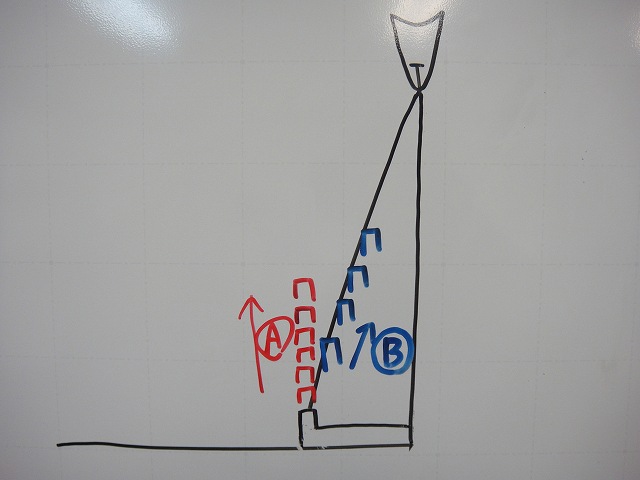
If large-flange enlargement happens only in the A direction (vertical) in the diagram above, there might be lateral stiffness benefits despite weight increase.
But if the hub flange is moved inward as shown in the B direction, the angle loss cannot be recovered with just a bit of large-flange design.
From experience too, lateral stiffness is difficult to secure with Amcla rear hubs, so the flange hole spacing around 66mm likely doesn't fully recover the loss from inward positioning of the non-freeheel flange.
As mentioned at the start, when I "consider large flange diameter together with" positioning, that's my conclusion.
As a tangent, large-front-flanges aren't typically seen on road bike hubs.
With cup-and-cone hubs, you need horizontal width for double locknuts.
Most front hubs set flange width as wide as possible within the 100mm over-locknut dimension, using the space between the nuts and spacers.
Even cartridge bearing hubs end up with similar flange widths to cup-and-cone.
Front hub left-right flange widths are generally similar.
So few manufacturers say "let's go large-flange to reduce spoke deflection" because for fore-aft deflection, "you can just tighten the nipples more."
As I noted, that's the direction where large-flanges contribute least, so no manufacturer feels the weight penalty is worth it.
For lateral deflection, most manufacturers set flange width as wide as possible, so hub differences are minor.


↑This Woodman front hub maximizes the cartridge bearing advantage of not needing double-nuts. Smart!
Amcla's front hub also has wide flanges.
Front hubs are good kids.
"I feel like American Classic's narrow flange width should be considered together with its large flange diameter."
American Classic (henceforth Amcla) rear hubs have such an indefensible specification even when taking flange diameter into account, so I'll write about that.
Before that.
Let me think about spoke deflection in two different directions.
In a completed wheel state, if we deflect a spoke, one way is like in the diagram above—pushing the spoke from the side.
The other is grabbing two spokes on the same side together and deflecting them.
Deflection in the fore-aft direction.
With tangent lacing, we'd grab the two crossing spokes.
Either way, raising spoke tension reduces deflection, but we can also aim to mitigate deflection by enlarging the hub flange.
(The same applies if rim height increases)
If that were all, it'd be fine.
What makes Amcla rear hubs indefensible is that the left flange is positioned inward.
The loss from this is not recovered by having a large flange.
First, regarding fore-aft deflection.
Let's call spoke tension ST,
and the force with which the nipple tries to bite through the rim RK (Rim Kuiyaburu—rim being eaten through).
As ST increases, RK also increases.
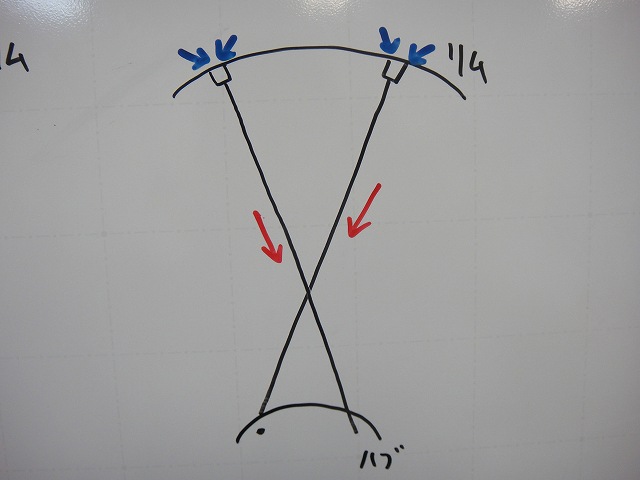
The previous diagram was radial lacing, but this is tangent lacing.
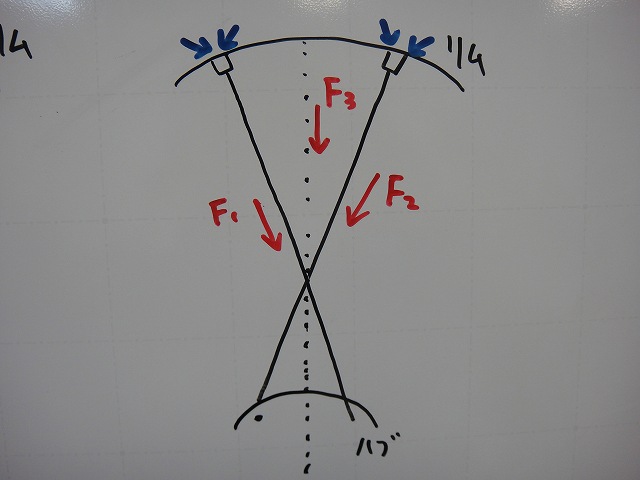
Let's call the pulling directions of the two crossing spokes in tangent lacing F1 and F2 respectively.
The combined pulling direction of F1 and F2 becomes F3 in the diagram above.
F3 aligns with the line connecting the spoke intersection point and the hub center.

Radial lacing, by definition, pulls spokes along the F3 line, so there's no angular loss in pulling direction.
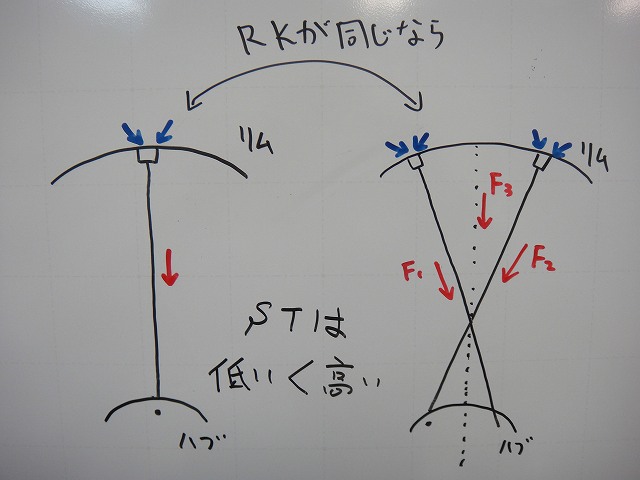
With the same hub and same rim, if both radial and tangent lacing have the same ST, the radial lacing produces higher RK.
To achieve the same RK, radial lacing requires lower tension.
This is a bit of a tangent from Amcla, but my 4×6 and 4×8 lacing patterns aim to bring the freeheel side closer to radial (while still being tangent lacing) to relatively raise the tension on the non-freeheel side.
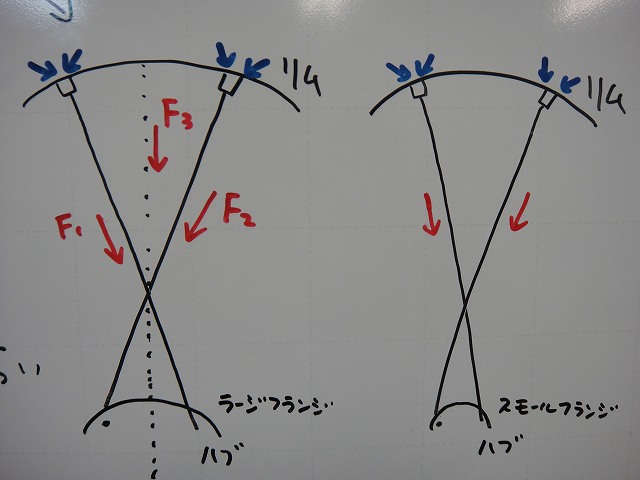
↑Taking the hub from before as a large flange, I've added a small flange hub next to it.
A small flange diameter doesn't mean you can't achieve sufficient ST.
Rather, the lacing method (radial or tangent) is a larger factor in the ST-RK relationship.
At the same ST, a large flange does deflect less when you squeeze the spoke intersection. That's true.
But reducing deflection during spoke-intersection squeezing is easy—just raise the ST.
Within realistic ranges (whether the hub is Tni, Dura-Ace, or Amcla), you can feel a meaningful change in fore-aft deflection with just one or half turn of the nipples near wheel completion.
What I'm saying is, large flanges provide little real benefit in reducing fore-aft deflection.
Next, lateral deflection.
Let me consider a front wheel with radial lacing (←if both sides have the same lacing pattern, really any pattern works, but I think radial is easiest to visualize).
The spokes connect the hub flange to the rim, and there's some angle between the wheel's centerline and the spoke's slant line.
The more obtuse this angle, the less spoke deflection.
↑Here's a large flange version. The red lines I added show that.
The angle between the centerline and the spokes is now more obtuse.
Which means this wheel is (if ST is the same) definitely stiffer laterally—less lateral deflection—than the previous wheel.
Now consider a hub with a large flange but the flange positioned inward.
In the diagram, you can see the acute angle between the centerline and spoke is sharper than on the original wheel.
Large flange will reduce fore-aft deflection, but as I said earlier, a small flange can recover that.
The lateral stiffness loss from moving the flange inward cannot be recovered by saying "I'll tighten the nipples!"
Let me try enlarging the flange diameter just enough, keeping this hub's flange width, to achieve the same spoke angle as the original wheel.
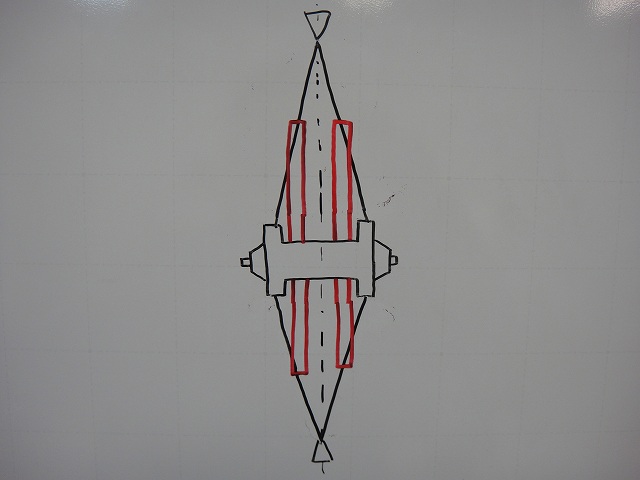
↑There we go.
The spokes become shorter, so even with the same acute angle between centerline and spoke, this wheel is much stiffer than the original.
My diagrams are quite exaggerated, so accuracy is questionable, but I'd like to now work through actual numbers with Tni Evolution's rear hub and Amcla's rear hub.
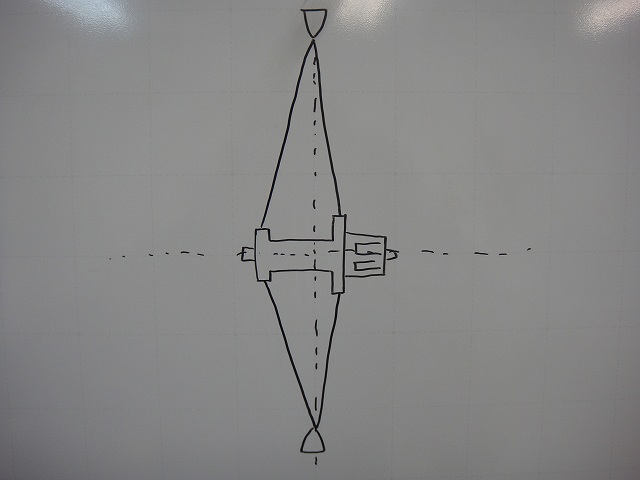
↑From this wheel diagram,
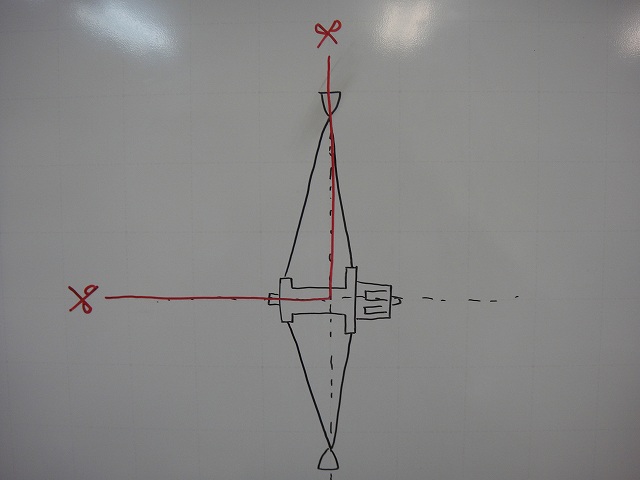
I'll zoom in on just the upper side of the non-freeheel side.
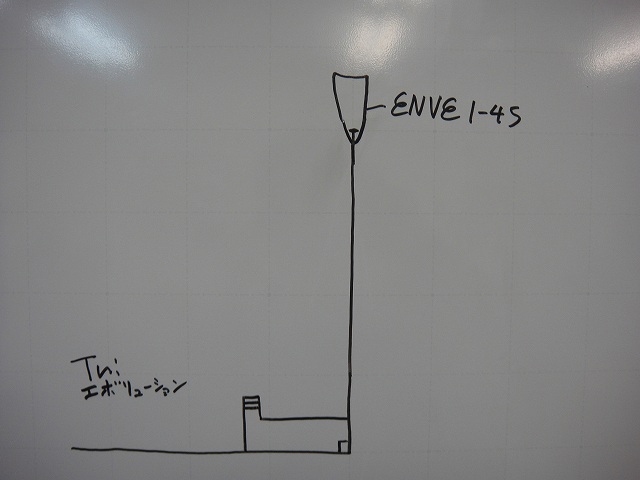
First, with the rim as ENVE 1-45 tubular and hub as Tni Evolution.
Let's say ENVE's rim inner diameter radius is 275mm.
It's not exactly 275.0mm, and I'd rather not go into Mesinota Neko Cord (thread pitch nomenclature), so please excuse the 275mm calculation.
Even so, it's close enough to measured values within rounding error.
For the Tni Evo hub, let's say the distance from wheel center to flange outer edge is 37mm, and the distance from hub axle center to hub flange hole center is 20.35mm.
↑I can see a right triangle where the height is half the rim inner diameter minus the flange radius, and the base is the distance from wheel center to hub flange outer edge.
The hypotenuse length is the spoke length for radial lacing.
Since this is about the acute angle between wheel center and spoke, calculating this gives

8.27°.
When I held a protractor to the diagram it read 30° (laugh).
The diagram is rough, but the angle numbers are accurate.
↑Let me do the same with Amcla's rear hub.
7.28°.
About 1° difference. The distance from wheel center to hub flange outer edge is 6.1mm less than the Tni Evo hub.
These numerical differences may not seem significant, but they're actually quite large.
So, with Amcla's left flange width as-is, how many millimeters would the hub flange diameter need to be to catch up to Tni's Evolution hub's acute angle between wheel center and spoke? Let me calculate.
Radius 62.5mm, diameter 125mm.
This is how much large flange would theoretically be needed to recover the angle loss from moving the left flange inward just slightly.
This focuses only on making the angles equal.
If a hub with flange hole centers 125mm apart actually existed, the spokes would be shorter, making it an even stiffer wheel than the Tni Evo hub.
If large-flange enlargement happens only in the A direction (vertical) in the diagram above, there might be lateral stiffness benefits despite weight increase.
But if the hub flange is moved inward as shown in the B direction, the angle loss cannot be recovered with just a bit of large-flange design.
From experience too, lateral stiffness is difficult to secure with Amcla rear hubs, so the flange hole spacing around 66mm likely doesn't fully recover the loss from inward positioning of the non-freeheel flange.
As mentioned at the start, when I "consider large flange diameter together with" positioning, that's my conclusion.
As a tangent, large-front-flanges aren't typically seen on road bike hubs.
With cup-and-cone hubs, you need horizontal width for double locknuts.
Most front hubs set flange width as wide as possible within the 100mm over-locknut dimension, using the space between the nuts and spacers.
Even cartridge bearing hubs end up with similar flange widths to cup-and-cone.
Front hub left-right flange widths are generally similar.
So few manufacturers say "let's go large-flange to reduce spoke deflection" because for fore-aft deflection, "you can just tighten the nipples more."
As I noted, that's the direction where large-flanges contribute least, so no manufacturer feels the weight penalty is worth it.
For lateral deflection, most manufacturers set flange width as wide as possible, so hub differences are minor.


↑This Woodman front hub maximizes the cartridge bearing advantage of not needing double-nuts. Smart!
Amcla's front hub also has wide flanges.
Front hubs are good kids.