A customer dropped off a WH-7800 (Shimano rear hub) with me.

Just the rear wheel.
A chain dropped and bent some spokes,
so they asked if I could replace them if possible.
Chain drops can happen from derailleur adjustment mistakes, of course,
but most of the time it's because the rear dropout on the frame has bent inward,
changing the conditions. However, this time the chain drop was caused by
the right end nut coming loose, which allowed the freewheel body itself to slide outward.
In terms of changed conditions, it's the same as a bent dropout.
This rear hub is Shimano's one and only "straight Campagnolo copy structure,"
so the right end nut is also reverse-threaded.
As I've mentioned before, loose right end nuts are only commonly seen
on Campagnolo and Fulcrum wheels,
so there's a possibility that this intentional reverse-thread design
actually makes things worse instead of better.
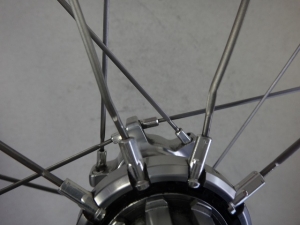
↑These are the two bent spokes.
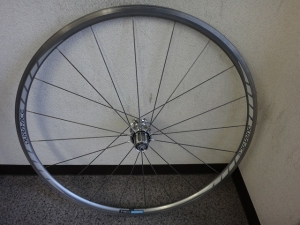
Anyway, they're fixed.
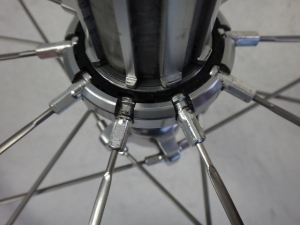
Since I didn't have identical spokes, I used ones from a different pre-built wheel
with similar spoke weight.
These are slightly thicker.
Just from visual inspection, I'd estimate
the spoke weight is roughly 2-3% higher.
You can't use thinner ones—there's a high risk they'll loosen up just at that spot.
When replacing spokes, I try to avoid touching
any spokes other than the ones being replaced initially.
As I work through truing,
if "the location with the most lateral runout is not directly under the replaced spoke's nipple,"
then I'm close to finishing.
(There are exceptions, like when surrounding nipples have been temporarily adjusted
to compensate for runout caused by a broken spoke)
When I first detected lateral runout in areas other than where I replaced those two spokes,
I checked the temporary center and found the rim shifted toward the freewheel side.
Since I'd only touched the replaced spoke nipples and
their runout was now within normal range,
this center shift was pre-existing.
When the rim sits toward the freewheel side, the basic fix is to tighten the anti-freewheel side,
but the hub-side nipple on the anti-freewheel tangent lacing of this rear hub
is incredibly difficult to turn.
Since I pursue the ideal wheel structure,
I don't mind it at all, but if you're a team mechanic rather than a shop mechanic,
you'd probably go mad over this design.
If you believe "maintainability is also performance,"
then it's a hack job, but I think it's a masterpiece.
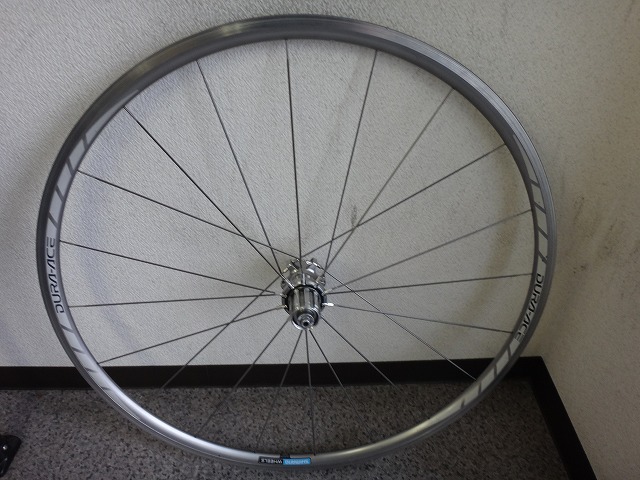
Just the rear wheel.
A chain dropped and bent some spokes,
so they asked if I could replace them if possible.
Chain drops can happen from derailleur adjustment mistakes, of course,
but most of the time it's because the rear dropout on the frame has bent inward,
changing the conditions. However, this time the chain drop was caused by
the right end nut coming loose, which allowed the freewheel body itself to slide outward.
In terms of changed conditions, it's the same as a bent dropout.
This rear hub is Shimano's one and only "straight Campagnolo copy structure,"
so the right end nut is also reverse-threaded.
As I've mentioned before, loose right end nuts are only commonly seen
on Campagnolo and Fulcrum wheels,
so there's a possibility that this intentional reverse-thread design
actually makes things worse instead of better.
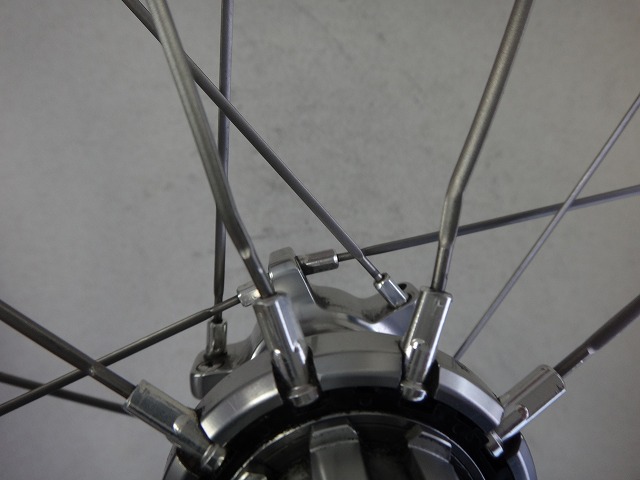
↑These are the two bent spokes.

Anyway, they're fixed.

Since I didn't have identical spokes, I used ones from a different pre-built wheel
with similar spoke weight.
These are slightly thicker.
Just from visual inspection, I'd estimate
the spoke weight is roughly 2-3% higher.
You can't use thinner ones—there's a high risk they'll loosen up just at that spot.
When replacing spokes, I try to avoid touching
any spokes other than the ones being replaced initially.
As I work through truing,
if "the location with the most lateral runout is not directly under the replaced spoke's nipple,"
then I'm close to finishing.
(There are exceptions, like when surrounding nipples have been temporarily adjusted
to compensate for runout caused by a broken spoke)
When I first detected lateral runout in areas other than where I replaced those two spokes,
I checked the temporary center and found the rim shifted toward the freewheel side.
Since I'd only touched the replaced spoke nipples and
their runout was now within normal range,
this center shift was pre-existing.
When the rim sits toward the freewheel side, the basic fix is to tighten the anti-freewheel side,
but the hub-side nipple on the anti-freewheel tangent lacing of this rear hub
is incredibly difficult to turn.
Since I pursue the ideal wheel structure,
I don't mind it at all, but if you're a team mechanic rather than a shop mechanic,
you'd probably go mad over this design.
If you believe "maintainability is also performance,"
then it's a hack job, but I think it's a masterpiece.