I received a comment about my article on the Sugino 42T outer chainring.
The comment asked: "Won't the front derailleur and inner chainring interfere if the tooth count difference between chainrings is 12T or less?"
And there was also a question: "To avoid interference, do you need to position the front derailleur away from the tooth tips?"
To get straight to the point, "there's no problem," but for cyclocross specifically, there are some other considerations I should address.

First, Shimano's front derailleur compatibility specs are:
Road bikes: 50–56T outer chainring, Cyclocross: 46–52T outer chainring.
For example, on road derailleurs, the curve of the outer cage plate's lower side is designed to match the tooth profile of a 56T chainring.

Whether you use the specified tooth count or smaller, the smaller you go with the outer chainring, the lower the front derailleur has to sit.
Chainrings decrease in size concentrically from the BB center, but the curve of the derailleur cage stays the same, and the derailleur moves closer to the chainring along the seat tube angle.
Please don't point out that the center of the circle is offset in the diagram above (laughs).

As a result, toward the rear end of the derailleur cage, the distance between the chainring teeth and the cage increases.
I call this "tooth clearance" on my own, and when tooth clearance is large, during a shift from inner to outer, the contact point between the chain and derailleur moves away from the ideal position for smooth shifting.

↑Before tooth clearance adjustment
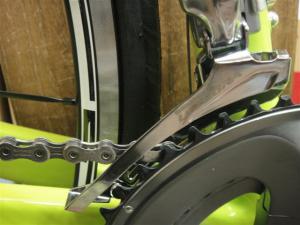
↑After adjustment
The before image is a bit blurry, but this is an example of tooth clearance adjustment I've done in the past.
Tooth clearance has another cause: it gets worse the steeper the seat tube angle is.
There are steel frames with 28.6mm seat tubes where the rear tire barely clears the seat tube, and that's because the seat angle is slack.
If you simply increase the seat tube diameter to 31.8mm or 34.9mm, the rear tire interferes with the frame.
Modern oversized tube frames don't have this problem because they universally have steeper seat angles.
You can't design a front derailleur that doesn't work with slack seat angle frames, because the opposite problem—"reverse tooth clearance"—could occur.
No manufacturer currently makes multiple front derailleur specs for different seat angles.
So the workaround is to adjust the front derailleur through secondary machining to compensate—that's what tooth clearance adjustment is.
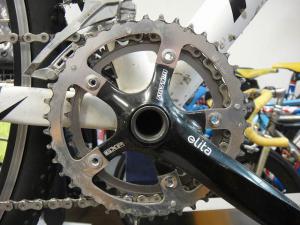
↑So, there happened to be a cyclocross with a 42T outer at our shop.
The inner is 34T, so that's an 8T difference.
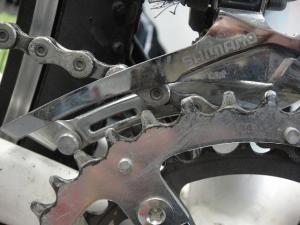
This is an FD-CX70 cyclocross front derailleur, but since it's a cage shape designed to work with up to 50T, and we're breaking the rules by fitting a 42T when the spec says up to 46T, there's definitely tooth clearance.
Setting aside whether it meets the manufacturer's specs, the trend among strong riders is to go with outer chainrings of 46T or smaller on cyclocross to increase their time in the saddle.

↑Anyway,
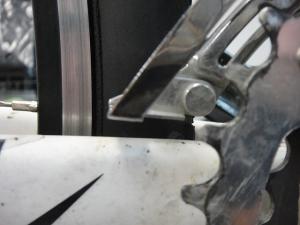
I adjusted it. You can see the relationship between the tooth tips and cage position has changed slightly.
Now, about the cyclocross-specific issue I mentioned earlier: cyclocross bikes have a higher BB than road bikes, so the chainstays and the rear end of the front derailleur cage are quite close together.
If you adjust too much tooth clearance, the front derailleur could interfere with the chainstays.
This is also true for some beefy road bikes with chunky chainstays.
That yellow-green road bike I mentioned earlier is a BMC carbon frame, and it's also pretty tight.
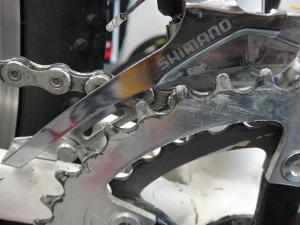
↑I didn't make a huge adjustment, but regarding the "inner cage plate scrubbing on the inner chainring teeth when on the outer" problem, the situation is worse after tooth clearance adjustment.
Because you're bringing the cage closer to the teeth.
Let me look at this from the opposite side.
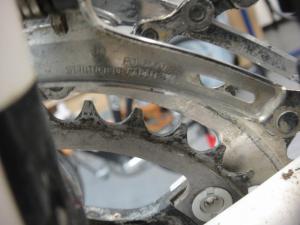
↑It's completely fine.
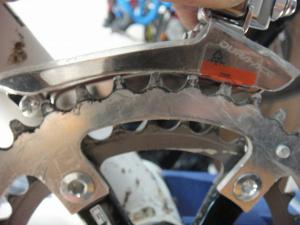
You might think "well, it's a cyclocross derailleur, so it won't interfere," so let me also check a road derailleur.
I positioned an FD-7800 Dura-Ace to make contact with the outer chainring teeth.
In actual setup, we wouldn't lower the position this much.
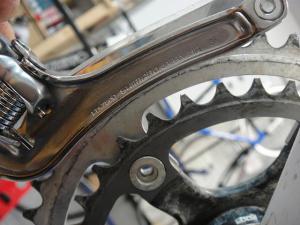
Looking at that from the opposite side.
Looks fine.
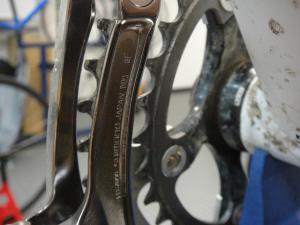
↑From a slightly angled perspective.
There's no problem even with a road derailleur.
Shimano's road and cyclocross front derailleurs have a maximum capacity of 16T.
That means you should keep the tooth difference between outer and inner to 16T or less.
While the maximum is 16T, there's no rule saying there's a minimum difference, and even with a 52–42T combo there's no interference, so a 12T difference definitely won't cause any interference between the derailleur and inner chainring.
(The cyclocross in the example above has an 8T difference)
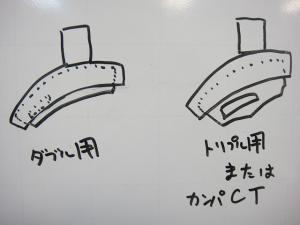
However, with triple front derailleurs (used as doubles) or Campagnolo's CT (compact gear) front derailleur from the 10-speed era, there was indeed a problem with the cage interfering with the inner chainring when using a smaller outer.
The comment asked: "Won't the front derailleur and inner chainring interfere if the tooth count difference between chainrings is 12T or less?"
And there was also a question: "To avoid interference, do you need to position the front derailleur away from the tooth tips?"
To get straight to the point, "there's no problem," but for cyclocross specifically, there are some other considerations I should address.
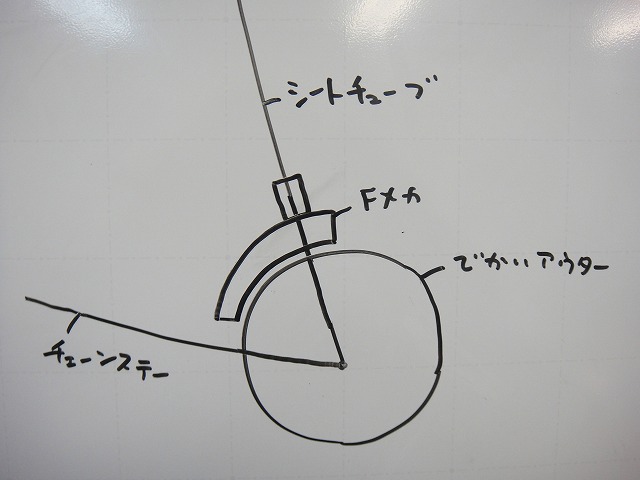
First, Shimano's front derailleur compatibility specs are:
Road bikes: 50–56T outer chainring, Cyclocross: 46–52T outer chainring.
For example, on road derailleurs, the curve of the outer cage plate's lower side is designed to match the tooth profile of a 56T chainring.

Whether you use the specified tooth count or smaller, the smaller you go with the outer chainring, the lower the front derailleur has to sit.
Chainrings decrease in size concentrically from the BB center, but the curve of the derailleur cage stays the same, and the derailleur moves closer to the chainring along the seat tube angle.
Please don't point out that the center of the circle is offset in the diagram above (laughs).
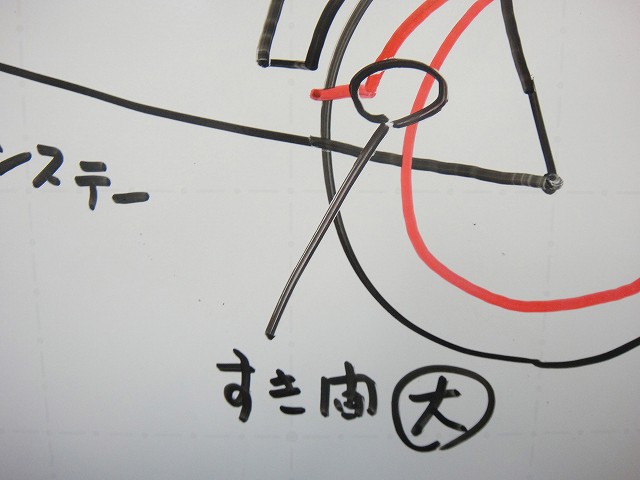
As a result, toward the rear end of the derailleur cage, the distance between the chainring teeth and the cage increases.
I call this "tooth clearance" on my own, and when tooth clearance is large, during a shift from inner to outer, the contact point between the chain and derailleur moves away from the ideal position for smooth shifting.
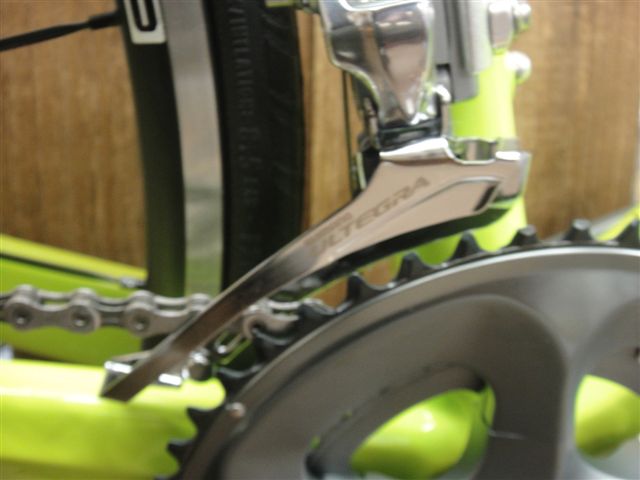
↑Before tooth clearance adjustment
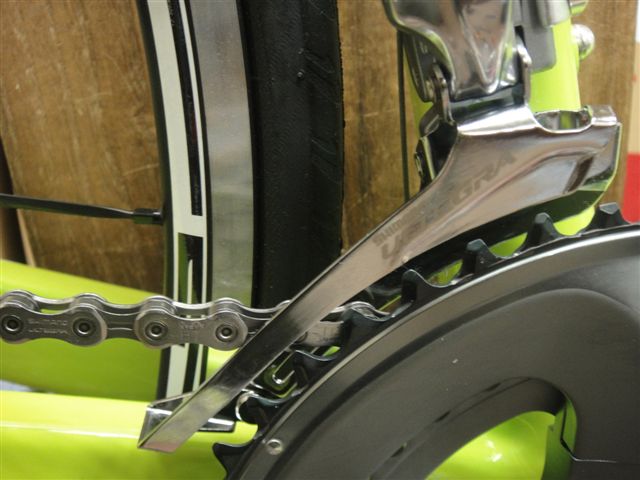
↑After adjustment
The before image is a bit blurry, but this is an example of tooth clearance adjustment I've done in the past.
Tooth clearance has another cause: it gets worse the steeper the seat tube angle is.
There are steel frames with 28.6mm seat tubes where the rear tire barely clears the seat tube, and that's because the seat angle is slack.
If you simply increase the seat tube diameter to 31.8mm or 34.9mm, the rear tire interferes with the frame.
Modern oversized tube frames don't have this problem because they universally have steeper seat angles.
You can't design a front derailleur that doesn't work with slack seat angle frames, because the opposite problem—"reverse tooth clearance"—could occur.
No manufacturer currently makes multiple front derailleur specs for different seat angles.
So the workaround is to adjust the front derailleur through secondary machining to compensate—that's what tooth clearance adjustment is.
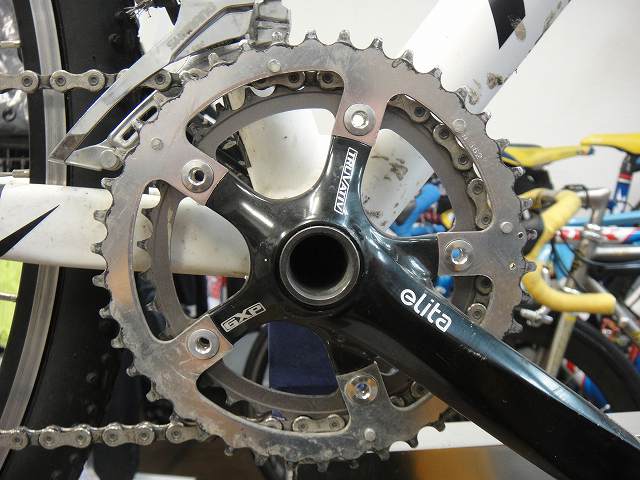
↑So, there happened to be a cyclocross with a 42T outer at our shop.
The inner is 34T, so that's an 8T difference.

This is an FD-CX70 cyclocross front derailleur, but since it's a cage shape designed to work with up to 50T, and we're breaking the rules by fitting a 42T when the spec says up to 46T, there's definitely tooth clearance.
Setting aside whether it meets the manufacturer's specs, the trend among strong riders is to go with outer chainrings of 46T or smaller on cyclocross to increase their time in the saddle.
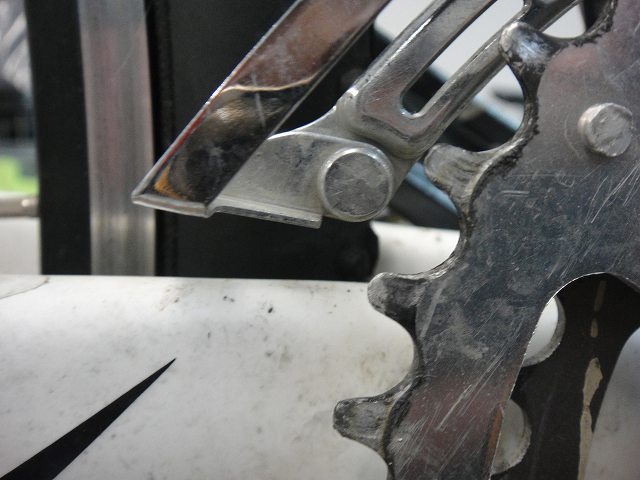
↑Anyway,
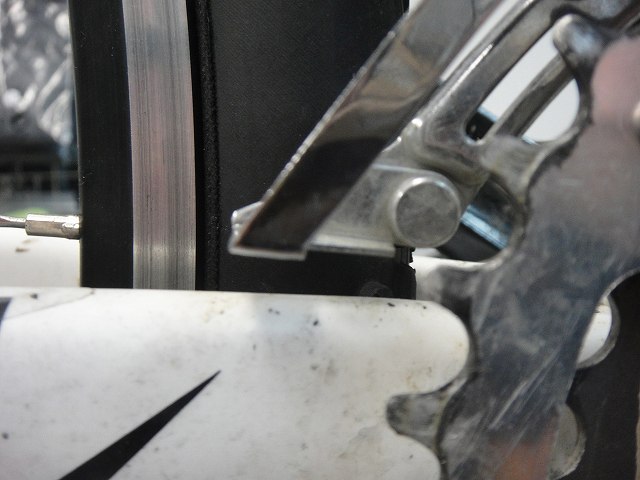
I adjusted it. You can see the relationship between the tooth tips and cage position has changed slightly.
Now, about the cyclocross-specific issue I mentioned earlier: cyclocross bikes have a higher BB than road bikes, so the chainstays and the rear end of the front derailleur cage are quite close together.
If you adjust too much tooth clearance, the front derailleur could interfere with the chainstays.
This is also true for some beefy road bikes with chunky chainstays.
That yellow-green road bike I mentioned earlier is a BMC carbon frame, and it's also pretty tight.
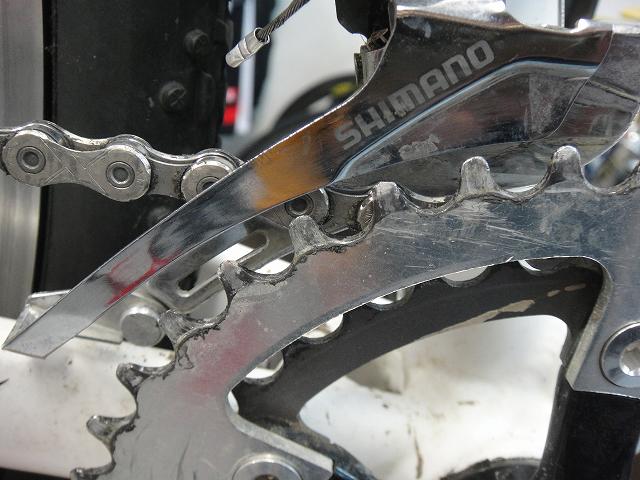
↑I didn't make a huge adjustment, but regarding the "inner cage plate scrubbing on the inner chainring teeth when on the outer" problem, the situation is worse after tooth clearance adjustment.
Because you're bringing the cage closer to the teeth.
Let me look at this from the opposite side.
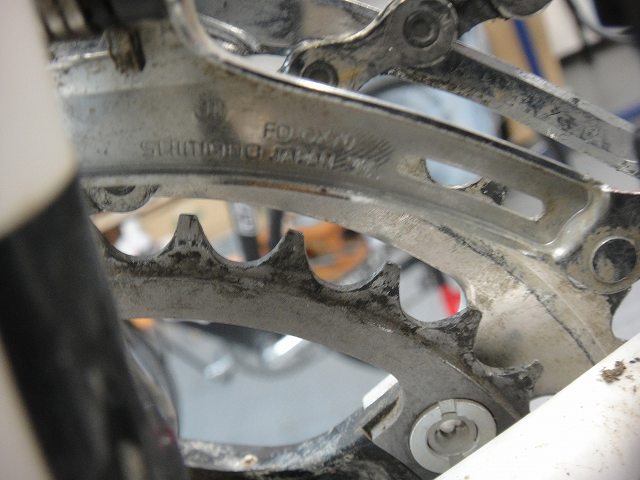
↑It's completely fine.
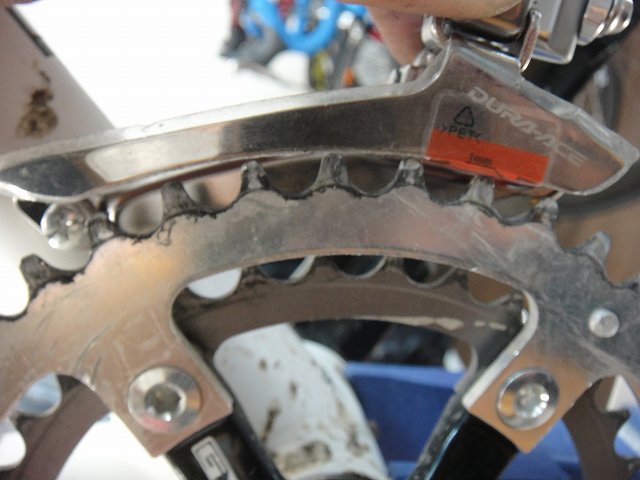
You might think "well, it's a cyclocross derailleur, so it won't interfere," so let me also check a road derailleur.
I positioned an FD-7800 Dura-Ace to make contact with the outer chainring teeth.
In actual setup, we wouldn't lower the position this much.
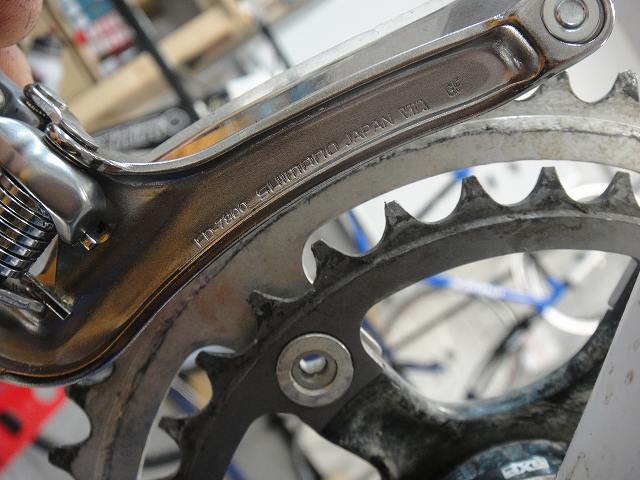
Looking at that from the opposite side.
Looks fine.

↑From a slightly angled perspective.
There's no problem even with a road derailleur.
Shimano's road and cyclocross front derailleurs have a maximum capacity of 16T.
That means you should keep the tooth difference between outer and inner to 16T or less.
While the maximum is 16T, there's no rule saying there's a minimum difference, and even with a 52–42T combo there's no interference, so a 12T difference definitely won't cause any interference between the derailleur and inner chainring.
(The cyclocross in the example above has an 8T difference)
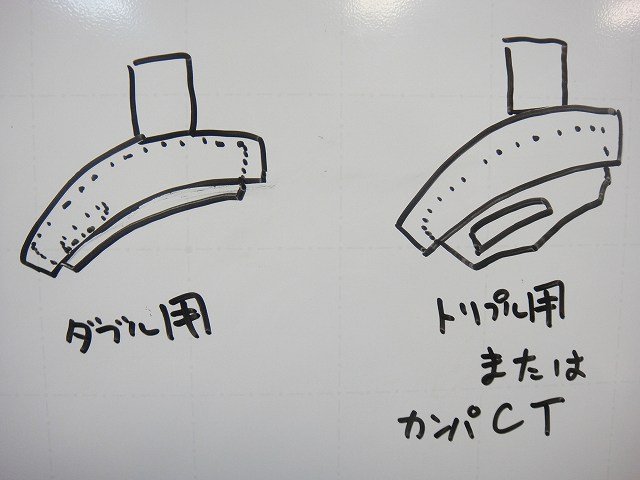
However, with triple front derailleurs (used as doubles) or Campagnolo's CT (compact gear) front derailleur from the 10-speed era, there was indeed a problem with the cage interfering with the inner chainring when using a smaller outer.