A customer brought in a Kysirium SLE for service.
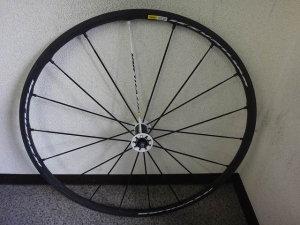
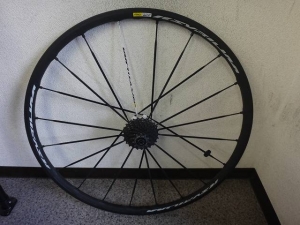
Both the front and rear brakes had slight spoke dish alignment issues that I could feel with a centering gauge,
but they were quick to fix.
Actually, removing and installing the tires took more time than the adjustment.
The higher-end Kysirium models use aluminum spokes.
I've written about this before, but I believe the real purpose of Kysirium isn't
simply to adopt aluminum spokes—
the main theme was actually
wanting to use radial spoking on the freewheel side.
The key idea behind aluminum spokes is to prevent
spoke twist during pedaling that's a weakness of radial spoking on the freewheel side,
or at least keep it below that of standard wheels—
it's not just aiming for simple rigidity gains.
The evidence that supports my belief that Kysirium's real theme is freewheel-side radial spoking is this:
When the original Kysirium debuted, it adopted freewheel-side radial spoking from day one.
It wasn't like an earlier aluminum-spoke version (like Helium) came out first,
and then suddenly the next model adopted radial spoking as an afterthought.
You might ask: "Are wheels with freewheel-side radial spoking but without aluminum spokes no good?
Like Kysirium Elite or the WH-7801?"
Well, those are marketed as getting "spoke balance characteristics similar to aluminum-spoke Kysirium
through freewheel-side radial spoking, but at a lower price"—
so of course their performance differs.
If you could get the same rigidity feel of aluminum spokes with steel spokes,
then Racing 3 would outperform Racing Zero, which obviously isn't the case.
I said "similar feel" because when spoke material, cross-section, and hub dimensions change,
how well the low-tension side follows the high-tension side also changes.
A rear wheel built 20-hole radial (a pseudo-Kysirium setup) will exhibit Kysirium-like characteristics,
but the spoke tension differences won't be identical to a real Kysirium,
and it won't have the same resistance to twisting in the freewheel body rotation direction.
So what's my point?
The Kysirium I saw today is a genuine, pure Kysirium after a long time.
Both sides of the rear wheel have aluminum spokes in freewheel-side radial configuration.
With R-SYS, the logic is (probably):
・Carbon spokes on the freewheel side break immediately from chain drops
・Carbon spokes are (allegedly) compression spokes, so they need to sit perpendicular to the hub, meaning radial spoking
・If it's metal spokes on the freewheel side, you'd want tangential spoking
This logic leads to anti-freewheel-side-radial spoking configuration.
I once wrote that with R-SYS, it's difficult to set enough hub width to do tangential spoking on the freewheel side with carbon spokes,
but because carbon spokes need to have a compression structure,
they must be radially spooked.
(It's literally "R-SYS front wheel with a little dish and a freewheel body attached")
Because I believe that's what true R-SYS is,
the R-SYS rear wheel with one side having aluminum spokes is
a necessary compromise, but it's compromised by worrying about various things.
So, the only wheel that truly embodies what R-SYS was trying to do is the front wheel right now.
Recently, the top-tier Kysirium shares its rear wheel with R-SYS.
Maybe that became the higher grade because it's lighter in weight or uses expensive materials,
so the full aluminum-spoke Kysirium rear wheel has become a second-tier model,
but I think the traditional Kysirium rear wheel's logic is more advanced than R-SYS,
so I'm uncomfortable with this situation:
"Someone who knows nothing buys an expensive wheel thinking it's better,
and unknowingly ends up with what's essentially R-SYS as their rear wheel."
Even for racing, the full aluminum-spoke Kysirium is more practical—without trouble noise around the track-compiling components.
I want people to know beforehand that the Kysirium SLR rear wheel is actually R-SYS, not Kysirium,
and then if you decide that's what you want and buy it anyway, that's fine—that's what I'm saying.
Some people might choose the second-tier Kysirium SL specifically to avoid having an R-SYS equivalent as the rear wheel.
I don't know if that's why today's customer chose this particular Kysirium,
but I definitely think it's a good wheel.
To finish, let me say I don't dislike R-SYS.
I absolutely hate that spoke truing adjustments require removing the track-comp components,
but in the sense that it's doing something only a complete wheel can do, it's the pinnacle.
Unlike pseudo-Kysirium, pseudo-R-SYS can never be hand-built on a spoke wheel.
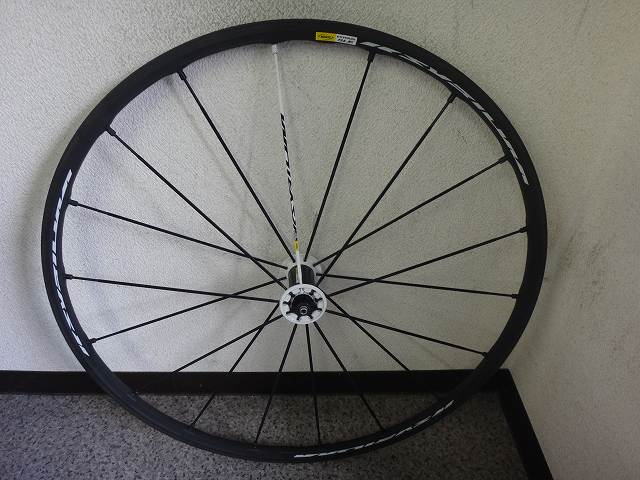
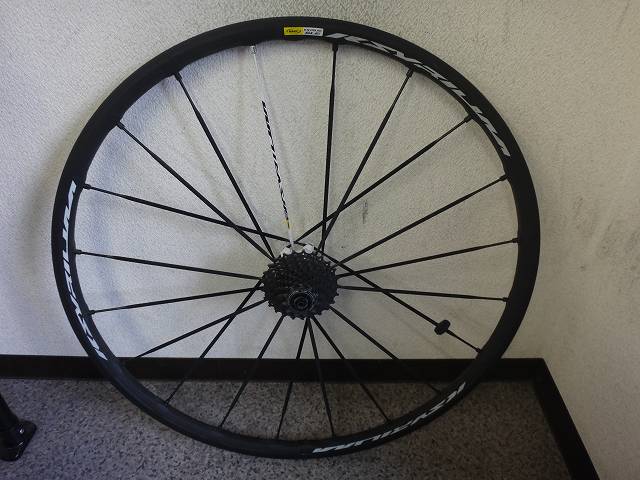
Both the front and rear brakes had slight spoke dish alignment issues that I could feel with a centering gauge,
but they were quick to fix.
Actually, removing and installing the tires took more time than the adjustment.
The higher-end Kysirium models use aluminum spokes.
I've written about this before, but I believe the real purpose of Kysirium isn't
simply to adopt aluminum spokes—
the main theme was actually
wanting to use radial spoking on the freewheel side.
The key idea behind aluminum spokes is to prevent
spoke twist during pedaling that's a weakness of radial spoking on the freewheel side,
or at least keep it below that of standard wheels—
it's not just aiming for simple rigidity gains.
The evidence that supports my belief that Kysirium's real theme is freewheel-side radial spoking is this:
When the original Kysirium debuted, it adopted freewheel-side radial spoking from day one.
It wasn't like an earlier aluminum-spoke version (like Helium) came out first,
and then suddenly the next model adopted radial spoking as an afterthought.
You might ask: "Are wheels with freewheel-side radial spoking but without aluminum spokes no good?
Like Kysirium Elite or the WH-7801?"
Well, those are marketed as getting "spoke balance characteristics similar to aluminum-spoke Kysirium
through freewheel-side radial spoking, but at a lower price"—
so of course their performance differs.
If you could get the same rigidity feel of aluminum spokes with steel spokes,
then Racing 3 would outperform Racing Zero, which obviously isn't the case.
I said "similar feel" because when spoke material, cross-section, and hub dimensions change,
how well the low-tension side follows the high-tension side also changes.
A rear wheel built 20-hole radial (a pseudo-Kysirium setup) will exhibit Kysirium-like characteristics,
but the spoke tension differences won't be identical to a real Kysirium,
and it won't have the same resistance to twisting in the freewheel body rotation direction.
So what's my point?
The Kysirium I saw today is a genuine, pure Kysirium after a long time.
Both sides of the rear wheel have aluminum spokes in freewheel-side radial configuration.
With R-SYS, the logic is (probably):
・Carbon spokes on the freewheel side break immediately from chain drops
・Carbon spokes are (allegedly) compression spokes, so they need to sit perpendicular to the hub, meaning radial spoking
・If it's metal spokes on the freewheel side, you'd want tangential spoking
This logic leads to anti-freewheel-side-radial spoking configuration.
I once wrote that with R-SYS, it's difficult to set enough hub width to do tangential spoking on the freewheel side with carbon spokes,
but because carbon spokes need to have a compression structure,
they must be radially spooked.
(It's literally "R-SYS front wheel with a little dish and a freewheel body attached")
Because I believe that's what true R-SYS is,
the R-SYS rear wheel with one side having aluminum spokes is
a necessary compromise, but it's compromised by worrying about various things.
So, the only wheel that truly embodies what R-SYS was trying to do is the front wheel right now.
Recently, the top-tier Kysirium shares its rear wheel with R-SYS.
Maybe that became the higher grade because it's lighter in weight or uses expensive materials,
so the full aluminum-spoke Kysirium rear wheel has become a second-tier model,
but I think the traditional Kysirium rear wheel's logic is more advanced than R-SYS,
so I'm uncomfortable with this situation:
"Someone who knows nothing buys an expensive wheel thinking it's better,
and unknowingly ends up with what's essentially R-SYS as their rear wheel."
Even for racing, the full aluminum-spoke Kysirium is more practical—without trouble noise around the track-compiling components.
I want people to know beforehand that the Kysirium SLR rear wheel is actually R-SYS, not Kysirium,
and then if you decide that's what you want and buy it anyway, that's fine—that's what I'm saying.
Some people might choose the second-tier Kysirium SL specifically to avoid having an R-SYS equivalent as the rear wheel.
I don't know if that's why today's customer chose this particular Kysirium,
but I definitely think it's a good wheel.
To finish, let me say I don't dislike R-SYS.
but in the sense that it's doing something only a complete wheel can do, it's the pinnacle.
Unlike pseudo-Kysirium, pseudo-R-SYS can never be hand-built on a spoke wheel.